Want Iyengar Yoga Canberra, Or Anywhere? Try Convenient, Online, Low Cost, Quality.
Plus, how I got into yoga standing poses, and what they gave me
Last updated: 25 October 2026
Short answer: Standing poses are the first poses taught in Iyengar yoga. They build strong legs, stamina and focus, and they teach you to stand evenly and stay calm. You can learn them with Flametree live online from Canberra or anywhere, or in the studio in Darwin. If you are new, your first class is free. Beginners then get 12 classes for $59.50 (10 at half price plus 2 free), and non-beginners get 10 at half price plus 2 free for $104.50. See the beginner timetable.
2 FREE Beginner Yoga Classes & 10 HALF Off | New & Lapsed | Online & Studio
NON-Beginner HALF Price 10 Packs | New & Lapsed | Online & Studio
For Iyengar Yoga Canberra classes, try convenient, half price deals. This online option is a convenient way to learn Iyengar yoga from Canberra. Plus, see the many benefits I got as I ongoingly learnt yoga standing poses, and much more.
I have been practising yoga for 28 years. During that whole time I’ve always including standing poses. Here’s why, plus my story of how I got past my reluctance about them.
Obviously, I can also still get better at them! Check out my story below.
Or, try standing poses, or improve yours, with Flametree’s HALF price and FREE options.
So, here’s what standing poses have delivered to me over the decades. Even today, what I get from them still evolves, and will continue to evolve.
When I was a beginner, they were the main yoga poses that I did. I struggled with having the patience, stamina or strength to stick at them!
My hot head impatience was sure that the teacher was at least sometimes overdoing standing poses!
Finally, as I became more experienced, and then went on to become an accredited Senior Teacher, I have of course also added in different families of asana (postures)…like inversions, forward bends, twists, forward bends, backbends, balancings, and jumpings.

Standing poses invigorate your body & quieten your mind
But, I still find standing poses nourishing, for the reasons I’ll outline.
At first, I used to wonder why standing poses are the initial poses taught to a beginner, especially when most find them challenging.
I now appreciate that they work in so many different ways that it makes total sense to start learning yoga via the practise of the standing poses.
In short, they build your foundation… your legs! In the process, you get strength, flexibility, stamina, and mental focus.
Still, I used to find standing poses a real struggle. Often during the pose I would wonder how much longer were we going to hold the pose before being allowed to release it!
Teaching elephants to dance!
My body seemed too stiff for standing poses. I found them hard to hold even for a few breaths.
I felt like an elephant when I jumped out into them.
My arms and legs seemed to have minds of their own, and go in all directions. I would perspire lots, and become quite shaky and exhausted.
Many of us who start yoga are pretty unfit, with bodies that are thick and sluggish. At 40, even though I was strong, I was entirely inflexible, and stiff as a board.
At the same time, my mind are turbulent, and raced from one thought to another.
I got strong from manual work in the gardening nurseries that I owned. But the strength just made me even stiffer.
Others who take up yoga have a history or doing sports. But, like I was, they are muscle bound and inflexible.
The amazing thing about standing poses is that they strengthen and tone all the muscles groups in the legs and arms… no matter what your background.
In addition, through regular practice of standing poses, you can build long, lean muscles in both the arms and legs, as well as increased flexibility.
In fact the long, lean muscles give you better flexibility than the bulked up muscles that many develop from sport or gym.

Even when you think you’re too stiff for yoga, easy standing poses are a good place to start.
Standing poses eased my lop-sided pain, and calmed my mind
Standing poses also teach you to stand upright.
Of course, nearly all of us labour under the illusion that we are already erect and upright.
For instance, before I started yoga, I tended to favour one side of my body, and drop weight down onto the other hip.
My uneven development caused all sorts of issues from hip pain, lower back pain, right up to stiffness in one shoulder, and one side of the neck.
I was unaware of what was causing the problem or would fix the pain. Plus, it was something I could not get to the bottom of on my own.
The central standing pose (called Mountain Pose or Tadasana) straightens the spine. Thankfully, it steadily did a lot for my issues.
But, Mountain Pose does much more too. It teaches you how to stand still, steady, and calm.
In other words, learning to stand still has a profound effect on settling the mind.
These days, even when my student have back injuries, and many other conditions, standing poses in a Gentle Yoga format, or Flametree’s Yoga For Backs & Stiffness class, still does wonders for them.
Try Flametree’s Live Online Classes From Canberra.
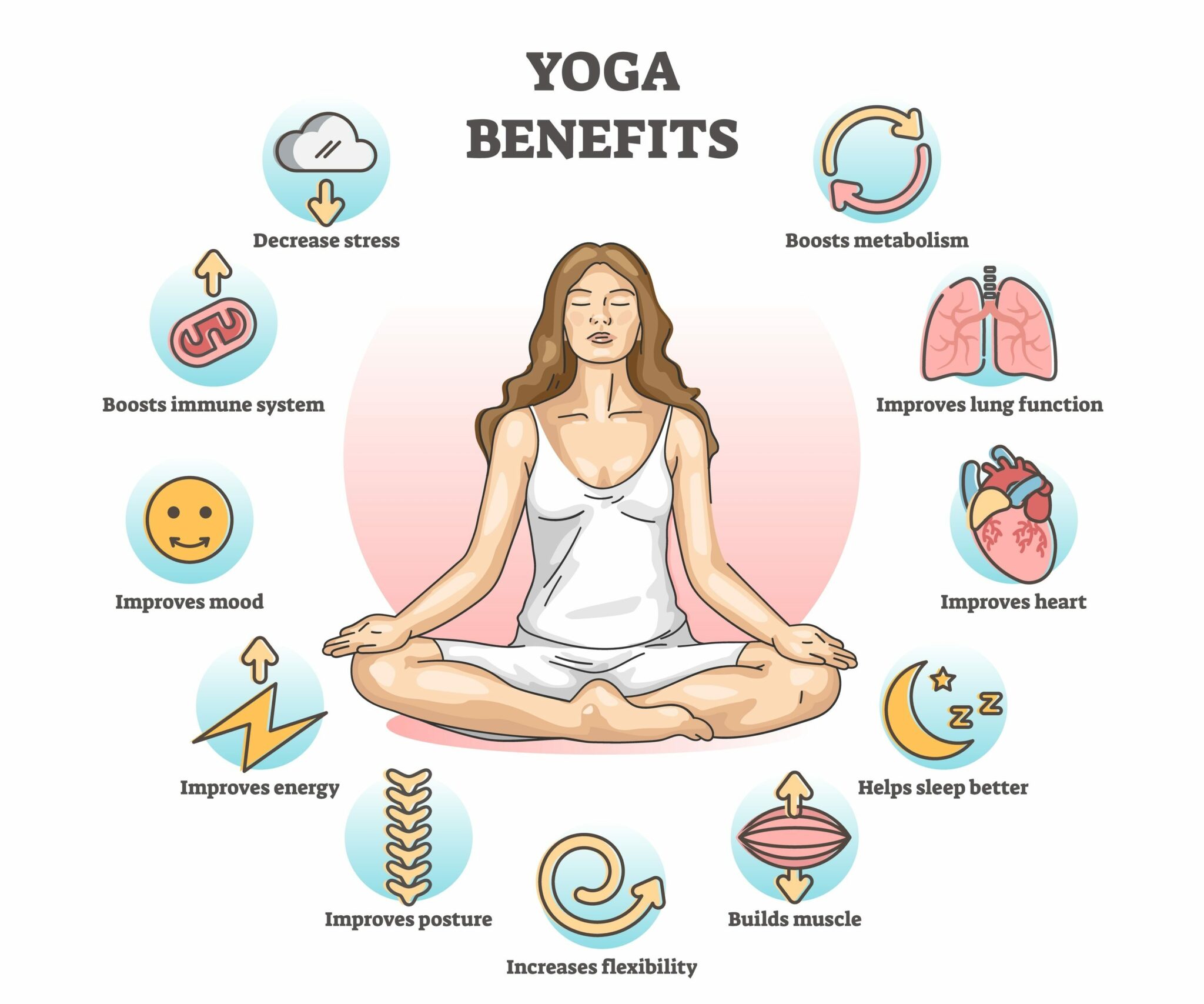
Some of the many benefits you get from yoga
The mental and physical benefits of standing poses
Among other things, as I’ve mentioned, yoga is a practice where you learn to still (or calm) your mind.
In this regard, standing poses are “held” positions. I mean that they’re a lot about calming and straightening.
They also build stamina, strength, and mobility.
In the process, they’re physically invigorating, and mentally quietening.
In the poses, your mind is taught to focus on various parts of the body, as well as to concentrate in order to become steady. Moreover, it’s all done while breathing normally.
So, it’s all part of stilling your mind, and eventually your body.
Have you ever noticed that you fidget in your relaxation poses? Or you used to? That’s one way of noting that your mind is not still (or calm), even yet.
At first, it is hard to quieten the mind because there are some many things going on, and so many sensations.
Plus, it’s hard to breath normally because you are stretching and opening parts of the body that you may never have stretched or opened before.
Try Our Iyengar Yoga Canberra Classes Online HALF Price Deals.
2 FREE Beginner Yoga Classes & 10 HALF Off | New & Lapsed | Online & Studio
NON-Beginner HALF Price 10 Packs | New & Lapsed | Online & Studio

Flametree’s online yoga is a convenient way to do good quality yoga from anywhere.
Learning to manage your emotions
There will be poses that you like, and find easier than others. Then, you’ll sometimes tend to overdo them, and exhaust yourself.
There will be other poses that you feel you are hopeless at, and you hate them!
You just want to get out of them!
So there will be all sorts of emotions coming up as you try to stay in standing poses.
These experiences are part of the human condition. They are not confined to online yoga students, or students wherever you’re located.
But, standing poses, also deliver huge mental and emotional benefits.
Standing poses also take the body through a whole range of leg movements that help to reduce stiffness in the hips, knees, and ankle joints.
Many of the poses tone muscles in the side of the chest, and abdomen. They also work the spine, shoulder joints and neck, and many students find they feel more open in the chest and breathing.
On top of all that, there are both physical and mental things happening due to the pose.
In particular, while you hold the poses, you are learning the art of becoming less emotionally reactive. This is called developing equanimity.
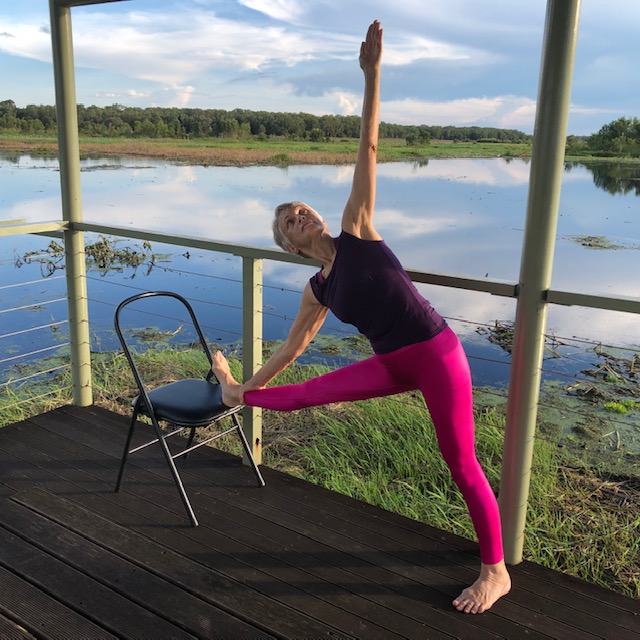
Using a chair, like you see in the picture, is an excellent way to start learning basic yoga for stiff men and women. So, for Iyengar Yoga Canberra classes, try Flametree’s convenient, half price deals, at the orange links. This online option is a convenient way to learn Iyengar yoga from Canberra.
Building mental and physical resilience
So, standing poses are often referred to as “grounding poses”.
This means they earth the feet, and steady the legs, but at the same time steady our minds and emotions.
In the process of all this, they also definitely build physical and mental resilience.
Standing poses are of course weight bearing poses. In other words, they hold up all of your body, so the legs, bones and joints all do real work.
As you work on them, it takes time to understand how to use the arches of your feet so you rebound the energy up into your legs and spine.
In addition, all standing poses involve a subtle shifting of weight from one side or the body to the other.
As a result, as I worked on standing poses, I started to notice postural imbalances.
In turn, I became far more aware and sensitive to how all my actions had various effects throughout my body.
Try Flametree’s Live Online Classes From Canberra.

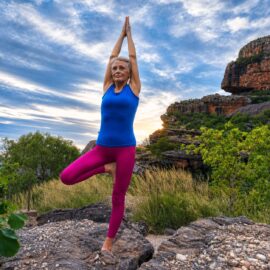
Tree pose is a foundational standing pose. It’s keeps on delivering benefits, as every level that you’re able to do it.
Standing poses ultimately deliver a positive, happy outlook
I also began to appreciate how all my actions led to thoughts that could be both positive and negative to my mental outlook, and ultimately my health and happiness.
While I continue to practice standing poses, my awareness is now increasingly directed internally.
But, when I was a beginner, I was preoccupied with just becoming stronger and more flexible.
As a beginner, I also tried to figure out what was required to make the shape of the pose. In other words, my awareness was more external.
Now that I am steady in the poses, my awareness has shifted to be more internal. That means I now aware how standing poses can help integrate all the different aspects of myself to deliver a quiet reflective state of mind.
Wow! Until it actually happened, I would never have thought that standing poses would deliver me all this, let alone equanimity, and reflection!
I’ve also come to appreciate how precise standing poses are one of the defining and wonderful aspects of the Iyengar style of yoga that we practise as Flametree Yoga.
So, for Iyengar Yoga Canberra classes, try Flametree’s convenient, half price deals, at the links below. This online option is a convenient way to learn Iyengar yoga from Canberra. See the many benefits I got as I ongoingly learnt yoga standing poses, and much more.
My yoga journey continues. It delivers more health and happiness with each passing day.
Try Our Iyengar Yoga Canberra Classes Online HALF Price Deals.

Over time, other types of poses, work at different levels of strength, flexibility, and focus.
Standing yoga poses and your bones: why the legs do the loading
Standing poses are where most of the bone work in a class happens. Triangle, Side Angle, Warrior 1 and 2, Intense Side Stretch and Chair all hold your weight on the legs and hips.
Chris Lalor, a senior Iyengar yoga teacher and certified yoga therapist, explains in her paper on yoga and bone that a standing pose loads bone in three ways at once. Gravity presses your body weight down through the bones that carry you. Your muscles pull hard on the bones they attach to. And the muscles on both sides of the leg work together, holding the limb in a precise shape while they pull on the same bone.
Bone builds where it is asked for more than it is used to. Walking and running load the thigh bone front to back. Almost nothing in daily life loads it sideways. Triangle, Side Angle, Half Moon and Warrior 2 do. In her view, that is why holding the pose, instead of rushing through it, gives bone a good reason to respond.
It is also why standing poses come first in our classes. They build the legs, the balance and the bones in one go.
Standing yoga poses: your questions
Are standing yoga poses good for your bones?
Yes, they are where most of the bone work in a class happens. A standing pose loads bone with gravity, with the pull of the muscles and with muscles working on both sides of the leg at once. Triangle, Side Angle, Half Moon and Warrior 2 also load the thigh bone sideways, which walking and running almost never do.
Why are standing poses taught first in yoga?
In Iyengar yoga, standing poses build the foundation: the legs. They give you strength, flexibility, stamina and focus, and they teach you to stand upright and evenly. Most students find they make the other poses easier later.
What are the benefits of standing yoga poses?
Known from long practice, standing poses tone the legs and arms, ease stiffness in the hips, knees and ankles, build stamina, and help you learn to stay steady and calm while you hold a pose. They are also weight-bearing, so the legs and joints do real work.
Can I do standing poses if I am stiff or unfit?
Yes. Many students start stiff, as Chris did. Easy versions use a chair, a wall or blocks, so you can hold each pose for a few breaths and build up slowly. You do not need to be flexible to start.
Can I learn Iyengar yoga if I live in Canberra?
Yes. Flametree teaches live online classes on Zoom, with a teacher who can see you and help you if your camera is on. Classes run on Darwin time. Canberra is 30 minutes ahead of Darwin in winter and 90 minutes ahead during daylight saving, so check the times for the day you choose.
How much does it cost to try?
Your first class is free if you are new to Flametree. Beginners can then get 12 classes for $59.50. Non-beginners can get 10 classes at half price plus 2 free for $104.50.
Where can I learn standing poses in Darwin?
Flametree teaches Iyengar yoga at Woolner and Coolalinga in Darwin, and live online. Standing poses are taught in the first classes. See the beginner timetable.
HALF price deals for beginners & non-beginners
Flametree has a large timetable of LIVE online & in-studio classes.
There are convenient and large timetables for both beginners and non-beginners.
Beginner classes are ongoing, and can be joined at any time.
Plus, there are Special Focus classes, like Gentle Yoga, Yoga for Backs, Restorative Yoga, Yoga For Immune System, and Fifty Plus options.
Flametree teaches genuine, modern classical yoga that fully delivers all the many benefits of yoga.
It gets you into the correct positions to naturally help your body and mind work to maximise your health and full performance potential.
Use one of the generous, introductory deals to give it a try. Please consider the deals at the links below.