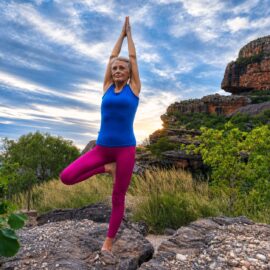
Yoga Inversions: Benefits, Beginner Poses And Who Should Take Care
Health benefits of inversions in yoga: the short answer
An inversion in yoga is any pose where your head is lower than your heart, from a simple standing forward bend or downward facing dog to headstand and shoulderstand. In the yoga tradition, inversions are practised to calm the mind, lift the mood and refresh the body, and many students feel alert and steady afterwards. Research on specific health effects is limited: a 2019 study found headstand does not increase blood flow to the brain. Start with easy preparatory poses, learn full inversions with a teacher, and tell your teacher first if you have high blood pressure, eye or neck problems, or a period.
Iyengar yoga is the style developed by Mr BKS Iyengar. In the 20th century he did more than anyone to set down traditional Indian yoga, through his books and his teaching, and he pioneered the use of props. It is sometimes called modern classical yoga, and it’s the style we teach at Flametree. This guide sits in our poses and practice notes.
Last updated: 25 October 2026
This article in short form
- Take care first: high blood pressure, glaucoma or other eye problems, neck or shoulder problems, headache or migraine, pregnancy, and during a period.
- What counts: any pose with the head below the heart.
- Beginner inversions: forward bends with the head supported, downward dog, legs up the wall, supported bridge.
- Full inversions: shoulderstand (the “queen”) and headstand (the “king”), for later.
- The research: limited, and it corrects some popular claims.
- The tradition: a calm, steady mind is the main reason teachers give.
- Go slowly: props and a teacher make it safer and easier.

Shoulder stand is practised with props and a teacher.
Who should take care with inversions?
Several groups should take advice first, and a good teacher can suggest a gentler alternative for each. These cautions come before the poses, and they match our guide to shoulderstand.
- High blood pressure, glaucoma or other eye problems: tell your teacher before head-down poses.
- Neck or shoulder problems: ask your teacher about headstand and shoulderstand, and for alternatives such as supported bridge or legs up the wall.
- Headache or migraine: avoid strong inversions while it lasts.
- During a period: in the Iyengar tradition, strong inversions such as headstand and shoulderstand are not practised, and supported restful poses are used instead.
- Pregnancy: talk to your teacher, especially if you are new to inversions.
Decades of turning upside down
By Chris Lalor, senior Iyengar yoga teacher, Flametree Yoga Studio.
I have been turning myself upside down now for decades. I practise headstand and shoulderstand every day. There is nothing quite like the feeling that comes from inverting.
Below, you will learn what an inversion in yoga is, what the yoga tradition and the research say about the benefits, and the easy preparatory poses I teach so that you can build up to full inversions safely.

Shoulderstand (Salamba Sarvangasana) is called the queen of yoga poses. The preparatory poses below help you build towards it.
What is an inversion in yoga?
An inversion in yoga is any pose where your head is lower than your heart. Inversions include standing forward bends, downward dog and bridge pose, and then headstand, shoulderstand and plough pose. When done with props, or in preparatory ways, they are still inversions.
Any version of these poses gives you a taste of being upside down. So it is fine to use props to learn to do them, and do them well. You are better off doing a basic version correctly, with the right props, than a harder version badly. Don’t let your vanity get in the way of taking time to get the basics right.
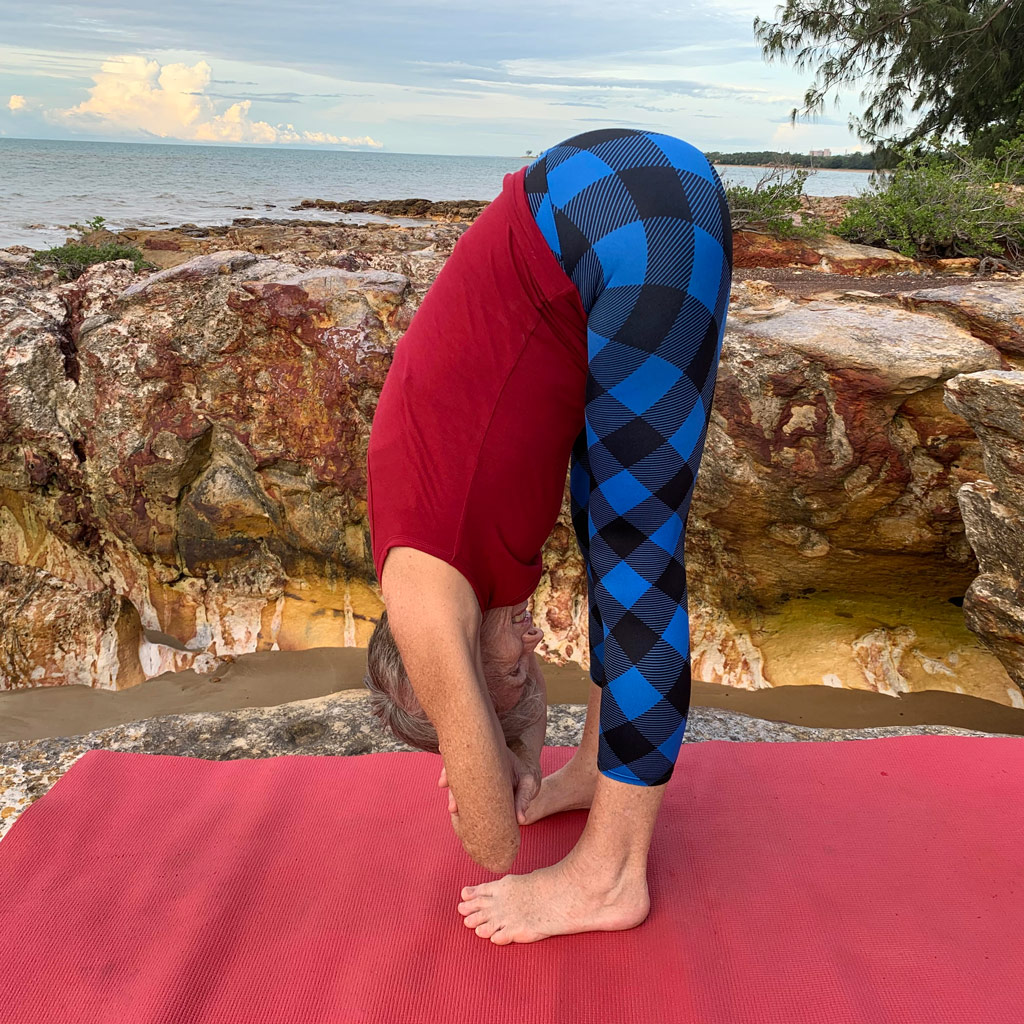
My head is lower than my heart, so a standing forward bend is also an inversion.
The benefits of inversions in yoga
There are physical, mental and emotional reasons people practise inversions. For me, the main reason is that my mind stops churning.
When I practise headstand (Salamba Sirsasana), my mind becomes very quiet. I am left feeling alert, focused, mentally refreshed and emotionally steady. When I practise shoulderstand (Salamba Sarvangasana), my mind becomes quiet in a different way, and I am left feeling calm and more introspective.
In the yoga tradition, Mr BKS Iyengar wrote in Light on Yoga that anyone who practises shoulderstand regularly will feel new vigour and strength, will be happy and confident, and will find the mind at peace.
In the Iyengar tradition, inversions are practised to:
- Calm and refresh the mind, and steady the emotions.
- Help the body rest, by settling the nervous system (in modern terms, the “rest and digest” side rather than “fight or flight”). Many students say they sleep better.
- Ease tired, swollen legs and feet, as gravity helps fluid drain back towards the heart.
- Build strength in the arms, shoulders, back and abdomen, as you learn to hold yourself upside down.
- Support good posture, by opening the chest and shoulders.
These are benefits known from long practice, not tested medical effects.

A supported inversion rests the head and calms the body.
What the research says about inversions
There is little research on inversions themselves, and some popular claims do not hold up:
- Blood to the brain: a 2019 ultrasound study of 20 people found headstand slightly reduced blood flow to the brain through the main neck arteries, which then returned to normal. The brain regulates its own blood supply (Minvaleev and colleagues, Journal of Alternative and Complementary Medicine, 2019, doi 10.1089/acm.2019.0060).
- Eye pressure: a 2015 study found eye pressure rose in head-down poses, including downward dog and plough, and returned to normal within 2 minutes (Jasien and colleagues, PLOS ONE, 2015, doi 10.1371/journal.pone.0144505). That is why people with glaucoma should tell their teacher first.
- The neck in headstand: a 2015 study of 45 practitioners found the head carried 40 to 48% of body weight at peak, and that coming up with straight legs together loaded the neck less (Hector and Jensen, Journal of Bodywork and Movement Therapies, 2015, doi 10.1016/j.jbmt.2014.10.002). This is why Iyengar teachers build shoulder and arm strength first, and teach headstand carefully.
So the benefits of inversions are mainly known from practice.
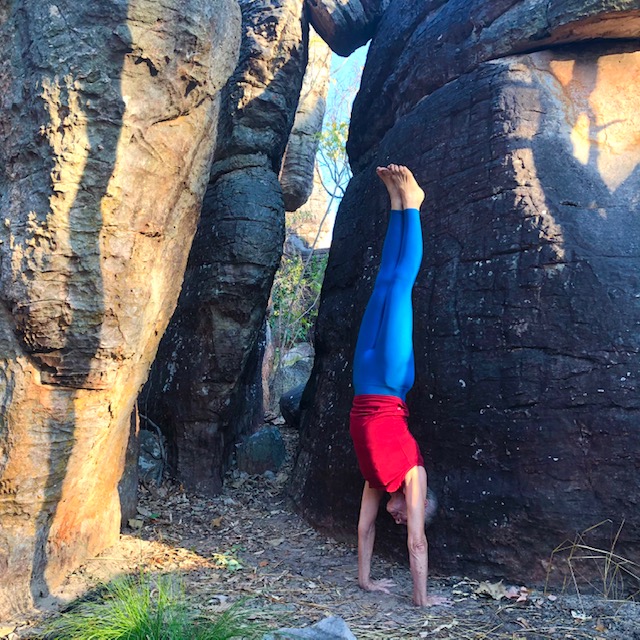
Handstand is a long way down the track. Beginner inversions start with much easier preparations.
How do we teach first inversions to beginners?
In small steps, with props, and with the feet on the floor or a wall. In our beginner classes, the starting poses are some mix of these, depending on what is doable for you:
- Chair Arch: feet on a chair, lifting the back over the chair.
- Legs Up The Wall: on one or two bolsters.
- Holding the feet with the shoulders on the ground.
From there, a beginner can walk their feet up a wall to an introductory shoulderstand. Chair Arch is an early preparation for shoulderstand, and Legs Up The Wall is a mild inversion that many students find helps them unwind. Chris encourages students to persevere, because these poses add up. See our notes on Legs Up The Wall and yoga sequencing for how poses build on each other.

Headstand is learned step by step, with a teacher close by.
Go slowly. Establish the foundation.
It takes time to build the strength to stand on your head or shoulders. It also takes time to overcome fear. You need to trust that you will be fine doing something you don’t normally do in everyday life.
There are many simple inverted poses that prepare you for the more advanced inversions. Many students find these poses soothe the nerves and calm the mind in their own right.
It helps to think of the poses like babushka dolls, the Russian wooden dolls that fit inside each other. Each inversion is another doll, and each one reveals another inversion, complete with its own beauty. When I first learned these lesser inversions, I had no idea how they fitted together, or what they were for. Years of practice have shown me that they make one whole set. Even if you have practised headstand and shoulderstand for years, the lesser inversions can improve the full ones.
1. Mountain pose and the arm variations
Mountain pose and its arm variations are the basis that lead you towards inversions. We tend to forget how important it is to stand upright with good posture: an extended chest, relaxed shoulders and a soft throat. Our note on mountain pose shows how.
Practise the arm movements you learn in Flametree’s beginner classes. They keep your chest open, shoulders flexible, neck relaxed, and upper back healthy. Standing poses are also a key place to build towards inversions.
2. Downward facing dog (Adho Mukha Svanasana)
Don’t underestimate downward dog! It:
- Strengthens your arms and the muscles along your spine.
- Opens the armpits and chest.
- Builds the abdominal strength needed for the more advanced inversions.
- Lengthens the hamstrings, and shows you how to use the legs to lengthen the spine.
- Teaches you to lengthen your neck and relax your face, so you can stay longer.
At first it seems impossible to hold this pose and stay calm, and the arms feel too weak. But stick with it, and you will progress to downward dog with your head supported on a block. That helps open the chest further, and shows you how quiet the mind can become. See our note on downward facing dog.
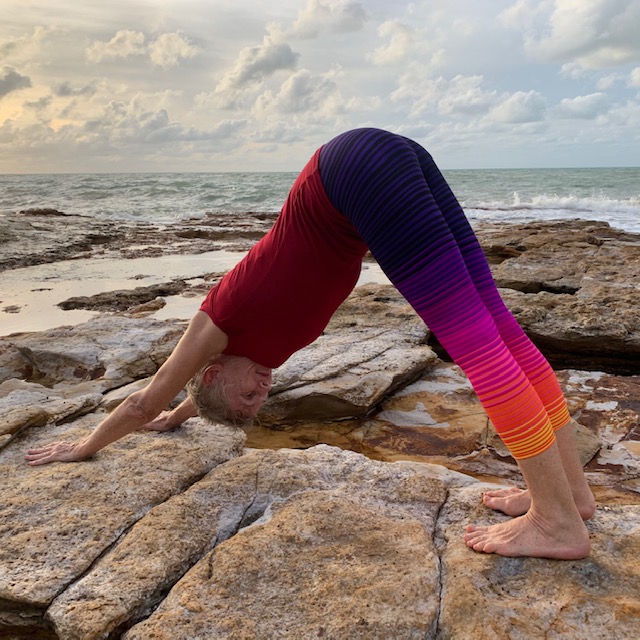
Downward facing dog is a simple inversion for beginners. It builds the strength for the full inversions.
3. Standing forward bend (Uttanasana)
A standing forward bend prepares you for inversions because you experience lowering your head below your heart. Practise with your head supported on blocks or a chair. These versions are calming and restful, and you can stay longer in the pose.
Come out of the pose slowly, and notice how you feel as you come up. (See the picture of this pose near the top of this guide.)
4. Wide leg forward bend (Prasarita Padottanasana)
The wide leg forward bend is another inverted pose. Many students find it quietens the mind and is refreshing, both physically and mentally.
Practise it first with your hands on blocks, to make a concave (slightly arched) spine. Lengthen the inner arms to bring space around the neck and shoulders. Then rest your head on blocks, a chair or the floor, so you can stay longer and feel how inversions take the mind inward.

Wide leg forward bend (Prasarita Padottanasana), shown by Kim, one of Flametree’s teachers.
5. Legs up the wall (Viparita Karani), my favourite
Legs up the wall is a wonderfully relaxing inverted pose that you can practise regularly, and for longer. Any wall becomes a yoga prop!
Rest your hips on a bolster, or on 2 or 3 blankets folded into a thin strip, about a brick’s distance from the wall, so your lower back spreads across the support. Aim to stay 8 to 10 minutes.
In the yoga tradition, the gentle chin position in this pose is said to refresh the throat area and quieten the whole nervous system. Many students find it helps them unwind and sleep better.
6. Bridge pose (Setu Bandha Sarvangasana), with props
Bridge pose is a semi-inverted pose that prepares you for shoulderstand. It can also be practised if neck or shoulder issues stop you doing a full shoulderstand.
Done actively, it is excellent shoulderstand preparation: you spread your weight between your feet and shoulders, and feel how it is on your neck. If that feels too much, do bridge pose supported over a bolster, which protects the neck.
You can also lift your back with the help of a chair, in chair arch. It gives you the feeling of being upside down, and shows you how to open your armpits and lift the back of the body.
Supported bridge pose, lying over two bolsters as below, gives the shoulders a larger drop. It allows long holds, and in the Iyengar tradition it is often practised instead of full inversions during a period, or when the neck or shoulders need care.
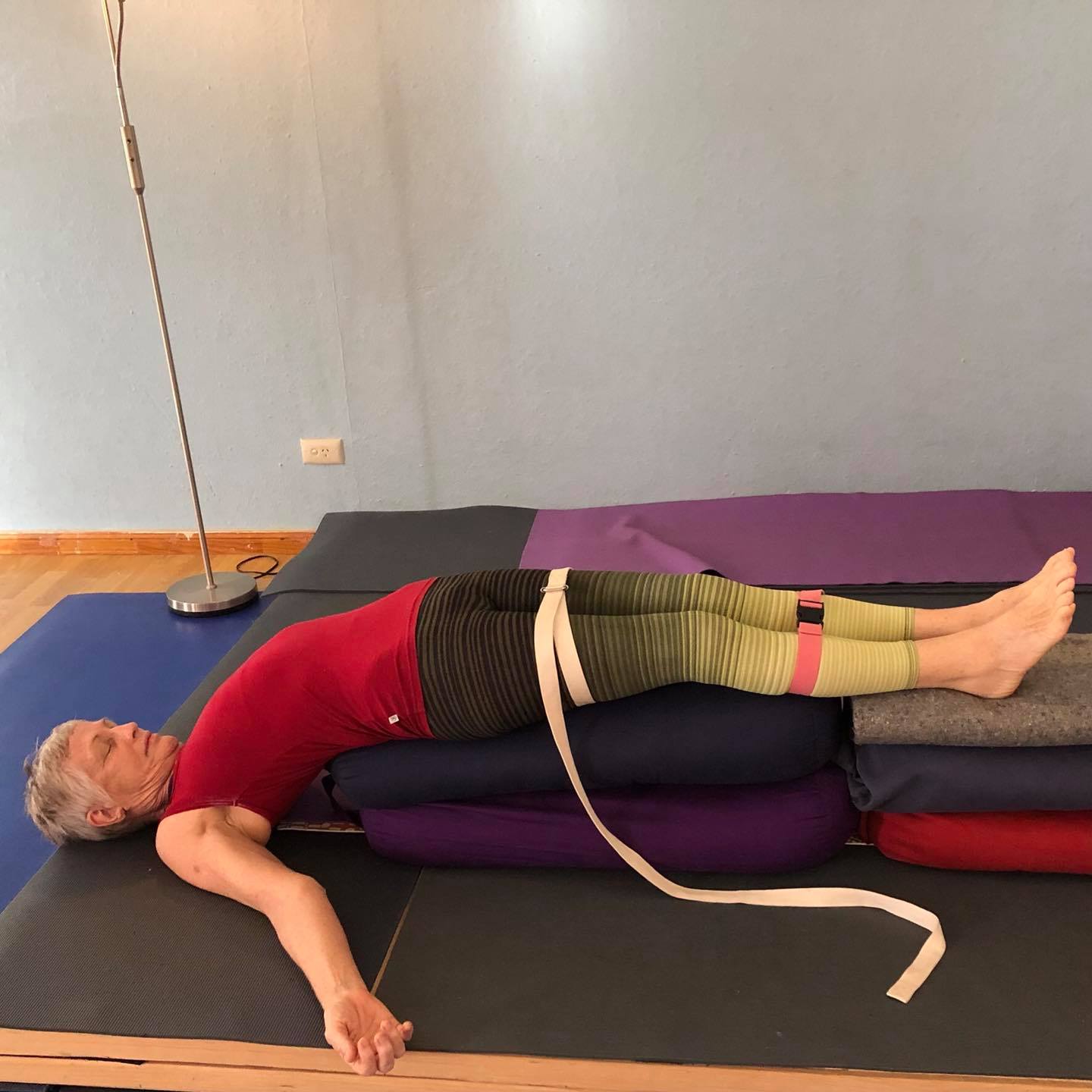
Chris Lalor, senior teacher at Flametree Yoga, in supported bridge pose. Chris specialises in teaching Iyengar yoga inversions.
7. Half shoulderstand, and plough pose
In a half shoulderstand, your feet can rest on a wall. Your shoulders are tucked a little under you, on folded blankets high enough that your neck feels fine. You learn to lift your pelvis off the floor, and support your back with your hands. Then stay there, and try taking one foot off the wall and balancing.
If your shoulders are stiff, add more height: another 1 or 2 blankets. Go slowly. Don’t stay too long at first, and see how you feel when you come down. We are all different, and some of us take more time to feel confident enough to take both feet off the wall.
Then try plough pose (Halasana). First take your feet to a wall or chair; later, when your hamstrings, back and neck allow, take your feet to the floor. See the full steps in our guide to shoulder stand.
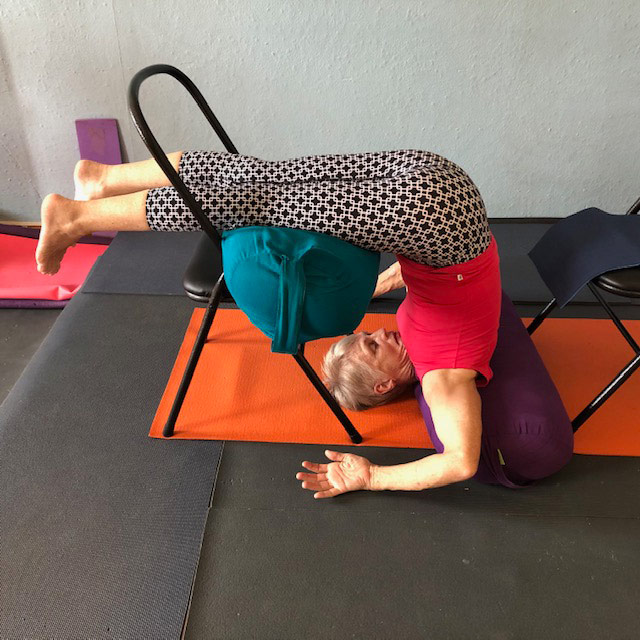
A supported version of plough pose (Halasana), with the feet on a chair.
Hanging upside down in the Build-Up
The first time I (Chris) turned myself upside down, I could not believe the feeling of stillness that spread from my head to every other part of my body. I wasn’t afraid. All the noise, all the chatter inside my head, all my worries seemed to fade. I saw the world from a different perspective, and I saw myself from a different perspective as well.
Years later I am still amazed at how inversions take me into a place of mental stillness. In Darwin’s hot, humid Build-Up to the Wet Season, I enjoy hanging upside down even more. Hanging lets gravity lengthen my whole spine, and I can do other poses as I hang, such as backbends and hip stretches. In my experience, older students often stand straighter and look brighter after a few minutes of hanging.
When you start yoga you learn to hang in ropes in downward facing dog. Over time we gradually work up the courage to hang upside down, as students progress through the levels. Hanging is often possible long before other inverted poses.
What do inversions have to do with yoga philosophy?
When you get upside down, everything feels familiar, yet completely different. It alters your perspective on the world and on yourself, and what you once took for a fixed truth can shift. This goes to the heart of yoga, because good yoga quietens the busyness of the mind and lets you explore how it works.
Thousands of years ago, the sage Patanjali wrote down what yogis had discerned. He named five mental states that cloud our clarity, called the kleshas (inner obstacles). Ignorance, a basic misperception of reality, is the primary one. The other four are too much ego, being driven by desire, pushing away what we dislike, and fear of losing what we have.
Change is hard, but yoga slowly quietens the mind, and over time it gives us the courage to do things differently. Think back to how many times a teacher showed you a pose and your response was “No way”. Yet here you are, attempting it. Something has shifted, not just in the body, but in the mind.

Headstand (Salamba Sirsasana) is known as the king of inverted poses. Working steadily with an experienced teacher, many students build up to the inversions shown here.
Learn yoga inversions online, from Brisbane to Perth
If you live outside Darwin, you can learn inversions step by step in Flametree’s live online classes, from Brisbane, Sydney, Melbourne or anywhere else in Australia. See the timetable for class times in Darwin time.
For online classes, a few yoga props help: a mat, blankets, a belt and a chair are enough to start. In Darwin, Flametree teaches inversions and their preparations at Woolner and Coolalinga. When you are ready for more, our notes on headstand and using props in yoga continue the path.
Practise this at Flametree
Flametree Yoga Studio teaches Iyengar yoga in the studio at Woolner and Coolalinga in Darwin, and LIVE online.
- New to Flametree? Your first class is free. In the studio, just come along. Online, go to our online class list, click the class time you want and we email you the link to join.
- Beginners: new students, and anyone who has been away three months or more, can get a half price 10 class pass with 2 extra classes free, to use online, in the studio, or both. See the beginner half price pass.
- Already practising yoga? The same half price 10 class pass with 2 extra classes free, for new students and for anyone away three months or more, is also available as the non-beginner half price pass.
- See every class time, including online classes, on the timetable.
Can’t make a class? Practise at home with our video courses.
Yoga inversions: common questions
What is an inversion in yoga?
Any pose where your head is lower than your heart. That includes simple poses like standing forward bends, downward facing dog and bridge pose, as well as headstand, shoulderstand and plough pose.
What are the benefits of inversions in yoga?
In the yoga tradition, inversions are practised to calm the mind, lift the mood and refresh the body. Many students say they feel alert and steady after headstand, and calm after shoulderstand. Research on specific health effects is limited, so these are mainly benefits known from practice.
Does headstand increase blood flow to the brain?
No, according to a 2019 study. Ultrasound in 20 people doing headstand found blood flow to the brain through the main neck arteries went down slightly, then returned to normal, because the brain regulates its own blood supply. The feeling of a fresh, clear head after inversions is real for many people, but it is not from extra blood flow.
What are the best yoga inversions for beginners?
Start with standing forward bend with your head on a block or chair, downward facing dog, wide leg forward bend, legs up the wall and supported bridge pose. They teach you to be upside down safely, and build the strength and confidence for headstand and shoulderstand later.
Who should not do yoga inversions?
Tell your teacher before doing inversions if you have high blood pressure, glaucoma or other eye problems, a neck or shoulder injury, a headache or migraine, or are pregnant. In the Iyengar tradition, strong inversions are not practised during a period. Your teacher can suggest alternatives.
Is legs up the wall pose an inversion?
Yes. In legs up the wall (Viparita Karani), your hips are raised on a bolster and your legs rest up the wall, so your head is below your heart. It is one of the gentlest inversions, and many people find it relaxing before sleep.
How long does it take to learn headstand?
It varies. Most people need months of regular practice of the preparatory poses before trying headstand, and it should be learned with a teacher. In Iyengar yoga, headstand is usually taught to non-beginners, often at a wall, after the shoulders and arms are strong enough.
How do you teach first inversions to beginners?
In small steps with props. Beginners start with some mix of Chair Arch, Legs Up The Wall on one or two bolsters, or holding the feet with the shoulders on the ground, then walk the feet up a wall to an introductory shoulderstand.
Where can I learn yoga inversions safely in Darwin or online?
Flametree’s senior Iyengar teacher Chris Lalor teaches inversions step by step, at Woolner and Coolalinga in Darwin, and LIVE online. If you are new to Flametree, your first class is free: in the studio, if you have lived in the NT for three months or more, and online, for anyone new.
Flametree Yoga Studio teaches Iyengar yoga in Darwin, at Woolner and Coolalinga, and LIVE online across Australia. This article is general information, not medical advice. If you have an injury or health condition, tell your teacher before class.
Sources: Minvaleev R et al, Journal of Alternative and Complementary Medicine, 2019, doi 10.1089/acm.2019.0060. Jasien JV et al, PLOS ONE, 2015, doi 10.1371/journal.pone.0144505. Hector RL, Jensen JL, Journal of Bodywork and Movement Therapies, 2015, doi 10.1016/j.jbmt.2014.10.002. Mr BKS Iyengar, Light on Yoga.