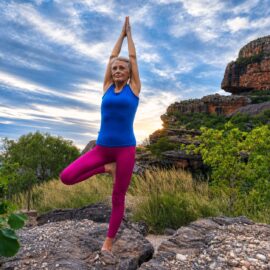
Yoga For Sleep: What The Research Says, And 6 Easy Poses
Yoga for sleep: the short answer
It’s 3am, your body is worn out and your mind is sprinting. Yoga for sleep gives you something to do about it, and the research is on your side. A 2026 review in BMJ Evidence-Based Medicine of 22 trials in people with insomnia found yoga, compared with usual care or lifestyle advice, likely added a large amount of total sleep time, and may help people fall asleep faster and wake less in the night. A 2020 review of 19 studies in women found yoga improved sleep quality. The easiest poses are ones you can do before bed, or when you wake at 2am.
Iyengar yoga is the style developed by Mr BKS Iyengar. In the 20th century he did more than anyone to set down traditional Indian yoga, through his books and his teaching, and he pioneered the use of props. It is sometimes called modern classical yoga, and it’s the style we teach at Flametree. This page sits in our stress and sleep notes.
Yoga for sleep in short form
- The research: a 2026 review of 22 insomnia trials, and a 2020 review of 19 studies in women.
- What it added: more sleep time and less night waking, in sleep diaries.
- Menopause: an earlier review was mixed, and newer reviews are positive.
- Six supported poses to do at bedtime, or if you wake at night.
- Slow breathing helps the body switch to “rest and digest”.
- Yoga nidra: promising, but the evidence is still very low certainty.
- Next step: your first class is free if you’re new to Flametree.
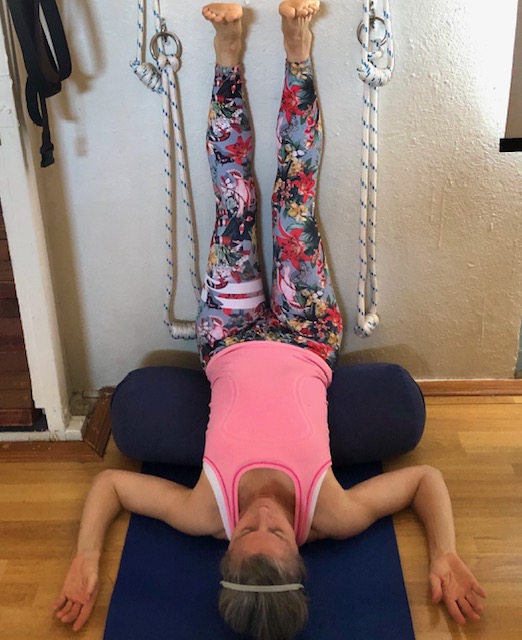
Yoga for sleep, the simplest version: Legs Up The Wall, with a bolster under the lower back. Stay 5 to 10 minutes, or longer.
Why sleep matters, and why yoga helps
Getting a good night’s sleep can be a real challenge. Sleep researchers such as Professor Matthew Walker have shown how much it matters: for memory, mood, blood pressure, the immune system and even how long we live. Poor sleep also makes stress and anxiety harder to manage, and the other way round.
Dr Timothy McCall’s poster “117 Health Conditions Helped by Yoga (as found in scientific studies as of June 2019)” lists insomnia among the more common conditions studies have found yoga helps. Here is what the research shows now.
What does the research say about yoga for sleep?
Insomnia
- Bu 2026, BMJ Evidence-Based Medicine. 22 trials, 1,348 people with insomnia, 7 kinds of exercise. Compared with usual care or lifestyle advice, yoga likely added a large amount of total sleep time, about 110 minutes more in sleep diaries (moderate certainty), and may improve sleep efficiency (the share of time in bed actually asleep), cut time awake in the night and shorten the time to fall asleep, all measured with sleep diaries. The authors named yoga among the most effective exercises for insomnia (Bu 2026).
Sleep quality in women
- Wang 2020, BMC Psychiatry. 19 studies, 1,832 women. Yoga improved sleep quality overall. The subgroups of women around menopause and women after breast cancer did not show a clear effect in that review (Wang 2020).

Resting with the legs raised eases tired legs after a long day.
Menopause and midlife sleep: the newer reviews
- Wang 2025, International Journal of Nursing Studies. 24 trials in women at menopause. Yoga improved sleep quality as well as overall menopause symptoms (Wang 2025).
- Bruyneel 2026, Sleep Medicine. In women around and after menopause with chronic insomnia, non-drug treatments, including yoga, improved sleep scores and were judged among the most robust first-line options (Bruyneel 2026).
- Fan 2025, Frontiers in Public Health. 18 trials of mind-body therapies in menopausal women. They improved sleep quality by a moderate to large amount, with yoga giving stable benefits for sleep (Fan 2025).
So the earlier mixed signal for menopause sleep has been joined by more positive reviews since.
How does yoga help you sleep?
Your nervous system has a “fight or flight” side and a “rest and digest” side. Sleep needs the second one. Supported yoga poses, held for several minutes with the body fully resting, move you towards “rest and digest”, the heart rate slows and the breath deepens by itself.
Iyengar teaching holds that inverted and supported poses, such as Legs Up The Wall and supported Bridge Pose, quieten the brain, partly through the way they change blood flow and the pressure sensors in the neck and chest. Research has not tested that part directly yet, but it is known from long practice, and students commonly tell us they sleep especially well after a restorative class.
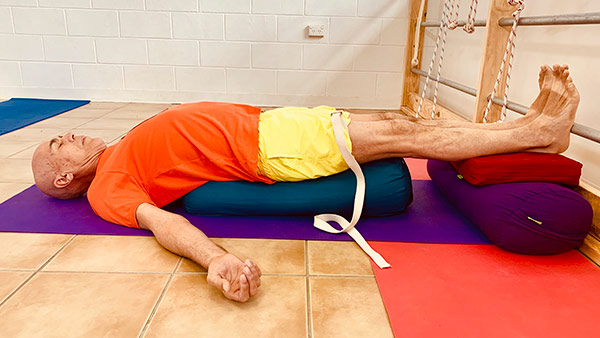
Supported Bridge Pose over T-shaped bolsters. The chest opens, the head is lower than the heart, and the body settles.
Six yoga poses for sleep, in Chris’s words
These are the poses I (Chris Lalor) use myself, at bedtime or if I wake in the night and need to get back to sleep. My mat and a bolster stay set up in the house so I can simply lie over them. Folded blankets, firm cushions or a pile of hard-cover books will do instead of yoga props.
- Legs Up The Wall (Viparita Karani). A firm bolster or folded blankets under the lower back, about a hand’s width from the wall, legs up the wall and feet flexed. Our legs up the wall note has the full set-up. Stay 5 to 10 minutes. Chris often stays 15 to 45 minutes, and a belt around the thighs makes that easier. If your legs tingle, fold them down for a moment and put them back up.
- Supported Bridge Pose, T-shape (Setu Bandha Sarvangasana). One bolster against the wall, another at right angles to it. Feet on the wall support, spine along the other, shoulders just touching the floor.
- Bridge Pose on a block. A firm foam brick, or two strapped together, under the sacrum (the flat bone at the base of the spine), feet wedged against the wall. Stronger, and for me the most calming. Stay 10 minutes if you can.
- Supported Child’s Pose (Adho Mukha Virasana), the forehead resting on a bolster.
- Reclining Bound Angle Pose (Supta Baddha Konasana), lying back over one or two bolsters with the soles of the feet together.
- Supported standing forward bend (Uttanasana), with the head resting on a chair or blocks. Good during the day, to arrive at bedtime already calmer.
Props for these yoga poses for sleep, at home and away
There is no need to worry about exactly where each foot or hand goes. Follow the pictures, keep it comfortable, and let the poses do the work.
Chris keeps just two tools in her bedroom: a bolster and a foam brick. Travelling? Take a foam brick or two, and put a blanket over the top for a make-shift bolster. It is better than soft pillows, and the higher you build the platform (within reason), the better it works.
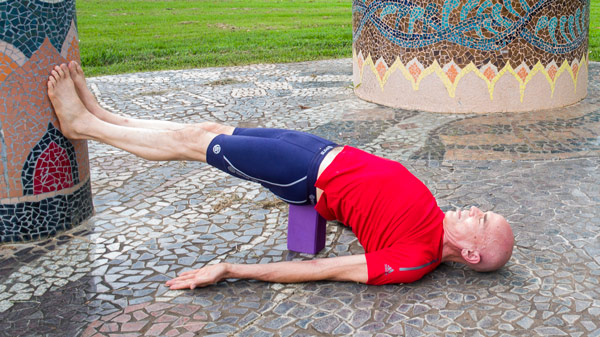
Bridge Pose on a block, the stronger version. Wedge the feet to the wall and stay 10 minutes or more.

Reclining Bound Angle Pose, with a bolster along the spine and a belt holding the legs. One of the best restorative yoga poses for sleep and relaxation.
Breathing for sleep
Slow breathing is the other half of yoga for sleep. A large 2022 review found slow breathing raises heart rate variability (a sign the calming side of the nervous system is working) (Laborde 2022). In Flametree’s pranayama (breath meditation) classes you learn slow, smooth breathing lying down with the chest supported, which many students then use in bed.
Most of your body’s settings you can’t change by willpower. You can’t just decide to lower your heart rate. Your breath is the exception, and it is the one dial you can reach in and turn. A slow, long out breath helps the calming side of the nervous system take over, a signal that the day is done. One practice Chris teaches for this is staircase breath (Viloma), done lying over blankets so the chest is open. It is learnt with a teacher, in the studio or LIVE online.
Keep evening breathing slow and quiet. Fast, energising breaths such as skull-shining breath (Kapalabhati) belong in the morning, not before bed.

Supported pranayama, lying over bolsters with the eyes covered. The same set-up works in bed for slow breathing before sleep.
What about yoga nidra for sleep?
Yoga nidra (a guided deep relaxation lying down) is popular for sleep. A 2026 review found possible benefits but called the evidence very low certainty, from only five small studies (Singh 2026). Flametree does not teach yoga nidra. Restorative yoga, with its supported poses and slow breathing, does much the same job, and we find it de-stresses, calms and improves sleep. If you want a guided practice, our pages on meditation for sleep and yoga nidra and why plain yoga helps too go further.
Yoga for insomnia: Chris’s own sleep routine
Chris Lalor came to yoga looking for help with sleep, and she still uses it most weeks. Some nights, after teaching two back-to-back evening classes, she gets home at 8.30pm too wired to sleep. On other nights she wakes in the small hours with a racing mind, and she knows that without sleep she will have what she calls a zombie mind the next day. So she keeps a bolster and mat set up close to where she sleeps. That is one person’s experience, not a promise, but it is the routine she follows.
“Yoga is a discipline that helps you quieten your mind and start to understand yourself. But a few years ago I came across Professor Matthew Walker’s TED talk, Sleep is your superpower, and realised there was still much more I could do to improve the quality of my sleep. I changed quite a few habits, and every one of them has helped.”

Lying supported lets the breath slow and the body settle.
What is in Chris’s evening routine?
- A dark room. A fitted blind that cuts out all light, and total darkness to sleep.
- No screens in the bedroom. Phones and tablets go off two hours before bed.
- A room for sleep only. No clutter, and kept cooler than the rest of the house.
- The same bedtime, around 10pm, every night.
- No late meals. “When I break this, I notice I don’t sleep as well.”
- No coffee, at any time of day.
- A warm, dim bedside light, turned off to sleep.
- Three things she is grateful for, every night.

Resting forward over a bolster calms the nervous system.
What does Chris do on the mat, morning and night?
Active poses early, quiet ones late. She practises pranayama every day, with inversions and more active poses in the morning and late afternoon to wake the nervous system up, and restorative poses at night to settle it.
“When I teach late evening classes, I come home and put my legs up the wall for 10 minutes, then lie in supported Bridge Pose for 10 minutes to wind down and stop my mind churning. Time and again, if I try to go straight to bed, my mind is simply too wound up, and I have to get up and do these poses anyway.”
The Flametree timetable follows the same idea: morning classes are more active, to wake the body up, and late classes are quieter, to prepare for sleep. Mornings matter too. Many people find that getting outside into daylight early, rather than onto a phone, helps them feel sleepy at night.

Legs Up The Wall, Chris’s 10 minutes after a late class. Supported, still, and no effort needed.
Honest limits, and good sleep habits
- The sleep time results come mostly from sleep diaries, not sleep lab measurements.
- Most trials are small and people know they are doing yoga.
- Results in women around menopause were mixed in an earlier review, though newer reviews are positive.
- If you snore loudly, stop breathing in your sleep, or are sleepy every day, see your GP. Sleep apnoea (breathing stopping during sleep) needs medical care.
Yoga works best alongside good sleep habits: a dark, cool room, a regular bedtime, and not eating late. In the Darwin build-up that cool room matters even more.
Yoga for sleep in Darwin, or LIVE online
Flametree Yoga Studio runs restorative and gentle classes, plus early morning pranayama, at Woolner and Coolalinga in Darwin and LIVE online. Restorative poses are also built into the end of most classes.
- New to Flametree? Your first class is free. In the studio, just come along. Online, go to our online class list, click the class time you want and we email you the link to join.
- Keep going at half price. New students, and anyone who has been away three months or more, can get a half price 10 class pass with 2 extra classes free, to use online, in the studio, or both. See the half price pass.
- Already practising yoga? The same half price 10 class pass for new students, and for anyone away three months or more, is also available as the non-beginner half price pass.
- See every class time on the beginner timetable.
Read more: what is restorative yoga, yoga for stress relief, yoga for anxiety and breathing for anxiety, what is pranayama, lower blood pressure with Iyengar yoga, sleep problems in Darwin, and the benefits of yoga hub.
Yoga for sleep: questions people ask
Is yoga good for insomnia?
For many people, yes. A 2026 review of 22 trials in people with insomnia found yoga likely added a large amount of total sleep time compared with usual care, and may help people fall asleep faster and wake less. Most results came from sleep diaries, and the trials were small, so yoga works best alongside good sleep habits and your GP’s advice.
Which yoga is best for sleep?
Restorative yoga, where the body is fully supported by bolsters, blankets and the wall, and poses are held for several minutes. Legs Up The Wall, supported Bridge Pose, supported Child’s Pose and Reclining Bound Angle Pose are the ones we use most.
Is yoga before bed good for sleep?
Yes, if it is quiet, supported yoga. Five to fifteen minutes of restful poses and slow breathing before bed helps the body switch to rest and digest mode. Save strong standing poses, backbends and fast breathing for earlier in the day.
What can I do if I wake at 2am and cannot get back to sleep?
Get up quietly and do Legs Up The Wall or Bridge Pose on a block for 5 to 10 minutes, breathing slowly with a longer out-breath. Many people find this settles them enough to get back to sleep. Keep the lights low.
How does yoga help you sleep?
Supported poses held for several minutes move the nervous system towards rest and digest mode: the heart slows and the breath deepens. Regular classes also lower day-to-day stress, which is one of the main reasons people lie awake.
Can yoga cure insomnia?
No one should promise that. What the research shows is that yoga can improve sleep time and sleep quality for many people with insomnia. If insomnia lasts more than a few weeks, talk to your doctor if you wish, who can go through the other treatments with you.
Does yoga help sleep during menopause?
Newer reviews say it can. A 2025 review of 24 trials found yoga improved sleep quality in women at menopause, and a 2026 review judged non-drug approaches including yoga among the most robust first options for menopause-related insomnia.
Where can I do yoga for sleep in Darwin?
Flametree Yoga Studio runs restorative and gentle classes, and early morning pranayama, at Woolner and Coolalinga in Darwin and LIVE online. If you are new to Flametree your first class is free, then there is a half price 10 class pass with 2 free.
Last updated 14 October 2026: reworded Chris Lalor’s sleep story, added the staircase breath and travel tips, and added the size of the sleep time result.
Sources
- Bu ZJ et al. Effects of various exercise interventions in insomnia patients, network meta-analysis. BMJ Evid Based Med 2026. doi:10.1136/bmjebm-2024-113512
- Wang WL et al. The effect of yoga on sleep quality and insomnia in women with sleep problems. BMC Psychiatry 2020. doi:10.1186/s12888-020-02566-4
- Wang H et al. The effectiveness of yoga on menopausal symptoms. Int J Nurs Stud 2025. doi:10.1016/j.ijnurstu.2024.104928
- Bruyneel M et al. Treatments for chronic insomnia in perimenopausal and postmenopausal women. Sleep Med 2026. doi:10.1016/j.sleep.2026.109040
- Fan Z et al. Mind-body therapies for sleep disturbances, depression, and anxiety in menopausal women. Front Public Health 2025. doi:10.3389/fpubh.2025.1686981
- Singh S et al. Effect of yoga nidra in sleep disturbances and insomnia. Sleep Breath 2026. doi:10.1007/s11325-026-03685-0
- Laborde S et al. Effects of voluntary slow breathing on heart rate and heart rate variability. Neurosci Biobehav Rev 2022. doi:10.1016/j.neubiorev.2022.104711
- McCall T. 117 Health Conditions Helped by Yoga (as of June 2019). Yoga As Medicine, DrMcCall.com.
Flametree Yoga Studio teaches Iyengar yoga in Darwin, at Woolner and Coolalinga, and LIVE online anywhere.
This article is general information, not medical advice. Talk to your yoga teacher, yoga therapist, and your doctor if you wish. If poor sleep lasts more than a few weeks, or you snore loudly and stop breathing in your sleep, talk to a doctor.