Lower Blood Pressure with Iyengar Yoga
More than one in five Australian adults has high blood pressure, and most do not know it
More than one in five adult Australians (23%) had high blood pressure when it was measured in the 2022 National Health Survey. Around the world, it is linked to more than 8.5 million deaths each year. This page looks at the best yoga for high blood pressure: which yoga is good for it, the poses that Iyengar yoga teaches for it, how the props are used, and what the studies say.
Iyengar yoga is the style developed by Mr BKS Iyengar. In the 20th century he did more than anyone to set down traditional Indian yoga, through his books and his teaching, and he pioneered the use of props. It is sometimes called modern classical yoga, and it’s the style we teach at Flametree. This page sits in our relaxation, stress and sleep notes.
Here is the page in short form:
- The numbers: high blood pressure often has no symptoms, so many people do not know they have it.
- The research: reviews of 30 and 34 trials found yoga lowered blood pressure modestly.
- The poses: supported, quiet poses such as bridge over a bolster and legs up the wall.
- The breathing: slow breathing with a longer out breath, and no breath holding.
- Take care: tell your teacher, keep taking your medication, and check with your doctor.
- Start: learn it in the studio at Woolner and Coolalinga, or LIVE online.
For people with high blood pressure, there are often no symptoms or signs. That means they can have high blood pressure, yet feel well. So it can sneak up on you, especially when you are constantly stressed. In that same survey, three in four adults (74.5%) whose measured blood pressure was high did not report having it.
It is not just a male problem. Women are affected too.
Which yoga is good for high blood pressure?
Calm, supported yoga that combines postures, slow breathing and relaxation. No trial has compared yoga styles head to head for blood pressure, so no style can claim to be the best. What the 2022 review below found is that the programmes that worked best combined postures, breathing and meditation or relaxation. Iyengar yoga suits blood pressure because of its focus on props and precise set-up, which let you hold supported, quiet poses for a long time without strain.
Which yoga asanas for high blood pressure?
The poses taught for blood pressure are restorative yoga poses, where the head is lower than the heart and the chin is tucked in. The idea is that this position works on the baroreceptor reflex (a pressure sensor in the neck), the vagus nerve and the parasympathetic nervous system (the rest-and-digest side of the nerves). See some examples below, plus more on each of them.
We also point to the studies, and say plainly where the research stops and the teaching starts. Yoga for blood pressure is taught in Flametree classes, in the studio and LIVE online.

Stress increases your heart rate and blood pressure.
Free ebook: Cutting Stress With Yoga. Stress and your heart: why programmes with breathing and relaxation lowered blood pressure about twice as much.
New to Flametree, or away 3 months or more? 2 free classes + 2 ebooks, only available via this offer. Already a student? You can still get this book. Get your free copy of Cutting Stress With Yoga
What studies show about yoga and blood pressure
The short answer: in trials, yoga lowered blood pressure modestly, and the latest reviews agree. Yoga sits alongside medication and your doctor’s advice, not in place of them. Here is what the research found, with the year and what yoga was compared with.
- 2025 review, PLoS One: 30 randomised trials, 2,283 people with high or borderline blood pressure. Compared with people on a waiting list, yoga lowered systolic pressure (the top number) by about 8 mmHg and diastolic pressure (the bottom number) by about 5 mmHg. Compared with other active treatments, the difference was smaller, about 2 mmHg on the bottom number. The authors rated the evidence very low quality because trials were small and varied.
- 2022 review, Frontiers in Public Health: 34 randomised trials in adults with high blood pressure. Yoga lowered systolic pressure by about 6.5 mmHg and diastolic by about 2.8 mmHg compared with control groups. The programmes that worked best more often combined postures, breathing and meditation or relaxation, which is how a full yoga practice is taught.
- 2019 review of slow breathing: 17 studies. Slow breathing lowered systolic pressure by about 5.6 mmHg and diastolic by about 3 mmHg.
For scale, in large trials of blood pressure medicines, each 5 mmHg fall in systolic pressure cut the risk of heart attack and stroke by about a tenth (Lancet, 2021). That finding comes from medication trials, not yoga, but it shows why a few points matter. It is not a replacement for treatment, and nobody should change their medication without their doctor.
A meta study of various other studies described yoga as “an effective intervention for reducing blood pressure.” Another meta study of yogic approaches, including pranayama, looked at people with high blood pressure and with pre-hypertension (blood pressure above normal but not yet high).
If you are already on blood pressure medication, keep taking it as your doctor prescribes, check your blood pressure regularly, and tell your teacher that you have high blood pressure.
In particular, come to a class with Christine Lalor, Flametree’s accredited Senior Yoga Teacher and Yoga Therapist. Plus, consider doing restorative yoga, or gentle yoga, or both.
As you can see in the diagram below, there are many reasons to take care of your blood pressure.

The many complications of high blood pressure are a reason to take all the care you can of it, and to manage it as well as you can with your doctor.
How to lower blood pressure with yoga: the supported bridge
Supported bridge pose (Setu Bandha Sarvangasana) is one of the best known poses taught for blood pressure and stress. There are much easier versions of it too. In essence, the hips and body sit higher than the shoulders, resting on a bolster, a foam block, a chair or a bed. You do not need to be flexible, and it can be done almost anywhere.
Among the Iyengar yoga asanas taught for high blood pressure
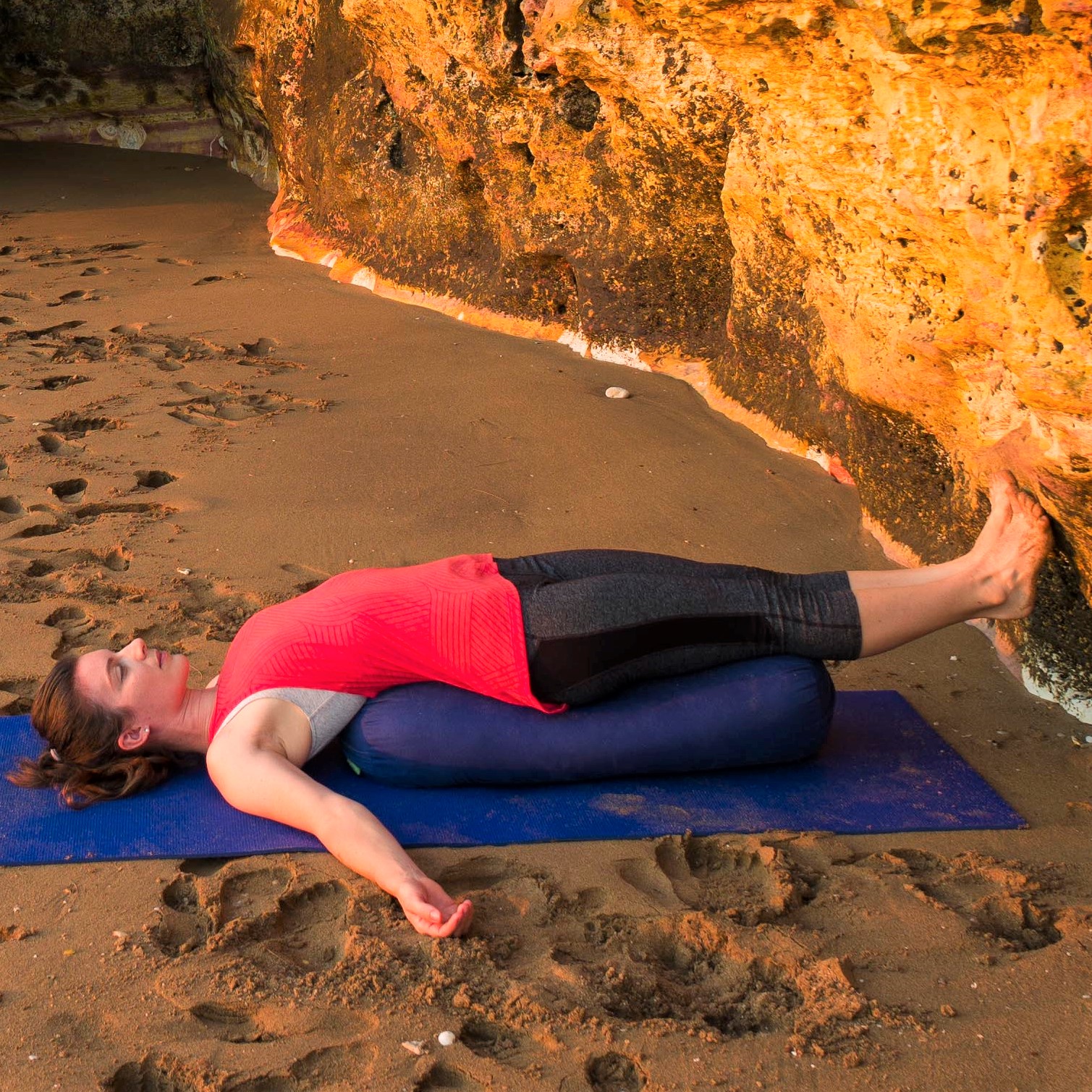
This supported Bridge pose, with a highish bolster prop underneath, is regularly done in Iyengar yoga. The props let you stay a long time, which is why restorative poses like this suit blood pressure and stress.
Why do head-low poses with a tucked chin get taught for blood pressure?
The traditional teaching, and the physiology behind it, goes like this. Baroreceptors (from the Greek idea of pressure, “baro”) are pressure sensors in the arteries on either side of the neck and in the upper chest. Their job is to stop pressure getting too high as blood enters the brain, so the brain gets a steady supply of blood and oxygen.
In supported bridge, the chin moves towards the chest and the head sits lower than the heart. The idea is that this neck position stimulates the baroreceptors, and the nervous system responds by easing pressure. It is a neat example of how a pose can act on the inside of the body.
This explanation has not itself been tested for yoga poses. What trials have measured is the overall effect of yoga programmes, as above. So we offer the baroreceptor idea as the reason these poses are taught, not as proof of how they work.

Iyengar yoga asanas for high blood pressure are essentially those with the head lower than the heart. Those that tuck in the neck are the ones taught to work on the baroreceptor reflex.
In supported bridge pose, Iyengar yoga uses props like a bolster or block, so we can stay a long time. Bolsters, folded blankets or firm pillows all do a similar job. In Iyengar teaching, supported bridge is commonly held for 5 to 10 minutes once you are used to it. Research has not yet tested the best hold time.
It is also a good idea to have your blood pressure checked regularly by a health professional, whether or not there is a family history of hypertension.

Quick summary of how baroreceptors work with blood pressure, and heart rate.
Iyengar yoga and heart health
The trials cited above show a modest drop in blood pressure, which is one of the main risk factors for heart disease. They did not test heart attacks or strokes directly.
The American Heart Association’s page on yoga and mindful movement (last reviewed in November 2023) says some research suggests yoga may help heart health, including blood pressure, and that more research is needed. It also notes that people with high blood pressure should modify or avoid some yoga poses, which is why you should learn with a teacher.
It is partly because yoga activates the parasympathetic nervous system (the rest-and-digest side of the nerves) through slow breathing and quiet poses such as:
- forward bends (such as Janu Sirsasana, with the head resting on a support)
- plough pose (only once blood pressure is controlled and your teacher agrees)
- corpse pose (Savasana)
- shoulder stand (supported, and only once blood pressure is controlled and your teacher agrees)
- bound angle pose
- child’s pose
- downward-facing dog pose (Adho Mukha Svanasana)
- staff pose (upright seated position)
- butterfly pose
- supported reclining bound angle pose (Supta Baddha Konasana)
- Diamond Pose (Vajrasana)
- standing poses with the crown of the head resting on a support, so the head is lower than the heart
- many other yoga exercises that have your chin tucked (including those shown in this post).
The key factor is practising regularly. Flametree yoga teachers can show you a wide range of easy pose options to use alongside whatever your doctor advises.

Your vagus nerve is a key part of your parasympathetic nervous system, which yoga poses and slow breathing are taught to calm.
Restorative yoga and the heart: what a cardiologist says about women and blood pressure
Restorative yoga is a doable, systematic way to relax, and relaxing matters because stress is part of the picture. Dr Clara Chow is a professor of medicine at the University of Sydney and a cardiologist at Westmead Hospital. In a 2022 piece in the Sydney Morning Herald (the one linked above), she said many women assume heart disease is something men suffer, yet it is the leading cause of death and disability in both women and men, and that she sees women in their 40s and 50s with heart disease. She described how heart attacks often show up differently in women, more often as breathlessness, fatigue or discomfort than as crushing chest pain. She also named high blood pressure as the leading modifiable cause of heart disease in the world, and said studies show about half of people with it are unaware of it.
Her point is a medical one, and yoga is not a replacement for seeing a doctor. But two things follow for yoga students. If you are a woman in your 40s or 50s, have your blood pressure checked and talk to your doctor about unusual breathlessness or tiredness. And the rest-and-digest side of the nerves is what restorative yoga is built to practise.
Restorative classes are taught at beginner and non-beginner levels, with supported poses such as bridge over a block or bolster, and legs up the wall. Teachers often see quickly which students are more stressed, more anxious or less able to relax. They find it hard to lie quietly in the relaxation pose at the start and end of class, or in restorative poses such as bridge. If that sounds like you, restorative yoga is even more worth trying. Beginner versions work just as well for systematic relaxation and de-stressing. See our page on restorative yoga.
Slow breathing and blood pressure
If your doctor has talked to you about your heart or your blood pressure, you might also consider learning slow pranayama (yoga breathing) with a teacher, alongside whatever your doctor advises. Pranayama is a natural partner for the yoga poses above, and adds to the wider benefits of yoga.
In addition, almost all yoga poses will increase your blood circulation, and support many of the conditions on Dr Timothy McCall’s list of health conditions studied in yoga research. High blood pressure is on that list, which names conditions where at least one controlled study found a benefit.
Best poses for blood pressure and stress
Three of the quiet poses taught most often for blood pressure and stress are any variation of the supported bridge pose, legs up the wall (Viparita Karani) and the relaxation pose (Savasana). Once your blood pressure is controlled and your teacher agrees, a supported shoulder stand (Salamba Sarvangasana) can be added. Our notes on legs up the wall and Savasana show how to set them up.
On the Flametree blog there are pictures of these and other poses for stress and sleep. They have other benefits too, such as helping sleep.
These are all easy poses that feel good each time you do them. They are also easy to build into your day, or into your regular yoga practice. The key poses for blood pressure, as well as pranayama, put more focus on your parasympathetic nervous system and vagus nerve, and so help reduce the load of stress.
Your parasympathetic nervous system

Your parasympathetic nervous system slows your heart rate. Quiet, supported yoga poses focus on it.
What an Iyengar class does for high blood pressure, and how to practise safely
An Iyengar class for blood pressure leans on supported, quiet poses and slow breathing, and leaves out the few things that push pressure up. The 2022 review found the programmes that worked best combined postures, breathing and relaxation, which is how a full class is built.
- Supported poses: bridge over a bolster or block, legs up the wall, and forward bends with the head resting on a chair or bolster.
- Standing poses: held calmly with normal breathing, and with the arms down rather than held overhead for long.
- Slow breathing: a longer out breath than in breath, through the nose, taught lying down first.
- Long relaxation at the end of class.
Safe practice with high blood pressure
- Tell your teacher before class, and keep taking your medication as prescribed.
- Leave out full headstand and unsupported shoulderstand until your blood pressure is controlled and your teacher agrees.
- Never hold the breath. Breath retention raises pressure, and it is left out for anyone with high blood pressure.
- Avoid long holds with the arms overhead and anything that makes you strain or go red in the face.
- Stop and sit down if you feel dizzy, get a headache or feel pressure in the head.

Legs up the wall (Viparita Karani), with a bolster under the hips. One of the quiet, supported poses taught for blood pressure and stress.

Supported bound angle pose (Supta Baddha Konasana) over bolsters, with a belt holding the feet. Restorative poses like this are where slow breathing is learnt.
For how slow breathing settles the nervous system, see how to calm your nervous system and what is pranayama. If stress and worry are a big part of it for you, see yoga for anxiety and yoga for sleep. The restorative yoga page explains the supported poses.
Other benefits of a less sedentary lifestyle
If you do the poses outlined, you may notice other benefits in addition to the blood pressure research above. Students often tell us about:
- more flexibility in the upper and lower body
- strength and less discomfort in the lower back
- feeling calmer and sleeping better
The poses outlined are usually taught gently, especially if you start with Flametree’s Gentle Yoga class.
Which yoga asanas for high blood pressure?
Start with calm, supported yoga.

Lack of exercise is a key issue in high blood pressure. Iyengar yoga is taught with props and a precise set-up, and with a strong focus on easing stress.
Flametree Yoga Studio
Flametree classes are LIVE online at the local time of Darwin, Australia, and in the studio at Woolner and Coolalinga. The classes are all standard, introductory hatha yoga poses in the Iyengar yoga style. The online format also gives you a wider range of classes than are often available locally.
There are also options, including Gentle Yoga, Yoga for Back (& Neck & Shoulders), and Restorative Yoga. The restorative poses are especially taught for stress and relaxation. If you like, see what other Flametree students have said about the online classes.
Another version of the top Iyengar yoga asanas for high blood pressure

Another version of Bridge pose, using a block
Try Iyengar yoga for high blood pressure
Flametree beginner yoga can be started at any time, online or in the studio, at beginner or non-beginner level. Consider restorative yoga, or gentle yoga, or both.
Flametree Yoga Studio teaches at Woolner and Coolalinga in Darwin and LIVE online, with Christine (Chris) Lalor, Senior Iyengar Yoga Teacher and certified yoga therapist, and the Flametree team.
Related research pages: yoga for posture, yoga for osteoporosis, yoga for back pain and the benefits of yoga page.
Yoga, breathing and blood pressure: common questions
Does deep breathing lower blood pressure?
Slow breathing does lower blood pressure for most people, at least while you are doing it and for a while afterwards. Around six breaths a minute is the rate most of the research settles on.
The effect comes from the nervous system rather than from the lungs. Slowing the breath tells the body it is not under threat, and the pressure follows.
How should I breathe to lower blood pressure?
Breathe out for longer than you breathe in, through the nose, without straining. If the in breath takes 4 counts, let the out breath take 6 or 8.
Do not hold your breath. Breath holding pushes pressure up, which is the opposite of what you want.
Does holding your breath lower blood pressure?
No. Holding the breath raises it. That is why blood pressure readings go wrong if you hold still and tense up while the cuff inflates.
In pranayama, breath retention is taught late and left out entirely for anyone with high blood pressure.
Does yoga lower blood pressure?
Yes, modestly. A 2025 review of 30 trials found yoga lowered the top number by about 8 mmHg and the bottom number by about 5 mmHg compared with a waiting list, and a 2022 review of 34 trials found similar results. The evidence is rated low quality because the trials were small, and the effect was smaller when yoga was compared with other active treatments.
The supported and restorative poses are the ones taught for blood pressure, rather than the vigorous ones, which is the opposite of what people often assume.
What yoga poses should you avoid with high blood pressure?
Full inversions such as headstand and shoulderstand, long held arms overhead poses, and any strong breath retention.
Supported versions are a different matter. Legs up the wall, a supported forward bend with the head resting, and lying over a bolster are the ones taught for this.
Can breathing exercises lower blood pressure on their own?
They can help, but treat them as one part of the picture alongside whatever your doctor has advised. Nobody should stop medication because a breathing practice felt good.
Flametree teaches breath work as a practice, not as a treatment. Your GP stays in charge of the medical side.
How long before breathing practice makes a difference?
A single session changes the reading for a short time. A daily habit over 8 to 12 weeks is what the studies tend to measure.
Ten minutes a day, most days, beats an hour once a week.
How do I know if I have high blood pressure?
Only a measurement tells you, because high blood pressure often has no symptoms. In the 2022 National Health Survey, three in four adults whose measured blood pressure was high did not report having it. A doctor or pharmacist can measure it in a few minutes. If you have it, tell your yoga teacher and keep following your doctor’s advice.
Why is supported bridge pose taught for blood pressure?
Because the head sits lower than the heart and the chin moves towards the chest, which is the position the baroreceptor idea is built on. The pose also lets you stay quiet and supported for 5 to 10 minutes. The baroreceptor explanation itself has not been tested for yoga poses. What trials have measured is the overall effect of yoga programmes.
Where can I learn this properly in Darwin?
Flametree runs breath and meditation classes alongside yoga in the studio at Woolner and Coolalinga in Darwin, and LIVE online. Your first class is free if you are new to Flametree: in the studio, if you have lived in the NT for three months or more, and online, for anyone new. The beginner timetable shows every class time.
Practise this at Flametree
Flametree Yoga Studio teaches Iyengar yoga in the studio at Woolner and Coolalinga in Darwin, and LIVE online.
- New to Flametree? Your first class is free. In the studio, just come along. Online, go to our online class list, click the class time you want and we email you the link to join.
- Beginners: new students, and anyone who has been away three months or more, can get a half price 10 class pass with 2 extra classes free, to use online, in the studio, or both. See the beginner half price pass.
- Already practising yoga? The same half price 10 class pass with 2 extra classes free, for new students and for anyone away three months or more, is also available as the non-beginner half price pass.
- See every class time, including online classes, on the timetable.
Can’t make a class? Practise at home with our video courses.
This article is general information, not medical advice. If you have high blood pressure, keep seeing your doctor and taking your medication as prescribed, and tell your teacher before class. Flametree Yoga Studio, Darwin and live online.
Sources: Geiger C and colleagues, A systematic review and meta-analysis of yoga for arterial hypertension, PLoS One, 2025, doi 10.1371/journal.pone.0323268. Nalbant G and colleagues, Content, structure, and delivery characteristics of yoga interventions for managing hypertension, Frontiers in Public Health, 2022, doi 10.3389/fpubh.2022.846231. Chaddha A and colleagues, Device and non-device-guided slow breathing to reduce blood pressure, Complementary Therapies in Medicine, 2019, doi 10.1016/j.ctim.2019.03.005. Blood Pressure Lowering Treatment Trialists’ Collaboration, Pharmacological blood pressure lowering for primary and secondary prevention of cardiovascular disease across different levels of blood pressure, The Lancet, 2021, doi 10.1016/S0140-6736(21)00590-0. Australian Bureau of Statistics, Hypertension and high measured blood pressure, National Health Survey 2022. American Heart Association, Exercise your mind and body with yoga and mindful movement, last reviewed November 2023. Dr Clara Chow, Sydney Morning Herald, March 2022. McCall T, list of health conditions studied in yoga research, DrMcCall.com.