
Yoga For Depression: What The Research Says, And Iyengar Poses For Low Mood
Yoga for depression: the short answer
When your mood is low, even getting out the door can feel like too much. Yoga for depression can help as one part of your care: a 2024 review of 24 trials found it eased depressive symptoms compared with no extra treatment, and more people reached remission. It has not clearly beaten other active treatments, and it is not a replacement for your doctor or psychologist. Here is what the research says, what an Iyengar class does for low mood, how to practise safely, and how to start in Darwin or online.
Here is the article in short form:
- Research: yoga eased depression versus no extra treatment (2024 review, 24 trials).
- Honest limit: no clear difference in symptom scores versus other active treatments.
- Iyengar trials: Boston studies paired Iyengar yoga with slow breathing.
- Dose: two or three classes a week did more than occasional practice.
- Safety: keep your doctor involved; never stop medication on your own.
- Next step: a gentle or restorative class, in Darwin or live online.

Legs up the wall (Viparita Karani), resting on a bolster. A restful pose many students use on flat, low days.
Low mood or depression: what is the difference?
Everyone has flat days. Depression is when low mood, loss of interest and tiredness last most days for two weeks or more and get in the way of work, sleep or relationships.
If that sounds like you, the first step is your GP. Depression is common and treatable, and yoga can be part of what helps.
Dr Timothy McCall’s June 2019 list of 117 health conditions helped by yoga includes depression and prenatal and postpartum depression. His list is a pointer to studies, not a ranking of how strong each one is, so here is the evidence itself.

A supported inversion rests the head and lifts the mood.
Free ebook: Cutting Stress With Yoga. Stress, worry, low mood and sleep: what the trials show, and why yoga and breath work deliver.
New to Flametree, or away 3 months or more? 2 free classes + 2 ebooks, only available via this offer. Already a student? You can still get this book. Get your free copy of Cutting Stress With Yoga
Is yoga good for depression? What the research says
Yes, as an addition to care, with honest limits. Each finding below gives the year and what yoga was compared with.
- 2024 review in Depression and Anxiety: 24 randomised trials (studies where people are allocated to groups by chance), 1,395 people with diagnosed depression. Compared with no extra treatment, yoga reduced depression moderately (standardised mean difference, SMD, minus 0.43). Compared with active treatments such as other exercise or education, the difference in symptoms was not significant. More people reached remission with yoga, against both kinds of comparison. Side effects were no different. Evidence quality ranged from moderate to very low.
- 2024 review in The BMJ: 218 trials of exercise for major depression, 14,170 people. Against active controls such as usual care, yoga produced a moderate reduction in depression (Hedges’ g minus 0.55), and it was among the best tolerated options. Confidence in the yoga result was rated very low, because few trials were at low risk of bias. The authors suggested exercise could sit alongside psychotherapy and medication.
- 2023 review in the British Journal of Sports Medicine: 23 studies found yoga did better than control groups for depression in depressive disorders, but the certainty was very low.
In plain terms: yoga helps more than doing nothing extra, it seems to help about as much as other active approaches, and the studies are small. That is still a useful thing to know, especially if you have tried to exercise and could not stick with it.
The Iyengar yoga trials from Boston
Researchers at Boston University tested Iyengar yoga with coherent breathing (slow, even breathing at about five breaths a minute) in adults with major depression.
- 2017, 30 people who finished: 12 weeks of 90-minute classes, two or three a week, plus home practice. Depression scores fell a lot in both groups, and 27 of the 30 had scores below the depression cut-off by week 12.
- 2019, same programme: more total minutes of practice went with bigger improvements in mood, anxiety and sleep.
Both were dosing studies with no group that did not do yoga, so they show what happened with regular Iyengar practice, not proof that yoga caused all of it. They are still the closest research to what we teach.

A restorative backbend over crossed bolsters. Iyengar teaching holds that lifting the chest in a supported way lifts the spirits.
What an Iyengar class does for low mood
An Iyengar class gives the mind something to do. Precise instructions for the feet, legs and chest leave less room for going over and over the same worries, and many students tell us that is the first thing they notice.
Yoga poses for depression that are commonly taught
- Supported backbends: lying over a bolster or a chair, the chest lifts without effort. In the Iyengar tradition these are taught to lift mood and energy.
- Standing poses: Warrior 2 (Virabhadrasana II) and Triangle (Utthita Trikonasana) build strength and a sense of steadiness, the feeling of standing on your own two feet.
- Supported inversions: legs up the wall and, once learnt, supported shoulderstand. The tradition teaches these to refresh a tired system.
- Restorative poses: fully supported with bolsters and blankets, for days when there is not much in the tank.
- Slow breathing: learning to lengthen the out-breath, one of the parts of the Boston programme.
These pose choices come from long practice, not from trials that tested each pose. Research has tested yoga programmes as a whole.

Kim in Warrior 2 (Virabhadrasana II). Standing poses build strength and a feeling of being grounded.
How to practise safely with depression
- Keep your doctor or psychologist in the loop, and never stop or change medication without them.
- Go gently on heavy days. A restorative class counts. So does ten minutes of legs up the wall at home.
- Tell your teacher. You do not have to explain why; just say you need a gentler day.
- Be wary of strong, fast breathing when you feel agitated. Slow, even breathing is the place to start.
- If you ever feel unsafe, contact your doctor or Beyond Blue on 1300 22 4636 straight away.
How much yoga helps depression?
Regularity matters more than intensity. The trials that helped most used two or three classes a week for about three months, plus some home practice. A 2021 review across mental health conditions also found bigger effects with more sessions each week.
Coming to a class on a set day also brings routine and company, which low mood often takes away. For the closely related area of worry and panic, see our page on yoga for anxiety and breathing exercises for anxiety, and for everyday pressure, yoga for stress relief.
What research has tested so far, and what practice already knows
Research has tested whole yoga programmes, and found real but modest benefits. Much of what Iyengar teachers do for low mood, such as which backbends to choose and how long to stay in an inversion, is known from long practice and has not yet been tested by modern research. Not yet tested is not the same as not working; it means science has not caught up yet.
What we do not claim: yoga does not replace medical care, and no study shows it works for everyone.
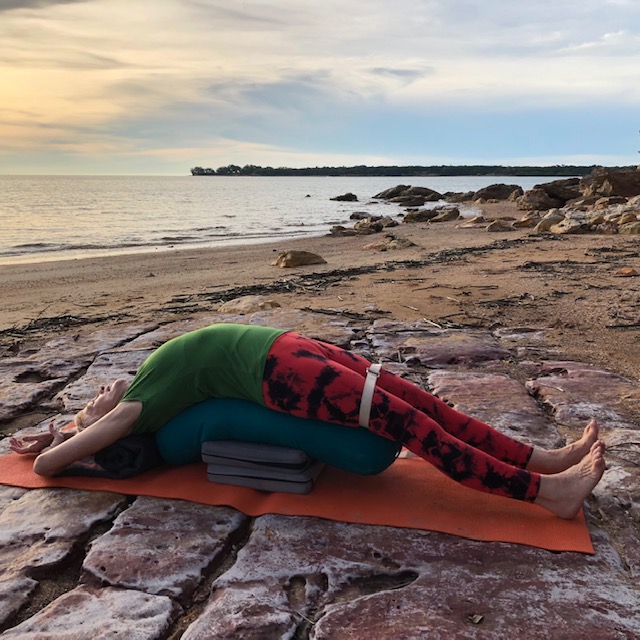
A resting backbend over a bolster by the sea. On low days, a fully supported pose is a good place to start.
A simple sequence for shifting moods
Iyengar yoga is the style developed by Mr BKS Iyengar. In the 20th century he did more than anyone to set down traditional Indian yoga, through his books and his teaching, and he pioneered the use of props. It is sometimes called modern classical yoga, and it’s the style we teach at Flametree.
Research tests whole programmes, so this is not a trial result. It is a sequence our teachers use when someone arrives feeling anxious, agitated, flat or spaced out, and it comes from long practice. In any class we vary it with the weather, the students’ needs and the skills of the group.
- Start with the head supported. Poses such as Downward Facing Dog and a standing forward bend, with the head resting on a support, help you feel more connected to your body. The spaced-out feeling tends to fade as you feel more grounded.
- Then backbends. These open the chest, and in the Iyengar tradition they are taught to lift the spirits. Props such as a bolster, a chair or a wall make them easier to learn, and give you the benefit while you are learning.
- Finish by quietening the nervous system. Supported shoulderstand, plough pose and supported bridge pose are taught for this. Shoulderstand and plough are learnt with props and a teacher, and they are not for everyone, so ask before you try them at home.
Backbends can feel frightening at first. In daily life we lean forward all the time, and we rarely open the front of the body. If that is you, go slowly and use support. Our note on wheel pose looks at props, ropes and fear of dropping back. If you feel very low or unsafe, use the safety steps above first.
Does yoga change brain chemistry? (still being studied)
A 2010 randomised study (Streeter and colleagues, Journal of Alternative and Complementary Medicine, doi:10.1089/acm.2010.0007) asked 34 healthy people to do either yoga (19 people) or a walking programme matched for energy use (15 people), for 60 minutes, three times a week, for 12 weeks. The yoga group reported greater improvement in mood and a bigger drop in anxiety than the walking group. Brain scans found that higher levels of GABA, a chemical messenger in the brain, in an area called the thalamus went with better mood and less anxiety.
This is the research rung, with clear limits. The people were healthy, not diagnosed with depression, and the study was small. The authors said the possible role of GABA in the benefits of yoga needs further study, so it is still being studied. It does not show that yoga is a treatment for depression.
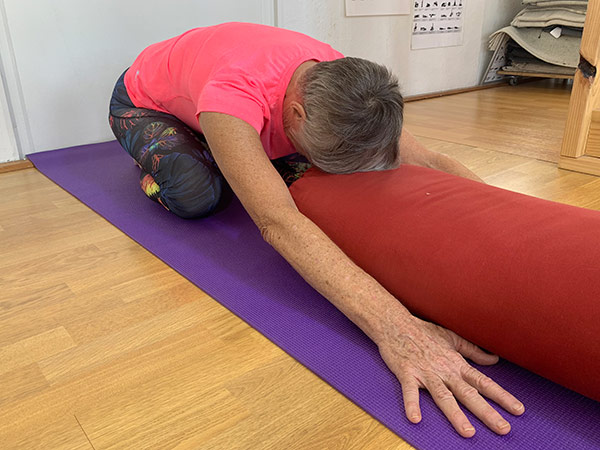
A forward bend with support calms the mind.
One student’s account, and why the level matters
One student, with her blessing, wrote to us after twelve months of our beginner program. She had lived with chronic back pain, weight gain, insomnia, depression and anxiety, and had tried many things that did not stick. She wrote: “A year ago I could not foresee this as being remotely possible.” She told us she had lost 30 kilograms, that her back pain had gone, and that she had a new relationship with her body, her movement and her food choices.
That is one person’s account of one year, not a trial result, and it tells you nothing certain about what will happen for you. What we take from it is the starting point. Chris Lalor says that when she first took yoga classes in Melbourne, decades ago, they were pitched far above where she was, and she went home aching and confused. The class was the problem, not her. If you are new, or returning after time away, ask for a class at the right level, because a door at the right height is easier to walk through.
More is in our Stress and Sleep notes, and our post on yoga for lower back pain covers the back pain side.

Lying supported lets the breath slow and the body settle.
Practise this at Flametree
Your first class is free if you’re new to Flametree. New students, and anyone who has been away three months or more, can also get a half price 10 class pass with 2 extra classes free, to use online, in the studio, or both. For the studio, just come along. For an online class, click the class time you want and we email you the link to join.
- Beginners: see the half price 10 class pass for new and lapsed students
- Not a beginner: see the half price 10 class pass for new and lapsed students
- The timetable, including online classes
Can’t make a class? Practise at home with our video courses.
Yoga for depression in Darwin and live online
Flametree Yoga Studio teaches Iyengar yoga at Woolner in Darwin and LIVE online, led by Christine (Chris) Lalor, Senior Iyengar Yoga Teacher and certified yoga therapist. Gentle Yoga and Restorative Yoga classes suit low-energy days, and beginner classes run every week.
- New to Flametree? Your first class is free. In Darwin, just come along to the studio. Online, click the class time you want and we email you the link to join. See the class times and get your link to join here, or see the beginner timetable.
- Keep going at half price. The beginner deal is 10 classes at half price plus 2 more free, in the studio, online or both. No discount code is needed, and it has a 14-day money-back guarantee. It is for newcomers and anyone away three months or more.
- Already practising yoga? The non-beginner half price 10 pass with 2 free: no code needed, with a money-back guarantee.
Related pages: yoga for anxiety, yoga for stress relief, yoga for sleep, what is restorative yoga, how to calm your nervous system, and the benefits of yoga page, which carries Dr Timothy McCall’s June 2019 list of 117 health conditions helped by yoga.
Read more in our free ebook, Cutting Stress With Yoga. Real stories, the research on stress, worry and sleep, and how an Iyengar class calms you.
2 free classes + 2 ebooks, only available via this offer, for new students or anyone away 3 months or more. Current students can still get the book. See what’s inside and get your copy
Yoga for depression: frequently asked questions
Is yoga good for depression?
It can help, as one part of care. A 2024 review of 24 trials in people diagnosed with depression found yoga eased symptoms compared with no extra treatment, and more people on yoga reached remission. Against other active treatments the difference in symptom scores was not clear. Yoga works best alongside your doctor or psychologist, not instead of them.
Which yoga poses are good for low mood?
In the Iyengar tradition, supported chest-opening poses and backbends over a bolster or chair are taught to lift mood and energy, standing poses to build steadiness, and restorative poses such as legs up the wall to settle a tired, anxious system. These are known from long practice rather than tested pose by pose in research, and a teacher will choose them for how you are on the day.
Can yoga replace antidepressants or therapy?
No. Do not stop or change any medication without your doctor. The research tested yoga mostly as an addition to usual care. Many people use yoga alongside medication or therapy, and a 2024 BMJ review of exercise for depression suggested exercise, including yoga, could sit alongside those core treatments.
How often should I do yoga to help depression?
More often seems to help more. In the Boston University trials of Iyengar yoga with slow breathing, people did two or three 90-minute classes a week plus short home practice, and more total practice went with greater improvement. Two classes a week is a realistic place to start.
What kind of yoga is best for depression?
Research has not found one style that clearly beats the rest. Some of the best-designed trials used Iyengar yoga with slow, even breathing at about five breaths a minute. Whatever the style, a class you will keep coming to, taught by an experienced teacher, matters most.
Can breathing exercises help depression?
Slow breathing is part of most yoga programmes tested for depression, and the Boston trials combined Iyengar postures with breathing at about five breaths a minute. A 2023 review of breathwork found small improvements in depressive symptoms. Fast or forceful breathing is best learnt with a teacher, and avoided when you feel agitated.
Is yoga safe if I am depressed?
Generally yes. The 2024 review found no difference in side effects between yoga and control groups. Tell your teacher how you are, go gently, and if you ever feel unsafe or have thoughts of harming yourself, contact your doctor or Beyond Blue on 1300 22 4636 straight away.
Is there a yoga sequence I can use on a low day?
Our teachers often start with forward bends with the head supported, to feel grounded, then move to supported backbends, and finish with supported bridge pose to quieten the nervous system. It comes from long practice, not from a trial, and a teacher will choose it for how you are on the day.
Does yoga change brain chemistry?
One small 2010 study of 34 healthy people found that a 12 week yoga programme went with greater improvement in mood and anxiety than a walking programme, and that higher levels of a brain chemical called GABA went with better mood. Researchers say it needs further study, and it does not show that yoga is a treatment for depression.
Where can I do yoga for depression in Darwin or online?
Flametree Yoga Studio teaches Iyengar yoga in Darwin and LIVE online, with gentle, restorative and beginner classes that suit low energy days. Your first class is free if you are new to Flametree.
This article is general information, not medical advice. If you think you may be depressed, see your GP. In a crisis, call 000. Flametree Yoga Studio, Darwin and live online.
Sources: Moosburner A and colleagues, Yoga for depressive disorder: a systematic review and meta-analysis, Depression and Anxiety, 2024, doi 10.1155/da/6071055. Noetel M and colleagues, Effect of exercise for depression: systematic review and network meta-analysis of randomised controlled trials, BMJ, 2024, doi 10.1136/bmj-2023-075847. Martinez-Calderon J and colleagues, Yoga-based interventions may reduce anxiety symptoms in anxiety disorders and depression symptoms in depressive disorders, British Journal of Sports Medicine, 2023, doi 10.1136/bjsports-2022-106497. Streeter CC and colleagues, Treatment of major depressive disorder with Iyengar yoga and coherent breathing: a randomized controlled dosing study, Journal of Alternative and Complementary Medicine, 2017, doi 10.1089/acm.2016.0140. Scott TM and colleagues, Psychological function, Iyengar yoga, and coherent breathing: a randomized controlled dosing study, Journal of Psychiatric Practice, 2019, doi 10.1097/PRA.0000000000000435. Brinsley J and colleagues, Effects of yoga on depressive symptoms in people with mental disorders, British Journal of Sports Medicine, 2021, doi 10.1136/bjsports-2019-101242. Fincham GW and colleagues, Effect of breathwork on stress and mental health, Scientific Reports, 2023, doi 10.1038/s41598-022-27247-y. Streeter CC and colleagues, Effects of yoga versus walking on mood, anxiety, and brain GABA levels: a randomized controlled MRS study, Journal of Alternative and Complementary Medicine, 2010, doi 10.1089/acm.2010.0007. McCall T, 117 Health Conditions Helped by Yoga, Yoga As Medicine, June 2019, DrMcCall.com.



Posture And The poses mentioned above are so helpful. And Yoga is so helpful for men who is depressed because in this way he got motivated.