
Yoga For Osteoporosis: Stronger Legs, Steadier Balance, Safe Poses, And What To Avoid
Yoga for osteoporosis: the short answer
One day a teacher told Chris Lalor to press the outer edge of her back heel into the floor in Triangle Pose. Her whole leg woke up, and she hadn’t moved. Yoga for osteoporosis works from that kind of effort: held, supported, well-aligned standing work that asks your muscles and bones to carry something. What it does well is build the leg strength, balance and body awareness that improve the main risk factors for falls, and teach you to move without loading the spine in risky ways. In a 2013 Sydney pilot, 12 weeks of Iyengar-based yoga improved balance, walking speed and getting up from a chair, the main risk factors for falls.
Iyengar yoga is the style developed by Mr BKS Iyengar. In the 20th century he did more than anyone to set down traditional Indian yoga, through his books and his teaching, and he pioneered the use of props. It is sometimes called modern classical yoga, and it’s the style we teach at Flametree. This page sits in our bones and balance notes.
Yoga for osteoporosis in short form
- Bone density: reviews in 2021 and 2025 found no reliable gain from yoga.
- Balance and strength: Iyengar-based yoga improved the main falls risk factors in 2013.
- Frailty review 2023: 33 studies, faster walking and stronger legs with yoga.
- Safety: avoid rounded forward bending under load; bend from the hips instead.
- Iyengar method: standing poses, chairs and walls, taught to your level.
- Wrists: build weight through the hands in stages, from the wall up.
- Next step: your first class is free if you’re new to Flametree.

Chris Lalor in Triangle Pose (Trikonasana) with the lower hand on a chair. Both legs straight and working, spine long: standing weight-bearing work with support.
Free ebook: Strong Bones, Steady Feet. Yoga for bones and balance after 50, including the 2013 Sydney Iyengar trial and the one known risk.
New to Flametree, or away 3 months or more? 2 free classes + 2 ebooks, only available via this offer. Already a student? You can still get this book. Get your free copy of Strong Bones, Steady Feet
What is osteoporosis, and why does it matter?
Osteoporosis (thin, fragile bones) means bones break more easily, often from a simple fall. Osteopenia (bones thinner than normal) is the earlier stage.
Bone mass peaks in our thirties and then slowly falls. For women the fall speeds up after menopause, when oestrogen (a hormone that protects bone) drops.
Stuart McGill, who teaches at Flametree, watched his father grow weaker, first with heart disease from his early 60s and then with Parkinson’s. A fall led to a rapid decline in hospital. It is one reason Stuart takes balance and strong legs seriously. Both can be trained, as the research below shows.
Falls are what turn thin bones into broken ones. Government data shows falls are Australia’s leading cause of injury hospitalisation, and the rate climbs steeply after 65. Balance and leg strength are the part you can train. See the Australian Institute of Health and Welfare falls report.

Bone mass peaks in our thirties and falls with age, faster in women after menopause.
Why do the odds matter, and what does bone respond to?
Broken bones from thin bones are common in Australia, and it is worth knowing how common. Healthy Bones Australia’s burden of disease report for 2023 to 2033, launched in 2024, estimated 193,482 fractures linked to osteopenia (bones thinner than normal) and osteoporosis in Australia in 2023 (reported here, from the report launch). That is roughly one break every 2.7 minutes. Chris read that number and it stopped her mid-cup of tea. Men break bones from osteoporosis too.
What helps is something you can do. Bone is living tissue and it responds to the load it carries. Walking loads the legs a little, but very little in an ordinary week loads the wrists, shoulders and upper back. A held pose uses your own body weight as the load: standing in Triangle Pose, coming up onto one leg, or taking weight through the hands. We explain the wrist side in detail further down this page. The case we make is strength and balance, and loading the places that ordinary life leaves out.
What does the research say about yoga for osteoporosis?
Yoga has good evidence for balance and strength, and the bone density trials are mixed. Here are the studies, with the year and what yoga was compared with.
Bone density: weak and mixed
- 2021 review, 11 studies: women aged 45 to 78 doing yoga or Pilates had no clear difference in bone density compared with control groups. The authors saw keeping bone density steady as a positive.
- 2024 review, 11 trials, 1,005 women: mind-body exercise in women around menopause showed a small to moderate bone density gain, but it pooled several practices, not yoga alone.
- 2025 review, 18 trials, 1,408 people: yoga clearly improved balance, but the effect on bone density was inconclusive.
- 2026 network review, 74 studies, 5,331 women after menopause: mind-body exercise combined with strengthening work did best for the spine and hip, and programmes of a year or more gave the most consistent results.
Dr Loren Fishman, a US physician trained in Iyengar yoga, led a ten-year study of 741 volunteers who found the programme online (Lu and colleagues, Topics in Geriatric Rehabilitation, 2016). The 227 who practised often enough, with a daily routine of about 12 minutes, improved bone density in the spine and femur (the thigh bone), and no serious yoga-related injuries were reported.

Balance is practised, and it can be learned at any age.
Balance, strength and falls: stronger
- Sydney pilot, 2013: 54 people, average age 68, twice-weekly Iyengar-based yoga for 12 weeks. Balance, walking speed, getting up from a chair and balance with eyes closed all improved compared with a control group. No serious adverse events.
- Frailty review, 2023: 33 studies, 2,384 older people, most often Iyengar or chair-based yoga. Moderate-certainty evidence of faster walking and stronger legs compared with education or no activity.
Those are the main risk factors for falls, and falls are what break bones. That is why this page leads with balance and strength.
Iyengar teaching also holds, from long practice, that standing poses held with the bones well “stacked” build strength around the joints.
Muscle is protection too
Muscle and bone work as a pair. Your muscles pull on your bones whenever they work, which is part of why strength matters for bone. Researchers use the word osteosarcopenia for having both osteoporosis and sarcopenia (loss of muscle mass and strength). A 2026 review of 16 studies of 7,631 women after menopause found that about 1 in 6 (15.6 per cent) had both, with the figure varying a lot between studies. The authors describe the combination as linked with more falls and fractures (Yu 2026, Journal of Endocrinological Investigation).
In standing poses, Chris watches for a simple sign. When a student holds a pose until the legs start to shake, the muscles are working near their limit. A little shaking is common, and we read it as effort, not a fault. If a hold is too much, the teacher shortens it or adds a chair, a wall or a block. Stop and tell your teacher if you feel pain or dizziness.

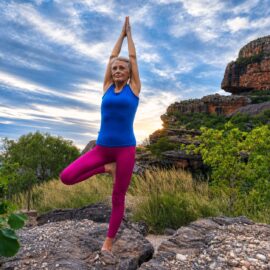
Stuart McGill in Tree Pose (Vrksasana). One-leg balance is first learnt at the wall, then away from it.
Is yoga safe with osteoporosis? The forward bending caution
Yes, when the poses are adapted. One movement needs real care: bending forward with a rounded spine.
A 2022 review for Osteoporosis Canada found very little research either way on yoga safety for people at risk of fracture. It did find two case series where vertebral fractures were linked to strong forward flexion (rounding) of the spine. The review’s advice was to avoid the end of the range in spinal bending, backbending and twisting.
What yoga poses to avoid with osteoporosis
- Rounded forward folds: touching the toes with a curved back, deep seated forward bends, child’s pose pushed hard.
- Curling up: sit-ups, rolling up from lying, rocking on the back.
- Strong twists taken to the end of your range, especially seated.
- Full shoulderstand and plough, which bend the neck and upper back strongly under body weight.
What to do instead
- Bend from the hips with a long spine, hands on a chair or the wall.
- Standing poses with a chair, block or wall for support.
- Gentle backbends with support, which work the muscles along the spine.

Bending forward from the hips with the hands on a chair keeps the spine long. This is the safe version of a forward bend for thin bones.
What about yin yoga for osteoporosis?
People often ask whether yin yoga (a style with long, passive floor holds) suits thin bones. Flametree does not teach yin, so we can only describe our own approach. The movement the safety review flagged is rounded forward bending. Iyengar classes include plenty of floor and restorative work, but with the spine kept long and supported, alongside standing poses that carry your weight.
What an Iyengar class does for thin bones
An Iyengar class puts standing, weight-bearing poses first, and adapts each one with props.
- Standing poses: Triangle, Warrior 2, Extended Side Angle and Half Moon carry your weight through the legs and hips, held long enough to work the muscles.
- Balance: Tree Pose and Half Moon, first at the wall or with a chair.
- Arms: supported arm balances and the hands on a chair or wall bring load through the wrists and shoulders, where fractures also happen.
- Posture: lifting the chest and lengthening the spine, which matters for posture and a rounded upper back.
- Precise set-up: the teacher checks your alignment so load goes where it should.

Extended Side Angle (Utthita Parsvakonasana). The bent front leg and straight back leg both carry weight.
Why do teachers fuss about the outer heel in Triangle Pose?
Because a pose is not something you hold like a photograph. It is something you keep doing, every second you are in it. Press the outer edge of the back heel down, and the work runs up through the ankle, shin, knee and thigh into the hip, so the leg wakes up and the spine gets longer.
Chris describes a pose as a set of muscles pulling in two directions at once, like the guy ropes on a tent. Bone is living tissue and it responds to the load it habitually receives, a principle first described by the German surgeon Julius Wolff in the 1890s. A pull of muscle on bone is that kind of load, and the precise set-up in an Iyengar class is there to send it where it is useful. Dr Fishman said in an interview that the alignment in Mr Iyengar’s method means “you can really try hard and not hurt yourself.”
Chris Lalor, in her own words, on learning to hold poses:
“When I first started yoga, I couldn’t hold poses for very long. I simply wasn’t strong enough. I also lacked the mental steadiness to stay in a pose, as well as to observe what was happening. With practise, and introductory beginner poses that build up over time, you come to change all these limits.”
Holding matters because muscles pull on bone while they work. Our post on yoga for strength and bone explains how, and can yoga build muscle? covers the muscle side.

Half Moon Pose (Ardha Chandrasana) with a chair. The chair lets you build balance and hip strength without fear of falling.

Reclining hand to big toe pose (Supta Padangusthasana) with a belt. The spine stays flat and supported while the legs work.
Yoga for osteoporosis and your wrists: why the arms need weight too
Wrists break too, not only hips. A white woman aged 50 has about a 15% chance of breaking a wrist in the rest of her life, according to a 1989 study in Archives of Internal Medicine. A wrist fracture can also be an early warning that bone density is falling. So a balanced practice of yoga for osteoporosis puts careful weight through the hands and arms, not only the legs.
Most of us strengthen the legs with standing poses, and do far less through the hands, because Downward-Facing Dog, Plank and Side Plank feel so much harder. That is the gap this section is about.
Chris’s first Downward-Facing Dog
Chris Lalor, Flametree’s founder, remembers it well:
“I still remember my first Downward-Facing Dog. I had never carried weight through my hands and wrists in that way, and my wrists certainly let me know it! When I began, even holding my arms out sideways felt almost unbearable. I could lift and carry things, but I had never strengthened my arms, shoulders and wrists step by step.”
“Yoga did not simply load my wrists. It taught me how to bear weight: how to spread my palms, press evenly through my hands, lift through my forearms, steady my shoulders and extend my trunk away from the floor. Most importantly, I learnt how to stay long enough to observe, adjust and improve. What once felt impossible became manageable. Then steady. Then strong.”
Our note on yoga for sore or weak wrists goes through the props in more detail.
None of this is a reason to force the body or push through pain. In the Iyengar method, strength is built in stages, with props, so the wrists have time to adapt.

Chris Lalor in Plank Pose. Arms straight, palms spread, body in one line: the whole arm and shoulder carry the load, not just the wrist.
How does weight through the hands help bone?
Bone is living tissue, and it responds to load. When bone carries weight, cells inside it sense the strain, and the body is signalled to keep or build strength there. Holding a pose adds a second signal, because working muscles pull on the bones they attach to.
Dr Loren Fishman, a rehabilitation doctor who studied with Mr BKS Iyengar, put it this way in a 2015 interview: “Yoga puts more pressure on bone than gravity does. By opposing one group of muscles against another, it stimulates osteocytes, the bone-making cells.”

A tall, steady seat is where most breathing practice begins.
How to build wrist strength safely, step by step
Start with less weight on the hands, and add it slowly. These are the stages an Iyengar teacher uses:
- Hands on the wall. Lean in, spread the palms and press evenly through the whole hand.
- Inclined Plank. Hands on a chair seat or a ledge, so only part of your weight is on the arms.
- Supported Downward-Facing Dog (Adho Mukha Svanasana), with the head resting on a block or bolster.
- Short holds, repeated, rather than one long hold that sinks into the wrists.
- A belt around the upper arms, which gives the arms something to push against and stops the elbows splaying.
- A chair version of Upward Plank (Purvottanasana), with the hands on the chair and the chest lifting.
The aim is not to punish the wrists. It is to teach them to bear weight, and to make the whole upper body more capable. As Mr Iyengar said, “Action is movement with intelligence.”
If you have osteoporosis or a past wrist fracture, tell your teacher before class so they can adapt the poses for you. Flametree teachers guide these stages in the studio and LIVE online.

Downward-Facing Dog (Adho Mukha Svanasana). The hands press evenly and the arms lift, so the weight travels up into the shoulders and legs.
How often, and how to start
In the Sydney pilot, people came twice a week for 12 weeks. The 2026 bone review found programmes of a year or more gave the steadiest results. So think of this as a habit, not a course.
- Bring your bone scan results if you have them, so your teacher knows where you stand.
- Tell your teacher before the first class.
- Start gently. Flametree’s Gentle Yoga class is the usual starting point.
- Come regularly, twice a week if you can, and practise a little at home.

A thin hip bone and a hip fracture. Balance and leg strength are the practical defence.
Yoga for osteoporosis in Darwin and live online
Flametree Yoga Studio teaches Iyengar yoga at Woolner and Coolalinga in Darwin and LIVE online across Australia. Classes are taught by Senior Iyengar Yoga Teacher and certified yoga therapist Christine (Chris) Lalor and the Flametree team. Gentle Yoga and Restorative Yoga suit most people with thin bones.
- New to Flametree? Your first class is free. In Darwin, just come along to the studio and check the beginner timetable. Online, go to our online class list, click the class time you want and we email you the link to join.
- Keep going at half price. New students, and anyone who has been away three months or more, can get a half price 10 class pass with 2 extra classes free, to use online, in the studio, or both. See the half price pass.
- Already practising yoga? The same half price 10 class pass for new students, and for anyone away three months or more, is also available as the non-beginner half price pass.
For the wider picture, see osteopenia, dowager’s hump, falls and yoga studies, yoga for seniors, yoga for posture, yoga for arthritis and the benefits of yoga page, which carries Dr Timothy McCall’s June 2019 list of 117 health conditions helped by yoga. Osteoporosis and fractures are on that list, which names conditions where at least one study found a benefit.
Read more in our free ebook, Strong Bones, Steady Feet. Stories, the research on balance, falls and bone, and how an Iyengar class loads the bones.
2 free classes + 2 ebooks, only available via this offer, for new students or anyone away 3 months or more. Current students can still get the book. See what’s inside and get your copy
Yoga for osteoporosis: frequently asked questions
What exercises should you avoid if you have osteoporosis?
The main one is bending forward with a rounded back, especially while holding weight. Sit-ups, toe-touches and deep seated forward folds all do this. Strong twists to the end of your range also need care. Bending from the hips with a long spine, often with a chair under the hands, is the safer version taught in an Iyengar class.
Is yoga a weight bearing exercise for osteoporosis?
Yes, for much of a class. Every standing pose carries your body weight through the legs, hips and spine, and poses on the hands add load through the wrists and arms. Your own body is the weight. It is not heavy lifting, but bone does respond to regular load.
Does yoga increase bone density?
The trials are mixed. A 2021 review of 11 studies in women aged 45 to 78 found no clear difference in bone density between yoga or Pilates and control groups, and a 2025 review of 18 trials called the bone results inconclusive. What yoga does reliably improve is balance and leg strength, which lower the chance of the fall that breaks a bone.
What yoga poses should you avoid with osteoporosis?
Deep forward folds where the back rounds, full seated twists, and anything that curls the spine while carrying weight, such as rolling up from lying. Full shoulderstand and plough also put strong bending on the neck and upper back. A teacher can give you a supported version of most other poses.
Can yoga reverse osteoporosis?
Yoga works on the parts you can change. It can build the muscle that pulls on bone, improve balance and confidence on your feet, and teach you to move without loading the spine in risky ways.
Is yoga safe if I already have a diagnosis?
Yes, with a teacher who knows what to change. Tell your teacher before class. At Flametree, Christine Lalor is a certified yoga therapist as well as a Senior Iyengar Yoga Teacher, and chairs, walls and blocks are used as a matter of course.
Is chair yoga good for osteoporosis?
It is a good start if standing is hard, and much better than nothing. But weight through the legs is the part that helps bone, so the aim is to use the chair as support in standing poses rather than only as a seat. That is how chairs are used in an Iyengar class.
How often should someone with osteoporosis exercise?
Twice a week is a good start. In the 2013 Sydney pilot, twice-weekly Iyengar yoga for 12 weeks improved balance and walking speed. A 2026 review found bone programmes of a year or more gave the most consistent results.
Can yoga strengthen weak wrists?
Yes, if the load is built up slowly. Start with your hands on a wall, then on a chair, then on the floor in supported Downward-Facing Dog, keeping the weight spread across the whole hand. This matters because the wrist is a common place to break a bone, as the section above explains.
How many Australians break a bone because of osteoporosis each year?
An estimated 193,482 fractures linked to osteopenia and osteoporosis happened in Australia in 2023, according to Healthy Bones Australia’s burden of disease report for 2023 to 2033. That is roughly one every 2.7 minutes. Balance and leg strength are the part you can train, and a good class works on both.
Where can I find yoga for osteoporosis near me in Darwin?
Flametree Yoga Studio teaches Iyengar yoga at Woolner and Coolalinga in Darwin and LIVE online. Gentle Yoga is a good place to start with osteoporosis, and your first class is free if you are new to Flametree.
Flametree Yoga Studio teaches Iyengar yoga in Darwin, at Woolner and Coolalinga, and LIVE online anywhere.
This article is general information, not medical advice. Feel free to check with your professional advisers if you wish, but also give yoga a try.
Last updated 14 October 2026: added the Triangle Pose heel story, the details of the 2016 bone density study, and a note from Stuart McGill.
Sources: Tiedemann A and colleagues, A 12-week Iyengar yoga program improved balance and mobility in older community-dwelling people: a pilot randomized controlled trial, Journals of Gerontology Series A, 2013, doi 10.1093/gerona/glt087. Loewenthal J and colleagues, Effects of yoga on frailty in older adults, Annals of Internal Medicine, 2023, doi 10.7326/M22-2553. Fernandez-Rodriguez R and colleagues, Pilates and yoga on bone mineral density in women, PLoS One, 2021, doi 10.1371/journal.pone.0251391. Xu H and colleagues, Effects of mind-body exercise on perimenopausal and postmenopausal women, Menopause, 2024, doi 10.1097/GME.0000000000002336. Bajaj P and colleagues, Effect of yoga on balance, falls, and bone metabolism, Osteoporosis International, 2025, doi 10.1007/s00198-024-07307-x. Effects of different types of exercise over 24 weeks on bone mineral density in postmenopausal women, Journal of Sport and Health Science, 2026, doi 10.1016/j.jshs.2026.101127. Kim KV and colleagues, Effect of yoga on health-related outcomes in people at risk of fractures, Applied Physiology, Nutrition, and Metabolism, 2022, doi 10.1139/apnm-2021-0736. Lu YH and colleagues (Fishman LM), Twelve-minute daily yoga regimen and osteoporotic bone loss (published title uses the word reverses; an uncontrolled volunteer study), Topics in Geriatric Rehabilitation, 2016, doi 10.1097/TGR.0000000000000085. McCall T, 117 Health Conditions Helped by Yoga, Yoga As Medicine, June 2019, DrMcCall.com. Cummings SR, Black DM and Rubin SM, Lifetime risks of hip, Colles’, or vertebral fracture and coronary heart disease among white postmenopausal women, Archives of Internal Medicine, 1989, doi 10.1001/archinte.1989.00390110045010. Fishman L, quoted in Feeling flexible? Benefits of yoga may go bone deep, AFP, December 2015. Healthy Bones Australia, Osteoporosis and fractures in Australia: a burden of disease analysis 2023 to 2033, launched October 2024 (launch page; the 193,482 figure as reported in Have a Go News, 10 October 2024). Yu K-Q and colleagues, Prevalence of osteosarcopenia in postmenopausal women: a systematic review and meta-analysis, Journal of Endocrinological Investigation, 2026, doi 10.1007/s40618-026-02900-9.



Great post. Very informative and encouraging. Don’t let the naysayers get away with nonsense. The biggest risk is not doing yoga especially as we age.