
Yoga Props: What To Buy, Make Or Improvise.
How To Improvise Props, & Cut Mat Slipperiness.
Plus how to set up a yoga space at home for better online yoga.
New or 3 months lapsed? Get 50% OFF 10 or 20 packs, & 2 classes FREE.
Yoga prop pack deals with or without HALF price yoga class packs.
In short: at home you need a non-slip mat and a yoga block. A belt, two blankets and a kitchen chair are the next props to add, and you can improvise most of them from things around the house. At a Flametree studio in Darwin, all mats and props are supplied free.
Last updated: 25 October 2026
Yoga props, including restorative yoga props, and other yoga accessories, help you do a pose correctly, so you get even more of the benefit of getting into that particular yoga shape. Here’s some yoga props Australia thinking and research for Iyengar yoga with props.
Quick start guide about what props to have for class
If you’re at one of our Flametree studios (Woolner or Coolalinga), all mats and props are provided.
If you’re online, or using a Flametree yoga video, try to have a non-slip surface, or a mat. In addition, it’s ideal have these items:
- a folded towel for your head,
- a firm pillow,
- a kitchen chair, and
- one or two folded blankets.
Just wear comfortable clothes, and have bare feet (for better grip).
Read on to see more about props, and how to improvise them, or find them.
Also see Flametree’s prop and yoga class deals.
Video on using chair yoga props
The video on this page is one tiny example of how a chair prop is used in easy Beginner yoga. Any chair, such as a kitchen table chair will work.
The only advantage of using a backless chair, like to see in the video, is that you can sit with your legs through it, for poses like twists, or backbends.
Below, see our yoga props Australia research to find the best prop options for you.
Using yoga props or yoga accessories is smart, not wussy!
If you are not in the right shape for a pose, you do not get the full benefit of it. Follow our hints and you’ll soon be doing powerful Iyengar yoga with props, or without props (as appropriate). For a guide to each prop, see our Iyengar yoga props notes.
Props also help you learn a pose.
The more props that students have at home, the more interesting, varied and useful our online or on-demand yoga video classes can be.
Plus, you can do extra practice, or de-stress with restorative yoga.
The use of props is not an indicator of whether you can or can’t do yoga, or about having the “toughness” or stamina to do without them. As you can’t see yourself doing yoga, you’ll usually fail to see that the use of a prop would more effectively let you do the pose.
For example, Mr BKS Iyengar was one of the most accomplished yoga masters of the 20th century. But even he recognised the power of props, and he invented many of them. That’s why people Iyengar yoga with props has become so popular.
For online yoga, you need to check what you can get in your local area, and we’ll talk about some of the options below.
If you are coming to Flametree’s in-studio classes, all equipment and props are supplied. You just need to wear comfortable clothes, that allow easy movement. You don’t have to have your own props.
But props are useful if you’ll be doing at least some yoga at home, such as via Flametree’s 50% OFF new & lapsed deals (beginner or non-beginner), or yoga videos.
The minimum of props is a mat and block
For beginner yoga (except Restorative Yoga), the minimum that you need at home is a mat and a yoga block (which is about the same size as a building brick).
However, if you can get or improvise (or buy) at least some of the yoga props we mention below for non-beginner use, then the better your home classes can be.
In this regard, Flametree’s prop packs are selected to give you the minimum props you need, just by the time you need them.
Restorative yoga props, for beginner or non-beginner classes, are discussed in the next section.
With yoga props, although you can economise and improvise, the more props you have, the better it will work.
So, especially if you can’t attend our studio where props are supplied, we suggest you get a mat, block, yoga belt, blankets, and yoga chair.
Then you’ll be on the fast track of doing Iyengar yoga poses with props.
New or 3 months lapsed? Get 50% OFF 10 or 20 packs, & 2 classes FREE.
Yoga prop pack deals with or without HALF price yoga class packs.
Props for restorative yoga
A bolster or barrel can also be used for gentle rolling pressure, see how to break up fascia with yoga.
Restorative yoga uses the most props. As we said, if you are in the Flametree studio, all props are supplied.
However, if you are doing online restorative yoga, or using it in home practice to sleep better, manage anxiety, de-stress, and more, then here is the minimum that you need.
- 1-2 kitchen chairs (or the specialised yoga chairs, or “Bunnings chairs” (see below), that are easy to sit on with your legs through, subject to your size)
- 2-3 blankets (or a mix of blankets and thick beach towels)
- a cushion or yoga bolster (less necessary if you have 3 blankets, and for many poses blankets can even work better)
- 1-2 blocks ideally (or a pile of books of an appropriate size).
- Some sort of belt, preferably made of webbing or thick cloth (and around 2 metres long)
- at least a moderate quality mat. (Be wary of the very spongy EVA mats).
In particular, note that you can acquire your props in stages, as your yoga skills develop.
We call it “just in time” props! Initially, the most useful props to have are just mat and belt, plus a couple of foam blocks. See Flametree’s basic yoga prop pack.
In this initial stage, you can combine the basics with blankets, thick towels, and chairs you’ll probably have around home.
But, as your skills and poses develeop, you may want to also get a pack of blankets, shoulderstand pads, yoga sandbags for weights, and an eye pillow to block out light.
Improvising props from around your home
As we said, many of these props can be improvised from around your house, including kitchen chairs, blankets, a stack of books and a firm pillow or cushions.
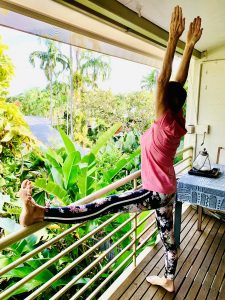
If you’re at home, you can also use benches, table tops and railings for support, like Chris Lalor, the Senior Yoga Teacher at Flametree Yoga, is demonstrating.
Here a few suggestions on finding the right props for you.
Low cost yoga chairs
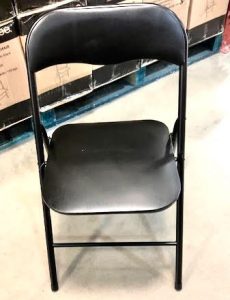
The chair in the picture is a low cost chair from Bunnings. It is lightweight, has a small back, and won’t fit everyone. But it is quite useful as a yoga chair.
If you have not seen a chair used for yoga, have a look at some of the pictures on our Facebook page.
As you know, most people in Australia at least, can find a Bunnings! We have also seen these chairs used by our international students.
Combine them with the prop packs we’ve deloped for your sequential learning.
Iyengar yoga with props
How yoga props developed, & why
The sophisticated use of yoga props was invented and greatly developed by Indian yoga maestro, Mr BKS Iyengar. He used props to work with his own physical and mental conditions.
In our post, see more on this yoga prop history.
Mr Iyengar says: “The prop is not a crutch, it’s a teacher.” See more from him about prop in this post.
In other prop posts, we’ve also outlined how even a yoga belt “moves the focus from the external shape to the internal action, transforming movement into conscious action and leading to true self-awareness”.
Props can also help you get the calmness of a chin lock, or the power and soothing of a correctly executed shoulderstand.
Blankets and Blocks
Blankets can often be found at a camping store.
If you don’t have blocks, and you have access to handy-person skills, you can also try sawing and sanding some timber that you can also buy at suppliers like Bunnings. Wood is firmer than the standard foam blocks, which some people prefer.
Get at least a moderate quality mat!
As you know, mats are quite widely sold.
But many are very low quality, spongy material that also does not lie flat easily.
With a mat, an important issue is how slippery it is or is not. (We have found the very cheapest mats are mostly unable to be safely used, due to their slipperiness).
Sometimes, it helps to wash a new mat in your washing machine, with just a sprinkle of washing powder. That will get rid of much of the slip.
Another good option is just to lay out the mat in your home for a week or two. Put it in a corridor where you’ll walk on it regularly. This alone will greatly reduce the slip.
We like to think of this as yoga props Australia thinking! We’ve specialised in Iyengar yoga poses with props, so ask us anything you are unsure about.
How to set up yoga accessories in your own space for online or home yoga
Over time, especially if doing regular online yoga, it’s best to set up your own space for regular yoga, especially with restorative yoga props. Do it with whatever yoga accessories you make or buy.
Even if you do some classes at the Flametree’s various physical locations, it’s worth having a space at home too. Sometimes it’s obviously just not possible to get to the studio.
First, if possible, have a space where you have all your props handy, and can minimise interruptions!
Second, if you’re using Flametree’s online classes, or yoga video classes, have as big a screen as you can see the teacher clearly. One good option is to plug your phone or iPad to a TV screen.
If you want guidance from Flametree’s yoga teacher, position the camera on your phone or computer so the teacher can see you clearly.
Another bonus of having a space set up is that you can use it at night, especially if it has restorative yoga props.
Flametree’s students sometimes do poses like “Legs Up The Wall” to help with sleep. It’s helpful if the bolster and mat is all set up. (See more about yoga poses for better sleep.) Legs Up The Wall pose is a favourite for those who love Iyengar yoga poses with props.

A TV connected to a PC, for online yoga
New or 3 months lapsed? Get 50% OFF 10 or 20 packs, & 2 classes FREE.
Yoga prop pack deals with or without HALF price yoga class packs.
Yoga accessories for pranayama (or breath meditation)
If you’re coming to our online pranayama classes, (or otherwise just doing it at home), here’s the props or yoga accessories you should have handy. (If you’re coming to the studio, all props are supplied).
For those relatively new to pranayama, we do lying down pranayama. The chest is lifted and extended by the 3 folded blankets you can see below.
There are also blog posts that explain how to use yoga accessories like pranayama sticks or belts for sitting straight.

To take strain off your back, and make it comfortable, it is also good to have a bolster (or firm, longish cushions), under the knees… like me, Chris, in the picture. The props can also be used as a restorative yoga props setup.
Iyengar yoga with props

Please also have a chair handy. Preferably make it a simple chair that you can put a belt through, like in the picture. This make is easier to sit upright for a longer period than otherwise.

A long, fabric belt is also useful… both for the chair, or the knees.
Last, you can use the belt, or eye pad, to give you some extra quietness of the mind. (Here’s more about how and why pranayama works.)
New / lapsed? Try 10 Pranayama meditation classes at 50% OFF.
Yoga props Australia: what to get first
Yoga props in Australia can be bought online or in shops, or improvised from things around your home. To start, you need a non-slip mat and a yoga block. Then add a belt, two blankets and a kitchen chair.
At a Flametree studio in Darwin, all mats and props are supplied free. For online classes at home, the prop pack deals on this page save you buying them one by one.
Questions about yoga props
What is the minimum yoga props to have at home?
A non-slip mat and one yoga block is the minimum for beginner yoga. Next add a belt, two folded blankets and a kitchen chair. For restorative yoga you need more: blankets, a bolster or firm cushion, and a second block. You can add props in stages as your practice grows.
What can I use instead of a yoga block?
A thick, firm book or a stack of books of the right size works well. Some people saw and sand a piece of timber from a hardware store, which is firmer than foam. Pick something stable that will not slide or squash when you put weight on it.
What can I use instead of a yoga bolster?
Fold two or three blankets into a long firm roll, or use a firm, longish cushion. For many restorative poses, blankets work even better than a bolster, because you can change the height by adding or removing a fold.
How do I stop my yoga mat slipping?
Wash a new mat in the washing machine with just a sprinkle of washing powder, which removes much of the slip. You can also lay the mat in a hallway for a week or two and walk on it. Very cheap, spongy mats are often too slippery to use safely.
What kind of chair can I use for yoga?
Any sturdy kitchen chair will do. A backless chair lets you sit with your legs through it for twists and backbends, but it is not needed. A lightweight chair with a small back from a hardware store also works, though it will not suit everyone.
Are yoga props cheating?
No. Props help you learn a pose and do it correctly. B.K.S. Iyengar invented many of them and said the prop is not a crutch, it is a teacher. Because you cannot see yourself, a prop often shows you what the pose needs.
What props do I need for restorative yoga?
Aim for one or two chairs, two or three blankets, a bolster or firm cushion, one or two blocks, and a belt about two metres long. Add a moderate quality mat. At a Flametree studio, all of these are supplied for you.
How do I set up a yoga space at home for online classes?
Keep your props close, in a spot with few interruptions. Use the biggest screen you have, such as a phone or iPad cast to a TV. Place your camera so the teacher can see you clearly, because your teacher can then guide you in your LIVE online class.
Accessing our yoga props Australia research
If you have questions or comments, or have good tips about buying or making yoga props, please contact Senior Yoga Teacher Chris Lalor via message through our Facebook Page, or +61 448 11 22 51 or +61 468 362 641, or [email protected].
You can also reach out to our Customer Service Team. See the links in the bottom right of this page.
See also our props pack or our prop and half price classes deal.
We’ll also be adding more prop pack deals soon.
Buy a pass, & then reserve a class (& use yoga props if you like)
To find the best value yoga pass for you, use the links on this page. Alternatively, check out these other popular yoga passes.
If attending classes at any of the locations on our beginner or non-beginner timetable, just come along. No need to reserve a spot.
You can buy passes online at this site (including via links on this page), or at class.
If attending online, make a reservation, for the class you want, and an invite the Zoom class will be emailed to you.
The links to reserve classes will be on your receipt.
Flametree’s beginner and non-beginner classes include a wide range of optional classes. They include restorative yoga, women only yoga, back care yoga, gentle yoga, and 50 plus yoga. Here at links to all Flametree classes.
Alternatively, see class types, and locations, via the beginner timetable, or non-beginner timetable.
Learn more about the options, or buy the deals at the links below. Get started or re-started with Iyengar yoga poses with props.
New or 3 months lapsed? Get 50% OFF 10 or 20 packs, & 2 classes FREE.
Yoga prop pack deals with or without HALF price yoga class packs.

Iyengar yoga poses with props. Yoga accessories help you get all the benefits of yoga, no matter what level of skills you have. Use our yoga props Australia research to find the best prop options for you.
