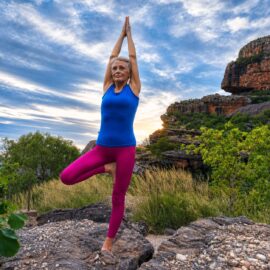
Is Iyengar yoga good for weight loss?
Also, is pranayama good for weight loss?
Is Iyengar yoga good for weight loss? It is one of the questions people ask us most at Flametree, along with whether pranayama (yoga breathing) helps. This page gives a straight answer, says what the research found, and explains why teachers point to stress and mindful eating rather than to calories burned. It also covers the Iyengar yoga poses taught for stress, and why restorative yoga comes up so often in this conversation.
Iyengar yoga is the style developed by Mr BKS Iyengar. In the 20th century he did more than anyone to set down traditional Indian yoga, through his books and his teaching, and he pioneered the use of props. It is sometimes called modern classical yoga, and it’s the style we teach at Flametree. This page sits in our food and habits notes.
Weight is a sensitive subject, with real concerns about body image and eating disorders. If that is you, please talk to your doctor or another health professional first, and feel free to skip this page. Yoga here is described as a practice, not a treatment, and nobody should start a weight plan without their doctor if they have a health condition.
Summary: “Is Iyengar yoga good for weight loss?”
Possibly a little, and mostly in indirect ways. A 2016 review of 30 trials found no overall effect on weight, but did find lower body mass index in people who were overweight or obese. Teachers also point to less stress and more mindful eating, which are still being studied, and to the activity itself.
Summary: “Is pranayama good for weight loss?”
It is taught for stress and attention, not as a weight method. We have not cited any trial of pranayama alone and weight on this page, so treat it as a calming practice that sits alongside the rest.
Below, you can see the research, the explanations teachers give, and the poses.

Bee Breathing (Bhramari), a pranayama practice that uses a hand mudra to close the ears and eyes. It can also be done in a chair. It is taught for calming, not as a weight method.
What research says about yoga and weight
The short answer: the best review we found reported no overall effect on weight, with a smaller effect on BMI in people who were overweight or obese. Here is what it found, so you can judge for yourself.
- 2016 review, Preventive Medicine: 30 randomised trials with 2,173 people in total. Across all the trials, the authors found no effect of yoga on weight, body mass index, body fat percentage or waist circumference.
- Split by group: in studies of healthy adults, yoga was linked with a lower waist to hip ratio compared with usual care. In studies of people who were overweight or obese, yoga was linked with a lower body mass index compared with usual care.
- The caution: the authors said the effects were not robust against selection bias, and publication bias could not be ruled out. No adverse events were reported. They concluded that, despite those drawbacks, yoga can preliminarily be considered a safe and effective way to reduce BMI in overweight or obese people.
So the honest answer is “modest and variable”, and nobody can promise a change on the scales. That fits what Dr Timothy McCall, a medical doctor and the author of Yoga as Medicine, says in a talk on yoga and weight loss. He says a tough yoga class burns a fair number of calories, but nothing like the aerobic workout of running or swimming. He points to other reasons yoga may help, covered next. These are his explanations, and they are still being studied.
Straight answers from a Senior Teacher
Christine Lalor is Flametree’s accredited Senior Yoga Teacher and Yoga Therapist, and these are the points she gets asked about. The three ways teachers say yoga may help are below. None of them is a promise.
First, a note on the 2016 review: it supports the “may help a little” reading, not a bigger claim. Second, the explanations below are the reasons teachers give, not results from trials of yoga poses. And third, anyone with a health condition, or who worries about food or weight, should speak to their doctor.

A basic restorative pose, demonstrated by Chris Lalor, a certified Senior Yoga Teacher and Yoga Therapist.
Iyengar yoga poses taught for stress and weight
Many articles on yoga for weight loss list hot, fast or very hard poses. That is one choice of yoga, but it is not the only one, and many people find those poses too difficult. In Iyengar yoga, the poses most often linked with the weight conversation are restorative: supported forward bends, legs up the wall and supported bridge pose, held for several minutes with props. They can be done by people of all ages and sizes, and your teacher can adjust them for you.
For how these poses are set up, see our notes on legs up the wall and Savasana, and our page on restorative yoga.

Triangle pose lengthens both sides of the body.
Why teachers link yoga to weight: three ideas
- Less stress. Dr McCall says yoga relieves stress by lowering the stress hormone cortisol, and that this in turn lowers appetite. He also says that eating extra calories while cortisol is high makes it easier for the body to store them as fat around the organs of the abdomen. The Harvard Medical School Guide to Yoga makes a similar case that chronic stress and cortisol matter more than calories burned in class. This is the explanation teachers give. The chain from poses to cortisol to appetite to weight is an explanation, and each step is still being studied.
- More mindful eating. McCall says mindfulness may be an even bigger factor than cortisol. When you really pay attention as you eat, you may notice the subtle cues that you are getting full, and if you are distracted by television or a screen, you may not notice them. In yoga teaching, noticing is the skill, and eating is one place to use it. This is described as a teaching idea. See our page on mindful eating.
- Movement. All yoga is activity, and some sequences with more flowing, standing poses ask more of you than others. How much it adds up to depends on the style, how often and how long you practise.
McCall also mentions a survey of women over 45 who practised yoga. In that study (Moliver and colleagues, International Journal of Yoga, 2011, 211 women aged 45 to 80), the more yoga experience they had, the lower their BMI and the fewer medicines they used. That kind of study shows a link, not that yoga caused it, because people who practise more may also differ in other ways.

Mindful eating is a skill taught alongside yoga: noticing what you eat and how often. It is one of the ideas teachers link to weight.
How stress and cortisol are explained
In the diagram below, see how stress releases cortisol. Cortisol is sometimes useful, but long term it has downsides.

Stress releases more cortisol into the bloodstream, via the green arrow above. Dr McCall explains this connection in the talk we link to below. The stress response is useful if you have to escape danger quickly, but it’s not a place to live most of the time. You need a time and place to rest and recover.
Your nervous system and body, mind and mood
Yoga and pranayama are taught to work with the parasympathetic nervous system (the rest-and-digest side), including the vagus nerve. That is why they are described as a wide system for body, mind, mood and emotions. Those effects are still being studied, and they are not weight results. For more, see how to calm your nervous system and yoga for sleep.

Yoga works with both your sympathetic and parasympathetic nervous systems. Restorative poses and slow breathing are taught to bring in the parasympathetic side.
Slow, small steps
McCall’s advice is to take a slow, easy approach and not to chase fast loss. He says losing weight very fast tends not to be sustainable, and that extreme diets can add stress. In his words, it’s really just about small steps in the right direction every day. That is a teaching view, not a trial result, and it matches how a regular yoga habit tends to build. Stuart’s own account of a daily practice is in our daily yoga habit note, and the fasting and mindful eating angles are in yoga and intermittent fasting and mindful eating.
Is pranayama good for weight loss? It is taught for stress, not as a weight method.
Stuart’s own experience
This is one person’s account, not a method and not a promise. Stuart, who runs Flametree with Chris, says his weight and waist have stayed about where they were at 18. He puts it down to three things: paying attention to sugar (he reads labels), paying attention to portion sizes, and moving on most days, which for him means yoga classes and home practice, or a walk on other days. He adds that regular backbends keep his mood positive, and that low mood is an easy way to put on weight for some people. He also says he has not always been this way and can put weight on easily. Everyone’s body, history and health are different, so please see this as one story only.
What other students say
If you would like to hear from other students, see what other Flametree students have said about the classes.
What to take from this
The research gives a modest, variable picture. The reasons teachers give are less stress, more mindful eating and regular activity, and any yoga or pranayama only helps if you keep at it. If you have a health condition, or any worry about food, weight or body image, talk to your doctor first and tell your teacher.

The vagus nerve connects brain and body. Restorative yoga is taught to slow the heart rate and breathing, and to relax you.
Flametree Yoga Studio
Flametree classes are LIVE online at the local time of Darwin, Australia, and in the studio at Woolner and Coolalinga. The classes are standard hatha yoga poses in the Iyengar yoga style. The online format also gives you a wider range of classes than are often available locally.
There are also options, including Gentle Yoga, Yoga for Back (& Neck & Shoulders), and Restorative Yoga.

An easy restorative or conventional pose to build hip flexibility.
Try Iyengar yoga
Flametree beginner yoga can be started at any time, online or in the studio, at beginner or non-beginner level. Consider restorative yoga, or gentle yoga, or both. For related notes see what is pranayama, yoga for mood and the benefits of yoga.
Yoga and weight: common questions
Is Iyengar yoga good for weight loss?
Possibly a little, and mostly in indirect ways. A 2016 review of 30 trials found no overall effect on weight, BMI, body fat or waist, but did find lower BMI in people who were overweight or obese. The authors said those effects were not robust and that bias could not be ruled out.
Teachers point to less stress, more mindful eating and regular activity as the likely reasons. Talk to your doctor if weight is a health concern.
Is pranayama good for weight loss?
Pranayama is taught for calming and attention, not as a weight method. We have not cited any trial of pranayama alone and weight, so we do not claim a result.
Slow breathing practice may help with stress, and stress is one of the things teachers link to eating habits. That link is still being studied.
Which Iyengar yoga poses are best for weight loss?
No pose has been shown to reduce weight. The poses most often discussed in this conversation are restorative: supported forward bends, legs up the wall and supported bridge pose, held for several minutes with props.
They are taught for easing stress, and they can be done by people of all ages and sizes. Your teacher can adjust them for you.
Does yoga burn calories?
Yes, some. Dr Timothy McCall says a tough yoga class burns a fair number of calories, but nothing like running or swimming. How much depends on the style, how often and how long you practise.
That is why teachers talk about stress and mindful eating as well as activity.
Does stress make it harder to manage weight?
Dr McCall and the Harvard Medical School Guide to Yoga both describe a link between chronic stress, the hormone cortisol and appetite. This is an explanation teachers give, and trials of yoga have not tested each step of it.
If stress is a big part of your life, restorative yoga and slow breathing are taught for easing it. They sit alongside, not in place of, advice from your doctor.
What is mindful eating, and how does yoga relate?
Mindful eating means paying attention as you eat, so you can notice cues such as feeling full. Dr McCall says mindfulness may be an even bigger factor than cortisol. In yoga, noticing is the skill that gets practised, and eating is one place to use it.
Our page on mindful eating goes deeper.
How quickly should I expect a change?
Slowly, if at all. Dr McCall suggests small steps each day and warns that fast loss tends not to be sustainable. The 2016 review found modest and variable effects, so no one can promise a change.
Keep your doctor involved if weight is a health matter for you.
Is this suitable if I worry about body image or have had an eating disorder?
Please talk to your doctor or another health professional first. The Harvard Medical School Guide to Yoga itself says people who struggle with body image or eating disorders should move away from a focus on weight, and that yoga is meant to help body and mind connect in an accepting way.
Tell your teacher too, so they can adjust how class is run for you.
Can heavier people do yoga?
Yes. Restorative poses with props are taught to people of all ages and sizes, and your teacher can adjust any pose for you. Tell your teacher before class about any health condition.
Where can I learn this properly in Darwin?
Flametree teaches Iyengar yoga in the studio at Woolner and Coolalinga in Darwin, and LIVE online. Your first class is free if you are new to Flametree: in the studio, if you have lived in the NT for three months or more, and online, for anyone new. The beginner timetable shows every class time.

Half moon builds balance, leg strength and trust.
Practise this at Flametree
Flametree Yoga Studio teaches Iyengar yoga in the studio at Woolner and Coolalinga in Darwin, and LIVE online.
- New to Flametree? Your first class is free. In the studio, just come along. Online, go to our online class list, click the class time you want and we email you the link to join.
- Beginners: new students, and anyone who has been away three months or more, can get a half price 10 class pass with 2 extra classes free, to use online, in the studio, or both. See the beginner half price pass.
- Already practising yoga? The same half price 10 class pass with 2 extra classes free, for new students and for anyone away three months or more, is also available as the non-beginner half price pass.
- See every class time, including online classes, on the timetable.
Can’t make a class? Practise at home with our video courses.
This article is general information, not medical advice. If you have a health condition, or any worry about food, weight or body image, please see your doctor first and tell your teacher before class. Flametree Yoga Studio, Darwin and live online.
Sources: Lauche R and colleagues, A systematic review and meta-analysis on the effects of yoga on weight-related outcomes, Preventive Medicine, 2016, 87:213-232, doi 10.1016/j.ypmed.2016.03.013. McCall T, Yoga and Weight Loss: The Science and the Myths (talk), and Yoga As Medicine. Harvard Medical School Guide to Yoga, Harvard Health Publishing. Moliver N and colleagues, Increased Hatha yoga experience predicts lower body mass index and reduced medication use in women over 45 years, International Journal of Yoga, 2011, doi 10.4103/0973-6131.85490.