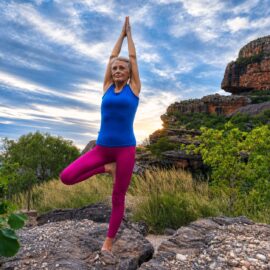
Nadi Shodhana Benefits: How To Do Alternate Nostril Breathing
What is nadi shodhana? The short answer
The first time Chris Lalor practised nadi shodhana, she was genuinely astounded. Within a short time her mind went quiet in a way she had never known, as if she had stepped through a doorway into a different inner landscape. Nadi shodhana is alternate nostril breathing: a slow, gentle yoga breath (pranayama) where you use your fingers to breathe in and out through one nostril at a time, taking turns. In Sanskrit, nadi means channel and shodhana means cleansing, so the name means “cleansing the channels”. It is also called anulom vilom in India, though some teachers treat that as a slightly different version.
The main benefits people notice are a calmer, clearer mind, better focus, and easier sleep. Research has also found that alternate nostril breathing can lower blood pressure a little, though the studies are mostly small. Flametree Yoga Studio in Darwin teaches nadi shodhana in its pranayama classes, in the studio and LIVE online. Your first class is free if you are new to Flametree.
Iyengar yoga is the style developed by Mr BKS Iyengar. In the 20th century he did more than anyone to set down traditional Indian yoga, through his books and his teaching, and he pioneered the use of props. It is sometimes called modern classical yoga, and it’s the style we teach at Flametree. This page sits in our breath and pranayama notes.
Nadi shodhana in short form
- What it is: breathing through one nostril at a time, guided by the fingers.
- Benefits: calm, focus and sleep (known from practice), and a small drop in blood pressure (supported by research).
- How to do it: eleven simple steps, below, with the Iyengar finger position.
- The first-time lesson: use a light touch, a quiet breath and less force.
- Who should take care: skip the breath holding if you are pregnant or have high blood pressure or a heart condition.
- Where to learn: Darwin or LIVE online, step by step with a certified Iyengar teacher.
- Next step: your first class is free if you are new to Flametree.
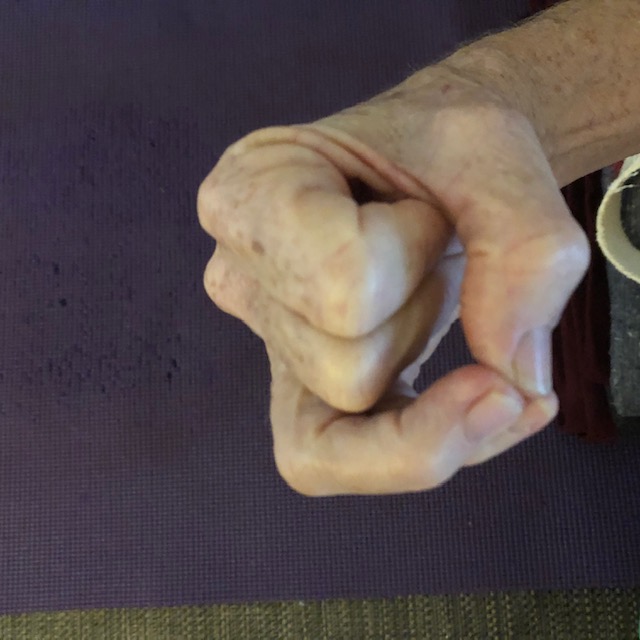
The Iyengar hand position for nadi shodhana: gentle pressure from the thumb on one side, and the ring and little fingers on the other, opens and narrows each nostril. The index and middle fingers are folded in. Other traditions use a slightly different hand position.
How alternate nostril breathing works
Each nostril is a separate pathway. By narrowing one side with the fingers and breathing through the other, the breath becomes slower, finer and more even than normal breathing. Nadi shodhana is a “digital” pranayama, which simply means it uses the fingers (digits).
What the yoga tradition teaches. Yoga tradition links the right nostril with heating, active energy (Pingala) and the left with cooling, calming energy (Ida). Nadi shodhana balances the two, so that neither side is dominant, and draws awareness towards the central channel (Sushumna), which the tradition associates with clarity and meditation. The tradition also teaches that it cleanses the energy channels (nadis) of the body. These ideas are known from long practice and have not yet been tested by modern research.
What students notice. Because the fingers, the nostrils and the count all need attention, nadi shodhana keeps the “monkey mind” busy. Many students tell us that if they start feeling scattered, a few rounds leave them settled and calm. It is a form of mindfulness you do with your hands and breath, rather than by trying to sit still and think of nothing.
If your nose is often blocked and you tend to breathe through your mouth, start with our note on how to stop mouth breathing.

Slow breathing is linked with the parasympathetic nervous system, which is the “rest and digest” mode of the body.
Nadi shodhana benefits
What research has found so far
- Blood pressure. A 2024 review of alternate nostril breathing found it lowered blood pressure compared with no practice (about 7 points systolic and 5 points diastolic, across 6 trials). The authors warned that the trials varied a lot and were mostly not blinded, so better studies are needed. (Nam and others, Complementary Medicine Research, 2024, read the review.)
- Heart rate. A 2023 review of breathing exercises, including alternate nostril breathing, Bhramari and slow breathing, found modest drops in blood pressure and heart rate compared with control groups. (Garg and others, International Journal of Cardiology: Cardiovascular Risk and Prevention, 2023, read the review.)
- Still being studied. The same 2024 review reports early findings on fatigue and memory. These are promising but not yet firm.
For more on breathing and blood pressure, see how to lower blood pressure. Breath practice is a helper alongside medical care, not a replacement for it.
What practice already knows
Students commonly tell us nadi shodhana brings calm, clearer thinking, better focus and easier sleep, and that it helps them manage a quick temper and feelings of anxiousness. The benefits often come quickly and are easy to notice. Yoga tradition has taught these effects for centuries, well before modern research began to test them.

Benefits students report from breath meditation at Flametree: calm, energy, mood, focus and sleep.
The benefits listed here are only part of the story. Flametree has written more on the benefits of pranayama in what is pranayama, Bhramari pranayama benefits and the wonders of pranayama. See also our benefits of yoga page.
What is it like the first time?
Mr BKS Iyengar, in Light on Pranayama (1981), treats nadi shodhana as one of the most refined breath practices, to be approached slowly. It is not a practice to rush. It teaches you to listen.
Chris Lalor’s first go was not a smooth one in one way. She tried far too hard and pressed her nostril too firmly. The lesson was to soften: a lighter touch, a quieter breath, less force, more listening.
In Iyengar yoga, nadi shodhana is taught step by step, usually after students have gained experience in Ujjayi (ocean breath) and Viloma (staircase breath), so the breath already has some steadiness and sensitivity. It is best learnt slowly and methodically with a qualified Iyengar yoga teacher, especially as the practice becomes more refined.

A tall, easy seat is where breathing practice begins.
Sit straight, on a chair or cross legged
Your spine needs to be upright and your chest free to expand. You can sit upright on a chair, or cross legged on a folded blanket. Either way, do not lean back against anything that stops your chest from opening. If sitting cross legged is hard for you, use a chair: you get the benefits of nadi shodhana either way.
Start with a few rounds and build up over time.

Alternate nostril breathing demonstrated by Christine Lalor, Senior Iyengar Yoga Teacher and yoga therapist, using the Iyengar hand position shown above.
How to do nadi shodhana pranayama, step by step
- Sit in a comfortable upright position with the spine straight. Apply the chin lock (jalandhara bandha, lowering the chin gently toward the chest). Sit on a chair with a straight back, or cross legged on a folded blanket.
- Bring the right hand up. Place the tip of the right thumb in the hollow just below the bone of the right nostril, and the ring and little fingers in the same place on the left nostril. See the finger clasp picture above.
- Partially block both nostrils.
- Breathe in and out through both partly narrowed nostrils for a few rounds.
- Block the left nostril completely.
- Narrow the right nostril and breathe out through the right.
- Then breathe in slowly and steadily through the partly narrowed right nostril.
- When the lungs are full, block the right nostril.
- Pause for a very short moment, only as long as is comfortable (skip this if you are pregnant or have high blood pressure or a heart condition).
- Partly open the left nostril and breathe out slowly through it.
- Breathe in through the left, block it, and breathe out through the right.
That is one round. Repeat the same pattern.
Chris teaches an easy way in. First, narrow both nostrils slightly and breathe slowly through both, with a full, quiet, unforced breath, for about five minutes, then rest in Savasana. Then move to the alternating pattern, beginning with about five rounds and returning to normal breathing. Over time the number of rounds may gradually increase. Keep the touch of the fingers light, and finish quietly with a rest in Savasana.
Nadi shodhana can be practised early in the morning or at night. At night, practise gently and without strain: in the tradition it is a settling practice that steadies the breath and prepares the mind for sleep. For which breaths suit the evening, see what is pranayama.

Triangle pose lengthens both sides of the body.
Finer points for getting the benefits
- The left hand is not used. Rest it in your lap or by your side.
- The index and middle fingers are folded in, not used.
- A short pause at key points is optional. It is not the main part of the practice.
- Find a rhythm that is comfortable and doable for you. You will get better at alternating quickly.
- While learning, lower your hand and rest between rounds.
- Once you are comfortable, do several minutes, pause, then do a few more rounds.
- With practice you will refine the pressure of the fingers and the narrowing of the nostrils.
- Keep your fingernails trimmed.
- Practise on an empty stomach, and lie down in Savasana (relaxation pose) afterwards.
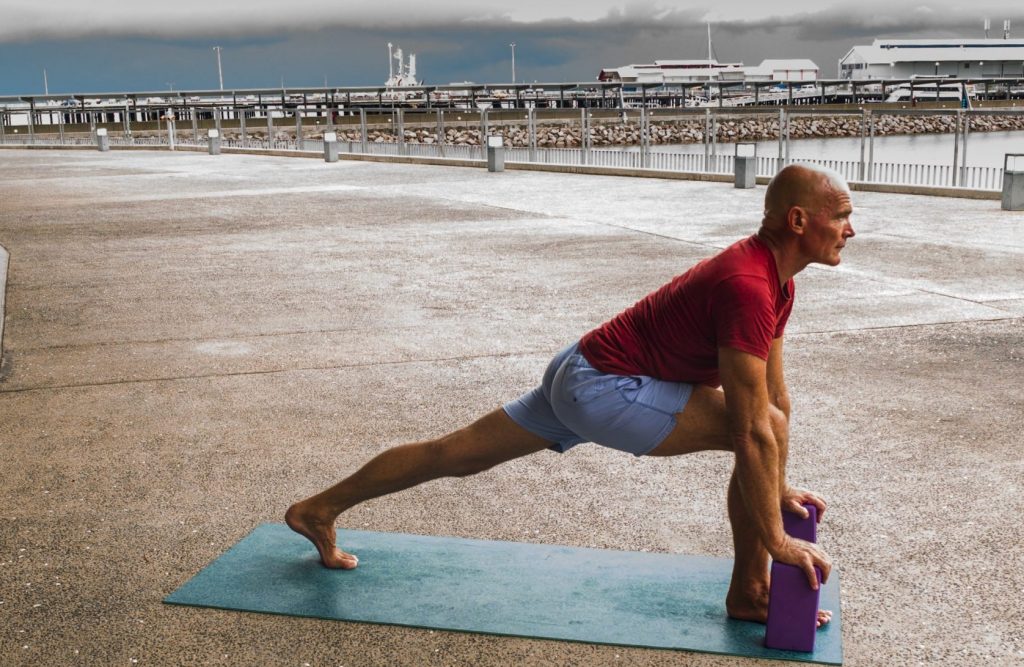
A steady lunge builds strong, willing legs.
Mr BKS Iyengar and regular pranayama practice
Mr BKS Iyengar, the founder of Iyengar yoga, wrote a whole book on breath practice, Light on Pranayama, as well as a book on the Yoga Sutras of Patanjali. He taught that, for most people, normal breathing is too shallow, and he used yoga poses to open the chest first. He also taught that pranayama is learnt in stages, starting lying down, then sitting, and always finishing with a rest in Savasana. His daughter, Geeta Iyengar, taught Iyengar teachers and students for decades.
At Flametree, nadi shodhana is taught step by step, usually after simpler breaths such as Ujjayi (ocean breath) and Viloma (breathing in stages). See the wonders of pranayama and how breath meditation works.
Where to learn nadi shodhana in Darwin or online
Flametree teaches pranayama classes in the studio at Woolner and Coolalinga in Darwin, and LIVE online. Nadi shodhana is taught regularly, along with other breath techniques, and the timetable shows the class times in your own time zone. Our breathwork classes and meditation classes in Darwin are also open to you.
The classes are taught by Christine (Chris) Lalor, a certified Senior Iyengar Yoga Teacher and yoga therapist. Pranayama is one of her great passions, because of what it has done for her.

Twist from the base of the spine and keep the chest lifting.
Practise this at Flametree
Flametree Yoga Studio teaches Iyengar yoga in the studio at Woolner and Coolalinga in Darwin, and LIVE online.
- New to Flametree? Your first class is free. In the studio, just come along. Online, go to our online class list, click the class time you want and we email you the link to join.
- Beginners: new students, and anyone who has been away three months or more, can get a half price 10 class pass with 2 extra classes free, to use online, in the studio, or both. See the beginner half price pass.
- Already practising yoga? The same half price 10 class pass with 2 extra classes free, for new students and for anyone away three months or more, is also available as the non-beginner half price pass.
- See every class time, including online classes, on the timetable.
Nadi shodhana: questions people ask
What is nadi shodhana?
Nadi shodhana is alternate nostril breathing, a slow yoga breath (pranayama) where you use your fingers to breathe through one nostril at a time, taking turns. The name means “cleansing the channels” in Sanskrit.
What are the benefits of nadi shodhana?
Students commonly find it brings calm, focus and easier sleep. Research has found alternate nostril breathing can lower blood pressure a little, though most studies are small. Early studies on memory and fatigue are still being done. See what is pranayama for more on breath practice.
How do you do nadi shodhana?
Sit upright, rest the right thumb beside the right nostril and the ring and little fingers beside the left. Breathe out and in through the right, close it, then breathe out and in through the left. That is one round. Keep the breath slow and smooth, and rest between rounds while you are learning.
Is nadi shodhana the same as alternate nostril breathing or anulom vilom?
Nadi shodhana and alternate nostril breathing are two names for the same practice. Anulom vilom is the name used widely in India. Some teachers treat it as the same thing, and others as a slightly different version, for example without any pause after breathing in.
Does alternate nostril breathing lower blood pressure?
A 2024 review of 6 trials found it lowered blood pressure by about 7 points systolic compared with no practice. The trials varied a lot and most were not blinded, so the result needs confirming. Keep taking any medication your doctor has prescribed. See how to lower blood pressure.
Who should not do nadi shodhana?
Most people can do the gentle breathing, but skip the breath holding if you are pregnant, or have high blood pressure or a heart condition, and tell your teacher. Do not force the breath through a blocked nose, and wait until you feel well if you are unwell. If you have a breathing condition such as asthma, talk to your teacher first. Stop if you feel dizzy. See is pranayama safe?
How long should I do nadi shodhana for?
Start with a few rounds, resting your hand between them, and build up slowly to several minutes. Always finish lying down in Savasana (relaxation pose) for a few minutes.
What should nadi shodhana feel like the first time?
Light, quiet and a little careful. Chris Lalor was astounded by how quiet her mind became the first time, but she also pressed her nostril too firmly. The lesson was a lighter touch, a quieter breath and less force. It is best learnt slowly with a qualified Iyengar yoga teacher.
Where can I learn nadi shodhana in Darwin or online?
Flametree Yoga Studio teaches nadi shodhana in its pranayama classes at Woolner and Coolalinga in Darwin, and LIVE online. Your first class is free if you are new. See the class times on the timetable.
Sources
- Nam and others. Alternate nostril breathing and blood pressure, systematic review. Complementary Medicine Research 2024. doi:10.1159/000539707
- Garg and others. Breathing exercises, blood pressure and heart rate, systematic review. International Journal of Cardiology: Cardiovascular Risk and Prevention 2023. doi:10.1016/j.ijcrp.2023.200232
- BKS Iyengar. Light on Pranayama, 1981.
Flametree Yoga Studio teaches Iyengar yoga in Darwin, at Woolner and Coolalinga, and LIVE online anywhere.
This page is general information, not medical advice: talk to your doctor or health professional about any health condition. Last updated 14 October 2026: added Chris Lalor’s first-time story, the easy way in, and a note on safety.