
Yoga For Trauma And PTSD: Annie’s Story And What The Research Says
Yoga for complex PTSD: the short answer
Annie had learned to shut her brain down into survival mode, ready to fight, freeze or flee whenever she sensed danger. Yoga helped her reach a point where, in her own words, she “slowly learned to just have feelings, without being hijacked by them”. That is the story at the heart of this note on yoga for complex PTSD (post-traumatic stress disorder that follows repeated or long-lasting trauma), and on yoga for trauma more broadly. In one 2014 trial, 52% of women who did trauma-informed yoga no longer met the criteria for PTSD after 10 weeks, compared with 21% of the comparison group. Yoga is a support alongside care, never a replacement for it.
Iyengar yoga is the style developed by Mr BKS Iyengar. In the 20th century he did more than anyone to set down traditional Indian yoga, through his books and his teaching, and he pioneered the use of props. It is sometimes called modern classical yoga, and it’s the style we teach at Flametree. This page sits in our stress and sleep notes.
Yoga for PTSD in short form
- Annie’s story: a psychiatrist’s patient who slowly learned to feel again, as told in a book.
- How common: about 75% of Australian adults have had a traumatic event, and about 11% have PTSD in their lifetime.
- The trial: 64 women, 10 weeks of trauma-informed yoga, 52% against 21% no longer meeting PTSD criteria.
- The body: many trauma specialists describe the body as holding the imprint of trauma.
- Trauma-informed: choice, going slowly, eyes open if you prefer, leave any time.
- Care first: yoga is not a replacement for a doctor or psychologist.
- Help now: talk to your GP or a mental health professional, or call 000 in an emergency.
- Next step: tell your teacher what you need, in the studio or LIVE online.
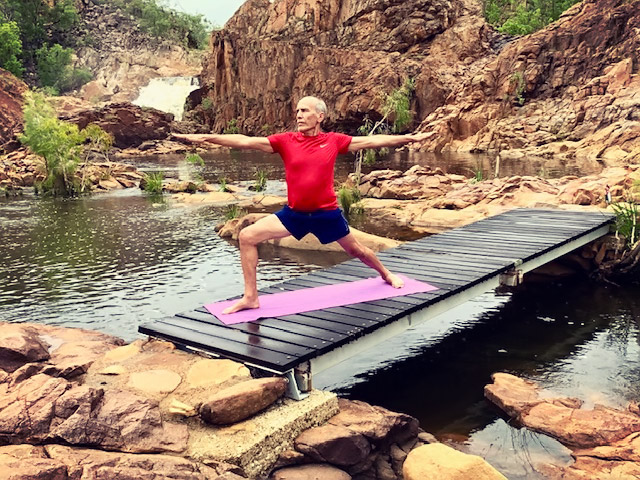
Warrior II, a steady standing pose. Feeling the feet on the ground is one way to come back to the body and the room.
What is Annie’s story?
Annie is a patient described in Dr Bessel van der Kolk’s book The Body Keeps the Score. Dr van der Kolk is a psychiatrist who has studied the effects of trauma on the mind, brain and body for decades. Chris Lalor, Flametree’s Senior Iyengar Yoga Teacher, read the book and wrote about it for students.
Trauma changes the way the brain manages perceptions, including what it chooses to think about and what it shuts out. That is what had happened to Annie. In chapter 16, van der Kolk recounts how yoga helped her slowly learn to inhabit her own body. She said she slowly learned to just have feelings, without being hijacked by them, and that life became more manageable.
Annie’s story is told in the book as one person’s experience. It is not a promise of what yoga will do for anyone else.

Rest properly at the end of practice. It is part of the pose, not an extra.
How common are trauma and PTSD in Australia?
Trauma is common, and PTSD is less common. The Australian Institute of Health and Welfare reports that an estimated 75% of Australian adults have experienced a traumatic event at some point in their lives, citing a 2020 Productivity Commission estimate.
The same page reports that about 11% of Australians have PTSD at some time in their lives, from the ABS National Study of Mental Health and Wellbeing 2020 to 2022. The figure is 14% for women and 8% for men. So most people who go through trauma do not develop PTSD, but a lot of people do.

A bolster takes the effort out of resting.
What does the research say about yoga and PTSD?
One well-known trial found that trauma-informed yoga reduced PTSD symptoms more than a comparison class. Van der Kolk and colleagues recruited 64 women with chronic, treatment-resistant PTSD. They were randomly given either trauma-informed yoga or a supportive women’s health education class, each for one hour a week over 10 weeks.
- Yoga group: 16 of 31 women (52%) no longer met the criteria for PTSD at the end.
- Comparison group: 6 of 29 women (21%) no longer met the criteria.
- Both groups improved in the first half. The yoga group kept improving, while the comparison group’s early gains slipped back.
That trial (Journal of Clinical Psychiatry, 2014) was one study of women only, over 10 weeks. It is a promising start, and more research would help. It does not show that yoga works for everyone with PTSD.

A bolster gives the body something kind to rest on.
Why do many trauma specialists focus on the body?
Because trauma is not only a memory in the mind. Many trauma specialists describe it as something the body also holds. Van der Kolk writes that our sense of ourselves is anchored in a vital connection with our bodies. In his view, numbing yourself can make life more tolerable, but the price is losing awareness of what is going on inside you, and with it the sense of being fully alive.
That is a way of understanding trauma that many specialists share and that guides trauma-informed yoga. It is an influential idea rather than a settled research finding.
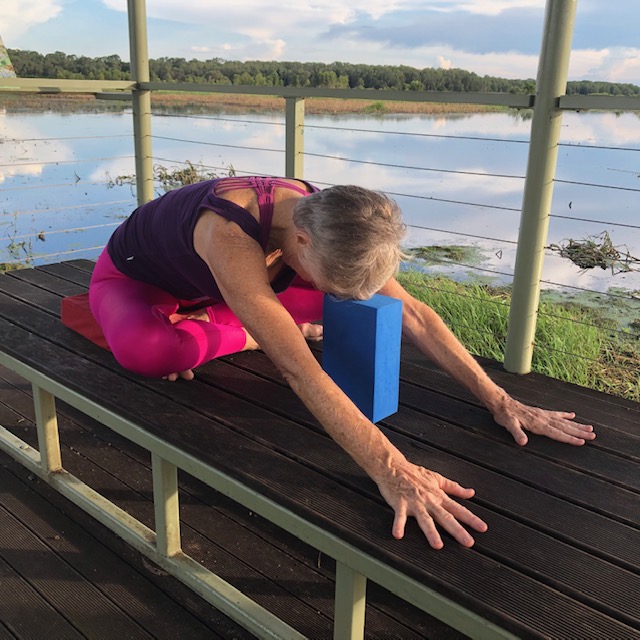
Fold from the hips and keep the spine long.
What do we see in class?
Chris’s experience is that a yoga practice teaches you to approach sensation calmly and not run away when it all gets too much. In her experience, poses that open the chest and hips, and stretch the hamstrings, work in areas where many of us seem to hold emotion. As the body softens, feelings such as anger, sadness, fear and happiness can come up. In Chris’s experience, yoga gives people the courage to keep practising and work it through.
That can be hard. It is why the way yoga is taught matters so much, and why you should go at your own pace. Whoever you are, you are welcome to talk to us first.

Bound angle pose with support opens the hips without strain.
What does trauma-informed yoga mean?
Trauma-informed yoga is taught with the effects of trauma in mind. Here is what it generally means:
- Choice: you can change, skip or rest in any pose.
- Going slowly: small steps, with no pressure to go deeper.
- Eyes open if you prefer: nobody has to close their eyes.
- Leave any time: you can step out without explaining.
- Restorative options: supported poses, with less revealing clothing if that feels safer.
- A teacher who watches for overwhelm and helps you come back to your breath or the room.
Tell your teacher what you need before class. You do not have to explain why.
When should I get other help?
Yoga is a support, not a replacement for care from a doctor or psychologist. If you are living with trauma or PTSD, talk to your yoga teacher, your psychologist and your doctor if you wish, and let them know what you are doing.
If you are in crisis, or thinking about harming yourself, please talk to your GP or a mental health professional. In an emergency, call 000.
Our notes on yoga for improved sleep and yoga for mood, anxiety and depression cover related questions.
Practise this at Flametree
Flametree Yoga Studio teaches Iyengar yoga in the studio at Woolner and Coolalinga in Darwin, and LIVE online.
- New to Flametree? Your first class is free. In the studio, just come along. Online, go to our online class list, click the class time you want and we email you the link to join.
- Beginners: new students, and anyone who has been away three months or more, can get a half price 10 class pass with 2 extra classes free, to use online, in the studio, or both. See the beginner half price pass.
- Already practising yoga? The same half price 10 class pass with 2 extra classes free, for new students and for anyone away three months or more, is also available as the non-beginner half price pass.
- See every class time, including online classes, on the timetable.
Can’t make a class? Practise at home with our video courses.
Yoga for PTSD: frequently asked questions
Can yoga help with PTSD?
It can be a helpful support alongside proper care. In a 2014 trial of 64 women with long-lasting, treatment-resistant PTSD, 16 of 31 women in the trauma-informed yoga group (52%) no longer met the criteria for PTSD after 10 weeks, compared with 6 of 29 (21%) in the comparison group. It was a single trial, so it is a starting point rather than a final answer.
What is trauma-informed yoga?
It is yoga taught with the effects of trauma in mind. It generally means choice in every pose, going slowly, no pressure to close the eyes, freedom to leave at any time, and supported or restorative options. The teacher watches for signs of overwhelm and helps you come back to your breath or the room.
What type of yoga is best for PTSD?
Research has not shown that one style is best. The 2014 trial used trauma-informed yoga taught slowly, with choice and attention to sensation. Whatever the style, look for a teacher who lets you choose, go at your own pace and stop whenever you need to.
Is yoga a replacement for treatment for PTSD?
No. Yoga is a support, not a replacement for care from a doctor or psychologist. If you are in crisis, please talk to your GP or a mental health professional, or call 000 in an emergency.
How common is PTSD in Australia?
The Australian Institute of Health and Welfare reports that an estimated 11% of Australians have PTSD at some time in their lives, based on the ABS National Study of Mental Health and Wellbeing 2020 to 2022. The figure is 14% for women and 8% for men. An estimated 75% of Australian adults have experienced a traumatic event, so most people who go through trauma do not develop PTSD.
What is complex PTSD?
Complex PTSD follows repeated or long-lasting trauma. As well as the usual symptoms of PTSD, it can include trouble managing strong feelings. A doctor or psychologist makes the diagnosis, and yoga is a support alongside their care.
Do I have to tell a yoga teacher about my trauma?
No. You can simply tell the teacher what you need, such as to keep your eyes open, to stay near the door, or to rest in a pose, without explaining why. A good teacher will respect that.
Can I do yoga online if I have PTSD?
Yes, you can. Online you stay in your own space and can step away from the screen whenever you need to. Flametree Yoga Studio streams classes LIVE online across Australia. You click the class time you want and we email you the link to join.
Where can I do yoga for trauma or PTSD in Darwin?
Flametree Yoga Studio teaches Iyengar yoga at Woolner and Coolalinga in Darwin and LIVE online, with Senior Iyengar Yoga Teacher Christine (Chris) Lalor. Tell the teacher what you need before class. In Darwin, your first class is free if you are new to Flametree (in the studio, if you have lived in the NT for three months or more; online, anyone new).
This article is general information, not medical advice. Flametree Yoga Studio, Darwin and live online. If you are in crisis, please talk to your GP or a mental health professional, or call 000.
Sources: van der Kolk BA, The Body Keeps the Score (book). van der Kolk BA and colleagues, Yoga as an adjunctive treatment for posttraumatic stress disorder: a randomized controlled trial, Journal of Clinical Psychiatry, 2014, found through PubMed, doi 10.4088/JCP.13m08561. Australian Institute of Health and Welfare, Stress and trauma, citing the Productivity Commission (2020) and the ABS National Study of Mental Health and Wellbeing 2020 to 2022.



You have really inspired me
Thank you so much
I would love to join a beginner online group