
Better Mind Body Connections
Yin yoga near me? Why straight legs matter in yoga poses
Why do we keep reminding you to straighten your legs? In Iyengar yoga, straight legs are one of the quickest ways into the mind body connection: you have to pay attention to keep them that way. If you searched for yin yoga near me, you may be after slow floor poses held for a long time. We do not run a class called yin yoga. What we teach is different, and this is one of the main reasons why.
Iyengar yoga is the style developed by Mr BKS Iyengar. In the 20th century he did more than anyone to set down traditional Indian yoga, through his books and his teaching, and he pioneered the use of props. It is sometimes called modern classical yoga, and it’s the style we teach at Flametree. This article sits in our poses and practice notes.
This note in short form
- The idea: keeping the legs straight asks for attention, and attention builds the mind body connection.
- Mr Iyengar: extension is attention, and expansion is awareness (the idea, from Light on Life).
- What students notice: steadier, taller, stronger legs, and a calmer mind.
- Five ways it helps: lines of extension, expansion, circulation, stamina and mindful engagement.
- Straight is not forced: use a chair, block or wall, and tell your teacher about knee or hamstring injuries.
- If you want yin yoga: we teach floor poses held longer, and restorative yoga with props.
- Next step: try a standing pose class in the studio in Darwin, or LIVE online.
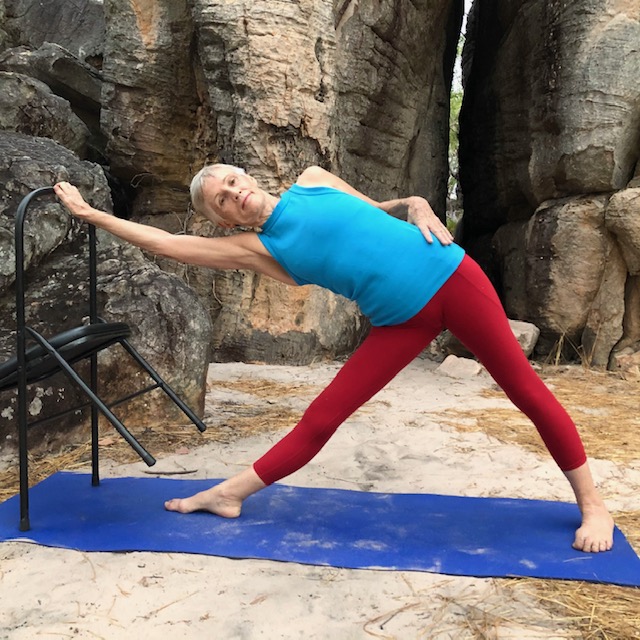
Extended Triangle Pose (Utthita Trikonasana), both legs straight, with a chair to help.
What did Mr Iyengar say about straightening and collapsing?
He linked posture to attention. In Light on Life, Mr BKS Iyengar wrote that you should not think of yourself as a small, compressed, suffering thing. You should think of yourself as graceful and expanding, however unlikely that may seem at the time. He said that when the body shrinks, the brain becomes heavy and dull, and the “doors of perception” are closed.
A few pages on, he wrote that when you collapse you do not recharge, and your attention scatters. The moment you bring attention, he said, you are creating something, and creation has life and energy. He described the goal of asana practice as working from the core of your being, and extending dynamically out to the edges of your body.
I think you can only do that if the legs are straight. His own summary, in our words, is short: extension is attention, and expansion is awareness.

Good alignment comes before depth.
Why keep your legs straight in standing poses?
These are the reasons I give my students, drawing on Mr Iyengar’s points. They come from practice and teaching, not from trials, so I have worded them as what many students notice.
- You stay in the present. Keeping the legs straight takes attention, and it builds what Iyengar teachers call body intelligence.
- You stand taller, and many students feel more confident for it.
- The legs get stronger and more toned, and the hamstrings (the muscles at the back of the thigh) are lengthened.
- The muscles that work into the pelvis are used, including the pelvic floor (the muscles that support the bladder and bowel).
- You feel better connected to the ground, which many find steadying.
- Many feel calmer, because steady poses give the mind one clear job.
- You avoid the shrinking and compression Mr Iyengar describes, and you keep the healthy curves of the spine in mind.
- Attention and awareness flow through the whole pose. With bent legs, the pose loses some of its awareness.
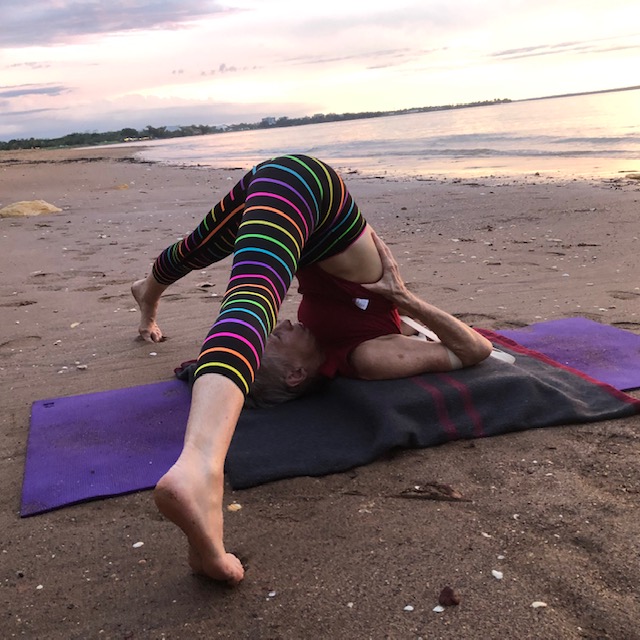
Reclining Angle Pose (Supta Konasana): both legs stay straight, even lying down.
What are the five ways straight legs help?
In the tradition, straightening the limbs is said to help the flow of energy. The tradition talks about prana (life force) moving through the nadis (energy channels). That is the tradition’s own language, known from practice rather than tested in trials. The physical points beside it are what we see in class. We show these in Half Moon Pose (Ardha Chandrasana).
- Lines of extension. Straight limbs make clear, long lines through the body.
- Expansion and release of tension. Lengthening the legs, arms and spine gives space around the joints, and many students feel unnecessary tension let go.
- Circulation. Many students feel their legs more awake and alive in straight, strong poses.
- Stamina. Poses that need straight, strong legs, such as Half Moon Pose, build staying power. Many students feel more alert afterwards.
- Mindful engagement. Keeping the legs straight takes conscious attention, which deepens the mind body connection.

Fold from the hips and keep the spine long.
Does straight mean locked or forced?
No. Straight does not mean forcing your knees back or going past what your body can do today. If your hamstrings or knees object, use a chair, a block or the wall to bring the pose closer to you. Tell your teacher about any knee injury or hamstring problem before class. Our notes on Triangle Pose, Warrior 2 and wide angle standing forward bend show how props help, and our post on standing poses says more.

Downward Facing Dog (Adho Mukha Svanasana) with the hands on blocks, which helps keep the legs long and straight.
Why does a pose need to be done correctly?
In our view, quality matters. When a pose is not done correctly, it cannot give what it was made to give. When it is, many students find the mind body benefits arrive. That is a big reason many people stay with Iyengar yoga for years. For how strength and muscle build in poses like these, see our guide on how a yoga pose builds muscle and bone.
What do we teach if you want yin yoga?
Yin yoga is a style with long holds, mostly on the floor. We do not run a class called yin yoga. Many Flametree classes include floor poses held for longer, and restorative yoga, where props fully support you, is part of the Iyengar method. Both are taught by certified Iyengar teachers who watch you and adjust what you are doing.

A supported forward bend over a bolster and chair, taught at Flametree.
Practise this at Flametree
Flametree Yoga Studio teaches Iyengar yoga in the studio at Woolner and Coolalinga in Darwin, and LIVE online.
- New to Flametree? Your first class is free. In the studio, just come along. Online, go to our online class list, click the class time you want and we email you the link to join.
- Beginners: new students, and anyone who has been away three months or more, can get a half price 10 class pass with 2 extra classes free, to use online, in the studio, or both. See the beginner half price pass.
- Already practising yoga? The same half price 10 class pass with 2 extra classes free, for new students and for anyone away three months or more, is also available as the non-beginner half price pass.
- See every class time, including online classes, on the timetable.
Can’t make a class? Practise at home with our video courses.
Why straight legs matter: frequently asked questions
Why should I keep my legs straight in standing poses?
Because straight legs ask for attention, and attention builds the mind body connection. Mr BKS Iyengar wrote that extension is attention, and expansion is awareness. Many students also find their legs feel stronger, longer and steadier.
Does straight mean locking my knees?
No. Straight does not mean forcing the knees back. If your hamstrings or knees object, use a chair, block or wall, and tell your teacher about any knee injury.
What did Mr Iyengar mean by the doors of perception?
In Light on Life, he wrote that when the body shrinks and slouches, the brain becomes heavy and dull, and the doors of perception are closed. He meant that how you hold the body affects how awake your attention is.
Which poses should I keep my legs straight in?
Mostly standing poses, such as Extended Triangle Pose, and many sitting and lying poses too. A few poses, such as Warrior 2, ask for a bent front knee. Props make straight legs possible while you are stiff.
Can I do this if I am stiff?
Yes. Props bring the floor, or the pose, closer to you, so you can keep the legs long without strain. Tell your teacher about injuries before class.
Do you teach yin yoga?
We do not run a class called yin yoga. Many Flametree classes include floor-based poses held longer, and restorative yoga is part of the Iyengar method, taught by certified teachers who watch you and adjust what you are doing.
Is the energy flow idea a research finding?
It is a teaching of the yoga tradition. Prana and nadis are the tradition’s own language, known from practice rather than tested in trials. What we can say is that many students feel more alert and steady when they keep their legs straight with attention.
Where can I learn standing poses in Darwin?
Flametree Yoga Studio teaches Iyengar yoga in Darwin, at Woolner and Coolalinga, and LIVE online. Your first class is free if you are new to Flametree (in the studio, if you have lived in the NT for three months or more; online, anyone new): in the studio you just come along, and online you click the class time you want and we email you the link to join. The half price 10 class pass is for newcomers and for students who have been away three months or more.
More from our classes is shared on the Flametree Yoga Facebook page.
Flametree Yoga Studio, Darwin and live online. This article is general information and not medical advice. The ideas credited to Mr BKS Iyengar are from Light on Life, given in our words.



Morning and thank you, Chris!
I always love reading your pieces of advice or blogs on the endless elements of Iyengar Yoga and then incorporating into my regular practise!