New? Lapsed? 50% OFF + Darwin Yoga Rebate Deal, Including Online
Original price was: USD$83.50. USD$41.75Current price is: USD$41.75.
New? Lapsed? 50% OFF + Darwin Yoga Rebate Deal, Including Online
Original price was: USD$83.50. USD$41.75Current price is: USD$41.75.
12 beginner classes (10 at HALF OFF + 2 FREE).
Use across Darwin or LIVE online. With money back guarantee. Yoga rebate option.
Try yoga for stiffness, strength, balance, stress, worry, or better sleep.
For permanent NT residents, or online use.
Want yoga for stiffness, strength, balance, stress, worry, or better sleep? Start with 2 FREE classes and 10 at HALF price ($4.96 each or $59.50 total). Available in Flametree’s Darwin studios or via LIVE interactive online classes, for yoga or breath meditation, or both.
It’s powerful for body and mind, with or without the new Health Fund rebate.
If your private health fund pays for yoga, and you have suitable extras cover, it may reimburse part of this cost as a yoga rebate. Not every fund pays yet, and what a fund publishes is not always what it does in practice, so always check directly with yours.
Health fund rebates apply for diagnosed conditions such as back pain, arthritis, menopausal symptoms, insomnia, high blood pressure, anxiety, diabetes, and more. A health professional signs your fund’s form before your first claimable class.
Where a fund pays, these yoga rebates can reduce, and sometimes cover, the cost of Flametree’s intro pack deals.
Yoga rebate claims can be made for classes done with Flametree’s start or re-start packages, once your form is signed.
Buy a pass, and then the same regular classes you do for the rebate also build your strength, slow the stiffness slide, improve balance, protect bone density, improve sleep, reduce worry, and much more.
Flametree’s beginner yoga is doable. No flexibility needed to start. Every age, size, and gender.
In our studios, props and mat supplied. (Otherwise, we show you how to improvise props, or see the prop pack deal.)
Several funds already pay for yoga. Medibank’s yoga cover is now expected in January 2027, but check with Medibank. (Updated October 2026.) This is still settling down, so please tell us what your fund says.
Use the Add to Cart button now. Money back GUARANTEE. Try your first class. Full refund within 14 days if it’s not for you.
Or see these links below for the bigger 55% OFF 20-pass + 10 add-on (32 classes at $4.87 each) | or yoga props pack with free shipping | or non-beginner HALF price deals.
Want more detail first? Jump to: Yoga for Strength · Yoga for Stiffness · Yoga for Balance, Falls and Bones · Yoga / Meditation for Sleep, Stress & Worry · How To Claim a Yoga Rebate · How to Build a Habit That Lasts
The $59.50 HALF price deal for 12 classes, with or without 5 more, is directly below, via the Add To Cart button. No discount code is needed.
2 FREE CLASSES + 10 AT HALF OFF? Use “Add To Cart”
Want a Beginner yoga Darwin health fund rebate? Or 50% OFF classes… including for non-beginners? Or an online yoga health fund rebate? Or just more on yoga for stiffness, strength, balance, worry, or sleep. Or you want to make exercising easy via a habit? See more below.
For your guidance, we’ve expanded on each key topic with more information and research results. Or, see the quick guide illustrations.
What’s covered below (with quick links to it)
- Feeling weaker than you used to? There is a reason, and a fix.
- Getting tighter, stiffer, less free in your movement?
- Worried about bone density, falls, or staying steady as you get older?
- Is stress, worry, or broken sleep making life harder than it should be?
- How the new yoga health fund rebate works, step by step
- How to actually make yoga a habit this time.
Other useful links to elsewhere
Alernatively, maybe you just want to go direct on any of these other links:
- See beginner or NON-beginner timetable
- Want up to 32 HALF price classes? See the 20-class 50% OFF deal
- Ready to reserve on online class? (In-studio folk can just turn up).
- Already know yoga? See the HALF-price NON-beginner 10 packs
- Joining online or practicing at home? See the props pack with FREE shipping
- Prefer a private class, or a yoga therapist class?
- Already a current beginner student (not new or lapsed)? See beginner pass options
- Need the low cost weekly NON-beginner deals?
- See my own story (Christine) on how and why I (almost accidentally) got into yoga.
Yoga for Strength
Muscle decline can be halted or reversed by yoga
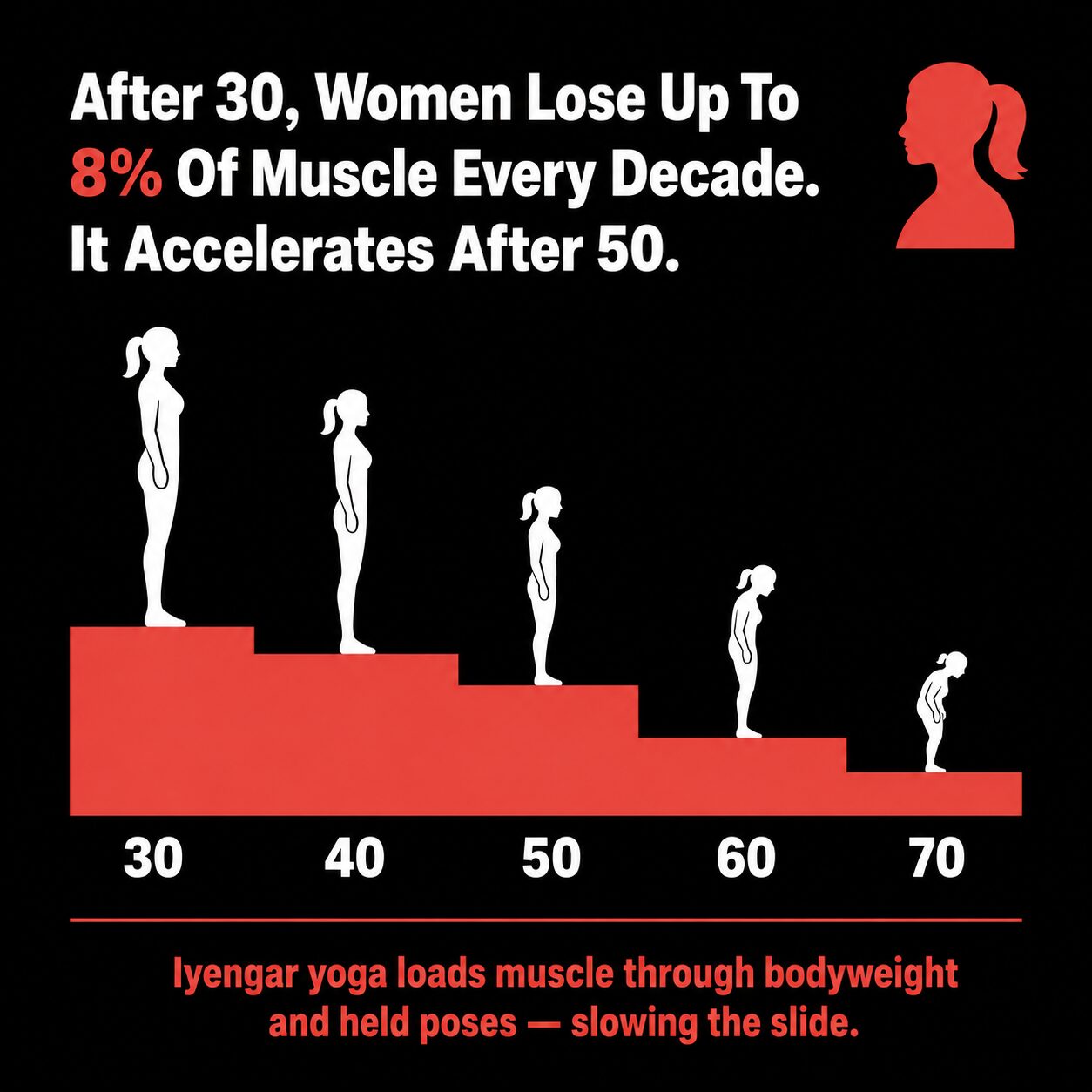
Darwin yoga for strength deal gets you breath meditation or yoga classes at less than 50% of the normal price, as well as the option of a yoga rebate if your health fund pays for yoga.
Muscle does not hold steady as the years pass. From around 40, it declines at roughly 1-2% per year. By 60, the rate accelerates.
For women, the process often starts earlier: from perimenopause, which can begin in the late 30s, hormonal changes trigger faster decline in both muscle and bone density, sometimes well before most people expect it.
Yoga counteracts this directly. Not with repetitive gym movements, but with sustained, weight-bearing standing poses held long enough to trigger real adaptation.
Yoga fires multiple muscle groups simultaneously through integrated load that is also gentle on joints.
Muscle building yoga: at 63% of maximum contraction strength
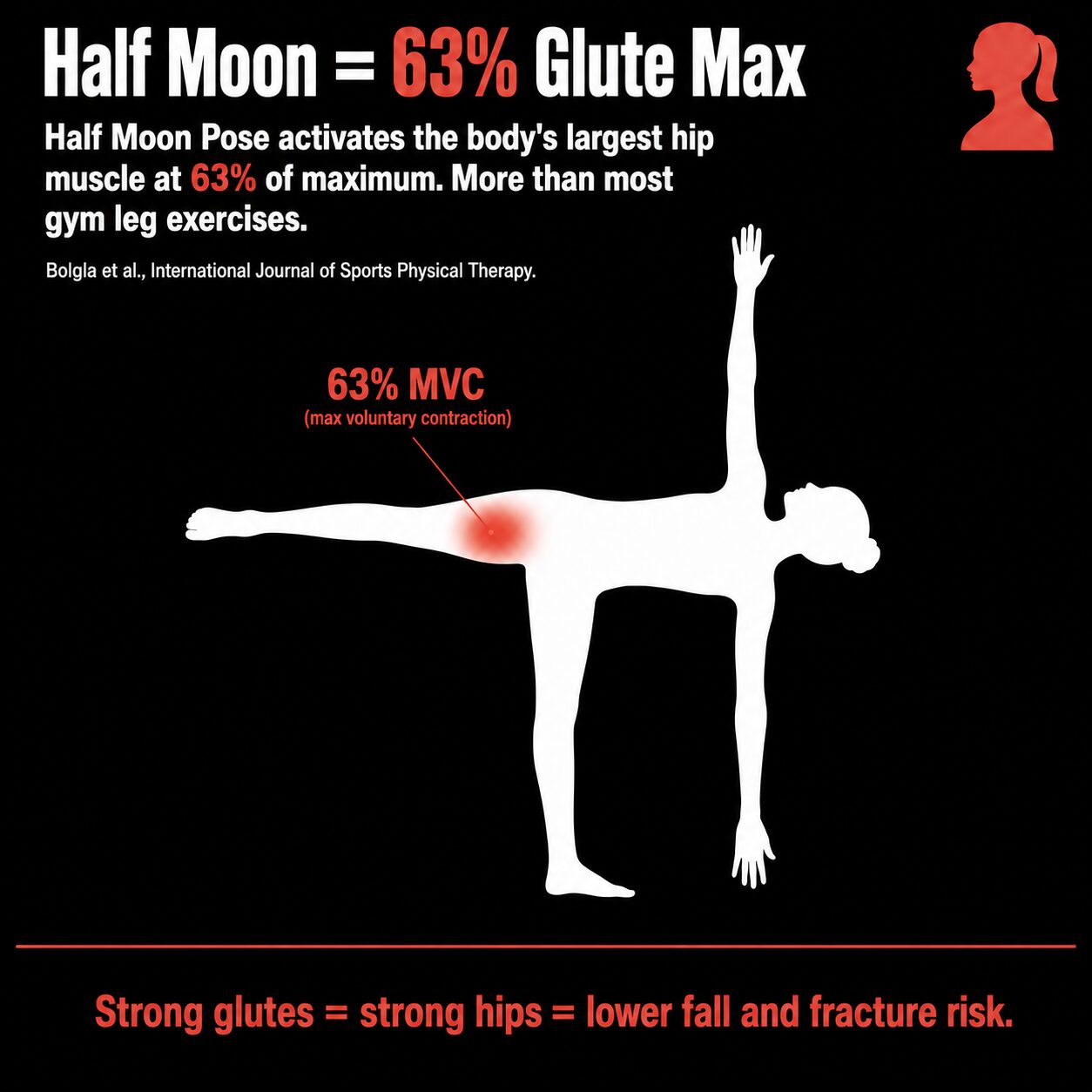
Half Moon Pose is a good example of Flametree Darwin yoga for strength at work. For instance, it builds key muscles at up to 63% of the maximum contraction that a muscle is able to do.
The same standing poses that build muscle put weight-bearing stress through the skeleton. That means every class does double duty: building the strength felt day to day, and reinforcing bone density for the decades ahead.
Flametree’s beginner yoga is built for this, and it is genuinely doable. No flexibility needed to start. Chris Lalor and her experienced teaching team have guided beginners in Darwin and online for 29 years. Classes start simple and build steadily, with props supporting every pose from the first class.
GET 2 FREE CLASSES + 10 AT HALF OFF $4.96 each or $59.50 total. Claimable on some health fund extras. (See how below).
Yoga for Stiffness
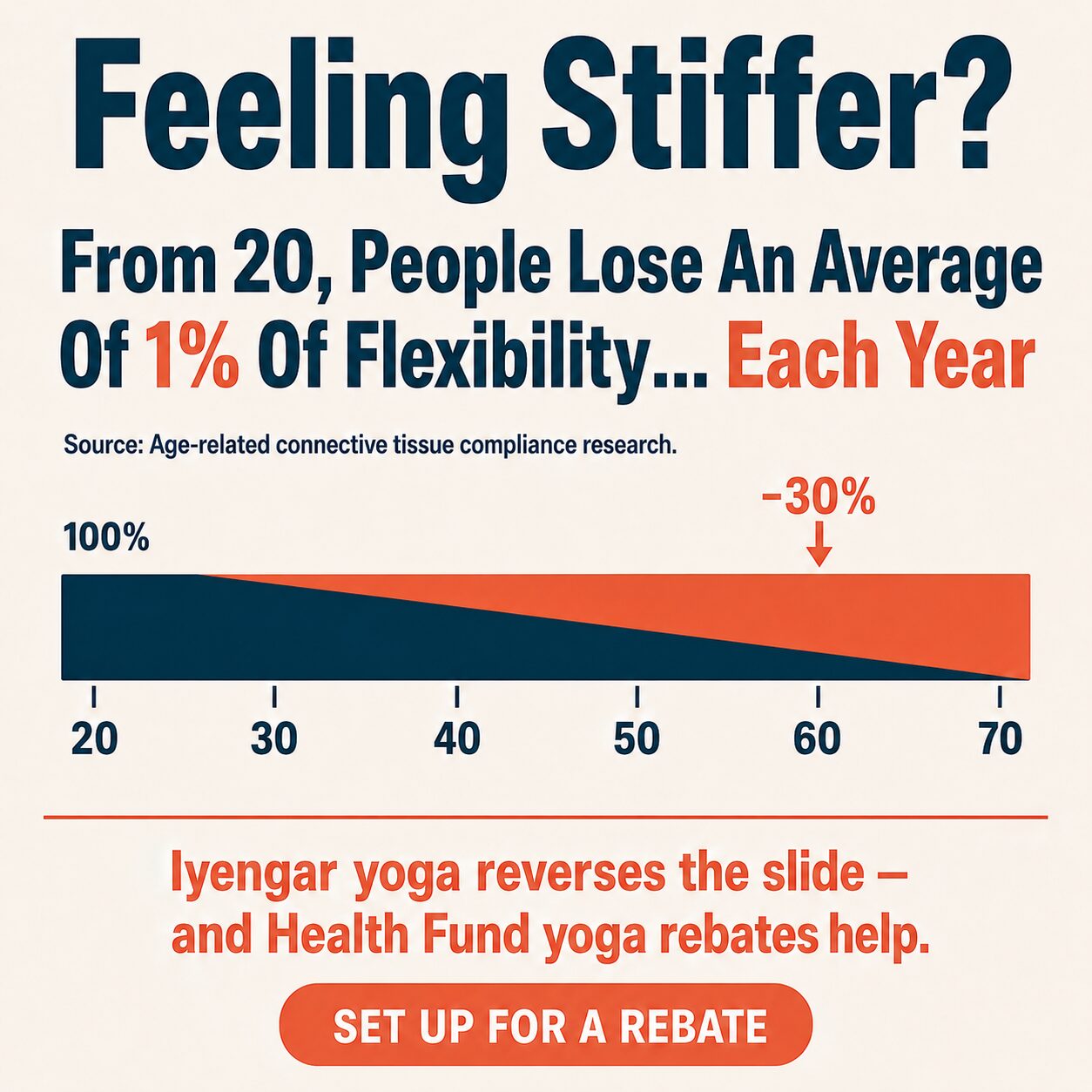
Online & Darwin Yoga for stiffness deal lets you head off this slide, or rebuild flexibility
From around 20, the body loses roughly 1% of its flexibility each year on average. By 60, that adds up to about 30% less range of motion than at peak. Most people feel it as morning stiffness, tightening hips, shoulders that have lost their reach, or everyday movements that take a little more effort.
What many do not realise is that stiffness has more than one cause. Inactivity is part of it. But eating inflammatory foods also contributes. Chronic, low-grade inflammation from diet expands stiffness in joints, making the problem larger.
The good news is that many students who start yoga for the first time, find the combination of regular movement and calmer breathing, changes how their body feels in ways that movement alone had not.
Yoga targets the nervous system’s role in stiffness, not just the muscles. Fast stretching can trigger a protective contraction reflex.
In contrast, yoga’s slow, sustained holds let the nervous system acclimate instead. Over time, connective tissue responds. Joints regain range. The stiffness slide slows, or reverses.
The mindfulness that comes with yoga also makes mindful eating easier.
Flametree’s beginner classes are designed for people starting stiff. Sessions begin where you are. Props help do the poses, and get maximum benefits by being in a “shape” that works best. No prior flexibility is required.
GET 2 FREE CLASSES + 10 AT HALF OFF Use the same pass for yoga or breath meditation, or both.
Yoga for Balance, Falls and Bone Health
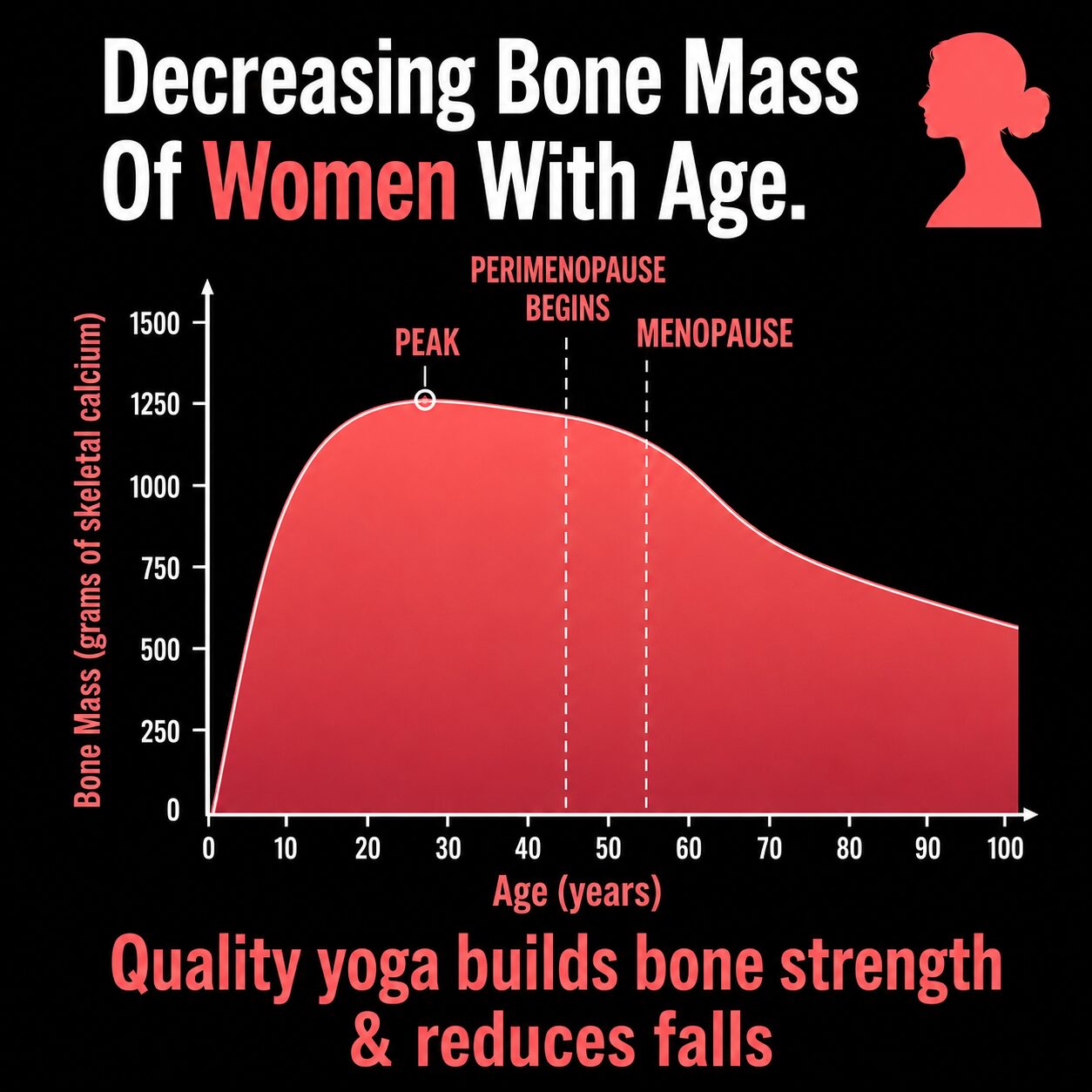
Darwin Yoga for bones decrease and even reverse this bone density decline.
Bone density peaks in the late 20s. After that it declines gradually, accelerating through perimenopause and menopause. By the time a bone density scan flags an issue, the process has been underway for years.
Weight-bearing yoga poses apply load through the skeleton, sending the mechanical signal that tells bone cells to maintain density.
Research into yoga and bone health has shown measurable improvements in bone mineral density, including in the spine and hips. The standing poses that drive this result make up 40-50% of a typical beginner Iyengar yoga class.
Balance draws on four foundations: foot and ankle stability, leg and hip strength, upright spinal alignment, and fast reflexes. Yoga trains all four in every class. Students frequently report that within weeks they feel more confident on stairs, on uneven ground, and getting up from seated positions.
Balance is the outcome of the quality standing poses taught at Flametree
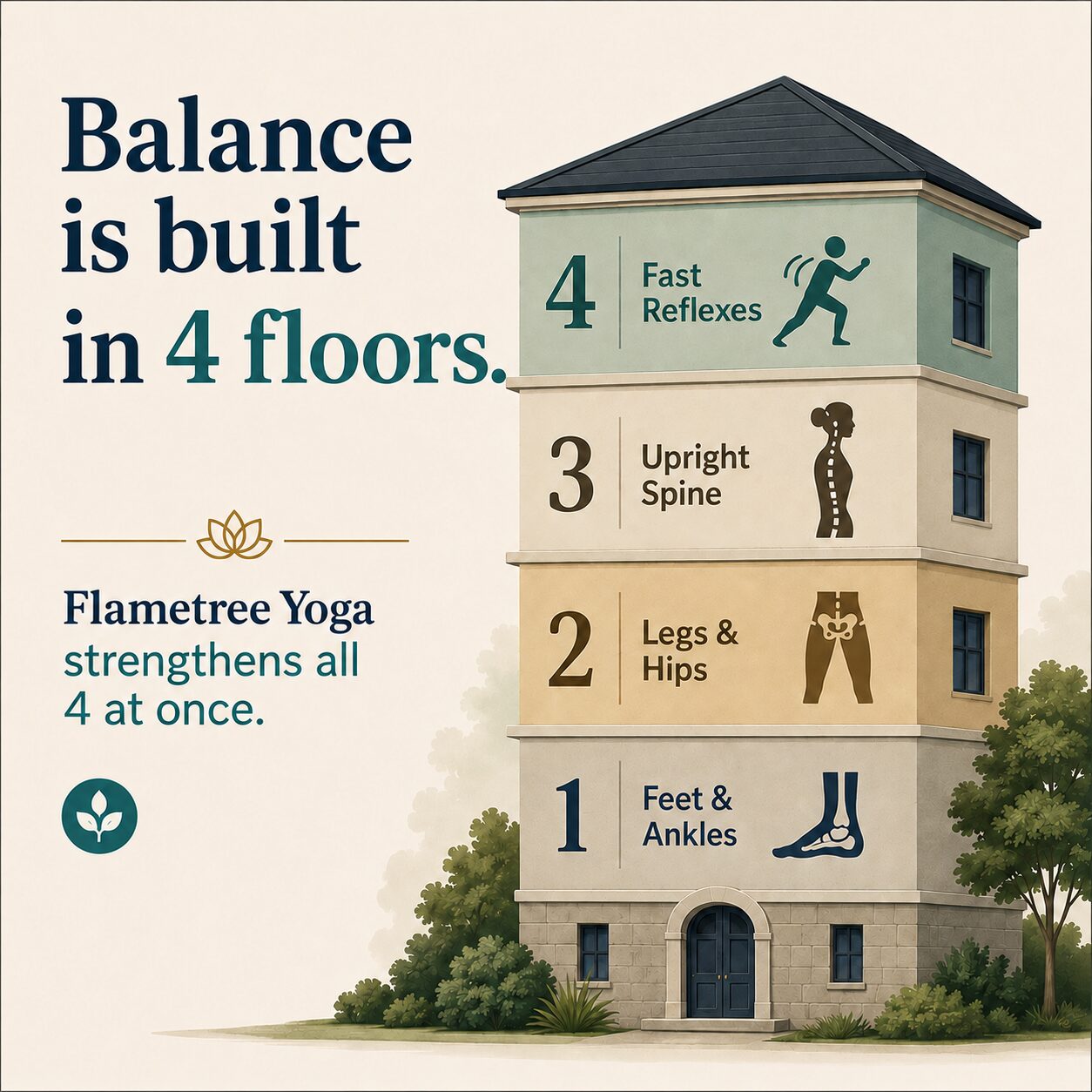
Here are the major components that we work on in Flametree Darwin Yoga for Balance classes. In turn, you build muscless, bones, balance, core, posture, and confidence.
The link between bone health and balance matters because the consequences of a fall depend heavily on bone density.
Stronger bones mean less severe outcomes if a fall does occur. Improved lower-limb strength and coordination reduce the chance of losing footing in the first place. Yoga works on both sides of that equation.
For women in perimenopause (which can begin from the late 30s), this is particularly relevant. The window to invest in bone density and balance overlaps with the years when yoga is most accessible. It provides load-bearing benefit without the joint impact that becomes a barrier in higher-impact activities.
GET 2 FREE CLASSES + 10 AT HALF OFF Use pass for yoga or breath meditation, or both.
Yoga and Breath Meditation for Sleep, Stress and Worry
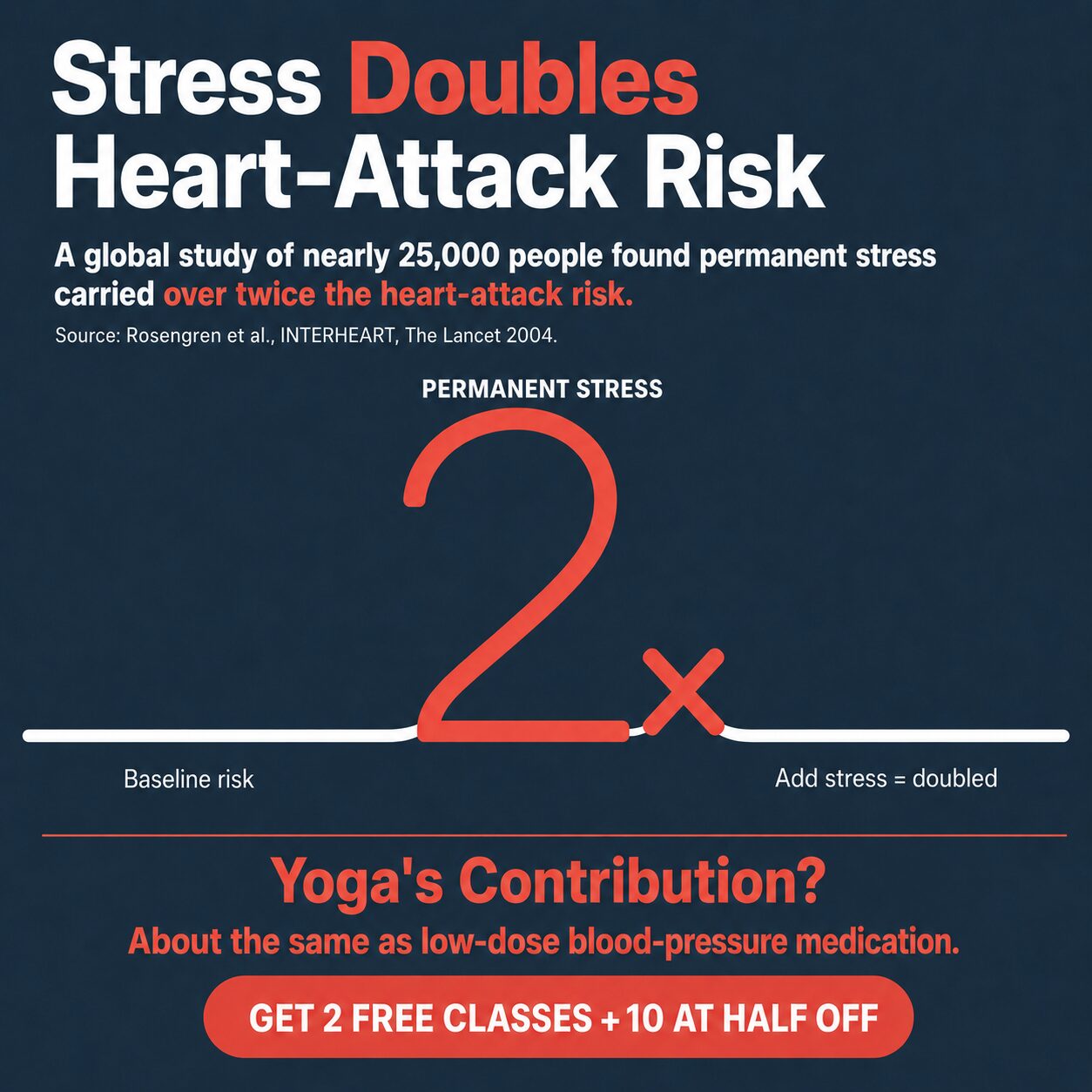
Darwin yoga for blood pressure, stress, worry, sleep, and heart attack risk reduction
A global study of nearly 25,000 people found that people under permanent stress carried more than twice the heart-attack risk of those who were not.
Yoga addresses this risk directly. Regular practice has been shown to reduce systolic blood pressure by around 5-8 mmHg, a reduction researchers have described as being in the same ballpark as low-dose blood-pressure medication.
Programs that combine yoga postures with breathwork (AKA pranayama meditation) achieve roughly double the blood-pressure benefit of posture-only programs.
The physical work improves circulation and lowers resting muscular tension. The breath work and end-of-class relaxation shift the nervous system into parasympathetic mode, the body’s rest-and-restore state.
For a synergistic outcome, where 2 + 2 =5, to some of both yoga asana, and pranayama meditation. Flametree’s timetable gives you good options for both.
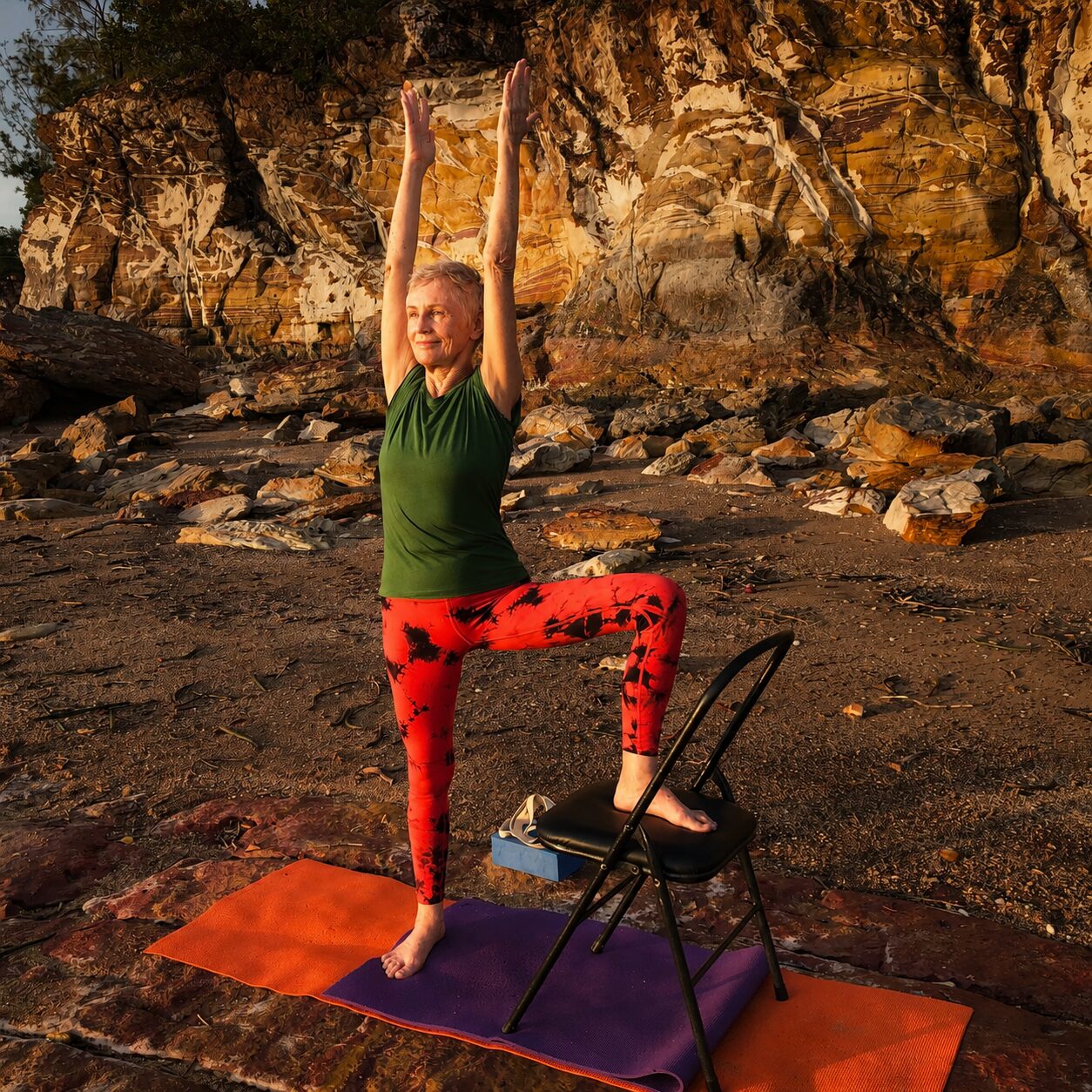
Flametree ‘s Beginner Yoga Darwin & online is doable for every age, size, and gender.
In addition, sleep and stress are tightly connected. When the nervous system stays in chronic low-level alertness, sleep suffers; and poor sleep makes stress worse. Yoga’s calming effect on the autonomic nervous system helps interrupt that cycle.
Students regularly report better sleep quality within the first few weeks of starting a regular practice.
In terms of synergy, one of the most striking recent findings in breath meditation research involves Humming Breath (Bhramari).
In a 2023 study, Humming Breath produced the lowest stress index of four states measured, including sleep itself.
Humming pranayama meditation helps stress, sleep, focus, and more
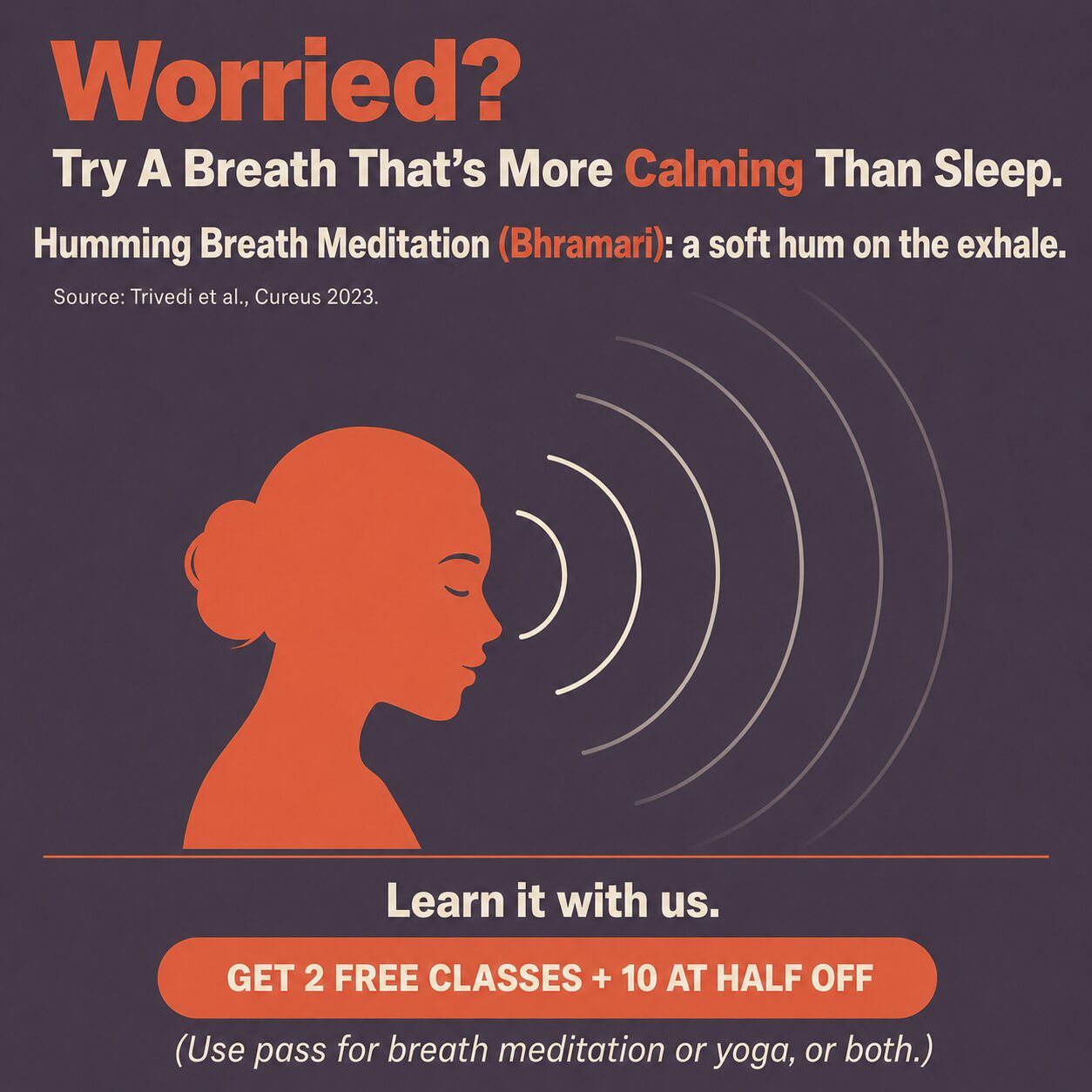
Pranayama classes online or in the studio have many stress reduction benefits. They’re also excellent if you looking for Darwin yoga for sleep. Do it with or without yoga.
Separately, research has shown that humming increases nasal nitric oxide by 15 times. It’s a compound with a direct calming effect on the nervous system.
A 2024 randomised controlled trial also found Humming Breath improved sleep quality scores and reduced cortisol (the “stress hormone”) in people with primary insomnia.
Flametree runs six breath meditation classes per week: four at Coolalinga Central and two at Woolner. Chris Lalor and the teachers she trains and actively supervises teach six techniques:
- Ocean Breath (Ujjayi),
- Alternate Nostril Breath (Nadi Shodhana),
- Staircase Breath (Viloma),
- Humming Breath (Bhramari),
- Refined Exhale Breath (Anuloma), and
- Cleansing Breath (Kapalabhati).
Some of these are LIVE (streamed and interactive) classes, and more online classes are coming soon. Personalised correction is part of every session, unlike pre-recorded videos.
The same 10-pass or 20-pass deal covers both yoga classes and breath meditation classes, online or in-studio. No separate pass required. (The same applies to the non-beginner half price ten pass for new and 3 months lapsed).
GET 2 FREE CLASSES + 10 AT HALF OFF $4.96 each or $59.50 total. (Use pass for breath meditation or yoga, or both.)
How to Claim a Yoga Health Fund Rebate
Some join private health funds. Some don’t. But if you do have or want private health cover, then also check what rebate, if any, the fund offers for yoga or pranayama meditation.
Some also cover online yoga classes, but check with them. See which health funds cover online yoga classes.
They will only provide a rebate for completed classes, using whatever mix of yoga passes you’ve chosen.
If you’re interested in this additional option, here’s more about how the online and Darwin yoga health fund rebates work.

Darwin yoga health fund rebates deal allow you to get a rebate for completed classes, if you follow the steps below.
Yoga became eligible again for health fund rebates in Australia from 1 July 2025, and funds have been switching it on through 2026. Several already pay, including the Teachers Health group, Doctors’ Health Fund, CBHS, ahm and Westfund. Medibank’s yoga cover is now expected in January 2027, but check with Medibank. (Updated October 2026.)
Tell us what your fund said. It will take a while for all this to settle down, and your answer helps the next person. Email [email protected] or use our contact page.
Where your fund pays, a health fund yoga rebate can reduce, and sometimes cover, the cost of getting started with yoga or pranayama (AKA breath meditation).
The same regular classes that deliver the benefits for strength, stiffness, stress, balance, and sleeep, can be classes that are claimable via a yoga rebate.
4 steps for a Flametree Darwin yoga health fund rebate
Step 1: Get your form from your fund. Contact your health fund and ask for the yoga rebate form, or find it through their app or website. It is a short form specific to complementary health programs.
Step 2: Have a health professional sign it before your first class. A GP, physiotherapist, osteopath, or other registered health professional can sign. They confirm one or more conditions that yoga can help address. (See more in the illustration below). This step must happen before classes begin for the rebate to apply. Make sure the form is dated before your first class.
Step 3: Start your classes. Your rebate reimburses you for classes completed after the form is signed. Begin as soon as you have the signed form in hand.
Step 4: Claim with your fund. Submit the signed form and your class receipt to your fund. Ask Flametree for your receipt whenever you are ready to claim, for example at the end of the financial year. It lists the classes you completed and their dates, with Flametree’s ABN and teacher details.
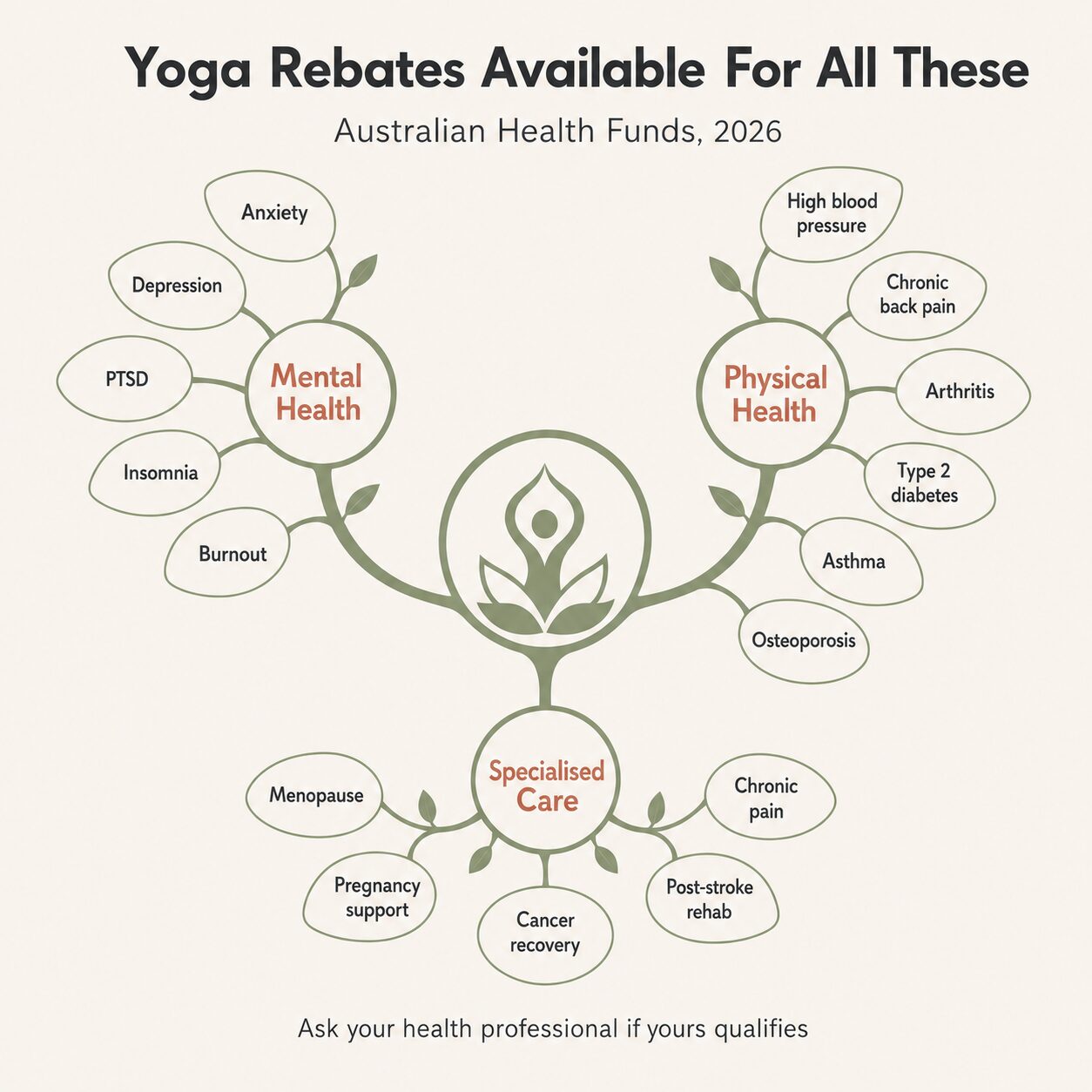
Yoga Health Fund rebates for yoga and pranayama fall into these areas. Have a health professional specify one or two of them on your form. Then, the same classes will also deliver strength, flexibility, de-stressing, sleep and the other major benefits of yoga and / or pranayama meditation.
Which health funds qualify?
Not every fund pays for yoga yet, and the amount varies by fund and cover level. What a fund publishes is not always what it does in practice, so check directly with yours. Some funds also ask for the teacher’s Yoga Australia registration number, which not every Flametree teacher has yet, so tell us if your fund needs it. See which funds pay, how much, and who can join the specialist funds (they reach much further than their names suggest) in our national guide: Can You Claim Yoga On Private Health Insurance? The 2026 Guide.
Start by checking your current extras cover.
If you are not insured and are considering joining a fund, check the waiting period first. Some funds run join offers that waive waits. For example, Teachers Health’s own page says new members who join an eligible Hospital & Extras cover or StarterPak (Basic Plus) by 31 October 2026 have the 2 and 6 month extras waits waived. Check the full terms with the fund.
Joining a fund? Check the waiting period.
Want to claim online classes too? See which health funds cover online yoga classes.
What conditions to list on the form
The form asks your health professional to confirm conditions that yoga can help with.
As you can see on the illustration above, some common conditions listed for yoga rebates include back pain, arthritis, menopause, insomnia, blood pressure, diabetes, stress, and musculoskeletal issues.
A key thing to note is that all of Flametree’s regular classes address one or more of these conditions. Ask your health professional to confirm which ones that apply to you, and then have them sign the form so you can claim your yoga rebate.
Your rebate form can usually be used for 12 to 24 months. Check the period with your fund.
Timing your claim
Most funds have a yearly limit per person, which resets each year. Check how your fund counts its year, and claim before any deadline it sets.
Your Flametree Yoga 10-pass or 20-pass is valid for 6 months from the date of your first class. A pass started late in your fund’s year may span two years of limits. Ask your fund how it treats that. (Obviously, weekly passes can also be used for whatever mix of classes and levels you do).
Important: the signed form must be dated before your first class. There is no benefit to backdating.
Any questions about this process? Call or text Flametree on 0468 362 641 or 0448 11 22 51. And once you have checked with your fund, please tell us what it said. Email [email protected] or use our contact page.
How to Build a Habit That Lasts
The so-called 21-day habit rule has been tested and found wanting. Instead, research from University College London (Lally et al., European Journal of Social Psychology) found the real average is 66 days, with a wide range from 18 to 254 days depending on the person and the activity.
What this means practically: the first few weeks are a little more challenging to maintain. Maybe each decision to go to class takes more active effort.
After that, it progressively takes less effort, and you’re likely to even come to enjoy the feeling afterwards, as well as catching up with the new friends you’ll create.
Around the 66-day mark for most people, going to class starts to happen without much deliberate thought at all.
Class attendance becomes more automatic, and much easier to maintain.
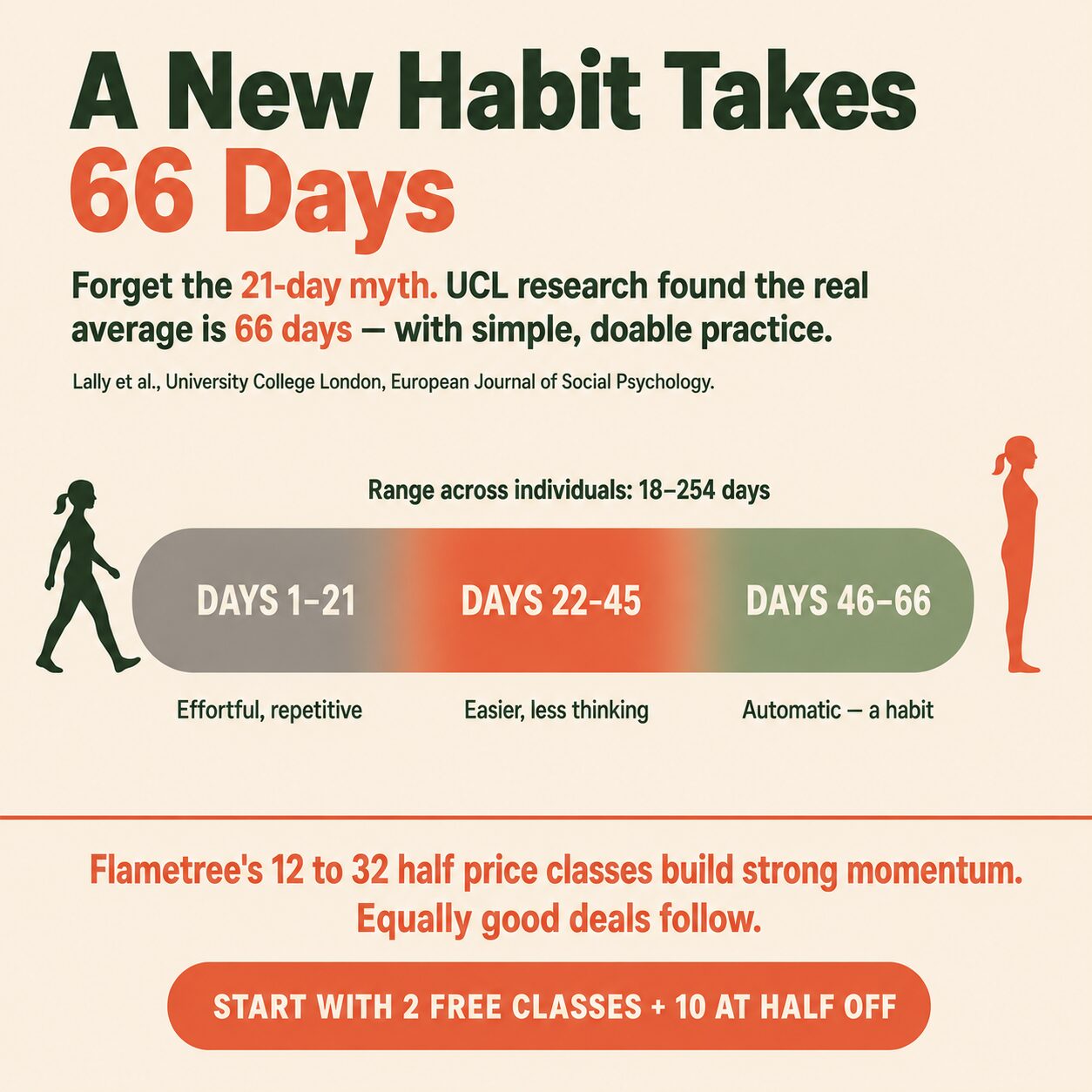
Flametree’s best beginner yoga Darwin and online packages give you the time to create a yoga habit. Then the classes will become much easier to attend as they’re built into your daily habits.
Flametree’s intro yoga packs are sized to cover this arc. Twelve classes (10-pass plus 2 free) at two per week takes six weeks, well into the easier phase. Twenty-two classes (20-pass plus 2 free) at two per week takes most people past the 66-day average. Thirty-two classes (20-pass with add-on) takes you comfortably into automatic territory.
After the intro packs, the ongoing unlimited beginner deal at $17.95 per week continues the habit at a low, predictable weekly cost.
(New and lapsed Non-beginners get equally attractive HALF price deals, even though non-beginner classes do cost a little more).
Start yoga, restart after a break, try breath meditation for the first time, or all of the above. With or without a health fund rebate, it’s well worth doing, and highly likely to change your life for the better.
You’ll get a body and mind outcome that no other type of practice delivers.
How often can I get it at HALF price?
These half-price deals for new or lapsed students are only available to any one person for a maximum of twice in a two-year period.
GET 2 FREE CLASSES + 10 AT HALF OFF $4.96 each or $59.50 total.
To buy, scroll up to use the Add To Cart button.
Money back GUARANTEE. Try your first class. Full refund within 14 days if it is not for you.
(Use pass for breath meditation or yoga, or both.)
Or see: 55% OFF 20-pass + 10 add-on (32 classes at $4.87 each) | yoga props pack with free shipping | non-beginner HALF price deals