Falls & Yoga Studies
Falls yoga studies: the short answer
Falls yoga studies keep finding the same thing. Taught in a studio, with a certified teacher in the room or LIVE online, yoga improves balance, walking and leg strength in older adults. The SAGE yoga trial is the exception. However, there are good reasons to think what it tested was not Iyengar yoga as it is normally taught. If you came here for yoga for balance, the section just below sets out the research, the poses and how to do them safely.
Falls Yoga Studies (& Sage Yoga Trial Issues)
Iyengar yoga falls prevention is real.
Yoga for falls in studio studies show very positive outcomes.
Yoga for balance: what the research says
Yoga for balance is one of the best supported uses of yoga for older adults. In the 2013 Sydney pilot study, 12 weeks of Iyengar yoga improved standing balance, one-leg balance with the eyes closed, walking speed and getting up from a chair, the main risk factors for falls, with no serious adverse events (Tiedemann 2013). Reviews since then point the same way.
- Tiedemann 2013, Sydney: 54 people, average age 68, twice a week for 12 weeks, taught in person, compared with an education-only group. Better on all four balance and mobility tests reported.
- Youkhana 2016, Age and Ageing: six trials, 307 people aged 60 and over. Yoga gave a small improvement in balance and a medium improvement in mobility (Youkhana 2016).
- Loewenthal 2023, Annals of Internal Medicine: 33 studies, 2,384 older adults, with Iyengar and chair-supported yoga the most common styles. Moderate-certainty evidence that yoga improved walking speed and leg strength and endurance, compared with education or no exercise (Loewenthal 2023).
- Chen 2026, Frontiers in Aging: 10 trials in frail and pre-frail (starting to become frail) older adults. Mind-body exercise including yoga improved overall, moving and standing balance, with the most consistent results at 2 to 4 sessions a week for 13 weeks or more (Chen 2026).
Dr Timothy McCall’s list, “117 Health Conditions Helped by Yoga (as found in scientific studies as of June 2019)”, includes both chronic balance problems and gait (walking) problems. The studies above are the up-to-date evidence behind those two entries.
Which yoga poses help balance?
Standing poses are the heart of yoga for balance. They load the legs, train the ankles and hips, and teach the eyes and the inner ear to work with the feet. In an Iyengar class they are built in an order.
- Mountain Pose (Tadasana). Standing evenly on both feet, the base for everything else.
- Tree Pose (Vrksasana), at first with a hand on a wall or a chair.
- Triangle Pose (Trikonasana) and Warrior II (Virabhadrasana II), which build the legs with both feet on the ground.
- Half Moon Pose (Ardha Chandrasana), with the back against a wall and a block under the hand.
- Warrior III (Virabhadrasana III), with the hands on a chair, once the legs are ready.
One-leg balances come after the legs have been built by the two-footed standing poses, not in the first week.

Yoga for balance often starts like this: Tree Pose with a chair close by, so the balance can be held long enough to learn from.
Yoga for balance, done safely
- Use support. A wall or a chair beside you lets you stay in a pose long enough to learn it.
- Build the legs first. Two-footed standing poses come before one-leg balances.
- Go regularly. The studies that worked ran at least twice a week for 12 weeks.
- Tell your teacher about dizziness, recent falls, joint replacements, osteoporosis (thin, fragile bones) or eye problems, so poses can be changed.
- See your doctor if you have had several falls, blackouts or sudden dizziness, since these need checking first.
The honest limits: the Sydney pilot and most balance studies measured the risk factors for falls rather than counting falls, and most were small. One 2026 review found the balance gains became smaller after adjusting for small studies, while quality of life stayed clearly better. None of the in-person studies reported more falls in the yoga groups.

Warrior III with a chair. The chair lets the standing leg do the work while the balance is learnt.
If you are new to Flametree, your first class is free. Then the half price 10 class pass with 2 classes free, $59.50, covers Darwin and online, with no code needed. Get your link to join an online class, or see the beginner timetable. For other conditions yoga may help, see the benefits of yoga hub, and the posts on yoga for lower back pain and yoga for osteoporosis.
Falls: In-Person Iyengar Yoga Studies (Studio-Based)
Falls yoga research in traditional class settings, with certified instructors physically present, generally shows positive outcomes for balance and mobility in older adults (and anyone). Plus, a quick overview of issues with the SAGE yoga trial.
Students have recently asked us about yoga for falls, and news reports on the issue. So here is an initial response, starting with a review of existing studies, including some Iyengar yoga falls prevention studies.
Why yoga for falls is so important
Falls are the largest single cause of injury death and injury hospitalisation among Australians aged 65 and over.
The Australian Institute of Health and Welfare reports that 6,698 Australians died from falls in 2022-23. That is 43% of all injury deaths. The health-system cost of fall injuries exceeds A$5 billion a year.
Plus, almost two-thirds of fall-injury hospitalisations are in females.
By comparison, the Bureau of Infrastructure and Transport Research Economics records 1,300 road-crash deaths in Australia in 2024.
Key falls yoga studies include those below.
Falls yoga studies show how to improve these outcomes
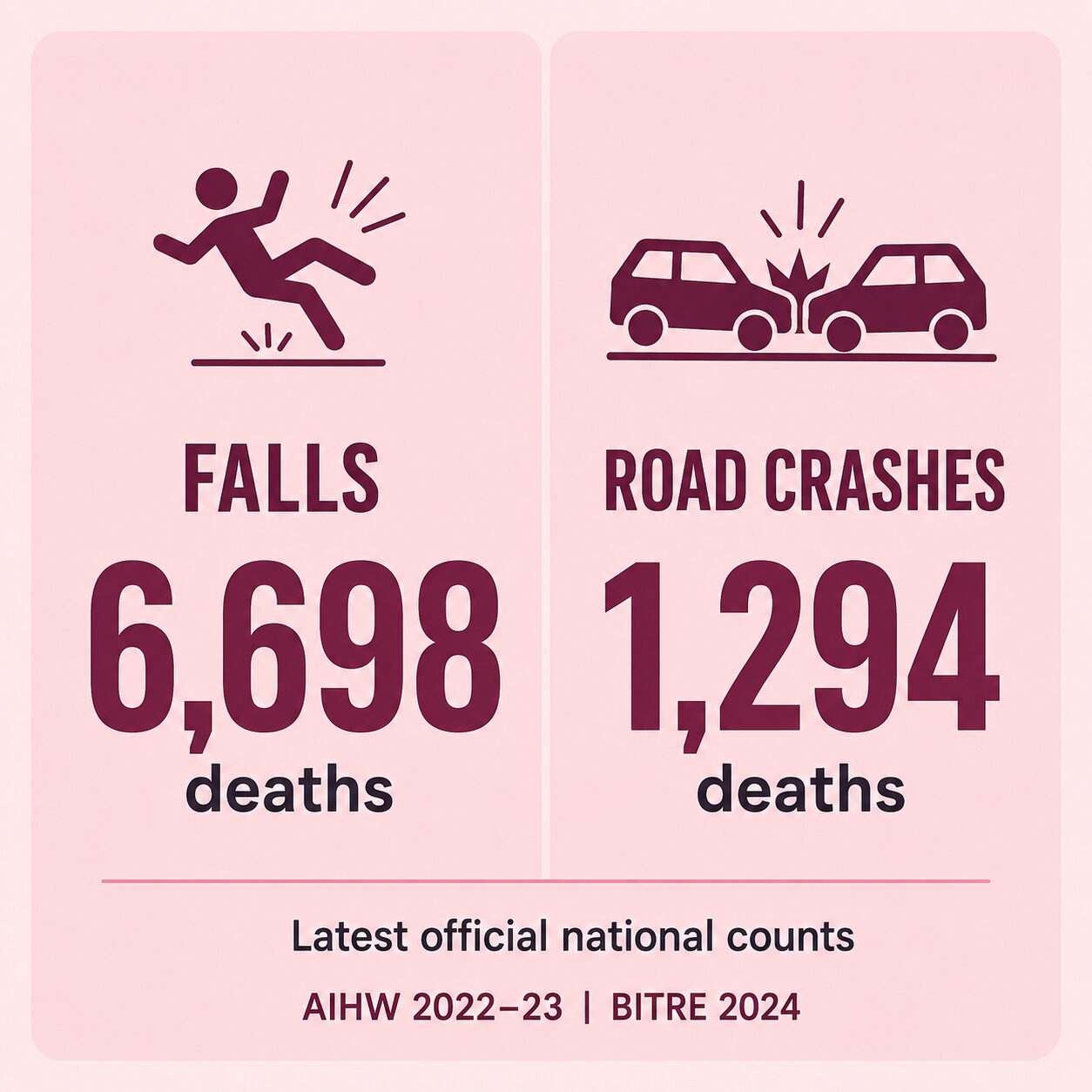
Falls Australia data demonstrates the importance of taking yogic steps to maintain bone strength, muscles, balance, and more.
Tiedemann et al. (2013, Australia): 12-week Iyengar Yoga Pilot RCT:
This Iyengar yoga study randomised 54 community-dwelling adults (mean age 68) to twice-weekly Iyengar yoga (focus on standing postures) or an education-only control[2][3].
After 12 weeks, the yoga group showed significant improvements in balance and mobility measures: longer one-leg stand times, faster chair stand and walk speeds, and better closed-eye balance[4]. No serious adverse events occurred[5].
This suggests in-person Iyengar yoga is feasible and can improve physical performance indicators linked to fall risk (though falls were not measured directly)[6].
Take action to address decreasing bone density
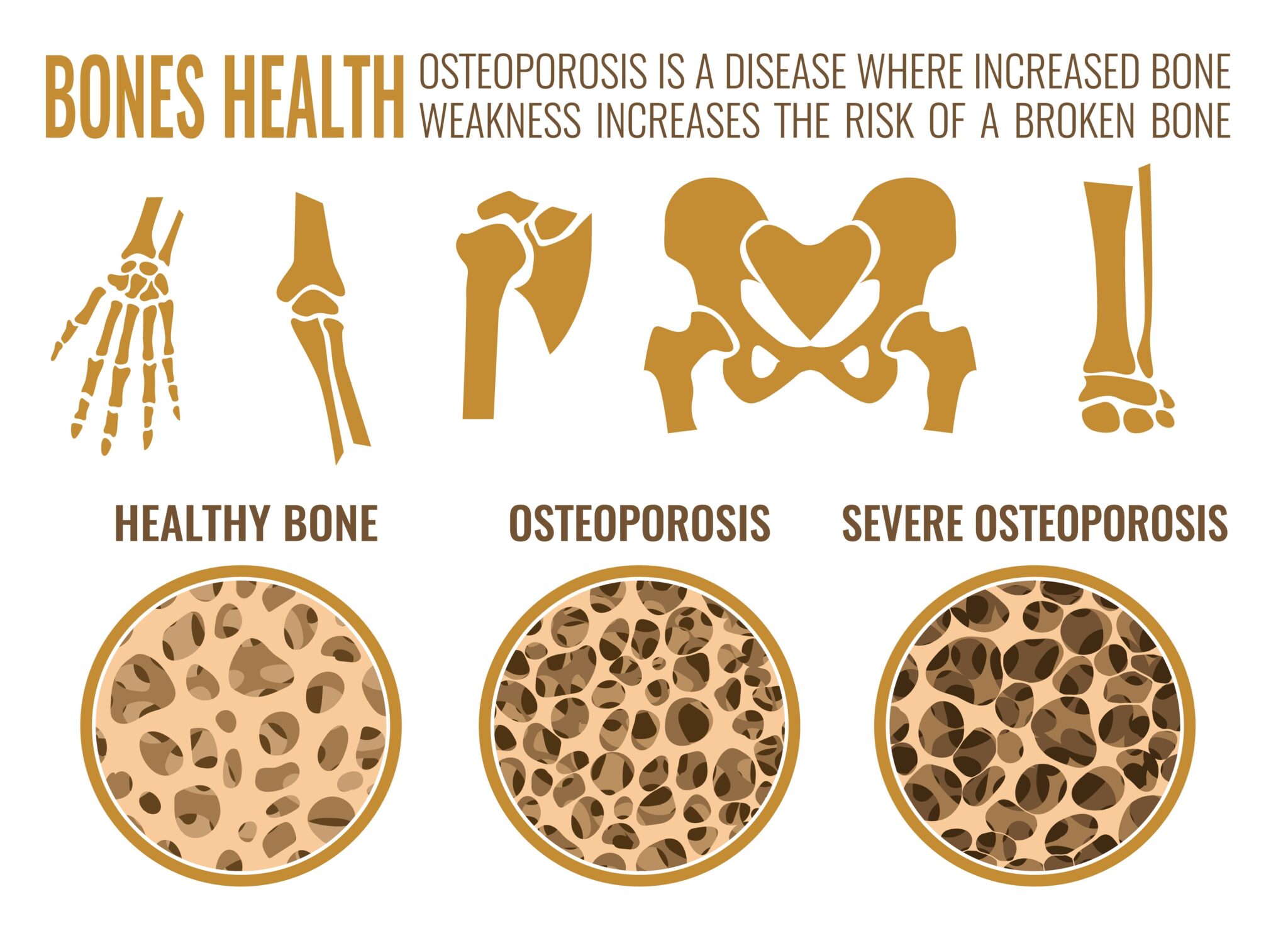
Although it was not drawn out in the report, the SAGE yoga falls study data showed a 39% decrease in falls among the least physically active participants, the group most often referred to falls prevention, without an increase in injurious falls.
The same research team, two opposite results
The 2013 pilot above, from the same research team, is one of the strongest pieces of evidence in the world that authentic, in-person, prop-supported, Certified Iyengar Yoga Teacher (CIYT) designed Iyengar Yoga improves the very outcomes (standing balance, sit-to-stand, gait) that are mechanistically linked to falls reduction in older adults.
Yet the same research team’s 2025 SAGE trial is presented as showing that “Iyengar yoga” increases falls.
The crucial difference is discussed below. Academics redesigned the SAGE yoga trial’s curriculum. It reached the students mostly through online methods we regard as insufficient. Those students came to it unprepared, in the sense that the right poses had not been taught in the right order. In addition, of the four named teachers, no more than two held current Certified Iyengar Yoga Teacher (CIYT) credentials. That is the recognised standard for the Iyengar method.
DiBenedetto et al. (2005, USA): 8-week Iyengar Yoga Gait Study:
This is relevant to Iyengar yoga falls because 23 older adults (62 to 83) took part in twice-weekly “gentle” Iyengar classes plus home practice, with pre-post gait lab assessments[7][8].
The program led to significant gains in gait parameters: participants increased their peak hip extension and stride length when walking (p<0.05)[8], and showed a trend toward reduced anterior pelvic tilt[9].
These changes are biomechanically meaningful, as restricted hip extension and shortened stride are linked to fall risk in elders.
Authors concluded that tailored Iyengar yoga may improve gait and could potentially help prevent or delay age-related gait changes associated with falls, warranting larger controlled studies[10][11].
Bone density: a key risk with falls
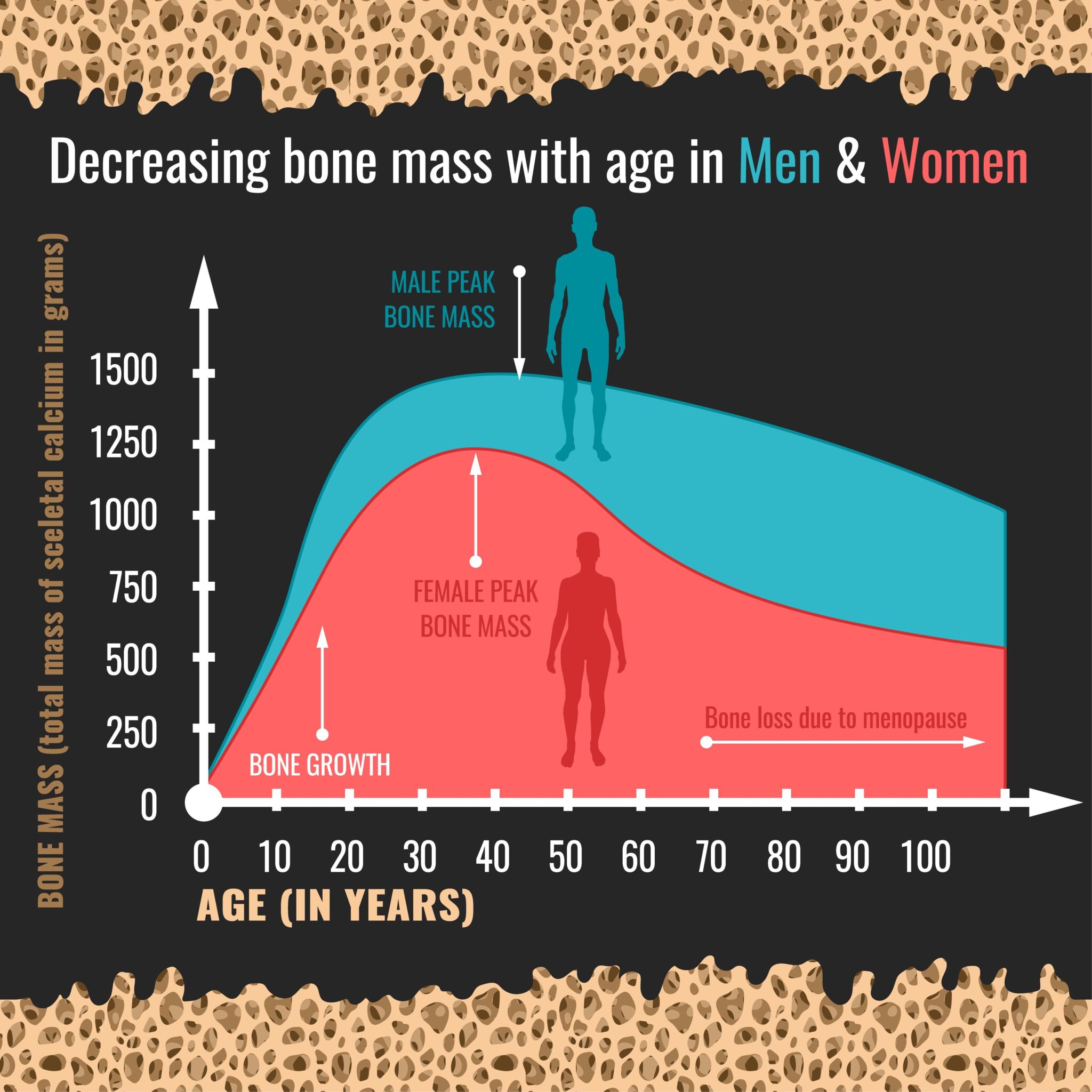
Bone density decline by age. An issue for men and women, starting earlier than realised.
Schmid et al. (2010, USA): 12-week Yoga Fear-of-Falling Pilot:
14 older adults (65+) with baseline fear of falling underwent a biweekly yoga program (a mix of seated and standing poses; the authors did not name the style, but it was alignment-based).
After 12 weeks, fear of falling (FoF) scores decreased by 6%, static balance (Berg Balance Scale) improved ~4% (p=0.045), and lower-body flexibility increased 34%[12].
Although a small single-arm study, it indicates yoga can reduce fear of falling and improve balance confidence in seniors [13], factors that often correlate with actual fall risk.
The authors suggested yoga is a promising intervention to manage fear of falling and improve balance, but called for further research to confirm falls outcomes [14].
Iyengar yoga for falls: Darwin & online
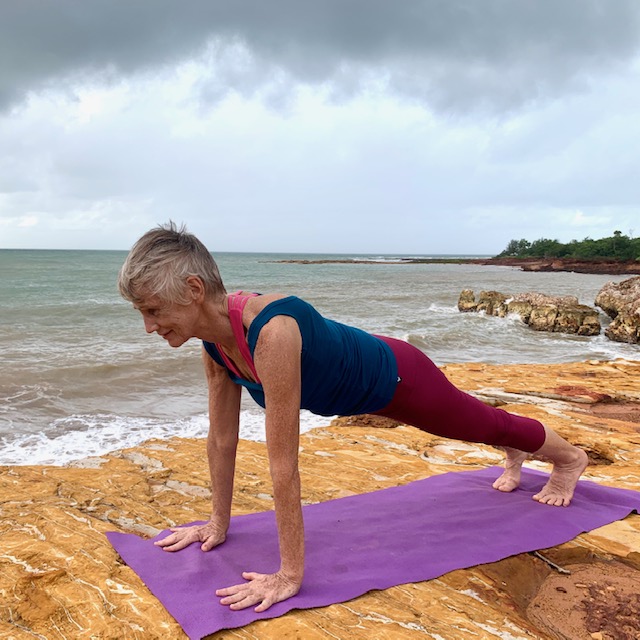
Iyengar yoga for bones & balance includes weight bearing poses like this straight arm plank pose. Demonstrated by Chris Lalor, from her Flametree Iyengar Yoga Darwin studio.
Ni et al. (2014, USA): Yoga vs. Tai Chi vs. Balance Training (RCT, older fallers):
In this falls yoga study, the researchers assigned 39 seniors with a history of falls to 12 weeks of: (a) a specially-designed yoga program, (b) standard balance exercise training, or (c) Tai Chi. All three interventions ran in person.
Falls yoga result: all groups showed significant improvements in both static and dynamic balance, with no clear winner. The yoga program matched Tai Chi and conventional balance exercises in these high-risk older adults[15].
Notably, there was no report of increased falls during the study.
This suggests that, when properly designed and supervised, even older adults prone to falling can practice yoga safely and gain balance benefits comparable to well-established fall prevention exercises.
With this last study, it’s worth noting that it was only yoga that was studied, and not Iyengar yoga. The yoga still performed well. In our view, given what the in-person Iyengar studies found, Iyengar yoga would have been well worth testing alongside it.
Zhu et al. (2021, China): 16-week Iyengar Yoga vs. Tai Chi vs. Control (RCT):
This falls yoga study randomised 48 adults aged 60 and over to Iyengar-based yoga classes, Tai Chi classes, or a no-exercise control [16].
Both Iyengar yoga and Tai Chi ran in person and led to significant gains in muscle strength, one-legged balance (eyes closed), timed up-and-go (dynamic balance), and balance confidence, compared to control [17].
In head-to-head comparison, Tai Chi had a slight edge in knee flexor and extensor strength, and in self-reported balance confidence. Iyengar yoga was equally effective or better on certain balance measures. It improved one-leg static balance and the 8-foot up-and-go test significantly more than Tai Chi[18][19].
The study concluded that both Tai Chi and Iyengar yoga are safe, beneficial exercise options for older people to improve physical functions related to falls[20].
Importantly, the trial noted no increase in falls. Rather, it presented these activities as protective or performance-enhancing.

Iyengar yoga for falls: a single leg balance like Warrior 3 comes after the legs have been built, not before.
Falls yoga: Summary of In-Person Findings
Across diverse settings (Australia, US, China), in-person Iyengar yoga interventions consistently improved outcomes linked to fall risk, including balance (static and dynamic), gait, lower-body strength, flexibility, and confidence [4][8][12][17].
Participants generally became more stable and more capable in objective tests. None of these studies reported an elevated fall rate associated with yoga practice. If anything, the expectation (though not directly measured in most cases) was that better balance and strength would translate into fewer falls long-term.
Notably, these programs ran relatively short (8 to 16 weeks), with qualified instructors supervising face-to-face, able to give real-time feedback and physical support.
The positive outcomes contradict the SAGE trial’s finding (via online yoga) that yoga increased falls, pointing to a potential influence of delivery mode and program design. There were also other issues with the SAGE study that we mention below (and will review further in another post).
It’s also worth noting that most of the above falls yoga studies were small pilot trials, underpowered to detect actual fall incidence; instead they tracked proxy measures.
Still, the overall evidence from studio-based Iyengar yoga is favorable.

Falls yoga studies, taught in person: promising for falls prevention, and still worth testing in larger trials.
As one review summarised, the majority of yoga studies in older adults show improvements in balance, muscle strength, flexibility, and even mood (reduced fear/anxiety), with particularly notable gains in static balance across different program durations [21].
SAGE Yoga trial was not Iyengar yoga
The 2025 SAGE yoga data, fairly described, would warrant a much more qualified conclusion than it claimed.
In brief, a fairer description is an academically designed, mostly online exercise programme. It was labelled “Iyengar yoga”, but delivered by a team of four, no more than two of whom held current Certified Iyengar Yoga Teacher credentials. In March 2026 The Lancet published a correction to the paper. It now describes the programme as “a supervised yoga exercise programme based on some elements of the Iyengar style”, and states that two of the four instructors specialised in the Iyengar style of yoga.
On the account of a teacher involved in the trial, it ran with limited Iyengar-style props. Participants often had their cameras off, and the spaces were often too small for the poses. Single-leg balance came in Week 1, which is contrary to a standard Iyengar curriculum.
On its own data, the programme produced only a marginal and statistically fragile increase in falls overall, alongside a 39% decrease in falls among the least physically active participants (IRR 0.61, p=0.05), and no increase in injurious falls.
This is obviously a very different headline to what the SAGE falls yoga study claimed. In our view, the claim that “Iyengar yoga” is “linked to higher rates of falls” is not fairly warranted by the study’s own underlying data.

The SAGE yoga trial, on its own data: a very different picture from the headline.
The task after the SAGE Yoga study
Falls kill more Australians than road accidents. Australia and the world need a falls-prevention strategy that is sustainable, lifelong, low-impact, individualised and embedded in a community of skilled teachers trained in the Iyengar style.
Authentic Iyengar Yoga, taught by properly trained Iyengar Yoga Teachers, in studio or online with proper conditions, with appropriate props and a foundation-first sequence, is exactly such a strategy. The above studies point that way, although they measured balance, gait and leg strength rather than falls themselves.
The SAGE yoga trial does not show otherwise. It shows what can happen when the form of yoga is borrowed without its complete substance. It ran largely online, without established online teaching methods. Of the four named teachers, no more than two were Iyengar-certified. On the account of a teacher involved, students often could not be clearly seen. They practised in spaces too small for the poses, and without the props the practice consistently needs.
In addition, because the published record does not say which teacher taught which student, no proportion of the teaching can be assigned to the Iyengar style at all. In our view, for a long list of reasons we discuss at greater length elsewhere, the SAGE yoga trial was not Iyengar yoga as it is normally taught.
The task ahead, for the global Iyengar Yoga community, is to make the substance, and the difference, unmistakable.

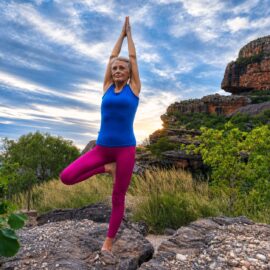
Tree Pose at Edith River. Steadiness on one leg is built from the ground up, over years.
Flametree Yoga timetables
Check out Flametree’s upcoming beginner schedule of classes.
We’re here to support you every step of the way in your yoga journey, including with authentic Iyengar yoga for falls prevention.
Enjoy, and see you in the studio; or online (with cameras on) and with you in the picture, with appropriate props!
Consider our half price deals for new and lapsed.
Standing poses for strength, bone health, balance, & more
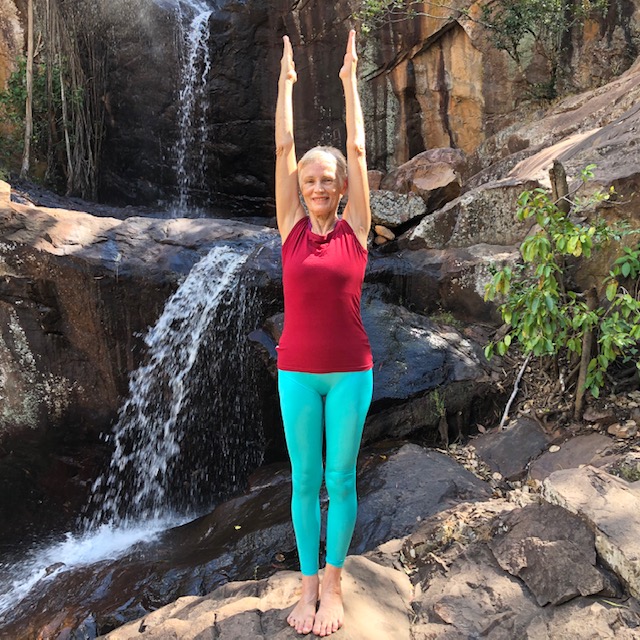
Iyengar falls yoga studies show the positive outcomes that many students experience. As usual, there’s always room for more and larger studies of yoga for falls, and much more.
Yoga for falls sources, including Tiedemann:
- Oliveira JS, et al. (2025). Lancet Healthy Longevity, Iyengar Yoga vs. Relaxation for falls (SAGE trial)[1][33].
- Tiedemann A, et al. (2013). Journals of Gerontology A, 12-week Iyengar yoga RCT in older adults[3][4].
- DiBenedetto M, et al. (2005). Arch Phys Med Rehabil, 8-week Iyengar yoga gait study[8][10].
- Schmid A, et al. (2010). Arch Phys Med Rehabil, 12-week yoga pilot on fear of falling[12][13].
- Zhu R, et al. (2021). J Sports Med Phys Fitness, 16-week Iyengar yoga vs. Tai Chi RCT[17][103].
- Ni M, et al. (2014). Arch Phys Med Rehabil, Yoga vs. Tai Chi vs. balance training in older fallers[15].
- Green E, et al. (2019). Am J Occup Ther, Systematic review of yoga for balance/falls[104][105].
- Symanski E. (2017). Yoga Practice for the Elderly: Good Choice to Avoid Falls, Review of yoga & balance studies[106][21].
- University of Sydney (2025). Press Release on SAGE trial, Researcher quotes and context[1][44].
- “Analyzing Iyengar Yoga Falls Study” (2025). Internal Report, Comprehensive analysis of SAGE and recommendations (not published).
Yoga, balance and falls: questions people ask
Is yoga on its own enough to prevent falls?
Probably not on its own, and it is only fair to say so. The strongest evidence for preventing falls is for programmes that combine two things: genuinely challenging balance work, and leg strengthening. You need to do both regularly, and to make them harder over time.
What a well taught Iyengar class gives you is both of those ingredients, with props and in an order that builds. So put it alongside an eyesight check and a medication review with your GP. Get rid of the loose rugs too. Between them, those cover most of what the research asks for.
Does yoga improve balance?
Yes, and this is one of the better supported claims in the whole yoga literature. Standing poses train the ankle, hip and eye systems that keep you upright.
The gains show up in the measures that matter, like how steadily you walk and how confident you feel on your feet.

Yoga for balance: Half Moon Pose, one of the standing balances that trains the ankle, hip and eye together.
How do you prevent falls in older adults?
Strength and balance training is the single most effective thing, and it needs to be challenging enough to be worth doing. Gentle chair movement alone is not enough.
The rest is practical: check your eyesight, review your medications with your GP, and get rid of the loose rugs.
Is yoga good for seniors who worry about falling?
Fear of falling is its own risk factor, because people who are frightened move less and get weaker.
Yoga tackles both sides at once. It builds the leg strength, and standing near a wall with a teacher watching rebuilds the confidence.
Is yoga or tai chi better for balance?
We are not qualified to comment on tai chi, so we are not going to. We have never trained in it and we do not teach it. What we can tell you is why people choose yoga, and why they stay.
Standing poses load the legs directly. Holding one is work, and that work is what builds the strength that keeps you upright. Yoga is also especially effective for building stronger bones, as we have discussed elsewhere. Beyond that it has a very wide range: the breathing, the way attention is trained, the effect on sleep and on a busy mind, and a long body of teaching about all of it.
That range is the reason most of our students give for still being here years later. They came for one thing, usually a sore back or a balance worry, and stayed because they got several others they were not expecting. Doing something regularly for years is what actually changes a body, and the range is why people keep doing yoga.
What is the best balance exercise for seniors?
Standing on one leg, done regularly, near something to hold. It is unglamorous and it is the one that shows up again and again.
Standing poses in yoga are that exercise dressed up with better instructions. In most yoga classes, even basic beginning yoga classes, you will, with the help of props including walls, usually stand on one leg for some part of such classes. In Iyengar yoga classes your teacher will also be giving you a range of precise instructions on how to achieve better bones, a steady mind, and get a range of other benefits.
How often do I need to practise to see a change?
The falls trials that worked generally ran twice a week for 12 weeks or more, with some practice at home in between.
Twice a week is the floor, not the target. As we have said elsewhere, the more often you do yoga, the more benefits from it that you will see.

The chair as support while standing. That is how a chair helps falls prevention, rather than sitting on it.
Is chair yoga enough for falls prevention?
It is a reasonable starting point for someone who cannot stand safely yet, but sitting down does not train standing up.
The aim should be to use the chair as support while standing, and that is how Flametree uses chairs.
Why did the SAGE yoga trial get a different result?
SAGE offered its yoga group 80 supervised classes over 12 months. In contrast, the control group got two one-hour workshops. The authors also state that most classes were held online because of COVID. In our view, that makes it difficult to draw conclusions. The trial reported 0.87 falls per person-year against 0.64, an incidence rate ratio of 1.33 with a confidence interval of 1.01 to 1.75. Of the four teachers the trial named, no more than two held current Certified Iyengar Yoga Teacher credentials. Iyengar yoga is a defined yoga style and people who have not had the rigorous training that Iyengar yoga teachers receive will not be able to do justice to the methods of Iyengar yoga or achieve what it has and does variously achieve. SAGE did not use the recommended amount of yoga props, or recommended Iyengar yoga sequences.
So, in our view, even beyond what we have mentioned, the programme it tested differed in important ways from Iyengar yoga as it is normally taught in a studio, or even in good quality online Iyengar yoga. That studio practice is what the earlier, and very positive trials, looked at. The SAGE authors’ own conclusion was a narrow one: that this programme should not be recommended for fall prevention “in its current form”.
Where can I do balance focused yoga in greater Darwin, or online?
Flametree teaches at Woolner (near Parap), and Coolalinga, and sometimes in Casuarina, Palmerston and the CBD, as well as online. See the timetable and book a class here.
More on this from Flametree
Falls are one part of a larger picture. Our companion article looks in detail at what the SAGE trial actually tested. Two newer articles go further: does yoga cause falls, and what the numbers actually say, and the SAGE trial correction, and what it left alone. Flametree has also written on yoga for bones and osteoporosis. There is a separate post on how a yoga pose builds muscle and bone at the same time, and another on activities for seniors in Darwin. Strong bones and steady legs are the same project.
If you want to start, the half price 10 class pass with 2 classes free covers Darwin and online.