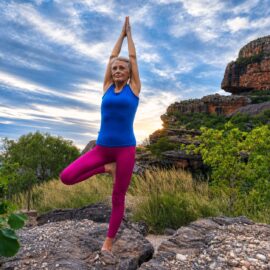
How To Calm Your Nervous System: What Yoga Actually Does
Calming your nervous system: the short answer
It’s 3am, the same “what if” is going round again, and telling yourself to calm down does nothing. That’s because how to calm your nervous system is not a decision. Your nervous system runs on automatic and takes cues from your breath and your body, not orders from you. A long, slow out breath is the quickest cue, supported poses are the next, and regular practice makes the calm last. Here is what Iyengar teaching does about it, what research has found, and how to calm your nervous system at night and in the middle of a bad day.
Iyengar yoga is the style developed by Mr BKS Iyengar. In the 20th century he did more than anyone to set down traditional Indian yoga, through his books and his teaching, and he pioneered the use of props. It is sometimes called modern classical yoga, and it’s the style we teach at Flametree. This page sits in our stress and sleep notes.
How to calm your nervous system in short form
- Slow breathing is the switch. It activates the vagus nerve, the main line telling the body it is safe.
- Make the out breath longer than the in breath. Four counts in, six or eight out.
- At night, rest supported. Legs up a wall or over a bolster, then a long out breath.
- Gentle and restorative poses do more here than hard ones. They give the body time to settle.
- Meditation shows up on scans. Calmer brain waves, and changes in brain structure after eight weeks of training.
- Students say it changes how they eat. Better sensing of hunger, less eating from stress.
- Doing it with other people helps. Shared, safe experience is part of how the nervous system relearns.
- Start with something doable. Your first class is free if you’re new to Flametree.
This page is drawn from a Flametree Yoga presentation given to a Darwin mental health group.
What “dysregulated” actually means
Your autonomic nervous system has two sides. The sympathetic side is fight or flight. The parasympathetic side is rest and digest. Both are supposed to be in use, taking turns.
Humans are finely tuned for that pattern: run from the danger, then recover. The problem is the recovery half. Most of us spend far too long on the sympathetic side and barely visit the other one.
Chronic stress is what that looks like over time, and it is what people mean by a dysregulated nervous system. Exhausted, hyped and short tempered, all at once. If you never recover, you do not get calmer. You get more brittle.
Yoga rebalances this through breath, movement and awareness. Not by relaxing you for an hour, but by giving the parasympathetic side regular practice at being switched on.


Why can’t I just tell my body to calm down?
Because your nervous system doesn’t take orders. It is on automatic, so you can’t cut anxiety or slow a racing heart just because you want to.
What you can do is put your body into certain shapes and breaths that talk to it directly. Think of the stress response as a lion. The bill, the test results, the family worry and the 3am “what if” keep it awake, and the question is how to switch it off once the danger has gone.
In Iyengar teaching, three things help the body come back to the middle:
- Slow breathing. A long, slow out breath tells the body the danger has gone. It is the quickest to try, and it costs nothing.
- Long supported poses. Resting over bolsters and blankets lets the body stay still long enough to settle. Many students tell us this is where tired, wound-up days finally ease.
- Better sleep. Sleep is when the body does its repair work, and a calmer evening helps a better night. Our six easy poses for sleep are a good place to start.
These are known from long practice in yoga. Research on parts of them, like slow breathing, is covered below, and research on the rest is still growing.
Mr BKS Iyengar put it plainly in Light on Life (2005): “the key to overcoming stress is to calm and strengthen the nervous system.” He added that we cannot remove stress from life. What matters is how much it affects the nerves.
The vagus nerve, and why it is the key
The vagus nerve is the main nerve of your parasympathetic nervous system. Vagus means wandering, and it is well named: it runs from the brainstem down through the throat, heart, lungs and gut.
It is the major brain to gut connection, which is why anxiety is felt in the stomach and why nerves affect digestion. It is a two way road.
Slow breathing activates it. That is the single most useful fact on this page. You do not need a device, an app or a supplement. A long, unhurried out breath stimulates the vagus nerve directly, and the body reads that as a signal that the danger has passed.
The calming side of the nervous system also works alongside your hormones, such as cortisol for stress and adrenaline for energy. When the body feels safe, it has less reason to keep the stress hormones high.

Can vagus nerve yoga make you less reactive?
Often, yes, and it is usually one of the first changes people notice. In the yoga tradition this steadiness is called equanimity: staying composed when faced with difficulty, pain or somebody else’s bad day. Research has started to link a well-working vagus nerve with feeling compassion for other people, which is the same quality seen from the other side.
Here is how I (Chris Lalor) first noticed it in myself.
My first retreat, and the drive home
Not long after I moved to Darwin, I went on my first yoga retreat. I had been practising for about three years. We went by boat across Darwin Harbour, camped under the stars for the weekend and did yoga classes. I loved the company, and the quiet times in between.
My partner came to pick me up. The car radio was on loud and he was completely absorbed in a current affairs programme. Something major and worrying had happened over the weekend, and I had been totally oblivious to it. He was stressed and anxious.
I sat and listened, and marvelled. The few days away, and my practice in general, let me feel his worry without reacting in a grumpy way. I remember thinking “oh, you poor bugger”. Before yoga, I think I would have been irritated at being pulled out of the retreat head space so abruptly.
I hear a version of this from new students all the time: “I’m not sure I’m getting a lot out of yoga yet, but the family seems more agreeable since I started.” The family has not changed. They have.

A forward bend with the head supported. Iyengar teaching uses poses like this to quieten the nervous system.
How does yoga teach equanimity?
By asking you to stay with a pose while it is uncomfortable, and to watch your reaction instead of acting on it. Some poses bring up strong feelings. Many of us have poses we would rather avoid, and others we only want to do because we are good at them.
Yoga teaches us to stay calm, take a little distance, and face discomfort in a more measured way. Afterwards it asks us to reflect: could I have approached that pose, or that conversation, with a different mindset? Over time the same habit turns up off the mat. If anger is the feeling that surfaces, our post on yoga and anger goes further.
Which yoga poses improve vagal tone?
Iyengar teaching uses four groups for this: long, slow exhalations in pranayama (breath work), the Shoulderstand cycle, forward bends with the head supported, and restorative poses. Vagal tone means how well the vagus nerve is doing its calming job. It is usually measured through heart rate variability (small, healthy changes in the gap between heartbeats).
Of these, slow breathing is the best tested. A 2022 review in Neuroscience and Biobehavioral Reviews found it raises heart rate variability, during practice and after training. The poses are known from long practice, and students commonly tell us they feel calmer and kinder after them, but modern research has not yet tested each one directly. Shoulderstand is learnt with props and a teacher, in the studio or LIVE online.
On compassion, researchers at the University of California, Berkeley found that when people watched others suffering, those who felt more compassion showed more vagal activity (Stellar and colleagues, Journal of Personality and Social Psychology, 2015). It is hard to stay judgemental when you can see what is going on for the other person. That is part of what the practice builds.
How to calm your nervous system, practically
Right now, in two minutes. Breathe in through the nose for a count of 4. Breathe out through the nose for 6 or 8. Do not strain, do not hold. Repeat for two minutes and notice what your shoulders do.
Today, in twenty minutes. Lie down with your legs up a wall (our note on setting up legs up the wall shows how), or over a bolster, and breathe slowly. Supported positions let the body stop working, which is the condition the parasympathetic side needs.
Over weeks. Two to four classes a week of gentle or restorative yoga. The props and alignment of Iyengar yoga promote a sense of safety, which matters more than it sounds, because a nervous system that feels unsafe will not switch over no matter how nice the room is.
Restorative yoga in particular is built for this. If you want the detail, see what restorative yoga does.
How do I calm my nervous system at night?
Make the evening slower, then rest supported before bed. Put the screen away, dim the lights, and lie with your legs up a wall or over a bolster for ten to twenty minutes.
Let each out breath run a little longer than the in breath. If you finish with a few minutes flat on your back, our note on savasana shows how to let go. When you get into bed, take the same breath with you. If the 3am “what if” arrives anyway, you now have something to do with it: breathe out slowly, and let the body do the work. For the full bedtime routine, see our sleep poses and habits.
If worry and stress feel bigger than breathing can handle, our page on yoga for anxiety goes further, and so does yoga for stress relief.
Your first class is free if you’re new to Flametree. New students, and anyone who has been away three months or more, can also get a half price 10 class pass with 2 extra classes free, to use online, in the studio, or both.
Brain waves, and what meditation measurably changes
Studies of meditation using EEG (a recording of the brain’s electrical activity) report a shift away from beta waves and towards alpha and theta waves. It is still being studied, but it matches what calm feels like from the inside.
Alpha waves, at roughly 8 to 13 Hz, go with creativity, flow state and focus.
Theta waves, at roughly 4 to 8 Hz, go with inner peace, REM sleep and deep meditation.
What that adds up to in ordinary life is better focus, better mood and less rumination. Rumination is going over the same thought for the fortieth time. It is exhausting, and it is the thing that eases first as you settle.
Brain scans have shown changes too. In a 2011 study in Psychiatry Research, 16 people took an eight week mindfulness-based stress reduction course, and their scans showed more grey matter in regions linked with learning, memory and emotion regulation, compared with 17 people on a waiting list (Hölzel and colleagues). In a separate 2010 study of 26 stressed people, those who felt less stressed after the same eight weeks showed less grey matter density in the amygdala, the brain’s alarm centre (Hölzel and colleagues, Social Cognitive and Affective Neuroscience). These were mindfulness courses, not yoga classes, but the brain is not fixed, and this is one of the few things ordinary people can do that shows up on a scan.


A calmer nervous system changes how you eat
This part surprises people, so it is worth spelling out.
Yoga is said to sharpen interoception, which is your ability to sense what is happening inside your own body. Hunger and fullness are interoceptive signals, and most of us have learned to talk over them.
When that sense sharpens, students often tell us that emotional eating eases. Not through willpower, but because you can tell the difference between being hungry and being upset. It is known from practice, and research on it is still growing.
The point is regulation, not restriction. When stress comes down and awareness goes up, eating habits tend to shift on their own. No harsh diet, no punishing exercise.
If disordered eating is part of your picture, please work with a professional alongside any yoga practice. Yoga supports that work. It does not replace it.
Why doing it in a group matters
Shared experience builds connection, and connection is not a nice extra here. Co-regulation, which is the way one calm nervous system settles another, is a big part of why a class feels different from the same practice alone in your lounge room.
That is also why yoga is used in social prescribing, where a health practitioner refers someone to a non-clinical activity rather than writing a script.
What to look for in a class, if you are starting for this reason
Avoid one-size-fits-all classes. A single level class where everyone does the same thing is too hard for most people arriving with a stressed nervous system, and being out of your depth is not calming.
Start with doable yoga, with props. Blocks, belts, chairs and a wall are what make a pose available to you today rather than in a year.
Look for a real range of options. Beginner, Gentle, Yoga for Backs, Restorative. A timetable with one kind of class has one kind of student in mind, and it may not be you.
Look for teachers trained to teach in steps. Being shown the shape is not teaching. Being taken to it in stages is.
Do the postures before the sitting. Trying to meditate with a wired mind and a stiff body is the hardest possible entry point. Quieten the body first, and the sitting becomes easy.
Make sure you can afford enough of it. This works through habit, not through a single session, so a block of classes matters more than one.


Questions people ask
How do I calm my nervous system quickly?
Lengthen the out breath. In for 4, out for 6 or 8, through the nose, for two minutes. A long out breath stimulates the vagus nerve, and that is the body’s own signal that the threat has passed. It is the fastest thing available to you and it costs nothing.
What calms the nervous system best over the long run?
A regular practice, not an intense one. Two to four sessions a week of gentle or restorative yoga with breath work will do more over eight weeks than anything dramatic will do in a day.
How do I know my nervous system is dysregulated?
The usual signs are being tired and wired at the same time, a short fuse, disturbed sleep, a churning stomach, and never quite settling even when nothing is wrong. If it is severe or long running, talk to your yoga teacher, yoga therapist and your doctor if you wish. There are causes worth ruling out.
Do vagus nerve exercises actually work?
The useful ones are simpler than the internet suggests. Slow breathing, humming, singing and gentle supported poses all engage the vagus nerve, and they are free. The Bhramari humming breath taught in pranayama is one of the oldest versions of this, and it predates the term vagus nerve by a couple of thousand years.
What is vagal tone, and can yoga improve it?
Vagal tone is how well your vagus nerve is calming the body, and it is usually measured through heart rate variability. A 2022 review of 223 studies found that slow breathing raises it (Laborde and colleagues, Neuroscience and Biobehavioral Reviews). Iyengar teaching adds supported forward bends, the Shoulderstand cycle and restorative poses, which students commonly find calming. Those are known from long practice rather than tested one by one.
Does yoga help mental health?
Many people find it does, especially for stress, worry and sleep. It sits alongside therapy and medication, not in place of them. What yoga does well is the body side of the problem, which talking does not reach.
How long before it makes a difference?
Many people feel a difference after one class. In the brain studies above, changes were measured after eight weeks of regular practice.
Should I do yoga before I try meditation?
For most people starting out, yes. A wired mind finds sitting still very hard, and the poses give it something to do. Once the body has quietened, meditation lands much more easily. That is the order Flametree teaches in, and it is deliberate.
Can yoga help with trauma?
Trauma-sensitive yoga supports body awareness and regulation, and it is used alongside conventional therapy rather than instead of it. Tell your teacher what you need. A class where nobody touches you without asking and nobody makes you close your eyes is a reasonable thing to request.
How do I calm my nervous system at night?
Make the evening slower, then rest supported before bed. Lie with your legs up a wall or over a bolster for ten to twenty minutes, and let each out breath run a little longer than the in breath. Take the same breath into bed with you.
Where can I try this in Darwin?
Flametree teaches at Woolner (near Parap) and Coolalinga, and LIVE online. Gentle Yoga and the restorative classes are the ones to look at first, and your first class is free if you’re new to Flametree.
Check the beginner timetable and just come along. For a LIVE online class, click the class time you want and we email you the link to join.
Research sources
- Laborde, S., et al. (2022). Effects of voluntary slow breathing on heart rate and heart rate variability: a systematic review and a meta-analysis. Neuroscience and Biobehavioral Reviews, 138, 104711. 223 studies. doi 10.1016/j.neubiorev.2022.104711
- Hölzel, B. K., et al. (2011). Mindfulness practice leads to increases in regional brain gray matter density. Psychiatry Research: Neuroimaging, 191(1), 36-43. 16 course participants, 17 waiting list controls. doi 10.1016/j.pscychresns.2010.08.006
- Hölzel, B. K., et al. (2010). Stress reduction correlates with structural changes in the amygdala. Social Cognitive and Affective Neuroscience, 5(1), 11-17. 26 participants. doi 10.1093/scan/nsp034
- Stellar, J. E., et al. (2015). Affective and physiological responses to the suffering of others: compassion and vagal activity. Journal of Personality and Social Psychology. doi 10.1037/pspi0000010
- Iyengar, B. K. S. (2005). Light on Life. Rodale.
Flametree Yoga Studio teaches Iyengar yoga in Darwin, at Woolner and Coolalinga, and LIVE online anywhere.
Last updated 14 October 2026: added the “why can’t I just tell my body to calm down” section, a night-time section, and the brain studies with their sample sizes. This article is general information, not medical advice. Talk to your yoga teacher, yoga therapist, and your doctor if you wish, before changing what you do.
Already practising yoga? The same half price 10 class pass for new students, and for anyone away three months or more, is also available as the non-beginner half price pass.