Yoga Classes For Teens, & How To Engage Them In Effective Mind Body Practices
Is yoga good for teenagers, and how do you get a teenager interested? Here is what Chris saw when she taught a group of 12 to 17 year olds in Darwin, what the research says, and how to start.
Yoga classes for teens: the short answer
Yoga for teens works best when it is active first and calm last: balance poses, standing poses and a few safe inversions to hold their attention, then a quiet lie-down at the end. Reviews of school yoga programs find it is safe and generally helpful for young people’s mood and focus, though most studies are small. Flametree’s regular classes are for adults, so contact us about a teen group, or about a young person joining a beginner class.
Iyengar yoga is the style developed by Mr BKS Iyengar. In the 20th century he did more than anyone to set down traditional Indian yoga, through his books and his teaching, and he pioneered the use of props. It is sometimes called modern classical yoga, and it’s the style we teach at Flametree. This page sits in our beginners notes.
This note in short form
- What happened when Chris taught a Darwin group of 12 to 17 year olds.
- Benefits of yoga for teens: what research has found, and its limits.
- How to engage teens in yoga: the right poses in the right order.
- Yoga poses for teens they enjoy, and a simple way to learn Tree Pose.
- Stress and body image: what the school and body image research says.
- Teaching yoga to teens takes a well trained teacher.
- Next step: contact us about a teen group, or try a beginner class.
The same ideas apply whether you are looking for yoga for young people, yoga for children or yoga for teens online. Flametree teaches Iyengar yoga, and the way it works is useful for any mix of young ages.
What happened when Chris taught yoga classes for teens?
Chris once taught two one-off classes to a group of 12 to 17 year olds from a teens drop-in centre, during the school holidays. Several adults and local organisations were working with the group. The teens were a typical cross-section of modern Darwin, boys and girls, and their states of mind were what you might expect.
It was similar to what she has done elsewhere over many years, including with children.
Yoga for children or teens: use plenty of balance poses

Balancing poses are a good start for young people. They are usually better at them than adults, and the focus such poses need is part of why the right sequence will calm a teenager.
Can yoga calm teenagers?
In these classes, what surprised the watching adults most was how the young people calmed down. As the sequence went on, the teens became steadily quieter and more focused. By the end they were lying in the usual relaxation pose (Savasana) with their eyes closed.
That was what Chris planned. It is what a sequence that moves from active poses to quiet ones is designed to do. Chris also noticed some other mind and body challenges, which adults will recognise in themselves.
Strength, balance and Tree Pose, one step at a time
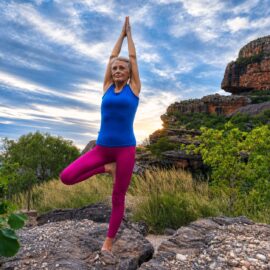
Tree Pose (Vrksasana) is a simple pose with benefits that are not obvious at first. Anyone can learn it, though it takes time to balance without help, especially outdoors with nothing to focus on.
- Start facing a wall. Look at a spot on it, and touch it if you need to.
- Move your focus to a point on the floor in front of you.
- When you are steady, raise your hands above your head to add balance and a stretch through the body and shoulders.

Tree Pose (Vrksasana) builds balance and focus, as well as strength. Stuart in Tree Pose on the rocks at Nightcliff, Darwin.
What are the benefits of yoga for teens?
The benefits of yoga for teens include building lean strength, balance and flexibility. Holding a pose still is called isometric work (the muscle tenses without moving), and moving in and out of poses is isotonic work. In our experience, yoga also calms minds, which helps focus and emotional regulation (managing strong feelings).
What research has found so far: a 2022 review of 21 randomised trials in school-aged children, in Clinical Child Psychology and Psychiatry, called the evidence for yoga and children’s mental health encouraging, while noting small samples and thin descriptions of the programs (Khunti and colleagues, doi 10.1177/13591045221136016). A 2026 review of 11 studies on body image found small, mixed benefits from yoga on its own, and more consistent ones when yoga was paired with group discussion (Schneider and colleagues, Body Image, doi 10.1016/j.bodyim.2026.102093). So yoga is a promising, low-risk support for teens, not a treatment on its own.
In a 2015 Psychology Today article, 7 ways yoga helps children and teens, psychiatrist Dr Marlynn Wei lists these areas: fitness, less stress and anxiety, optimism, focus, self-esteem, creativity, and self-control. We offer that as a useful summary of what many teachers see, not as proof.
The benefits of yoga for teens also overlap with the many outcomes adults get from yoga. Chris, a certified Senior Yoga Teacher and Yoga Therapist, knows this because Flametree Yoga Studio has taught young people as well as adults.
If a young person is struggling with anxiety or low mood, yoga can be one support, but please talk to their doctor or school counsellor too.

Young people will also have a go at advanced poses, like this arm balance, if they are shown how and given encouragement. Sequences still need to suit the group. Teens enjoy the challenge.
Why does school stress matter for teens?
An article in The Conversation, why we should put yoga in the Australian school curriculum, reports that nearly half (47%) of Australian students feel very tense when they study, compared with an international average of 37%. It draws on older survey data, so treat it as a snapshot rather than today’s figure.
The same article argues that schools could teach young people how to notice and manage stress, and describes US studies of school yoga and mindfulness programs. That is the research Flametree sees as most relevant here. Yoga is one tool for learning to settle yourself, alongside good sleep, friends and talking to people you trust.
Can yoga help body image?
The 2026 review above suggests it can help a little, and more so when classes include group discussion. A PsychCentral article on body image and teenagers makes a similar point: yoga is non-competitive, and teens can shift their focus from how their body looks to how it moves and feels.
It also warns that some people compare themselves with others in a yoga class. That is why inclusive classes matter, and why we teach yoga as something personal, not a way to get a “yoga body”.
How to engage teens in yoga?
To engage teens in yoga, use real yoga poses that interest them, taught in a lively way. You need the right poses in the right order, moving from active, exciting or focusing poses to quieter ones.
Balance poses and inversions such as handstand at a wall are often popular, as long as they are taught at a suitable level to the right group. Some teenagers may not want to try handstand, and that is fine. A room with walls helps, because the wall can support balance. A quiet room gives the calmest results.
What can be done depends on the mix of boys and girls, their fitness and their ages.
In yoga for children or teens, backbends are also favourites

Backbends are popular with young people. The teacher adjusts the poses, and their order, minute by minute, to suit what is working in the class.
Mind body challenges in yoga classes for teens
In any teen class you will see a range of abilities, and some reluctance from students who have never tried yoga. The challenges can include these.
- A scattered, dismissive or unfocussed state of mind before class.
- Low flexibility or not enough strength yet.
- Older boys going through rapid growth, which can make them stiff.
- Some young people who are very flexible but do not yet have the strength to use it.
- Many with quite good balance, often better than adults, who want to build on it.
When teaching yoga to teens, or children, start with standing poses

Standing poses build strength and balance, and give young people something clear to work at. Wide-leg standing forward bend (Prasarita Padottanasana) with the hands on a bench.
Why teens need calm as well as activity
Young people live in the same busy, connected world as adults. Many activities and screens keep the body’s “fight or flight” side switched on (the sympathetic nervous system). Yoga also works on the calming “rest and digest” side (the parasympathetic nervous system). You can see both in this diagram of your nervous system.
A sequence that is active first and quiet last gives teens both. It also gives them a way to settle themselves, which they can take into adult life.
If you have walls, include handstand when teaching yoga to teens

Handstand at a wall (Adho Mukha Vrksasana). A wall makes it safe to try, and many teens love the challenge.
What do teens take into adulthood?
In Flametree beginner classes, Chris sees adults working to overcome stiffness, poor balance, little strength and scattered minds. Chris herself was good at school sport but was horribly stiff before she found yoga. Starting good yoga early may spare a young person some of that.
Many people find that even within weeks of starting regular beginner classes they feel looser and steadier. Gentle, easy classes such as those in gentle yoga for beginners are a friendly place to begin, and yoga for beginners in Darwin explains how to choose.
The benefits of yoga for teens are extended when you have good yoga props

Props such as a barrel or bench let young people try poses they could not reach alone, and learn them safely.
What did the teens make of it?
The young people were amazed that two older teachers, Stuart and Chris, could demonstrate the poses. There were audible gasps in class.
There is nothing special about their skills. They come from regular practice of the same poses taught in any class. When a pose looked undoable, the teens often rose to the challenge. Stiffness happens even when you are young, but with practice and support, it can change. Young people grow when they are encouraged.
If you are remote, yoga for teens online could be a good option

Upward Facing Dog (Urdhva Mukha Svanasana) on the shared path by the Elizabeth River bridge. Online classes use the same mix of poses.
Emotional regulation in teen classes
Yoga can help people calm down and focus. In the Iyengar tradition the aim is a clear and steady state of mind, called sattvic. Mind and body practices can support emotional regulation, and they give young people a calm place to stand when things get tense. You can read how this works in yoga for anger.
How to engage teens in yoga, including even headstand

Headstand (Sirsasana), taught only at a suitable level. For the safe way to learn it, see our note on yoga headstand.
Yoga for teens training: how long does it take to teach?
“Yoga for teens training” can mean teaching teens, or training to become a teacher of young people. Flametree was once asked by an organisation to quickly teach them how to run classes themselves. That is understandable, but quality teaching takes years. Certified Iyengar teachers train for a minimum of three years, after years of their own practice.
The results an organisation gets from yoga depend on the quality of its teachers. If you are interested in teacher training, see Flametree’s training for teachers of yoga.
How can a young person try yoga at Flametree?
Flametree’s regular classes are adult classes, so contact us first about a young person joining a beginner class, or about a group. We will talk it through with you. Yoga for teens online is also possible, so ask us about options.
Adults can start with the beginner timetable. Our approach to starting well is in yoga class levels, and a story of starting later in life is in my story of cutting stress and weight.

A standing balance on one leg with the other leg raised, on the path beside the Elizabeth River bridge.
Practise this at Flametree
Flametree Yoga Studio teaches Iyengar yoga in the studio at Woolner and Coolalinga in Darwin, and LIVE online.
- New to Flametree? Your first class is free. In the studio, just come along. Online, go to our online class list, click the class time you want and we email you the link to join.
- Beginners: new students, and anyone who has been away three months or more, can get a half price 10 class pass with 2 extra classes free, to use online, in the studio, or both. See the beginner half price pass.
- Already practising yoga? The same half price 10 class pass with 2 extra classes free, for new students and for anyone away three months or more, is also available as the non-beginner half price pass.
- See every class time, including online classes, on the timetable.
Can’t make a class? Practise at home with our video courses.
Yoga for teens: common questions
Is yoga good for teenagers?
Yes, for most teens. Reviews of school yoga programs find it safe and generally helpful for mood, stress and focus, though most studies are small. In our experience teens respond best to active, challenging poses first and a quiet rest at the end.
What are the benefits of yoga for teens?
Strength, balance and flexibility from holding poses, plus a calmer mind and better focus. Research on school programs points to benefits for mood and stress, and yoga paired with group discussion has helped body image. Benefits build with regular practice.
How do you get teenagers interested in yoga?
Start with poses that feel like a challenge: balances such as Tree Pose and Warrior 3, handstand at a wall, and backbends. Keep it moving, then finish with slower poses and a lie-down. Teens engage when they can see themselves getting better at something.
What yoga poses are good for teens?
Tree Pose, the Warrior poses, Triangle Pose, Downward Facing Dog, Boat Pose for the abdominals, supported backbends, and handstand or headstand preparations at a wall once the basics are sound. Finish with a forward bend and Savasana (lying relaxation).
What age can children start yoga?
Children can start simple, playful poses young, and by the early teens most can follow a structured class. What matters more than age is a teacher who adjusts the poses to the group and keeps it safe, especially with inversions.
Can teenagers do yoga online?
Yes. Online classes work well for teens in remote areas or with busy schedules, as long as the teacher can see them and there is space and a wall to use. Contact Flametree to ask about online options for young people.
Can yoga help teenagers with exam stress?
It can be one helpful support. Studies of school yoga and mindfulness programs, mostly in the US, report benefits for stress, mood and focus, though many studies are small. If stress or anxiety is heavy or lasting, talk to a doctor or school counsellor as well.
Does yoga help teenagers with body image?
A 2026 review of 11 studies found small, mixed benefits from yoga alone, and more consistent benefits when yoga was paired with group discussion. Inclusive, non-competitive classes matter, because comparing yourself with others can work against it.
What training do you need to teach yoga to teens?
A solid general yoga teaching qualification comes first, then experience with young people. Certified Iyengar teachers train for a minimum of three years after years of their own practice, which is a good base for adjusting poses to any age.
Is there yoga for teens in Darwin?
Flametree Yoga Studio has taught teen groups in Darwin, and teaches adults in the studio at Woolner and Coolalinga and LIVE online. Contact us about a teen group, or about a young person joining a beginner class. For adults, your first class is free if you are new to Flametree: in the studio, if you have lived in the NT for three months or more, and online, for anyone new.
Flametree Yoga Studio teaches Iyengar yoga in Darwin and LIVE online. This article is general information, not medical advice. For a young person with anxiety, low mood or a health condition, talk to their doctor or school counsellor, and tell the teacher before class.
Sources: Khunti and colleagues, Clinical Child Psychology and Psychiatry, 2022, doi 10.1177/13591045221136016. Schneider and colleagues, Body Image, 2026, doi 10.1016/j.bodyim.2026.102093. Wei M, Psychology Today, 2015, 7 ways yoga helps children and teens. The Conversation, why we should put yoga in the Australian school curriculum. PsychCentral article on body image and teenagers.