
Tinnitus (Ringing In The Ears) And Yoga: What The Iyengar Tradition, Dr Shah And The Research Say

A ringing, hissing or humming that nobody else can hear, loudest when the room goes quiet and you are trying to sleep? That is tinnitus, and it is very common. The sound itself is only half the story. The other half is how tense, tired and worried it makes you, and that half is where yoga comes in. This guide brings together what the Iyengar tradition, an ear, nose and throat surgeon who studied with Mr BKS Iyengar, and the research say about tinnitus. It covers what causes tinnitus, why ringing in ears is loudest at night, how yoga for tinnitus works, and classes for tinnitus in Darwin. Last updated: 5 November 2026.
Get 2 Free Yoga Classes And 2 Free Ebooks
Tinnitus and yoga: the short answer
Tinnitus is hearing a sound, such as ringing in the ears, buzzing or hissing, when there is no sound outside you. Yoga is well worth doing for tinnitus. In a study of 12 adults who had lived with tinnitus for years did a weekly yoga class and home practice for three months: their tinnitus stress, handicap and severity scores all fell. A 2021 review of yoga, pranayama (yogic breathing) and meditation for tinnitus found most studies reported less severity, stress, anxiety and irritability, and a better quality of life. In larger trials, mindfulness eased tinnitus severity more than relaxation training, and the gain held at six months.
Overall evidence: Strong
The research here is strong. Reviews or large trials mostly agree that yoga helps, so you can have plenty of confidence in it.
Best study (review of many trials): Sattel 2024 pooled 37 randomised trials of online psychological programmes, mindfulness among them, for tinnitus. Tinnitus distress dropped by a large amount. These were mindfulness and psychological programmes, not yoga poses.
The Iyengar tradition adds the practical side: rest the head, soften the neck, jaw and ears, slow the out-breath and learn to be quiet. Dr J. T. Shah, a medical doctor who was also an Iyengar yoga teacher, who worked closely with Mr BKS Iyengar for many years, names tinnitus on one page of his book: the calming practice of closing the ears and eyes, Sanmukhi Mudra. The studies so far tested yoga in general, not Iyengar yoga. Why the kind of yoga matters. We teach yoga for tinnitus at Flametree Yoga Studio in Darwin and LIVE online.
The bottom line: five key moves for tinnitus
- Go to a yoga class at your level, once or twice a week, for at least three months. The tinnitus yoga study used a weekly class plus home practice for three months. A calmer nervous system takes regular practice.
- Make the slow, soft out-breath a daily habit. Calm pranayama settles the nerves. In class it is taught slowly and softly, step by step, often lying down with the head supported.
- Rest the head and soften the neck, jaw and ears. Forward bends with the forehead on a bolster or chair, and a soft face, take tension out of the area around the ears.
- Learn to rest in quiet. Savasana (Corpse Pose, the lying rest) and, with your teacher, Sanmukhi Mudra teach you to meet silence without bracing against the sound.
- Start now. New, or away 3 months or more? 2 free classes, then half price, in Darwin or LIVE online.
First, a word on Iyengar yoga. Iyengar yoga is the style developed by Mr BKS Iyengar. In the 20th century he did more than anyone to set down traditional Indian yoga, through his books and his teaching, and he pioneered the use of props such as blocks, belts, bolsters and chairs. It is sometimes called modern classical yoga, and it is the style we teach at Flametree. None of the tinnitus studies so far tested Iyengar yoga; we explain why that matters in Yoga Or Iyengar Yoga? Why The Difference Matters In The Research.
This guide in short
- Overall evidence: Strong. Best study: Sattel 2024 pooled 37 randomised trials of online psychological programmes, mindfulness among them, for tinnitus. Tinnitus distress dropped by a large amount. These were mindfulness and psychological programmes, not yoga poses.
- Mr BKS Iyengar: no tinnitus page in his books. His nearest advice is for giddiness, stress and sleep, and it includes Sanmukhi Mudra and alternate nostril breathing.
- Yoga the Iyengar Way: the one Iyengar book with a tinnitus entry: supported forward bends, supported inversions and lying over bolsters, with the head and ears set carefully.
- Geeta S Iyengar: lengthen the space at the base of the ears, support the neck, and rest the head.
- Dr J. T. Shah, an ear surgeon: lists Sanmukhi Mudra for tinnitus, with calming breath, rest and meditation.
- Dr Timothy McCall, an American medical doctor and yoga therapist who studied with Mr BKS Iyengar, author of Yoga as Medicine: lists tinnitus (no. 112) and cites one yoga study.
- The research: yoga, pranayama and mindfulness eased tinnitus distress and severity in early studies and trials.
The tinnitus loop, and where yoga breaks it
The sound is only half the story
A ringing or hiss the brain keeps noticing, loudest in a quiet room.
Attention locks on: “Is it getting worse? Will I sleep?”
The nervous system goes on guard. Sleep suffers. The jaw and neck tighten.
A slow out-breath, a rested head, a soft jaw and a quiet mind. The sound often stays, but it bothers you less.
A simplified picture. Studies of yoga, mindfulness and relaxation mostly measured the distress side of tinnitus, and that is where they found the gains.
What is tinnitus, and what causes it?
In short: a sound made inside the hearing system, most often linked with some hearing loss, and made louder by stress, tiredness and quiet rooms.
Tinnitus can sound like ringing, buzzing, hissing, humming, clicking or a roar like the sea. It may be in one ear, both ears or “in the head”. A 2020 Cochrane review puts it at up to about 1 in 5 adults, with 1 to 3 in every 100 badly troubled by it. It becomes more common with age.
The common causes and triggers, in plain words:
- Hearing loss. Age-related hearing loss and noise damage are the most common partners of tinnitus. When the ear sends the brain less sound, the brain can “turn up the volume” and hear its own background noise.
- Loud noise. Concerts, machinery, power tools and gunfire. A ringing after a loud night is short-lived tinnitus.
- Blocked or inflamed ears. Earwax, a cold, or a middle-ear infection.
- Inner-ear conditions. Such as Ménière’s disease, which brings ringing with spinning and a full feeling in the ear. Our vertigo guide covers the balance side.
- Jaw and neck tension. Clenched teeth, a tight jaw and a stiff neck can change the sound for some people.
- Stress and poor sleep. They rarely start tinnitus, but they make it louder and harder to ignore. This is the part yoga reaches most directly.
For many people tinnitus fades, or becomes much less noticeable as the brain learns to tune it out. That tuning-out goes better when the nervous system is calm.
Sanmukhi Mudra: closing the ears and eyes to quieten the mind
Chris Lalor in Sanmukhi Mudra: the thumbs close the ears and the fingers rest lightly over the closed eyes. Dr Shah lists it for tinnitus (noises in the ear).
“Silence has acoustics.”
What Mr BKS Iyengar’s books say about tinnitus
In short: no tinnitus page, but his advice for giddiness, stress and sleep points the same way: closing the senses, calm breathing, and rest.
Yoga: The Path to Holistic Health, Mr Iyengar’s book of yoga for health conditions, has no page for tinnitus. Its nearest pages are the stress, anxiety and sleep pages. In the same book he describes how reclining poses, inversions and resting poses slow the body down and calm the body and mind (p. 408). For someone kept on edge by a sound in the ears, that is the direction to go.
Light on Yoga, his first book, has an appendix of poses for health problems. It has no heading for the ears or tinnitus. The nearest, for giddiness (p. 423), includes Headstand, Shoulderstand, Plough, Seated Forward Bend, Sanmukhi Mudra, and alternate nostril breathing (Nadi Sodhana), finishing in Savasana. In his description of Sanmukhi Mudra (section 46, p. 102, Plate 106) the thumbs close the ear-holes to shut out outside sound; if that is uncomfortable, the small flap at the front of the ear (the tragus) is pressed over the opening instead.
One teaching detail from Pune is worth knowing. Mr Iyengar taught that jutting the chin out and up in Triangle Pose squeezes the ear-holes, and had partners check the ear canals with a little finger (Yoga Pushpanjali, p. 304). He did not say this was about tinnitus. It shows how closely he watched the ears and the neck.
Yoga the Iyengar Way: the one Iyengar book with a tinnitus entry
In short: supported forward bends, supported inversions and lying over bolsters, with the head and ears set carefully.
Yoga the Iyengar Way, by the senior Iyengar teachers Silva, Mira and Shyam Mehta, gives tinnitus its own entry under “Ears”. Mira Mehta trained with Mr Iyengar in Pune from childhood and has taught in London for many years. The entry lists, in our words: Downward-Facing Dog; supported Headstand and Shoulderstand; Half Plough; a supported backbend over a chair; Head To Knee Pose and Seated Forward Bend with the head resting; and lying back over crossed bolsters. Its own short instruction:
“The head and the ears have to be adjusted carefully.”
For pressure in the ears in upside-down poses, the book points to its cautions under Headstand and Shoulderstand (pp. 98 and 108). We do not reproduce the sequence: a teacher fits it to you, and the full inversions are not for everyone.
What Geeta S Iyengar taught about tinnitus
In short: lengthen the space at the base of the ears, keep the neck supported, rest the head, and do not force.
Geeta S Iyengar (Mr Iyengar’s daughter, and a great teacher in her own right) spoke about tinnitus twice in what we hold.
- Vancouver, 2001. In a medical class reported in Yoga Vaani 74 (June 2003, pages 28 to 36), she taught a fully supported Shoulderstand with the back of the head resting on a small roll, so the neck sits between two supports. She said the space at the base of the ears needs to lengthen in people with tinnitus and vertigo. That was a medical class with trained assistants. Our vertigo guide tells the rest of that class.
- Australia, 2009. In the notes of her 2009 Australian visit, a question on imbalance and tinnitus is answered with the neck supported on chairs and bolsters, supported forward bends, and no backbends while the problem is active.
The two Iyengar sources differ on backbends: Yoga the Iyengar Way includes a supported backbend over a chair, and Geeta’s 2009 notes leave backbends out. That is exactly why your teacher decides, person by person.
Her general teaching fits tinnitus well. In Savasana she wanted the inner corners of the eyes to sink, the root of the tongue to drop and the throat to soften. Those are signs, she said, that the nerves are relaxing.
Resting the head quietens a noisy mind

Downward-Facing Hero Pose (Adho Mukha Virasana) with the forehead resting on a bolster. When the head rests, the neck and jaw let go.
“Relax the eyes, the ears, and the tongue.”
What Dr Shah recommends for tinnitus: an ear surgeon’s calming practices
In short: Dr J. T. Shah was an ear, nose and throat surgeon. He names tinnitus on one page, Sanmukhi Mudra, and backs it with calming breath, rest and meditation.
Who Dr Shah is: Dr J. T. (Jawahar) Shah, a Mumbai ear, nose and throat surgeon, practised yoga from 1963, studied with Mr BKS Iyengar and taught yoga himself from 1985. His book Therapeutic Yoga carries a foreword by Mr Iyengar and colour-codes every pose by the body systems it works.
His pages that bear on tinnitus:
- Six-Gate Seal, closing the senses (Sanmukhi Mudra), p. 101: he lists it for “Headaches, eye strain and tinnitus (noises in the ear)”, and says it calms the mind, soothes the nerves and reduces blood pressure. It is the only page in his book that names tinnitus.
- Alternate Nostril Breathing (Nadi Shodhana Pranayama), p. 99: he says it calms the nerves and mind and reduces stress and strain.
- Corpse Pose (Savasana), p. 95: he says it soothes the nerves and mind, and lists it for insomnia and anxiety.
- Meditation (Dhyana), p. 103: he says it quietens the mind, and lists it for mental stress and insomnia.
For the balance side of the inner ear, his standing balances are set out in our vertigo guide.
The body systems they work: the nervous system and mind (his dark blue N), with the heart and circulation.
Dr Shah’s cautions, kept as he gave them:
- Upside-down poses: Dr Shah says people with high short-sightedness (high myopia), high blood pressure, glaucoma, a detached retina, discharging ears or cervical spondylitis avoid inverted poses (p. xiii).
Known from practice; not yet tested by trials. This is a surgeon’s clinical view, not a trial result. The tinnitus research below is separate.
Tell your teacher. If you have tinnitus, tell your teacher. Your teacher will adapt each pose with props, which is how Dr Shah himself said therapeutic work should be done: with an experienced teacher. Dr Shah describes Sanmukhi Mudra sitting in Lotus Pose; in class it is usually done sitting on a bolster or a chair. Classes run in Darwin and LIVE online.
Source: Dr J. T. Shah, Therapeutic Yoga (foreword by Mr BKS Iyengar), Vakils, Feffer and Simons, Mumbai, 1999, cautions p. xiii, pose pages 95 to 103. Summarised in our own words.
Closing the ears with the thumbs

From the side: the thumbs press the small flap at the front of each ear. The outside world goes quiet, and the out-breath slows.
What Dr Timothy McCall and Dr Krishna Raman say
In short: Dr McCall lists tinnitus and one study; Dr Krishna Raman, a medical doctor in Chennai who trained in yoga under Mr BKS Iyengar and has used yoga in his medical practice for decades, names supported Shoulderstand and Half Plough, and leaves inversions out while an ear is infected.
Dr Timothy McCall, the US medical doctor and yoga therapist who wrote Yoga as Medicine, includes tinnitus as no. 112 on his 2019 list of 117 conditions helped by yoga. His list cites one study for it, the Turkish yoga study described below. His book has no tinnitus chapter.
Dr Krishna Raman is a medical doctor in Chennai (Madras), India, who trained in yoga under Mr Iyengar. In Yoga and Medical Science: FAQ (with Dr S Suresh), his ear, nose and throat answers (questions 438 to 444) include tinnitus. In our words: Shoulderstand and Half Plough, with a rolled mat, help. Elsewhere (question 327) he says upside-down poses are left out with a middle-ear infection or a hole in the eardrum until it has healed.
Dr Loren Fishman, an American medical doctor who studied with Mr BKS Iyengar and teaches yoga through his own programme: we have found nothing from him on tinnitus so far. We will add it if we do.
A story: an inner ear that settled with quiet practice
In an Iyengar association newsletter, a student wrote about yoga during and after labyrinthitis, an inflammation of the inner ear. What helped, in our words: noticing how much neck and shoulder tension sat under the ear trouble; resting forward bends with the head hanging free and the arms resting on boxes or a chair; working with the back to a wall; covering the eyes and head with a blanket in Savasana; and calm, slow breathing, with alternate nostril breathing a welcome addition. Fast, shallow breathing made things worse. Headstand came back only once recovery was well along.
Different ears, different problems, but the same thread runs through the Iyengar sources: quiet the head, support the neck, slow the breath.
Source: “Yoga and Inner Ear Disorders”, a student’s article in a BKS Iyengar association newsletter, held in our library. Retold in our own words.
Which yoga poses need care with tinnitus?
Signs to take seriously
- Tinnitus that comes with a sudden change or loss of hearing in one ear.
- Ringing or whooshing that pulses in time with your heartbeat.
- Ringing that starts after a knock to the head or a neck injury.
If you notice any of these, consult your professional advisers as appropriate. We are yoga teachers, and this page is general information.
In short: no pose is banned for life. Keep the breathing slow and soft, support the neck, and take full inversions slowly, with your teacher.
- Fast, forceful breathing: shining skull breath (Kapalabhati) and bellows breath (Bhastrika) can raise pressure in the head. The Iyengar sources for ear trouble all lean to slow, soft breathing.
- Full inversions: Dr Shah says upside-down poses are avoided with discharging ears (p. xiii), and Dr Raman leaves them out with a middle-ear infection or a hole in the eardrum. If your ears feel full or the ringing gets louder in Headstand or Shoulderstand, come down and tell your teacher. Supported versions, with the neck between supports, come first.
- Backbends: the sources differ. Supported backbends over a chair or bolsters are the usual choice, and your teacher decides.
- The neck and jaw: keep the neck long and supported, never cranked back, and let the jaw and tongue soften.
What does the research say about yoga for tinnitus?
In short: early studies of yoga and pranayama, and larger trials of mindfulness and relaxation, all found less tinnitus distress, and often lower severity.
Research at a glance
- Yoga lowered tinnitus stress, handicap and severity scores. 12 adults, 3 months, Turkey, 2018.
- Most yoga, pranayama and meditation studies found less severity, stress and anxiety. A review of 5 studies, 2021.
- Mindfulness eased tinnitus severity more than relaxation, and it held at 6 months. 75 adults, 8 weeks, London, 2017.
- Applied relaxation cut tinnitus severity by a large amount. 126 adults, online, 2021.
Details and links below. All tested yoga, mindfulness or relaxation in general; none tested Iyengar yoga.
Yoga and pranayama for tinnitus
- Tinnitus stress, handicap and severity scores all fell after three months of yoga. 12 adults who had had tinnitus for about five years on average did a weekly class of poses, pranayama, Savasana and yoga nidra (guided relaxation), plus home practice. No comparison group. Köksoy and colleagues, Mersin, Turkey, International Archives of Otorhinolaryngology, 2018. (Köksoy 2018)
- Three of five studies found yoga eased tinnitus: less severity, stress, anxiety and irritability, and better quality of life. A systematic review of yoga, pranayama and meditation for tinnitus. Gunjawate and Ravi, Manipal, India, Journal of Laryngology and Otology, 2021. (Gunjawate 2021)
- Every mind-body practice studied reduced the distress of ear, nose and throat conditions, tinnitus included. A review of randomised trials of breathing exercises, meditation, yoga and other mind-body practices. Kothari and colleagues, USA, Otolaryngology: Head and Neck Surgery, 2023. (Kothari 2023)
- Regular physical activity, yoga included, looks helpful for tinnitus, especially with anxiety, low mood or poor sleep. A scoping review. Sharma and colleagues, India, Indian Journal of Otolaryngology and Head and Neck Surgery, 2025. (Sharma 2025)
These tested yoga in general, mostly small groups. Early studies are still worth knowing: yoga research is underfunded, and these point the same way as the larger mindfulness trials below.
Mindfulness and meditation
- Mindfulness eased tinnitus severity, distress, anxiety and low mood, and did better than intensive relaxation, with the gain still there six months later. 75 adults with long-standing, distressing tinnitus, eight weekly two-hour sessions, against intensive relaxation. McKenna and colleagues, UK, Psychotherapy and Psychosomatics, 2017. (McKenna 2017)
- Five sessions of mindfulness meditation improved tinnitus reaction, anxiety and low mood, more than relaxation did. 86 adults recruited, randomised. Arif and colleagues, Wales, Journal of Laryngology and Otology, 2017. (Arif 2017)
Mindfulness and yoga overlap a great deal: you cannot do a pose or pranayama well without being mindful. Our how to quiet the mind post sets out how Geeta Iyengar taught it through the breath.
Mindfulness and relaxation programmes, larger and newer
- Online psychological programmes, mindfulness among them, brought a large drop in tinnitus distress, with smaller gains in low mood, anxiety and sleep, mostly lasting. A review of 37 randomised trials. Sattel and colleagues, Germany, Telemedicine and e-Health, 2024. (Sattel 2024)
- A smartphone programme of relaxation, attention training, mindfulness and acceptance cut tinnitus distress by a large amount in three months, and lowered stress and low mood. 187 adults, randomised against a delayed start. Walter and colleagues, Germany, PLOS Digital Health, 2023. (Walter 2023)
- Mindfulness-based programmes eased tinnitus distress compared with other approaches and with no programme. A review of 15 studies, 12 of them on tinnitus. Wang and colleagues, UCL, American Journal of Audiology, 2022. (Wang 2022)
Relaxation
- Applied relaxation, guided online, brought a large drop in tinnitus severity that held at follow-up. 126 adults, randomised to applied relaxation or a full online programme; both helped. Beukes and colleagues, Internet Interventions, 2021. (Beukes 2021)
That was relaxation, not yoga. Every Iyengar class ends in Savasana, a deep, guided relaxation lying down.
Slow breathing and sleep
- Slow breathing switched on the calming side of the nervous system, during practice, straight after it and after a course of it. A review of 223 studies of heart rate variability, a measure of calm heart control. Laborde and colleagues, Neuroscience and Biobehavioral Reviews, 2022. (Laborde 2022)
- Slow breathing brought more relaxation, comfort and alertness, and less anxiety, low mood and anger. A systematic review. Zaccaro and colleagues, Pisa, Frontiers in Human Neuroscience, 2018. (Zaccaro 2018)
- In people with insomnia, yoga added close to two hours of sleep a night on sleep diaries compared with usual care, and helped them fall asleep faster. A network review of 22 randomised trials and 1,348 people. Bu and colleagues, BMJ Evidence-Based Medicine, 2026. (Bu 2026)
These were not tinnitus studies. They matter because tinnitus is worst when the nervous system is on guard and sleep is poor, and these are the two things slow breathing and yoga reach.
Iyengar yoga studies
No trial has yet tested Iyengar yoga, taught by trained Iyengar teachers, for tinnitus. Not yet studied is not the same as not working. In our view as certified Iyengar teachers, the supported, prop-based way Iyengar yoga rests the head and slows the breath is exactly what a stressed, sound-weary nervous system needs. Why the kind of yoga matters.
Lying back over a bolster: practising quiet

Chris Lalor lying back along a bolster, the head supported and the eyes covered, for slow breathing. Quiet, practised daily, gets easier to meet.
Managing tinnitus day to day: the yogic approach
In short: for long-standing tinnitus, yoga is a way to help manage it and live better with it. The studies above are why we can say so. Some people also choose other professional help, as they see fit.
- A steady routine. Regular classes, and a short daily practice at home once your teacher has shown you the poses. Little and often beats a big effort once a month.
- The neck and jaw through the day. Notice a jutting chin at the screen or a clenched jaw in the car. Mr Iyengar watched how the chin and neck squeeze the ear-holes; the same habits show up off the mat.
- Wind down before bed. A few minutes in a supported forward bend or lying over a bolster, then slow breathing, before sleep. Tinnitus is loudest in a quiet bedroom when the mind is busy.
- Bad days and good days. On a loud, tense day, choose the restful poses: head supported, eyes covered, long Savasana. On a good day, the standing poses and a full class build strength and steadiness.
- Protect your ears. Loud music, power tools and machinery can add to tinnitus. Ear protection is simple common sense.
- Do not fight the sound. Geeta Iyengar taught attention without strain. Noticing the sound and letting it be, rather than bracing against it, is the same skill the mindfulness trials trained.
Yoga, pranayama and mindfulness: how they work together
Some of the studies above tested a mindfulness or meditation course, not yoga. That still counts for our classes. Mindfulness is steady, present attention, and yoga poses and pranayama (yogic breathing) are old routes to that same state. So the research on mindfulness and meditation for tinnitus also shows what a good yoga and pranayama class can build. No trial separates which part does the work.
Two routes to one steady mind
A steady body, with attention held on the pose.
A steady breath, with attention held on the breath.
Mindfulness: steady, present attention. Each makes the other easier.
A simplified picture, known from practice. No trial separates which part does the work.
We suggest coming to both a yoga class and a pranayama class. Mr Iyengar taught that asana (poses), pranayama and meditation are not divided, and in our experience the two together do more than either alone. See every class time. We trace the history and the links in Yoga And Mindfulness: Why The Mindfulness Research Points Back To Yoga And The Breath.
How this comes together in a Flametree class
You do not need a special tinnitus class in Darwin or online. A good Iyengar class already does what the research and the tradition point to: it steadies the nervous system, trains attention, and ends in a long, quiet rest. The extra steps for tinnitus are small:
- Head-supported forward bends, with the forehead on a bolster, block or chair.
- A long, supported neck in lying poses and inversions: a folded blanket under the head, never the chin jutting up.
- A soft face: eyes, ears, jaw and tongue relaxed, as Geeta Iyengar taught.
- Slow, soft pranayama, learnt step by step in our pranayama classes once you are ready. We suggest starting with some yoga poses first, because asana quietens the mind and makes the breathing easier to learn.
- Savasana every class, and Sanmukhi Mudra when your teacher brings it in.
Iyengar teachers are among the longest trained in yoga. Each one spends at least three years as a student, then at least three years in teacher training, before being assessed by a panel of senior teachers. That training is why a teacher can see a tight jaw, a held breath or a cranked neck, and change the pose for you. Please tell your teacher about your tinnitus.
Forward bends with the head resting
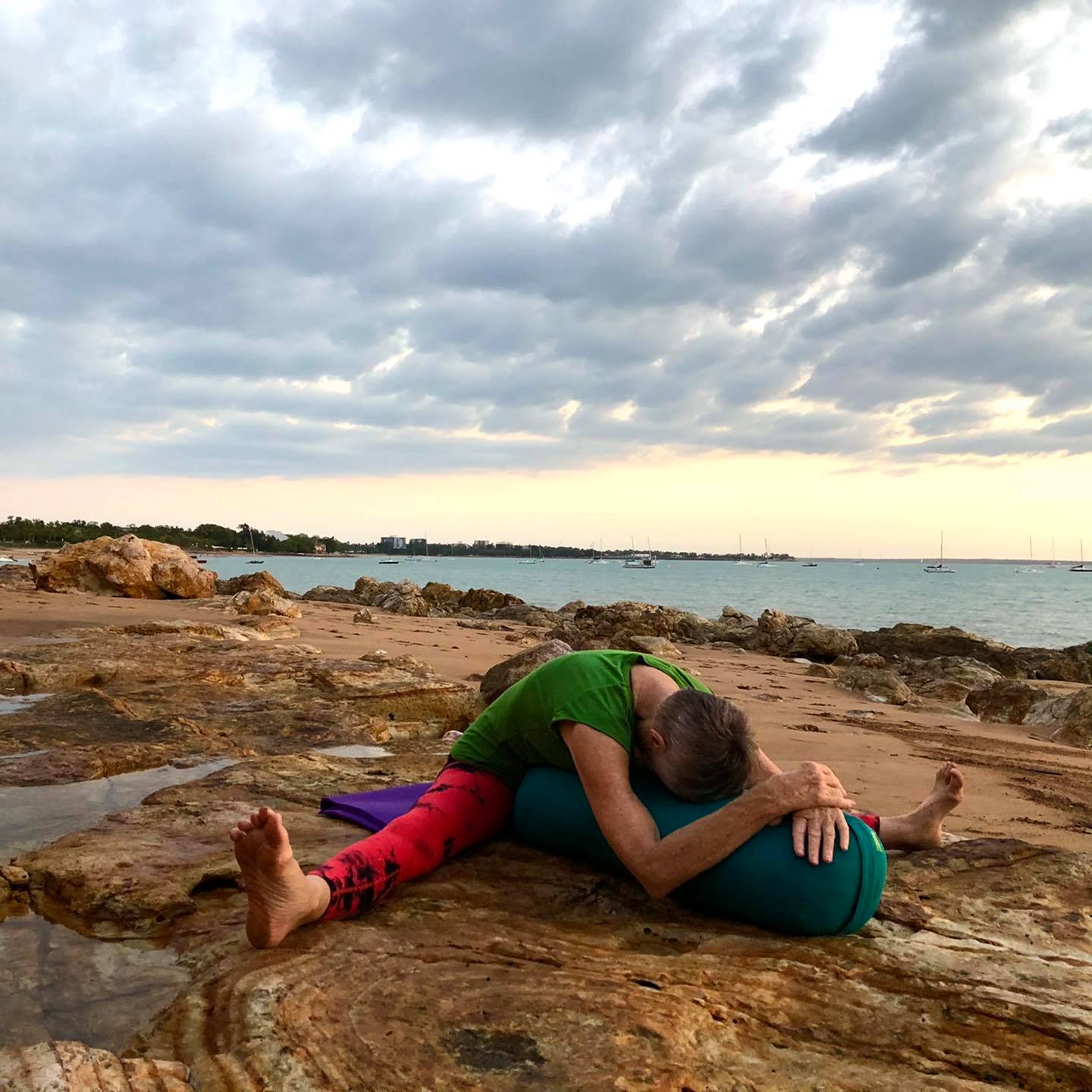
A seated forward bend with the head resting on a bolster. Supported forward bends are on every Iyengar list for tinnitus.
Read more on tinnitus, stress and a quiet mind
- Vertigo exercises and yoga: the inner ear, balance, and Geeta Iyengar’s medical class
- Stress and burnout
- Anxiety and anger
- Sleep and energy: when the ringing keeps you awake
- Headaches and migraine, which also uses Sanmukhi Mudra
- Neck pain and cervical spondylosis
- How to quiet the mind: what Geeta Iyengar taught
- Savasana, the Iyengar way
- Bhramari pranayama: humming breath and calm
Take it further
Free ebook: Cutting Stress With Yoga. Stress turns the volume of tinnitus up. This book shows why the long out-breath settles a busy brain, with stories, including how Mr Iyengar put a worn-out Yehudi Menuhin to sleep in minutes. Then do the free classes, and put it into action.
New to Flametree, or away 3 months or more? 2 free classes + 2 ebooks, only available via this offer. Already a student? You can still get this book. Get your free copy of Cutting Stress With Yoga
- Classes, in Darwin or LIVE online: new, or away 3 months or more? 2 free classes, then 10 at half price. Already practising yoga? See the non-beginner half price pass. See every class time.
- Masterclasses: two of our 2027 Sunday Arvo Masterclasses with Chris Lalor, Certified Senior Iyengar Yoga Teacher and certified Yoga Therapist, fit tinnitus well: Yoga For Sleep And Energy (10 January) and Yoga For Anxiety And Anger (18 April). You learn the restful poses, sequences and calm pranayama that put this into action.
- Retreats: a week of daily yoga, pranayama and rest in Bali. See the retreats.
Flametree Yoga Studio teaches Iyengar yoga for tinnitus, stress and sleep at Woolner and Coolalinga in Darwin, and LIVE online across Australia. Other conditions are in our encyclopaedia of yoga for health conditions. Follow us on Facebook.
Tinnitus and yoga: questions people ask
Can yoga help with tinnitus?
Yes. In a study of 12 adults with long-standing tinnitus did a weekly yoga class and home practice for three months, and their tinnitus stress, handicap and severity scores all fell. A 2021 review found most yoga, pranayama and meditation studies reported less severity, stress and anxiety. Larger trials found mindfulness eased tinnitus severity more than relaxation, with the gain holding at six months.
What causes tinnitus?
Tinnitus is most often linked with some hearing loss, from age or loud noise. Earwax, a cold or an ear infection, inner-ear conditions such as Ménière’s disease, and jaw and neck tension can play a part. Stress and poor sleep rarely start it, but they make it louder and harder to ignore, and that is the part yoga reaches most directly.
What does tinnitus sound like?
Most people describe ringing in the ears, but tinnitus can also be buzzing, hissing, humming, clicking or a roar like the sea. It can be in one ear, both ears or seem to be inside the head, and it is usually loudest in a quiet room or at night.
Does tinnitus go away?
Often it fades, or becomes much less noticeable as the brain learns to tune it out. Short tinnitus after a loud concert usually settles within a day or so. Long-standing tinnitus may stay, but in the yoga and mindfulness studies people were bothered by it much less. A calm nervous system helps the brain tune it out.
Do hearing aids help tinnitus?
For many people with hearing loss, yes. Hearing aids bring outside sounds back up, so the tinnitus stands out less. Yoga works on the other half: the stress, poor sleep and tension that make tinnitus harder to live with. The two sit well together.
Is it safe to do upside-down poses with tinnitus?
Supported versions are usually fine, with your teacher. Dr J. T. Shah, an ear surgeon, says upside-down poses are avoided with discharging ears, and Dr Krishna Raman leaves them out with a middle-ear infection or a hole in the eardrum until it heals. If your ears feel full or the ringing gets louder in Headstand or Shoulderstand, come down and tell your teacher.
What is Sanmukhi Mudra, and why is it linked with tinnitus?
Sanmukhi Mudra (the six-gate seal) is a quiet practice in which the thumbs close the ears and the fingers rest lightly over the closed eyes, while you breathe softly. Mr Iyengar describes it in Light on Yoga, and Dr J. T. Shah lists it for headaches, eye strain and tinnitus. Learn it with a teacher, usually sitting on a bolster or a chair.
Does stress make tinnitus worse?
Yes, for most people. Stress puts the nervous system on guard, which makes the brain notice the sound more, and poor sleep adds to it. That is why the trials that helped most, mindfulness and relaxation, work on the stress side. Slow pranayama and a long Savasana do the same job in a yoga class.
How do you pronounce tinnitus?
Both TIN-it-us and tin-EYE-tus are used and both are correct. In Australia you will hear both.
Where can I do yoga for tinnitus in Darwin?
Flametree Yoga Studio teaches Iyengar yoga at Woolner and Coolalinga in Darwin, and LIVE online across Australia. Our teachers support the head and neck, keep the breathing slow and soft, and end every class with a long Savasana. New and lapsed students can start with two free classes, then a half price pass.
Where this comes from
Mr BKS Iyengar, Yoga: The Path to Holistic Health (Dorling Kindersley; general guidelines p. 408; no tinnitus page) and Light on Yoga (Appendix II, giddiness p. 423; Sanmukhi Mudra section 46, p. 102); Yoga Pushpanjali (p. 304); Silva, Mira and Shyam Mehta, Yoga the Iyengar Way (“Ears”, with cautions pp. 98 and 108); Geeta S Iyengar, Yoga: A Gem for Women, and notes of her 2009 Australian visit; Dr J. T. Shah, Therapeutic Yoga (pp. xiii, 95, 99, 101, 103); Dr Krishna Raman and Dr S Suresh, Yoga and Medical Science: FAQ (questions 327 and 438 to 444); Timothy McCall MD, Yoga as Medicine and his June 2019 list of conditions (no. 112); “Yoga and Inner Ear Disorders”, a student article in an Iyengar association newsletter. In our own words.
- “Medical Class with Geetaji”, Vancouver, 3 May 2001. Yoga Vaani 74, June 2003, pages 28 to 36. Iyengar Yoga Australia e-Library.
- Köksoy S and others, The effects of yoga in patients suffering from subjective tinnitus, International Archives of Otorhinolaryngology, 2018, 22(1):9 to 13. doi.org/10.1055/s-0037-1601415
- Gunjawate DR and Ravi R, Effect of yoga and meditation on tinnitus: a systematic review, Journal of Laryngology and Otology, 2021, 135(4):284 to 287. doi.org/10.1017/S0022215121000566
- Kothari DS and others, review of randomised trials of mind-body therapies in ear, nose and throat conditions, Otolaryngology: Head and Neck Surgery, 2023, 170(1):45 to 60. doi.org/10.1002/ohn.523
- Sharma A and others, scoping review of physical activity and idiopathic tinnitus, Indian Journal of Otolaryngology and Head and Neck Surgery, 2025, 77(8):3279 to 3289. doi.org/10.1007/s12070-025-05594-2
- McKenna L and others, randomised trial of mindfulness-based cognitive therapy against relaxation for chronic tinnitus, Psychotherapy and Psychosomatics, 2017, 86(6):351 to 361. doi.org/10.1159/000478267
- Arif M and others, A randomised controlled study of mindfulness meditation versus relaxation therapy in the management of tinnitus, Journal of Laryngology and Otology, 2017, 131(6):501 to 507. doi.org/10.1017/S002221511700069X
- Beukes EW and others, randomised trial of online applied relaxation and online cognitive behavioural therapy for tinnitus, Internet Interventions, 2021, 25:100402. doi.org/10.1016/j.invent.2021.100402
- Sattel H and others, internet-based psychological interventions for chronic tinnitus: systematic review and meta-analysis, Telemedicine and e-Health, 2024. doi.org/10.1089/tmj.2024.0050
- Walter U and others, randomised trial of a smartphone programme for chronic tinnitus, PLOS Digital Health, 2023. doi.org/10.1371/journal.pdig.0000337
- Wang B and others, third-wave psychological therapies in people with audiological problems: systematic review and meta-analysis, American Journal of Audiology, 2022. doi.org/10.1044/2022_AJA-21-00162
- Laborde S and others, Effects of voluntary slow breathing on heart rate and heart rate variability, Neuroscience and Biobehavioral Reviews, 2022. doi.org/10.1016/j.neubiorev.2022.104711
- Zaccaro A and others, How breath-control can change your life, Frontiers in Human Neuroscience, 2018. doi.org/10.3389/fnhum.2018.00353
- Bu ZJ and others, Effects of various exercise interventions in insomnia patients: a systematic review and network meta-analysis, BMJ Evidence-Based Medicine, 2026. doi.org/10.1136/bmjebm-2024-113512
- Fuller T and others, Cognitive behavioural therapy for tinnitus, Cochrane Database of Systematic Reviews, 2020 (how common tinnitus is). doi.org/10.1002/14651858.CD012614.pub2
This page is general information, not medical advice.
