
Yoga For OCD: What Mr Iyengar, The Yoga Doctors And The Research Say
Checked the door three times, and your mind still says check again? Thoughts that will not leave, and rituals that seem to switch them off for a moment, are the loop at the heart of OCD (obsessive compulsive disorder). This guide brings together what Mr BKS Iyengar’s teaching, the yoga doctors and the research say about yoga, pranayama (yogic breathing), meditation and mindfulness for OCD. Last updated: 9 November 2026.
By Chris Lalor, Certified Senior Iyengar Yoga Teacher and certified Yoga Therapist, Flametree Yoga Darwin.
Get 2 Free Yoga Classes And 2 Free Ebooks
Does yoga help OCD? The short answer
Yes. Yoga for OCD is well worth adding to the help you already have. In randomised trials, people with OCD who added yoga had fewer obsessions and compulsions, and less anxiety and low mood, than people who did not. A yoga breathing and meditation programme did better than a relaxation meditation. Mindfulness, the steady, present attention a good yoga class builds, has the most research of all: reviews of dozens of trials found it eased OCD about as well as standard talking therapy, though one large 2026 review was less sure, as we explain below. In the trials, yoga was added to people’s usual care, not used instead of it.
Overall evidence: Moderate
The research here is moderate. Several trials, or reviews with a more modest result, point to a benefit.
Best study (review of many trials): Bürkle 2025 pooled 46 trials and 2,221 people with OCD. Mindfulness and acceptance programmes brought large falls in OCD severity, and did as well as standard talking therapy. These were mindfulness courses, not yoga classes; the yoga trials point the same way but are fewer, the largest with 50 people.
One thing to keep in mind as you read: every OCD yoga trial so far tested yoga in general, in India, the United States and Sweden, taught by teachers with very different training. No trial has yet tested Iyengar yoga for OCD. Not yet tested is not the same as does not work. Iyengar teachers train for years and are assessed by a panel of senior teachers, and in our view as certified Iyengar teachers, well-taught Iyengar yoga is likely to go further than the average. Why the kind of yoga matters.
Plainly, the evidence is mixed. The yoga trials for OCD are small, and they added yoga to usual care. The mindfulness reviews are not all positive either. A 2026 review of 68 trials and 4,019 people compared seven kinds of talking therapy for OCD. Every kind beat a waiting list. But mindfulness-based therapy was the one kind that did not clearly beat usual care or a placebo talking therapy, and in the best-designed trials it no longer clearly beat a waiting list either (Wang 2026, read the review). The authors say many of the trials were small or at risk of bias, so this is a result to weigh, not a final verdict. The main recognised help for OCD is exposure-based talking therapy and medicine, and yoga and mindfulness are best seen as something to add to that care.
What The OCD Trials Tested
The trials
Yoga in general.
Teachers with very different training.
India, the United States, Sweden.
Iyengar yoga
Not yet tested for OCD.
Teachers train for years.
Assessed by senior teachers.
Yoga for OCD: what the trials tested, and where Iyengar yoga fits. Our view as certified Iyengar teachers.
The bottom line: five key moves for OCD
- Go to a yoga class at your level, two or three times a week, and keep going. The trials used yoga daily to weekly, for 4 weeks to 12 months, alongside people’s usual care.
- Add breath work (pranayama). A slow, smooth breath calms the mind and brings stress, worry and anger down. Anxiety drives the urge to check and repeat, so a calmer system has less to push against.
- Give your attention one job. Holding a pose well, or following the breath, trains the mind to stay with what is here. That is mindfulness, the practice with the most OCD research.
- Cut back on what makes it worse. Rushed days, too little sleep, and too much coffee all wind up the alarm system. Yoga makes you notice these habits, so they are easier to change.
- Start now. New to Flametree, or away 3 months or more? 2 free classes, then 10 at half price, in Darwin or LIVE online.
Five Key Moves For OCD
1. Go to class
Two or three times a week, at your level.
2. Add pranayama
A slow breath calms the alarm system.
3. One job for the mind
Stay with the pose or the breath.
4. Cut back
On rushing, short sleep and too much coffee.
5. Start now
2 free classes, then 10 at half price.
Yoga for OCD in five moves: steady practice, a calm breath and trained attention.
Who was Mr BKS Iyengar? Iyengar yoga is the style we teach at Flametree. During the 20th century, Mr BKS Iyengar was the major teacher who codified traditional Indian yoga, through his seminal books and widespread teaching. He also pioneered the use of props, so poses can be adapted to almost any body. His style is sometimes called modern classical yoga. This guide is part of our encyclopaedia of yoga for health conditions.
This guide in short
- Overall evidence: Moderate. Best study: Bürkle 2025 pooled 46 trials and 2,221 people with OCD. Mindfulness and acceptance programmes brought large falls in OCD severity, and did as well as standard talking therapy. These were mindfulness courses, not yoga classes; the yoga trials point the same way but are fewer, the largest with 50 people.
- The Iyengar approach: we have not found a separate entry for OCD in Mr Iyengar’s books. His teaching on the anxious, doubting mind points to steady standing poses, supported forward bends, a calm breath and rest.
- Dr Timothy McCall, an American medical doctor and yoga therapist who studied with Mr BKS Iyengar, author of Yoga as Medicine: OCD is no. 66 on his list of conditions helped by yoga.
- The research: about 23 studies listed below, for yoga, breathing and mindfulness, including 10 reviews.
- Nearby guides: anxiety and anger, depression and low mood and stress and burnout.
- Take it further: our free ebook Cutting Stress With Yoga, the 2027 masterclass on anxiety, upsets and anger, and classes in Darwin and online.
Yoga For OCD On One Page
Tradition and research point the same way: calm the alarm, steady the attention, keep going.
The Iyengar approach
Steady poses, supported forward bends, a calm breath, rest.
Dr Timothy McCall
OCD is no. 66 on his list of 117 conditions.
Yoga research
Fewer obsessions and compulsions, less anxiety.
Mindfulness research
Large falls in OCD severity across 46 trials.
Yoga for OCD at a glance. Each source is set out in full below.
What OCD is
OCD (obsessive compulsive disorder) has two parts. Obsessions are thoughts, images or urges that push in again and again, unwanted, and bring anxiety, disgust or doubt: germs, harm, things not being “just right”, or fear of having done something wrong. Compulsions are the things a person does to make that feeling go away: washing, checking, counting, ordering, repeating words in the head, or asking for reassurance. The relief is real but short, so the loop starts again.
The OCD Loop
Thought
An unwanted thought or image pushes in.
Alarm
Anxiety, disgust or doubt rises.
Ritual
Checking, washing, counting or asking.
Relief
Short-lived. The thought comes back.
↻ And round again
The loop at the heart of OCD. Yoga works on the alarm step: a calmer body and breath give the thought less to push against. A simplified picture.
Everyone double-checks the stove sometimes, and plenty of people like a tidy desk. OCD is different: it takes up a lot of time each day, causes real distress, and gets in the way of work, family and rest. It usually begins in the teens or early adult years, and it affects men and women in similar numbers.
Everyday Checking, Or OCD?
Everyday habits
You check once and move on.
You like things tidy, but you can leave them.
It takes little time.
OCD
The doubt comes back straight after checking.
The ritual feels like something you must do.
It can take an hour or more a day.
OCD is about distress, time and the loop, not about being neat.
It is common. In the ABS National Study of Mental Health and Wellbeing (2020 to 2022), about 3.6% of Australians aged 16 to 85 had OCD in the past year.
OCD In Australia
713,000
Australians aged 16 to 85 had OCD in the past year (3.6%).
Source: ABS National Study of Mental Health and Wellbeing, 2020 to 2022. An estimate.
The main recognised help for OCD is talking therapy, especially exposure therapy (where a person faces the trigger and learns not to do the ritual), and medicine. Every yoga trial on this page added yoga to that care. If you are already working with someone on your OCD, yoga and mindfulness sit well alongside it, and the two are usually complementary. Always follow the directions of any doctor you are consulting.
“In your discipline, if doubt comes, let it come. You do your work and let doubt carry on with its work. And let us see which gives up first!”
What Mr BKS Iyengar taught about the doubting, anxious mind
In short: we have not found a separate entry for OCD in the Iyengar books we hold. But Mr Iyengar wrote a great deal about the restless, doubting mind, and his answer keeps coming back to three things: steady the body, slow the breath, and give the mind something precise to do.
- The scattered mind (Yoga: The Path to Holistic Health, pp. 50 to 51). He describes five states of mind, from dull to still. The scattered state, which he calls “constantly plagued by doubt and fear”, is the most common. Yoga moves the mind, step by step, towards the steadier states.
- His course for anxiety (pp. 364 to 365). Supported forward bends, reclining poses, standing poses and supported inversions (upside-down poses held with props), with a staircase breath (Viloma) and a final rest.
- “Mere relaxation is not sufficient” (stress chapter, pp. 180 to 181). He pairs rest with active practice. Standing poses use up nervous energy first, so the mind can then settle in the quieter poses.
- Props whenever a person is stressed (p. 181), so the body is held and the mind can let go.
Mr Iyengar On The Restless Mind
Not written about OCD by name. His teaching on doubt, fear and a busy head.
The scattered mind
Full of doubt and fear. The most common state of mind.
His anxiety course
Forward bends, standing poses, supported inversions, Viloma, rest.
Not just relaxing
Active poses first, then rest. Too much passive practice unsettles.
Props
The body is held, so the mind can let go.
Mr BKS Iyengar, Yoga: The Path to Holistic Health. In our words.
Why does this fit OCD? In an Iyengar class the attention is held on exact detail: the line of the front leg, the turn of the arm, the length of the out-breath. That precision gives a looping mind a better place to go. Many people with OCD already have a sharp eye for detail. In a pose, that eye is put to work on the body and breath, instead of on the doubt.
We do not publish Mr Iyengar’s sequences. A sequence needs a teacher who can see how you respond and adapt each pose, which is what a class is for.
“You have to tame your breath to tame your brain.”
What Dr Timothy McCall says
In short: OCD is on his list of conditions helped by yoga, and the textbook he co-edited reviews the OCD trials and puts the slow breath at the centre.
Dr McCall is a US medical doctor and yoga therapist who studied with Mr BKS Iyengar, author of Yoga as Medicine and former medical editor of Yoga Journal. His June 2019 list of 117 health conditions helped by yoga includes obsessive compulsive disorder as no. 66.
He also co-edited the textbook Principles and Practice of Yoga in Health Care (2016), with Sat Bir Singh Khalsa, Lorenzo Cohen and Shirley Telles. Its chapter on anxiety, by Karen Pilkington, Patricia Gerbarg and Richard Brown, sets out the OCD research and makes three points, in our words:
- The early OCD trials were positive. A yoga breathing and meditation programme beat a relaxation and mindfulness meditation in a randomised trial, after an encouraging year-long pilot.
- Slow breathing is the most direct way to calm the system. The authors point to a slow breath of about 4.5 to 6 breaths a minute to shift the nervous system from alarm towards calm.
- Go gently. In severe anxiety, body and breath practices are best brought in slowly, with an experienced teacher.
In Yoga as Medicine (chapter 8, on anxiety and panic), Dr McCall describes the anxious breath as fast, choppy and high in the chest, and the calm breath as smooth, low and through the nose, with a longer out-breath. Our anxiety guide covers that chapter in full.
The Anxious Breath And The Calm Breath
The anxious breath
Fast and choppy.
High in the chest.
Often through the mouth.
The calm breath
Smooth and slow.
Low, through the nose.
A longer out-breath.
Dr Timothy McCall, Yoga as Medicine, chapter 8, and Principles and Practice of Yoga in Health Care, chapter 6. In our words.
Other voices
In short: Dr Krishna Raman and Dr Loren Fishman, two other medical doctors who studied with Mr Iyengar, do not write about OCD in the material we hold. Geeta S Iyengar, Mr Iyengar’s daughter, writes in Yoga: A Gem for Women that in the right forward bend “an upset, irritated, and restless mind becomes tranquil”. And Melbourne researchers at Monash University, reviewing 33 lifestyle trials for OCD, found the strongest effects among the stress-management programmes came from yoga (Brierley 2021, listed below).
What does the research say about yoga for OCD?
In short: when yoga was added to usual care, people with OCD had fewer obsessions and compulsions, and less anxiety and low mood. Mindfulness has a much larger body of trials, with large falls in OCD severity. Every yoga trial tested yoga in general, not Iyengar yoga. Why the difference matters.
The Research At A Glance
Four key studies, conclusion first.
46 trials, 2,221 people
Mindfulness programmes: large falls in OCD severity (Bürkle 2025).
50 outpatients, 4 weeks
Added yoga eased obsessions, compulsions and anxiety (Bhat 2024).
48 adults
Yoga breathing and meditation beat relaxation meditation (2019).
60 outpatients
80% responded to mindfulness therapy, 27% to stress management (Mathur 2021).
Yoga for OCD research at a glance. Every study is listed in full below.
Reviews of yoga for OCD
- Yoga brought significant falls in OCD severity, with less anxiety and better well-being. Yadav 2025, a review of 7 studies of yoga for OCD. Read the study.
- Of the stress-management programmes for OCD, yoga had the greatest effects. Brierley 2021, Monash University, Melbourne, a review of 33 lifestyle trials for OCD and related conditions. Read the study.
- Yoga programmes reduced symptoms of OCD, anxiety, PTSD and depression, with no serious side effects. Roy 2026, a review of 15 randomised trials and about 1,370 people. Read the study.
- Yoga showed a large effect in OCD, and mindfulness meditation a moderate one. Sarris 2012, a review of 14 studies of self-help and complementary approaches for OCD. Read the study.
- The results for yoga were encouraging, particularly for OCD. Kirkwood 2005, a review of 8 studies of yoga for anxiety and anxiety disorders. Read the study.
The Yoga For OCD Review
7 studies
of yoga for OCD in one review showed significant falls in OCD severity.
Yoga for OCD: Yadav 2025. The authors ask for more and larger trials.
Yoga trials in people with OCD
- Adding yoga eased obsessions, compulsions, anxiety and low mood in 4 weeks, compared with a waiting list. Ten supervised sessions of a yoga programme designed for OCD, then home practice, on top of usual medicine. Bhat 2024, a randomised trial of 50 outpatients at NIMHANS, Bangalore, India, with blinded raters. Read the study.
- A yoga breathing and meditation programme improved OCD more than a relaxation meditation, and gains kept growing over a year. People who finished improved 40% on the standard OCD scale (Y-BOCS), against 18%; 31% were in remission, against 9%. Shannahoff-Khalsa 2019, a randomised trial of 48 adults in San Diego, United States. Read the study.
- The same kind of yoga programme beat relaxation plus mindfulness meditation, and after 15 months the group had improved 71%. Shannahoff-Khalsa 1999, a randomised trial of 22 people; 7 in each group finished the first 3 months. Read the study.
- A year of a yogic breathing practice brought an average 54% improvement in OCD scores. Shannahoff-Khalsa 1996, an early pilot of 8 adults with no comparison group; 5 finished. Read the study.
- A month of added yoga improved OCD and low mood scores. Bhat 2021, a case series from India. Read the study.
Yoga Breathing And Meditation Versus Relaxation
Improvement on the standard OCD scale among people who finished, and how many were in remission.
Yoga for OCD: the yoga programme more than doubled the improvement. Shannahoff-Khalsa 2019. Bars drawn to scale from zero.
Yoga in a related group
- Ten weeks of yoga eased obsessive and compulsive symptoms more than free-choice exercise. Sfendla 2018, a randomised trial of 152 prison inmates in Sweden (not people diagnosed with OCD), weekly 90-minute classes. Read the study.
Iyengar yoga studies
No trial has yet tested Iyengar yoga for OCD, and none of the OCD trials used Iyengar-trained teachers. Not yet studied is not the same as not working. In our view as certified Iyengar teachers, the precision of Iyengar teaching, and the years of training behind it, are likely to suit a mind that needs a clear, exact job to do.

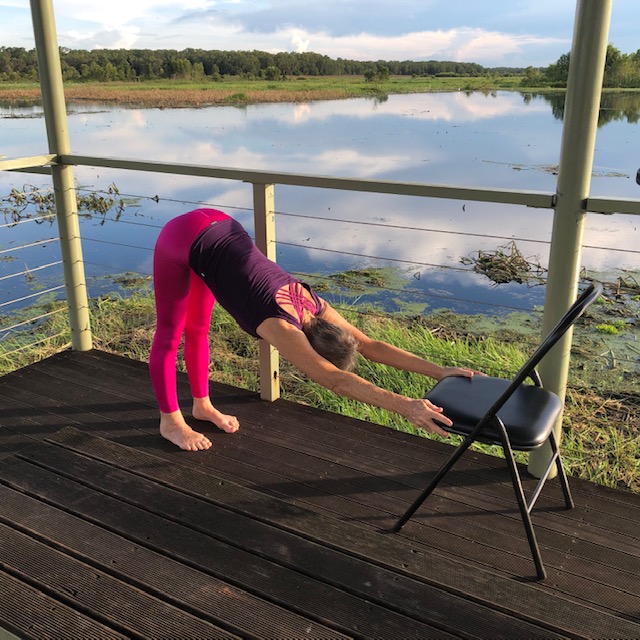
Chris Lalor in a fully supported lying pose. Supported poses let a wound-up system settle while the attention stays on the breath.
Breathing and pranayama
No trial has yet tested pranayama on its own for OCD. Breathing practice was part of every yoga programme above, and the year-long 1996 pilot was built around one yogic breathing pattern. Not yet studied is not the same as not working. We teach slow, smooth, nasal pranayama step by step, starting lying down.
Mindfulness For OCD: Two Big Reviews, Two Answers
46 trials, 2,221 people. Mindfulness and acceptance programmes brought large falls in OCD severity, as good as standard talking therapy.
68 trials, 4,019 people, seven talking therapies. All beat a waiting list. Mindfulness-based therapy did not clearly beat usual care or a placebo talking therapy.
Both reviews say many trials were small. Details of both are listed below.
Mindfulness for OCD: helpful in most trials, with one large review less sure, so it sits best alongside the care you already have.
Mindfulness and meditation
- Mindfulness and acceptance programmes brought large falls in OCD severity, did as well as standard talking therapy, and did better than medicine alone and a waiting list. Bürkle 2025, a review of 46 trials and 2,221 people with OCD. It includes acceptance-based therapy as well as mindfulness. Read the study.
- Mindfulness did as well as the standard cognitive and behavioural techniques, including exposure, on OCD, anxiety and low mood. Perin 2025, a review of 6 randomised trials and 499 adults. Read the study.
- A 2026 review of seven kinds of talking therapy found mindfulness-based therapy was the one kind that did not clearly beat usual care or a placebo talking therapy. Wang 2026, a network review of 68 trials and 4,019 people with OCD. All seven kinds beat a waiting list and a pill placebo, but mindfulness-based therapy lost its edge over a waiting list in the best-designed trials. The authors urge care, because many trials were small or at risk of bias, and found no clear difference in effect between the therapies overall. Read the study.
- Mindfulness-based cognitive therapy significantly reduced OCD symptoms compared with control groups. Başkaya 2021, a review of trials from 2008 to 2020. Read the study.
- Mindfulness improved quality of life in anxiety-related conditions, including OCD. Fortes 2024, a review of 15 randomised trials and 1,465 people. Read the study.
Mindfulness For OCD: A Review Of 46 Trials
46 trials
2,221 people with OCD. Large falls in OCD severity, as good as standard talking therapy.
Mindfulness for OCD: Bürkle 2025. A 2026 review of 68 talking therapy trials was less sure about mindfulness (Wang 2026).
And the single trials:
- 80% responded to mindfulness therapy, against 27% to stress management training. Twelve weekly sessions. Mathur 2021, a randomised trial of 60 outpatients at a specialist OCD clinic in India. Read the study.
- For people still struggling after standard help, mindfulness therapy cut OCD scores by 32%, against 8% with usual care. There was also less low mood, rumination and stress. Serra-Blasco 2025, a randomised trial of 68 people in Spain. Read the study.
- Mindfulness therapy brought faster gains in self-rated OCD symptoms and quality of life than an education group. Külz 2019, a randomised trial of 125 people in Germany with symptoms left after talking therapy. By 6 and 12 months both groups had improved to a similar degree. Read the study.
- Mindfulness added to exposure therapy reduced OCD more than exposure therapy alone. Sheikh 2026, a randomised trial of 54 adults with OCD and depression in India. Read the study.
- Three months of meditation added to usual medicine halved OCD scores (a 50% fall), against an 18% fall with medicine alone. Mehta 2020, a study of 50 patients in Amritsar, India (not randomised). Read the study.
- Mindfulness therapy plus medicine improved OCD, low mood and quality of life more than medicine alone. Ten weeks. Wei 2026, a study of 53 patients in China (not randomised). Read the study.
- App-based mindfulness training made teenagers with OCD more mentally flexible, switching between tasks more easily. Rempel 2026, a randomised trial of 53 young people aged 10 to 19, against an audiobook group. Read the study.
Mindfulness For OCD: Two Trials
Share who responded, and how far OCD scores fell.
Mindfulness for OCD clearly beat the comparison in both trials. Bars drawn to scale from zero.
Three Routes, One Direction
What each group of studies found for OCD.
Yoga
Fewer obsessions and compulsions, less anxiety and low mood.
Breathing
Part of every yoga programme. Not yet tested on its own.
Mindfulness
Large falls in OCD severity across dozens of trials. One 2026 review was less sure.
Yoga for OCD, pranayama and mindfulness all point the same way.
What the yoga that worked had in common
The programmes that helped were regular, not occasional. They combined poses, breathing and a quiet, focused attention. They were taught by a teacher, then practised at home. And they were added to the care people already had. That is close to what a good class, and a little home practice, gives you.
How Long The Trials Ran
1. 4 weeks
Added yoga eased obsessions and compulsions.
2. 8 to 12 weeks
Mindfulness courses: large responses.
3. 3 months
Yoga breathing and meditation: double the gain.
4. A year
Gains kept growing with practice.
How long yoga for OCD takes: weeks for the first changes, a year for the full picture.
Yoga, pranayama and mindfulness: how they work together
Most of the OCD studies above tested mindfulness courses or meditation, not yoga poses. That still counts for our classes. Mindfulness is steady, present attention, and yoga poses and pranayama (yogic breathing) are old routes to that same state. So the mindfulness trials that eased OCD also show what a good yoga and pranayama class can build. The yoga trials that helped most combined poses, breath and meditation in one programme. No trial separates which part does the work.
Two routes to one steady mind
A steady body, with attention held on the pose.
A steady breath, with attention held on the breath.
Mindfulness: steady, present attention. Each makes the other easier.
A simplified picture, known from practice. No trial separates which part does the work.
We suggest coming to both a yoga class and a pranayama class. Mr Iyengar taught that asana (poses), pranayama and meditation are not divided, and in our experience the two together do more than either alone. See every class time. We trace the history and the links in Yoga And Mindfulness: Why The Mindfulness Research Points Back To Yoga And The Breath.
How this comes together in a Flametree class
Everything above points the same way, and it is how we teach yoga for OCD in Darwin and online.
- Precise, step-by-step teaching. Each pose is taught in clear stages, so the attention always has a definite job.
- Standing poses first. They use up nervous energy and build a sense of being steady on your feet.
- Supported forward bends and lying poses, with the head resting, to settle a wound-up system.
- Props in every class: chairs, belts, blocks, blankets, bolsters, the wall and the ropes, so the body is held and the mind can let go.
- Rest and breath to finish: every class ends with supported rest, and our pranayama classes teach the slow, smooth breath step by step.
- A practice for every kind of day: our gentle yoga and restorative yoga classes suit the days when everything feels too much.
See the timetable and book a class. Body, then breath, then a quieter mind: that is the path a class follows, and it is why we offer poses and breathing together.
Practising Yoga With OCD
Worried about getting it exactly right?
Your teacher tells you when it is right. Good enough is the goal.
Busy mind in the rest?
Go back to feeling the out-breath.
Some days too much?
Choose a gentle or restorative class.
Not sure?
Tell your teacher. The class is changed for you.
Yoga for OCD in class: adapted to you, with good enough as the goal. Known from practice.

Supported rest ends every class: the calm, present attention the OCD mindfulness trials measured.
Read more on the mind and emotions
- Anxiety and anger: panic, worry, performance anxiety and the calm breath
- Depression and low mood
- Stress and burnout
- PTSD and trauma and sleep and energy
- Yoga for anxiety and yoga and mindfulness
Take it further
This guide gives you the facts on what helps. The clearest thread through OCD is an alarm system that will not switch off, so the ebook to start with is our stress book, with the stories of people it has helped. Go and do the free classes, see what you think, and then a pass puts it all into action.
Four Ways To Put Yoga For OCD Into Action
Classes
2 free, then 10 at half price. Darwin or LIVE online.
Free ebook
Cutting Stress With Yoga.
Masterclass
Anxiety, upsets and anger, 2027.
Retreat
A week of daily, adapted yoga in Bali.
Yoga for OCD: the facts are on this page, and classes put them into action.
Free ebook: Cutting Stress With Yoga. How long stress wears the body down, and how an Iyengar class turns the alarm off. The same calm, steady attention the OCD trials on this page measured.
New to Flametree, or away 3 months or more? 2 free classes + 2 ebooks, only available via this offer. Already a student? You can still get this book. Get your free copy of Cutting Stress With Yoga
- Classes, in Darwin or LIVE online: new, or away 3 months or more? 2 free classes, then 10 at half price. Already practising yoga? See the non-beginner half price pass. See the timetable and book.
- Masterclass: anxiety, upsets and anger is one of our 2027 Sunday Arvo Masterclasses with Chris Lalor. Come for the poses, the sequences and the pranayama that calm an alarm system stuck on high. Bookings are open.
- Retreats: a week of daily, adapted yoga in Bali. See the retreats.
2027 Masterclasses From 28 December
Over four months, learn the poses and breath practices that make the biggest difference for a range of key health conditions: arthritis, sleep and energy, pelvic floors, backs, wisdom, and anxiety, upsets and anger. In Darwin or LIVE online.
Other conditions are in our encyclopaedia of yoga for health conditions.
“So often what prevents us from living an admirable life is the chattering of our minds, which pester us with long outdated doubts and despair.”
Yoga for OCD: questions people ask
Does yoga help OCD?
Yes. When yoga was added to usual care, people with OCD had fewer obsessions and compulsions, and less anxiety and low mood. In a trial of 50 outpatients in India, 4 weeks of added yoga beat a waiting list (Bhat 2024), and in a trial of 48 adults in the United States a yoga breathing and meditation programme improved OCD more than a relaxation meditation (Shannahoff-Khalsa 2019). Every trial tested yoga in general; Iyengar yoga has not yet been tested for OCD.
Can yoga cure OCD?
No. OCD is often long-lasting, and no practice can promise to remove it. What yoga can do is ease the obsessions, compulsions, anxiety and low mood that come with it, as the trials found, and give you a calmer body and breath to meet the hard days with.
What Yoga Can And Cannot Do For OCD
Yoga can
Ease obsessions and compulsions.
Lower anxiety and low mood.
Build calm, steady attention.
Yoga cannot
Promise to remove OCD.
Stand in for the care you already have.
Yoga for OCD: a strong partner to the help you already have.
Does mindfulness help OCD?
Yes, and it has the most research. A review of 46 trials and 2,221 people found mindfulness and acceptance programmes brought large falls in OCD severity and did as well as standard talking therapy (Bürkle 2025). In one trial, 80% responded to mindfulness therapy against 27% to stress management (Mathur 2021). Yoga builds the same steady, present attention. Not every review agrees: a 2026 review of 68 trials found mindfulness-based therapy did not clearly beat usual care or a placebo talking therapy (Wang 2026), so it is best used alongside talking therapy and medicine.
Can breathing exercises help OCD and intrusive thoughts?
Breathing was part of every yoga programme that helped OCD, but no trial has yet tested pranayama on its own for OCD. A slow, smooth breath through the nose, with a longer out-breath, calms the stress response, and the textbook Dr McCall co-edited points to slow breathing as the most direct way to shift the nervous system towards calm. We teach pranayama step by step, starting lying down.
The Calm Breath, Step By Step
1. Lie down, supported
A bolster or folded blanket under the back.
2. Through the nose
Smooth and quiet.
3. Longer out-breath
Let it lengthen a little, without strain.
4. Come back
When a thought pulls you away, return to the breath.
Breathing for OCD: a slow, smooth breath, learned with a teacher. Known from practice.
Which yoga is best for OCD?
The trials used programmes that combined poses, breathing and meditation, practised regularly with a teacher and at home. In the Iyengar tradition, a class with precise, step-by-step instruction, standing poses, supported forward bends and rest gives a looping mind a clear job to do. Your teacher adapts the poses for you.
Can yoga replace therapy or medication for OCD?
Every yoga trial for OCD added yoga to the care people already had; none tested it as a replacement. Yoga and mindfulness sit well alongside talking therapy and medicine, and the two are usually complementary. Always follow the directions of any doctor you are consulting.
Yoga Alongside Your Usual Care
In every trial
Yoga was added to usual care.
Mindfulness reviews
As good as standard talking therapy.
Together
Usually complementary, and both useful.
Yoga for OCD works alongside the help you already have.
How long does yoga take to help OCD?
The trials ran from 4 weeks to more than a year. Obsessions and compulsions eased within 4 weeks of added yoga in one trial (Bhat 2024), mindfulness courses ran 8 to 12 weeks, and in the longer yoga trials gains kept growing over 12 to 15 months. So come regularly and give it time.
Is yoga safe if I have OCD?
Yes. No serious side effects were reported in the yoga trials. Some people with OCD worry about doing a pose exactly right; in class your teacher tells you when it is right, and good enough is the goal. Strong, forceful breathing and long breath-holds are not for beginners, so learn pranayama gently, with a teacher.
Can I do yoga for OCD in Darwin or online?
Yes. Flametree Yoga teaches Iyengar yoga in Woolner and Coolalinga in Darwin, and LIVE online, with gentle and restorative classes and pranayama classes for the breath. New students can begin with our new-student offer of 2 free classes, then 10 at half price. Book a class
Where this comes from: BKS Iyengar, Yoga: The Path to Holistic Health (Dorling Kindersley), pp. 50 to 51, 180 to 181 and 364 to 365; Light on Life (Kindle edition); Sparks of Divinity. Geeta S Iyengar, Yoga: A Gem for Women, forward bends. Timothy McCall MD, his June 2019 list of 117 health conditions helped by yoga, and Yoga as Medicine (Bantam), chapter 8. Khalsa, Cohen, McCall and Telles (eds), Principles and Practice of Yoga in Health Care (2016), chapter 6, Yoga therapy for anxiety, by Pilkington, Gerbarg and Brown. ABS National Study of Mental Health and Wellbeing, 2020 to 2022. Studies as linked above, each looked up in PubMed in November 2026. Everything is summarised in our own words.
This page is general information, not medical advice. Flametree Yoga Studio, Darwin and LIVE online.
