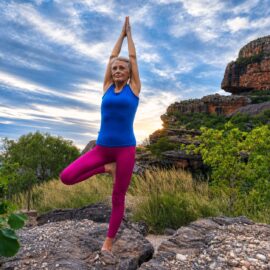
The Eight Limbs Of Yoga, Explained Plainly
The eight limbs of yoga: the short answer
Most people walk into a yoga class for the poses, and the poses turn out to be one slice of a much bigger picture. The eight limbs of yoga are the path Patanjali set out about 2,000 years ago in the Yoga Sutras (a short book of sayings about the mind). They run from how you behave towards other people, through the poses and the breath, to the quietest states of mind. Poses are the third limb, not the first, and not the point.
Iyengar yoga is the style developed by Mr BKS Iyengar. In the 20th century he did more than anyone to set down traditional Indian yoga, through his books and his teaching, and he pioneered the use of props. It is sometimes called modern classical yoga, and it’s the style we teach at Flametree. This page is drawn from Chris Lalor’s Eight Limbs talk, given at the Flametree Bali retreat, and it sits in our Iyengar yoga and philosophy notes.
The eight limbs of yoga in short form
- Yama: how you treat others. Five of them, starting with non-violence.
- Niyama: how you treat yourself. Cleanliness, contentment, discipline, self-study, surrender.
- Asana and pranayama: the poses (limb 3) and breathing that influences the mind (limb 4).
- Pratyahara: withdrawing the senses, so you stop being pulled outward.
- Dharana, dhyana, samadhi: concentration, unwavering contemplation, then absorption.
- Not a ladder: the limbs grow together, and the ethics tend to creep up on you.
- Seeing clearly: why the mind misjudges, and what a mirror cannot show you.
- Next step: your first class is free if you’re new to Flametree.
Who Patanjali was, and what the Yoga Sutras are
Patanjali’s Yoga Sutras are still the major text, because they lay out what yoga is and how to arrive at a yogic state. They are short, dense and practical rather than devotional.
The Sutras are about the mind: its qualities, and how you can influence it. Patanjali defined yoga as the ability to still the fluctuations of the mind, and to direct it without distraction.
Two teachers are worth quoting on what that is for.
TKV Desikachar: “The goal of yoga is to encourage us to be a little better than we were before. We become better by making an effort and by practising. Our efforts may change in intensity, but over time we will gradually experience progress.”
Mr BKS Iyengar: “Ethics is not a way of just thinking, but a way of doing with thinking. It is the process of re-alignment of the body, senses, mind, intelligence, and consciousness. You cannot separate ethics from physical or mental discipline.”
That last line is the whole argument for why a yoga class is not just exercise.

A statue of Patanjali, who set out the eight limbs in the Yoga Sutras.

TKV Desikachar on the goal of yoga.

Mr BKS Iyengar on why ethics and practice cannot be separated.
First, the five states of mind
Before the limbs, Patanjali describes what the mind is actually doing. He lists five activities, or vrttis:
- Comprehension
- Misapprehension
- Imagination
- Deep sleep
- Memory
Notice that only one of those is seeing things as they are. Misapprehension, imagination and memory can all feel exactly like comprehension from the inside, which is the problem the whole system is built to address.
And samskaras, the grooves we run in
Samskaras are the impressions and dispositions that develop and accumulate deep inside a person. They come from perception, inference, choices, preparation, practice, interaction with others, thoughts, intent and wilful actions.
They show up as habits, behaviour, tendencies and psychological predispositions. In plain terms: the groove you have worn, and keep falling into without deciding to.
Yoga does not delete them. It makes them visible, and a habit you can see is a habit you can do something about.

The five states of mind (vrttis) in Patanjali’s Yoga Sutras.

Samskaras, the grooves we keep running in.
Why is it so hard to see yourself clearly?
Patanjali’s answer is that the mind is busy and the view is clouded. Chris Lalor puts it this way: have you noticed how often your own perception is clouded and wrong? You think you have read a situation correctly, and then you see you were acting from habit, from ego, from a like or a dislike, or from fear.
That is not a 21st century problem. It is an old one, and it is the one the eight limbs are built to address. Patanjali’s view is that steady practice, over time, can steady and direct the mind so you see more clearly.
Chris sometimes practises a pose in front of a mirror. The mirror shows her what she cannot see or feel at that moment, and she can correct what she is doing. New students sometimes ask her why there are no mirrors in the yoga studio. Her answer is that regular practice builds a different sort of seeing, one that does not rely on an outside source. You learn to feel your body, and to feel your breath opening and relaxing it.
It is hard at first. There are many sensations, and the mind jumps about. Chris says that within her first few classes she could have told you which poses she liked, which she didn’t, which she thought she was good at, and which she never wanted to do again because of fear. Those likes, dislikes and fears are the clouds. Over time, she says, practice moves you towards sound judgements that leave you feeling calm. Patanjali’s own map of the clouded mind, the five states of mind (vrttis) and the obstacles to seeing clearly (kleshas), is set out in full on our 8 limbs of yoga course page.
One: Yama, how you treat others
Five moral disciplines, and they are ordinary rather than lofty.
- Ahimsa. Non-violence, including towards yourself.
- Satya. Truthfulness.
- Asteya. Not stealing, which extends to not taking people’s time or credit.
- Brahmacharya. Right use of energy, often translated as moderation.
- Aparigraha. Non-possessiveness, not grasping and not hoarding.
Michael Stone put the point of them well: the yamas remind us that the purpose of yoga is to show how experience can be made a creative action, and that the most difficult parts of our personality are often more useful sources of wisdom than the comfortable parts, because those are the ones we have struggled with and know most intimately.

The five yamas: how you treat others.
Two: Niyama, how you treat yourself
- Saucha. Cleanliness and purity, of body and of surroundings.
- Santosha. Contentment.
- Tapas. Self-discipline, and the heat that comes from sustained effort.
- Svadhyaya. Self-study.
- Ishvara pranidhana. Surrender, or letting go of the need to control the outcome.
Santosha is the one most people find hardest, and it is also the one that changes daily life most. We have a whole note on it: santosha, or contentment, in yoga.

The five niyamas: how you treat yourself.
Three: Asana, the poses
In asana, Patanjali saw the body and mind as moving in harmony. Asanas increase physical capability, promote attentiveness, and open you up to new experiences.
It is worth sitting with the fact that this is limb three of eight. Modern yoga has made asana the whole subject. In the original scheme it is a third of the way in, and its job is partly to prepare you for what follows.

Asana, the third limb: body and mind moving in harmony.
Four: Pranayama, breath meditation
Pranayama is the process of breathing in a way that influences the mind.
That is a deliberately narrow definition and it is the right one. The point of the breath work is not lung capacity. It is what a slow, controlled breath does to your state of mind. If you want the techniques in detail, see what pranayama is and how to do it.

Pranayama, the fourth limb: breathing so as to influence the mind.
Five: Pratyahara, withdrawal of the senses
Pratyahara is the process of withdrawing the senses, and in turn it helps you focus.
The senses are built to face outward and to report every change. Pratyahara is the deliberate turning down of that flow, which is why restorative practices cover the eyes and why a quiet room matters more than people think.
Some students tell Chris they have stopped watching the news on TV and read it when they choose instead. One told her he now avoids the news early in the day, before his yoga or breath practice. It is a small, everyday way of turning the volume down. Patanjali taught that all of us have a quiet, still place inside.

Pratyahara, the fifth limb: withdrawing the senses.
Six: Dharana, uninterrupted concentration
Dharana is fixing the mind in one place: concentration on a single point or object.
Patanjali’s description is uninterrupted concentration, with the mind focused steadily on a particular point or object. The word doing the work is uninterrupted.

Dharana, the sixth limb: concentration on one point.
Seven: Dhyana, unwavering contemplation
Dhyana is the state where the mind flows onto an object without interruption, and you are fully engaged without the mind wandering.
This is meditation. The span of concentration has increased so that the whole mind encompasses the object and contemplates it unwaveringly. Dharana is aiming. Dhyana is having arrived.

Dhyana, the seventh limb: contemplation that does not waver.
Eight: Samadhi, absorption
Samadhi is where the mind is fully absorbed in the object of meditation, to the point where self-awareness loosens. It is usually translated as absorption, or a sense of oneness.
It is not a goal to chase, and chasing it is one of the surer ways to miss it.

Samadhi, the eighth limb: absorption.
Limbs five to eight, and modern brain wave research
Some research on meditation records brain waves with an EEG (a recording of the brain’s electrical rhythms). It reports a shift towards slower rhythms as attention settles.
That echoes the settling Patanjali describes in limbs five to eight, from withdrawing the senses to absorption. The parallel is our observation, not a proven match. There is more on that in what yoga does to your nervous system and brain waves.
The ethics creep up on you
This is the practical point to finish on, and it is the one Chris makes at the end of the talk.
Nobody arrives at a yoga class intending to work on non-possessiveness. But the yogic ethics explained by the eight limbs tend to just creep up on you as you steadily practise yoga or pranayama, or preferably both.
You notice you are less reactive in traffic. You notice you stopped needing to win an argument. It happens sideways, through the body, rather than by deciding to be a better person.

The ethics of yoga tend to creep up on you as you practise.
Do you have to follow the eight limbs?
No. Chris’s view is that nothing in yoga forces a code of conduct on you. You can choose some version of the eight limbs, and let it change as your practice does, or you can choose not to. Yoga as we teach it is secular, and it fits with any religion you follow, or none. Our eight limbs course is one way to explore them if you want to.
Mr BKS Iyengar summed the limbs up in a tree diagram, with every part growing together. If you want to know more about the man himself, read who was Mr BKS Iyengar.
One scene: how a daily habit brought the ethics along
Stuart, who runs Flametree with Chris, tells the story this way. He saw a picture of an 85 year old man who was thin and muscular, and thought that if he can do it, so can I. He started daily Iyengar yoga in Melbourne, usually straight after work.
He did not set out to follow Patanjali’s eight limbs. But he noticed he was “losing it” less, and could step back from things and respond in a considered way. He noticed he was paying more attention to honesty and to ethical living, and he wanted less food and less junk food. Years later, in teacher training, he learnt that the eight limbs describe those very things. It is one person’s experience, but it matches what Chris says: the principles creep up on you.
Studying the eight limbs properly
Reading about the limbs is one thing. Working through them with a teacher over time is another, and it is where the material stops being interesting and starts being useful.
Flametree runs an eight limbs of yoga course, and the Bali retreats give the whole thing a week of undivided attention, which is where this talk was originally given. For a plain account of the Yoga Sutras themselves, see this overview of the Yoga Sutras of Patanjali.
Practise this at Flametree
Flametree Yoga Studio teaches Iyengar yoga in the studio at Woolner and Coolalinga in Darwin, and LIVE online.
- New to Flametree? Your first class is free. In the studio, just come along. Online, go to our online class list, click the class time you want and we email you the link to join.
- Beginners: new students, and anyone who has been away three months or more, can get a half price 10 class pass with 2 extra classes free, to use online, in the studio, or both. See the beginner half price pass.
- Already practising yoga? The same half price 10 class pass with 2 extra classes free, for new students and for anyone away three months or more, is also available as the non-beginner half price pass.
- See every class time, including online classes, on the timetable.
Questions people ask
What are the eight limbs of yoga?
Yama, Niyama, Asana, Pranayama, Pratyahara, Dharana, Dhyana and Samadhi. Ethics towards others, ethics towards yourself, poses, breath, withdrawing the senses, concentration, meditation and absorption.
Who wrote the eight limbs of yoga?
Patanjali, in the Yoga Sutras, about 2,000 years ago. The Sutras are a compilation rather than a single invention, and they gather and order what was already being taught.
Do you have to do them in order?
No. Most students start at limb three, the poses, and work outward from there. The order describes a logic rather than a timetable. You can practise asana and ahimsa (non-violence) in the same week without having mastered either.
What is the difference between the yamas and the niyamas?
Yamas are outward facing: how you behave towards other people and the world. Niyamas are inward facing: how you treat yourself. Five of each, and the pair covers most of what people mean by ethics.
What is samadhi?
The eighth limb. Complete absorption in the object of meditation, to the point where the sense of being a separate self loosens. It is a state, not a qualification, and it is not permanent.
How many yoga sutras are there?
196, arranged in four chapters. They are extremely short, which is why they have attracted so much commentary.
How do I actually practise the eight limbs?
Start where most people start: turn up to class, work on the poses, and learn some breath work. The other limbs tend to arrive once those two are steady. Reading the Sutras alongside a regular practice is worth far more than reading them on their own.
Is the eight limb path religious?
No. Flametree teaches secular yoga. The eight limbs are a set of practices and observations about the mind, and they fit with whatever religious belief a person holds, or none.
Where can I learn the eight limbs of yoga in Darwin?
Flametree Yoga Studio teaches Iyengar yoga and pranayama at Woolner and Coolalinga in Darwin, and LIVE online. Classes start with the poses and breath, and the Bali retreats include talks on the eight limbs. Your first class is free if you are new to Flametree. See the class times on the timetable.
Sources
- Patanjali, Yoga Sutras (Edwin Bryant translation). Overview: Yoga Sutras of Patanjali.
- TKV Desikachar, The Heart of Yoga.
- Mr BKS Iyengar, quoted on ethics and practice, and his tree of yoga.
- Michael Stone, The Inner Tradition of Yoga.
- Chris Lalor, eight limbs talk, Flametree Bali retreat.
Flametree Yoga Studio teaches Iyengar yoga in Darwin, at Woolner and Coolalinga, and LIVE online anywhere.
This article is general information about yoga philosophy and practice, not medical advice. Talk to your yoga teacher, yoga therapist, and your doctor if you wish.