
Legs Up The Wall: What It Does And How To Set It Up
Legs up the wall: the short version
Lying awake at 2am with a racing mind? Legs up the wall is the pose Chris Lalor reaches for when sleep will not come, and all it needs is a wall and something firm to lie on. You rest your hips on a bolster (a firm cushion) or folded blankets, and let your legs lean up the wall for five to ten minutes. Students often say the legs feel lighter and the head quieter afterwards, which is why the benefits are so easy to feel for yourself.
This note in short form
- What it is: a resting pose with your hips on a bolster and your legs up a wall.
- Set-up: leave a gap between the bolster and the wall, about the thickness of a foam brick.
- How long: five to ten minutes, and longer if it feels good.
- What students notice: lighter legs and a quieter mind (an experience, not a promise).
- Check first: glaucoma, uncontrolled high blood pressure, hiatus hernia, late pregnancy.
- Next step: try it in a class, in the studio or LIVE online. Your first class is free if you’re new.
Back to our Stress And Sleep notes.
What is the legs up the wall pose?
It is a resting pose where you lie on your back with your legs supported up a wall. Its Sanskrit name is Viparita Karani, and some teachers call it waterfall pose. Because your legs are above your heart, it counts as a gentle inversion (a pose where the head is lower than the heart).
Iyengar yoga is the style developed by Mr BKS Iyengar. In the 20th century he did more than anyone to set down traditional Indian yoga, through his books and his teaching, and he pioneered the use of props. It is sometimes called modern classical yoga, and it’s the style we teach at Flametree. Props are the whole point of this pose. The bolster lets your legs rest without effort, so your body can let go.
How do you set up legs up the wall?
Place a bolster or folded blankets a little way from a wall, rest your hips on it, and lie back with your legs up the wall. Here is the order we use:
- Start with one firm bolster, or two or three folded blankets. Over time you can build up to three or four blankets, or two flatter bolsters.
- Leave a gap between the support and the wall, about the thickness of a foam brick. A thick book works as a spacer.
- Sit sideways on the support with your hip near the wall, lie back, and swing your legs up.
- Press up through your heels and keep your knees straight.
- Put your arms out to the sides with the palms up, and close your eyes.
- If you want to relax even more, put a belt around your thighs.

Folded blankets under the hips, the legs straight up the wall and the arms resting out to the sides. A sandbag on the feet helps the legs settle.
If your back is stiff, use less height under your hips. A lower support is a good place to begin, and you can add height as the pose gets easier.
What does this pose do?
Students tell us it calms them and takes the heaviness out of tired legs. Research on this pose alone is thin, so it helps to separate what we know from practice from what research has found.
Known from practice. Many students put their feet up the wall as soon as they arrive at class, especially after a day of sitting or standing. Chris keeps a mat and a bolster set up at home for nights when her mind will not switch off. In the Iyengar tradition, supported inversions like this are used to quieten the mind, partly through the pressure sensors (baroreceptors) in the neck and chest that report blood pressure to the brain. Research has not tested that part for this pose yet.
Supported by research. A 2026 review in BMJ Evidence-Based Medicine (Bu and colleagues, 22 trials, 1,348 people with insomnia) found that yoga likely added a large amount of total sleep time compared with usual care or lifestyle advice. Those trials tested yoga programs, not this pose alone, and most results came from sleep diaries. Slow breathing may help too. A 2022 review of 223 studies (Laborde and colleagues, Neuroscience and Biobehavioral Reviews) found that slow breathing raises heart rate variability (a sign the calming side of the nervous system is working). In the pose, try breathing out a little longer than you breathe in.
Still being studied. You may read that the pose helps lymph flow or balances hormones. Those ideas have not been tested for this pose, and we do not lean on them.
For the full sleep sequence, including supported Bridge Pose, see Yoga For Sleep: What The Research Says, And 6 Easy Poses. For the Darwin side of sleep, see sleep problems in Darwin.
What if you cannot sleep at night?
Get up quietly, set up your bolster in another room, and stay with your legs up the wall for 10 to 15 minutes before going back to bed. Keep the lights low. If your legs tingle or “go to sleep”, fold them into a cross-legged shape for a little while, then put them back up.
Chris says this pose, together with Bridge Pose over a bolster or a foam block, is usually enough to quieten her mind so she can sleep. She also says that sometimes even very regular yoga is not enough, and that is why the bolster stays set up at home. That is one person’s experience, not a promise.
Which version suits you?
Bend your knees and bring the soles of your feet together if straight legs feel too much. In class we also teach a wide-legged version, with the feet on the wall and the legs open, sometimes with sandbags resting on the thighs. The steady weight gives tight legs something to let go into. A belt around the thighs does a similar job when the legs want to drift apart.
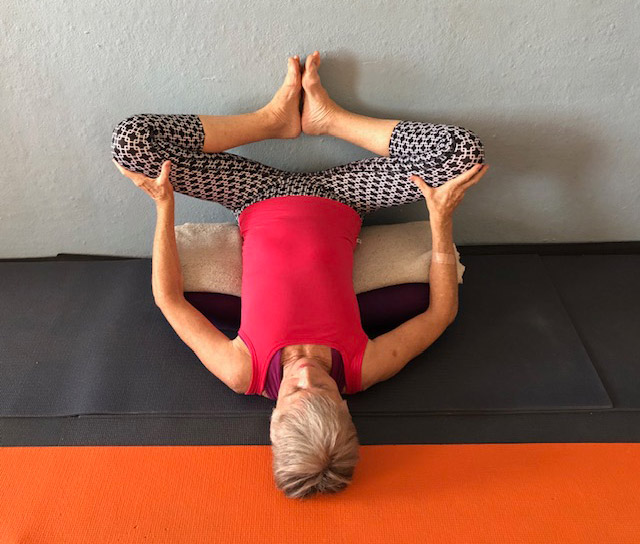
A variation: knees bent, soles together and hands resting on the thighs. Props make it comfortable.
If you like props, our note on what restorative yoga is shows how bolsters and blankets let the body rest. Legs up the wall often comes just before the final rest of a class, and our note on how to relax properly in savasana picks up from there.
Who should check first?
Before trying it, talk to your yoga teacher, yoga therapist, and your doctor if you wish, if you have glaucoma, high blood pressure that is not under control, a hiatus hernia (part of the stomach pushing up through the diaphragm), or you are in the later months of pregnancy. In the Iyengar tradition, women usually leave this pose out during a period. If you feel pain, numbness or dizziness, come out and rest.
The glaucoma caution has a research basis. A 2015 study in PLoS One (Jasien and colleagues, 20 people, 10 with glaucoma and 10 without) measured eye pressure in four head-down yoga poses held for two minutes each. In this pose, eye pressure rose from about 17 to about 21 mmHg in both groups, and it returned to baseline within two minutes of sitting up. The rise was bigger in poses such as Downward Facing Dog. If you have glaucoma, ask your eye specialist first, and tell your teacher.
Try this pose with a teacher
Your first class is free if you’re new to Flametree. New students, and anyone who has been away three months or more, can also get a half price 10 class pass with 2 extra classes free, to use online, in the studio, or both. We teach in the studio at Woolner in Darwin and LIVE online. For the studio, just come along. For an online class, click the class time you want and we email you the link to join.
See the half price pass or see the beginner timetable.
Already practising yoga? The same half price 10 class pass for new students, and for anyone away three months or more, is also available as the non-beginner half price pass.
Questions people ask about legs up the wall
How long should you stay in legs up the wall?
Five to ten minutes is a good start. Many students stay ten minutes or more once it feels easy, and Chris sometimes stays much longer at night. Come out sooner if you feel any pain, numbness or dizziness.
Can you do legs up the wall without a bolster?
Yes. Two or three folded blankets or a firm cushion work well. Put a thick book between the support and the wall as a spacer, and keep the height low at first if your back is stiff.
Does legs up the wall help you sleep?
Many students find it settles a busy mind before bed or when they wake in the night. Research has tested yoga programs for sleep more than this pose alone. A 2026 review of 22 trials found yoga likely added a large amount of sleep time for people with insomnia, and we cover it in our sleep article.
Is legs up the wall good for tired, heavy legs?
Many students say it is. After a day of sitting or standing, five to ten minutes with the legs up leaves legs feeling lighter. We would not promise a medical effect, and if swelling is sudden, on one side only, or does not go away, talk to your doctor.
Why do my legs tingle in legs up the wall?
Tingling is common when the legs rest straight for a while. Fold your legs into a cross-legged shape for a few breaths, then put them back up the wall. If tingling or numbness keeps returning, lower the height of the support or come out of the pose.
Who should not do legs up the wall?
Check first if you have glaucoma, high blood pressure that is not under control, a hiatus hernia, or you are in the later months of pregnancy. In the Iyengar tradition women usually leave it out during a period. Talk to your yoga teacher, yoga therapist and your doctor if you wish.
Can a stiff beginner do legs up the wall?
Yes. We teach it in our beginner classes, and a stiff back is a reason to use less height under the hips, not to skip it. A lower bolster, a belt round the thighs and bent knees all make it kinder.
Where can I learn legs up the wall in Darwin?
Flametree Yoga Studio teaches it in the studio at Woolner in Darwin and LIVE online, so you can set up a bolster at home with a teacher guiding you. Your first class is free if you’re new to Flametree.
Flametree Yoga Studio, Darwin NT, teaching Iyengar yoga in the studio and LIVE online. This note is general information, not medical advice.
Sources
- Bu ZJ and others. Effects of various exercise interventions in insomnia patients: a systematic review and network meta-analysis. BMJ Evidence-Based Medicine, 2026. doi:10.1136/bmjebm-2024-113512
- Laborde S and others. Effects of voluntary slow breathing on heart rate and heart rate variability: a systematic review and a meta-analysis. Neuroscience and Biobehavioral Reviews, 2022. doi:10.1016/j.neubiorev.2022.104711
- Jasien JV and others. Intraocular pressure rise in subjects with and without glaucoma during four common yoga positions. PLoS One, 2015. doi:10.1371/journal.pone.0144505



