
Vertigo Exercises And Yoga: What Mr Iyengar, Geeta Iyengar And The Research Say

You roll over in bed, or look up at a high shelf, and the whole room whirls. A few seconds later it stops, and you are left shaky and wondering what just happened. That is vertigo. It is very common, especially for women over 50, and in most people it comes from a small problem in the balance organs of the inner ear.
Vertigo exercises and yoga: the short answer
Vertigo is a false feeling of spinning or moving when you are still. The best known vertigo exercises are vestibular rehabilitation: steady, repeated head and body movements that retrain the brain’s balance system. Yoga does the same job. In a 2024 trial of 150 people with long-standing inner-ear vertigo, 12 weeks of yoga eased their dizziness as much as specialist vestibular exercises, and both did far better than no exercise. A 2013 Sydney trial of Iyengar yoga improved balance, balance with the eyes closed and walking speed in people averaging 68. Iyengar yoga adds what matters most with vertigo: slow, supported head movement, props, and a teacher who adapts every pose. We teach it at Flametree Yoga Studio in Darwin and LIVE online.
Get help now if…
Sudden, severe dizziness with weakness, numbness, a drooping face or slurred speech. Dizziness with double vision, trouble walking or confusion. Dizziness with a severe new headache or new neck pain, even days after a class. Dizziness after a knock to the head. We are not doctors, and this page is not medical advice. If any of these is happening to you right now, get help straight away: call 000.
The bottom line: five key moves for vertigo and dizziness
- Go to a yoga class at your level, two or three times a week, for about three months. The vertigo trial ran for 12 weeks. Steady, repeated movement is what retrains the balance system.
- Move the head slowly, and come up in stages. Most dizzy moments in any class come from the head changing level too fast.
- Rest the head on a support. A bolster, block or chair under the forehead, and a folded blanket under the head when lying down. When the head rests, it quietens.
- Keep the breath slow and soft. Calm pranayama (yogic breathing) steadies the nerves. Fast, forced breathing and strained breath holds are the ones to leave out.
- Start now. New, or away 3 months or more? 2 free classes, then half price, in Darwin or LIVE online.
First, a word on Iyengar yoga. Iyengar yoga is the style developed by Mr BKS Iyengar. In the 20th century he did more than anyone to set down traditional Indian yoga, through his books and his teaching, and he pioneered the use of props such as blocks, belts, bolsters and chairs. It is sometimes called modern classical yoga, and it is the style we teach at Flametree. Most vertigo trials so far tested yoga in general, not Iyengar yoga; we explain why that matters in Yoga Or Iyengar Yoga? Why The Difference Matters In The Research.
This guide in short
- Mr BKS Iyengar: with dizzy spells or vertigo, look down in standing poses, not up; rest the head in forward bends.
- Geeta S Iyengar: support the head, keep it turned away in twists if you get dizzy, and keep the eyes open.
- Other Iyengar teachers: head-supported forward bends and a long, quiet relaxation for giddiness.
- Dr Krishna Raman: holding the breath in poses brings on dizziness; breathe freely.
- The research: yoga eased long-standing vertigo as much as specialist balance exercises.
What is vertigo, and what causes it?
In short: a false message from the balance system, most often from loose crystals in the inner ear.
Each inner ear holds two balance sensors. Three fluid-filled loops sense the head turning. A small bed of tiny calcium crystals senses tilt and gravity. The brain puts these signals together with what the eyes see and what the feet feel. When one sends a wrong signal, the brain gets a mismatch, and you feel spinning, sickness and unsteadiness. Vertigo is a wrong signal, not damage, and most causes are harmless and pass.
The main causes of vertigo, from most to least common:
- Loose crystals (BPPV). Doctors call it benign paroxysmal positional vertigo (harmless, sudden, set off by head position). A few crystals drift into one of the fluid loops, and when the head moves through gravity they roll and the room spins, usually for under a minute. About 1.6 in every 100 adults have it in any year. It is about twice as common in women, far more common after 60, and over half of those who have it once get it again.
- Vestibular migraine. A migraine that shows up mainly as dizziness, often with no headache at all. About 1 in 100 adults a year. Stress, bright light, weather change and poor sleep set it off.
- Feeling faint on standing. Not true vertigo, but people often call it that. Blood pressure dips for a moment when you stand up. About 22 in 100 older people have it. Heat, too little water, an empty stomach and blood pressure tablets all make it more likely.
- Inner-ear inflammation and Ménière’s disease. Less common. Ménière’s brings spinning with ringing in the ear, muffled hearing and a full feeling in the ear.
Thin bones and low vitamin D have both been linked with BPPV coming on and coming back, which matters for women after menopause. Our bones and balance guide covers the bone side.
Three different things people mean by “dizzy”
Spinning, lightheaded or unsteady?
The room whirls when the head moves.
Most often: loose inner-ear crystals, or vestibular migraine.
In class: slow, supported head movement.
Faint, woozy, vision greys for a moment.
Most often: a blood pressure dip on standing, heat, not enough water.
In class: come up in stages, drink water.
Wobbly on your feet, worse in the dark.
Most often: weak legs, slower reactions, the eyes doing all the work.
In class: standing poses, at a wall at first.
A simplified picture. The first question a teacher asks a dizzy student is “is the room spinning, or do you feel faint?”
Vertigo exercises start with a quiet, supported head
Standing Forward Bend (Uttanasana) with the head resting on a block. With the head supported, it stays still and quiet.
“Do not close the eyes, keep them wide open.”
What Mr BKS Iyengar taught about dizziness and vertigo
In short: look down rather than up, rest the head, and let props carry the load.
In Yoga: The Path to Holistic Health, Mr Iyengar gives dizzy spells and vertigo a caution of their own in Triangle Pose (Utthita Trikonasana, pp. 70 to 75): look down, and do not turn the head up. In Standing Forward Bend (Uttanasana, p. 92), he suggests the feet a little apart for anyone prone to dizziness. He also lists dizziness among the physical signs of anxiety (p. 364), a reminder that a racing mind and a spinning head are often linked.
In an interview on props, edited by Geeta Iyengar and reprinted in Yoga Vaani 42 (December 1995, pages 39 to 45), the journal of Iyengar Yoga Australia, Mr Iyengar described a curved wooden box he designed for supported backbends and inversions. People with giddiness, he said, could use it to do these poses in comfort. This is the heart of his method: change the pose with props, so the person can still do it.
He knew the feeling himself. In 1958, at about 40, he wrote that he felt “dizzy, heavy and stiff” in his practice, and that other yogis told him age was taking its toll. He did not accept it, and kept working (Yoga Vaani 15, December 1988).
Triangle Pose for vertigo: look forward or down, not up
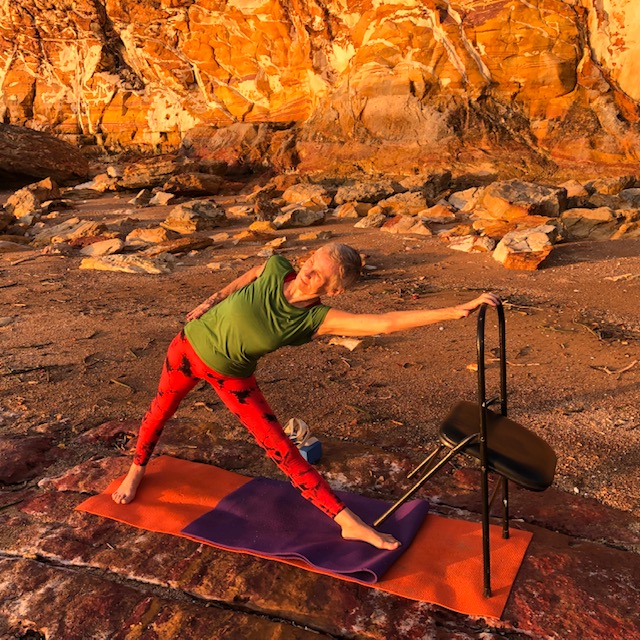
Triangle Pose (Utthita Trikonasana) with the hand on a chair. With vertigo, the head looks forward or down, not up at the top hand.
What Geeta S Iyengar taught about vertigo
In short: no ready-made list of poses. Support the head, work with gravity, and keep the eyes open.
Much of what follows is known from practice: found over many years of teaching, and tested daily in class, but not yet studied in trials. Not yet studied is not the same as not working.
Geeta S Iyengar (Mr Iyengar’s daughter, and a great teacher in her own right) ran a medical class at the Canadian Iyengar Yoga Conference in Vancouver in May 2001. A report of it appeared in Yoga Vaani 74 (June 2003, pages 28 to 36). Her starting point was blunt: “There are no ready-made answers.” A list of poses for a problem gives no real guidance; the teacher has to know each pose, and the person. Within that, she gave several points for vertigo, in our words:
- Twists: in a chair twist, someone with dizziness or vertigo turns the trunk but keeps the face turned the other way, with the ear and temple resting on a bolster. The head does not swing round with the body.
- Triangle Pose: look down when the turn brings dizziness. Looking down, the head goes with gravity, and the dizziness does not come.
- Head support: for migraine, Ménière’s disease and vertigo, she rested the head on a bolster or blanket so the person works with gravity rather than against it, and found relief came.
- Shoulderstand, fully supported: with the shoulders on blankets and the back of the head resting on a small roll, the neck is held between two supports. She said this space at the base of the ears needs to lengthen in people with tinnitus (ringing in the ears) and vertigo. This was a medical class with trained assistants; while spins are happening, a teacher uses gentler options first.
In Yoga: A Gem for Women, she told women not to be alarmed by dizziness when coming up from backbends: keep the eyes wide open, and it passes. Elsewhere she describes going slowly into backbends for women around menopause, who are often nervous and prone to vertigo: curve the neck a little first, then the chest, step by step (Yoga Vaani 50, September 1997).
“There are no ready-made answers.”
A forehead rest calms a busy, spinning head

Head To Knee Pose (Janu Sirsasana) with the forehead resting on a bolster. Head-supported forward bends are a classic Iyengar answer to giddiness.
Other Iyengar voices on giddiness
In short: head-supported forward bends, a wall at your back, and a long, quiet relaxation.
In Yoga the Iyengar Way, the senior Iyengar teachers Silva, Mira and Shyam Mehta give giddiness its own short entry: forward bends with the head supported, then a supported relaxation. We do not reproduce their sequences; a teacher fits them to you. Mira Mehta trained with Mr Iyengar in Pune from childhood and has taught in London for many years.
The very first issue of Yoga Vaani (September 1986) made the same practical point for Triangle Pose: older students, or anyone experiencing dizziness, do the pose with the back against a wall. The wall gives the brain a clear signal of where upright is.
An Iyengar teacher who is also a GP added a point worth knowing in Yoga Vaani 86 (June 2006): the brief dizziness some students feel on coming up quickly from Downward Dog on the ropes can be stronger in people taking blood pressure tablets. More on that in our yoga with high blood pressure post.
What Dr Krishna Raman says
In short: do not hold the breath in poses; it brings on dizziness.
Dr Krishna Raman is a medical doctor in Chennai (Madras), India, who trained in yoga under Mr Iyengar. In Yoga and Medical Science: FAQ (with Dr S Suresh), he says holding the breath in a pose causes headache, palpitations and dizziness, and raises the pressure in the main artery (question 125). He answers a question on dizziness when coming out of Half Moon Pose (Ardha Chandrasana, question 151), and gives giddiness and vertigo an entry of its own (question 420). His views, in our words: breathe freely, keep the head and neck soft, and come out of balancing poses slowly.
Dr Timothy McCall, the US medical doctor and yoga therapist who wrote Yoga as Medicine, does not give vertigo a chapter of its own in the parts of his book we hold notes on. His chapter on headaches and migraine is the nearest, and it points to the same thing: a calmer nervous system and steady, well-taught practice.
Supported inversions, chosen with care

Legs Up The Wall Pose (Viparita Karani) on blankets. The head stays flat and still, which is why it is often used instead of Headstand while spins are happening.
Why do I get dizzy in yoga?
In short: almost always the head moving too fast, a held breath, or heat. All three are easy to change.
Dizziness in a yoga class is common, and it is usually harmless. The main reasons:
- Coming up too fast. Standing up quickly from a forward bend, an inversion or the final relaxation (Savasana) drops the blood pressure for a moment. Sit down, and it passes in seconds.
- Holding the breath. Dr Raman’s point above. Many beginners hold the breath when a pose is hard.
- Fast or forced breathing. Over-breathing blows off carbon dioxide, which narrows the blood vessels to the brain and brings lightheadedness and tingling.
- Heat, an empty stomach, not enough water. In a Darwin build-up, this is the dizziness most likely to happen in a class.
- Head position, for people prone to loose crystals. Positions that move the head through gravity can stir the crystals: the head tipped back while lying, the head turned while lying, or going upside down.
If you feel dizzy in class: sit or lie down where you are, keep the eyes open on one fixed point, keep the head still and breathe slowly. Get up in stages once it has fully passed. And tell your teacher, so they can set you up differently next time.
Which poses need more care with vertigo: four groups, not forty poses
Ask one question: what is the head doing?
Head upright and still, or resting on a support. Standing poses looking forward, seated poses, forward bends with the forehead on a bolster, quiet breathing.
The head changes level. Coming up from forward bends and relaxation, unsupported Downward Dog, rolling over, getting up off the floor.
The head tips back, turns while lying, or goes upside down. Headstand, Shoulderstand, Plough, Camel, looking up in Triangle.
Fast, forced or strained. Shining skull breath (Kapalabhati), bellows breath (Bhastrika), long or strained breath holds.
A simplified picture, drawn from Geeta Iyengar’s medical class and the way BPPV is set off. A teacher places any pose by what the head does.
Which yoga poses should I avoid with vertigo?
In short: no pose is banned for life. While spins are happening, skip the full upside-down poses and anything that throws the head back, and use the supported versions.
“Never put the head below the heart” is a rule you will see online, but it does not hold up. Child’s Pose has the head below the heart and is one of the calmest poses there is. The better test is what the head does. In practice, while you are having episodes:
- Inversions: leave out Headstand, full Shoulderstand and Plough. Use Legs Up The Wall Pose (Viparita Karani), Bridge Pose on a bench (Setu Bandha Sarvangasana) or Half Plough with the feet on a chair, as your teacher shows you.
- Backbends: rest the head on a bolster or chair seat instead of letting it hang back.
- Standing poses: look forward, not up. Use a wall behind you at first.
- Twists: turn the trunk, and let the head follow gently, or keep it turned away as Geeta Iyengar taught.
- Breathing: no Kapalabhati or Bhastrika. Breath holds short and soft, never strained.
Once things have settled, the poses come back step by step. Stopping all movement tends to slow recovery; steady, gentle movement is the whole idea behind vertigo exercises.
Supported Bridge Pose keeps the head flat and still

Supported Bridge Pose (Setu Bandha Sarvangasana) on a brick. The chest lifts, and the head stays flat on the floor.
What does the research say about yoga for vertigo?
In short: yoga eased long-standing vertigo as much as specialist vestibular exercises, and Iyengar yoga improved balance in older people.
Research at a glance
- Yoga matched specialist balance exercises for long-standing vertigo. 150 people, 12 weeks, India, 2024.
- Yoga poses eased dizziness, and did better on movement sensitivity. 32 people, 3 weeks, Pune, 2021.
- Iyengar yoga improved balance, balance with the eyes closed and walking speed. 54 people averaging 68, 12 weeks, Sydney, 2013.
- A mindfulness course eased dizziness in vestibular migraine. 20 women, 8 weeks, USA, 2025.
Details and links below. The first two tested yoga in general; the Sydney trial tested Iyengar yoga.
Vertigo and inner-ear dizziness
- Yoga cut dizziness as much as specialist vestibular rehabilitation, and both beat no exercise at one, two and three months. 150 people with long-standing inner-ear vertigo were randomised to yoga, vestibular rehabilitation or a control group for 12 weeks. Vaishali and colleagues, Manipal, India, F1000Research, 2024. (Vaishali 2024)
- Yoga poses and standard vestibular exercises both reduced dizziness; yoga did better on how sensitive people were to movement. 32 people with inner-ear balance problems, 4 days a week for 3 weeks. Gazbare and colleagues, Pune, Neurology India, 2021. (Gazbare 2021)
Both trials tested yoga in general. Where the result is “yoga did as well as vestibular exercises”, it was yoga in general; Iyengar yoga has not yet been tested against vestibular exercises on its own. In our view as certified Iyengar teachers, the slow, supported, prop-based way Iyengar yoga handles the head is exactly what a sensitive balance system needs.
Vestibular migraine
- Dizziness, mood and anxiety scores all improved, and daily vertigo fell, over an 8-week mindfulness course. 20 women with vestibular migraine, no control group, Duke University and UCSF, Cureus, 2025. (Formeister 2025)
Mindfulness and yoga overlap a great deal: you cannot do a pose or pranayama well without being mindful. Our headaches and migraine guide has more on calming the nervous system.
Iyengar yoga studies
This trial tested Iyengar yoga taught by trained Iyengar teachers.
- Iyengar yoga improved standing balance, balance with the eyes closed, walking speed and getting up from a chair, the main risk factors for falls. 54 people averaging 68, twice a week for 12 weeks, with no serious adverse events. Tiedemann and colleagues, Sydney, Journals of Gerontology, 2013. (Tiedemann 2013)
Balance with the eyes closed is the telling one for vertigo: it is the inner ear and the feet doing the work, without the eyes to lean on. No trial has yet tested Iyengar yoga on its own for vertigo. Not yet studied is not the same as not working.
What is BPPV, and where do BPPV exercises fit?
For loose-crystal vertigo, the best known BPPV exercise is the Epley manoeuvre: a short set of head positions that guides the loose crystals back out of the fluid loop. It is specific to BPPV, and it is quick. Yoga is the steady practice around it: it trains the whole balance system, eyes, inner ears and feet together, and builds the leg strength and confidence that make a fall less likely.
Relaxation, with the head level and supported

Relaxation with the calves on a chair. A folded blanket under the head keeps the forehead level, never tipped back.
How this comes together in a Flametree class
You do not need a special vertigo class. A good Iyengar class already works the way vertigo exercises work: steady, repeated, controlled movement of the head and body, with the eyes and feet giving the brain good information. The extra steps for vertigo are small:
- Move the head slowly, and come up in stages. Out of relaxation: bend the knees, roll to the side, pause, sit, pause, then stand. Geeta Iyengar taught exactly this.
- Rest the head on a support in forward bends, Downward Dog and lying poses.
- Keep the head in line with the spine. Never hanging back, never cranked round.
- Go easy on inversions while spins are happening, and use the supported versions.
- Keep the breath slow and soft. Pranayama starts lying down, with the head supported.
- Look after heat, water and food. In Darwin’s build-up this matters more than almost anywhere. Drink water, don’t come on an empty stomach, and get up extra slowly if you take blood pressure tablets.
Iyengar teachers are among the longest trained in yoga. Each one spends at least three years as a student, then at least three years in teacher training, before being assessed by a panel of senior teachers. That training is why a teacher can see a head moving too fast, a held breath or a tipped-back neck, and change the pose for you. Please tell your teacher before class if you have had vertigo or a dizzy spell recently.
Supported breathing, the head resting and the eyes quiet

Lying back over bolsters, the head supported, for slow pranayama. The breath stays soft, which keeps lightheadedness away.
Read more on vertigo, balance and the nervous system
- Yoga for bone health, balance and falls: the full encyclopaedia guide
- Headaches and migraine
- Circulation, low blood pressure and fainting on standing
- High blood pressure and yoga, and can you do yoga with high blood pressure?
- Brain, memory and dementia risk
- Healthy ageing and yoga
- Neck pain and cervical spondylosis
- Balance test: three simple ones researchers use
- Half Moon Pose: balance, straight legs and the wall
Take it further
Free ebook: Strong Bones, Steady Feet. Here are the facts on vertigo; the ebook has even more on balance, including the Sydney Iyengar trial in full and stories of students in their 70s, 80s and 90s. Then do the free classes, and put it into action.
New to Flametree, or away 3 months or more? 2 free classes + 2 ebooks, only available via this offer. Already a student? You can still get this book. Get your free copy of Strong Bones, Steady Feet
- Classes, in Darwin or LIVE online: new, or away 3 months or more? 2 free classes, then 10 at half price. Already practising yoga? See the non-beginner half price pass. See every class time.
- Masterclasses: our 2027 Sunday Arvo Masterclasses with Chris Lalor, Certified Senior Iyengar Yoga Teacher and certified Yoga Therapist, teach the supported poses, sequences and calm pranayama that put this into action.
- Retreats: a week of daily, adapted yoga and pranayama in Bali. See the retreats.
Flametree Yoga Studio teaches Iyengar yoga for vertigo and balance at Woolner and Coolalinga in Darwin, and LIVE online across Australia. Other conditions are in our encyclopaedia of yoga for health conditions. Follow us on Facebook.
Vertigo exercises and yoga: questions people ask
Can yoga help vertigo?
Yes. In a 2024 trial of 150 people with long-standing inner-ear vertigo, 12 weeks of yoga eased dizziness as much as specialist vestibular rehabilitation, and both did far better than no exercise. Steady, repeated, controlled movement of the head and body is what retrains the balance system, and that is what a good yoga class gives you.
What are the best vertigo exercises?
Vertigo exercises retrain the brain’s balance system with steady, repeated head and body movement. Specialist vestibular exercises do this, and so does yoga, which matched them in a 150-person trial. For loose-crystal vertigo (BPPV), the Epley manoeuvre is a short set of head positions that guides the crystals back into place. Yoga then builds balance, leg strength and confidence around it.
Which yoga poses should I avoid with vertigo?
While spins are happening, leave out the full inversions (Headstand, Shoulderstand, Plough), backbends where the head hangs back, looking up in standing poses, and fast or forced breathing. Use the supported versions instead, such as Legs Up The Wall Pose and Bridge Pose on a bench. Once things settle, poses come back step by step with your teacher.
Why do I get dizzy in yoga?
The usual reasons are coming up too fast from a forward bend or relaxation, holding the breath, fast or forced breathing, heat and not enough water. Sit down, keep the eyes open on one point and breathe slowly, and it passes. Come up in stages, breathe freely, and tell your teacher.
Are inversions safe with vertigo?
Full inversions such as Headstand and Shoulderstand are best left out while you are having spins, because turning the head upside down can stir loose inner-ear crystals. Gentle supported inversions where the head stays flat, such as Legs Up The Wall Pose (Viparita Karani) and Bridge Pose on a bench, are the usual alternatives. Geeta Iyengar used fully supported Shoulderstand for vertigo in her medical classes, with the head resting; that is for a teacher to judge.
What did Geeta Iyengar teach about vertigo?
Geeta Iyengar said there are no ready-made answers: the teacher has to know the pose and the person. For vertigo she supported the head on a bolster or blanket, had people look down in Triangle Pose, and in twists turned the trunk while keeping the head turned away. She also taught keeping the eyes wide open if dizziness comes when coming up from a pose.
How often should I do yoga for vertigo?
The vertigo trial ran for 12 weeks, and the Sydney Iyengar balance trial used two classes a week for 12 weeks. Two or three classes a week for about three months is what we suggest, then keep going.
Where can I do vertigo exercises and Iyengar yoga in Darwin?
Flametree Yoga Studio teaches Iyengar yoga at Woolner and Coolalinga in Darwin, and LIVE online across Australia. Our teachers adapt poses for vertigo and dizziness. New and lapsed students can start with two free classes, then a half price pass.
Where this comes from
Mr BKS Iyengar, Yoga: The Path to Holistic Health (Triangle Pose cautions pp. 70 to 75; Standing Forward Bend p. 92; anxiety p. 364); Geeta S Iyengar, Yoga: A Gem for Women (backbends); Silva, Mira and Shyam Mehta, Yoga the Iyengar Way (giddiness); Dr Krishna Raman and Dr S Suresh, Yoga and Medical Science: FAQ (questions 125, 151 and 420); the Iyengar Yoga Australia e-Library; Flametree’s own teacher briefing on vertigo (October 2026); and the studies below. In our own words.
- “Medical Class with Geetaji”, Vancouver, 3 May 2001, Part 2. Yoga Vaani 74, June 2003, pages 28 to 36. Iyengar Yoga Australia e-Library.
- “Different Props: Their Use and Effects”, from an interview with BKS Iyengar, edited by Geeta S Iyengar. Yoga Vaani 42, December 1995, pages 39 to 45.
- Yoga Vaani 1 (September 1986), 15 (December 1988), 50 (September 1997) and 86 (June 2006). Iyengar Yoga Australia e-Library.
- Vaishali K and others, Effectiveness of vestibular rehabilitation therapy and yoga in the management of chronic peripheral vertigo: a randomized controlled trial, F1000Research, 2024. doi.org/10.12688/f1000research.147142.1
- Gazbare PS and others, Effect of yogasanas versus gaze stability and habituation exercises on dizziness in vestibular dysfunction, Neurology India, 2021, 69(5):1241 to 1246. doi.org/10.4103/0028-3886.329557
- Tiedemann A and others, A 12-week Iyengar yoga program improved balance and mobility in older community-dwelling people: a pilot randomized controlled trial, Journals of Gerontology Series A, 2013, 68(9):1068 to 1075. doi.org/10.1093/gerona/glt087
- Formeister EJ and others, Mindfulness-based stress reduction for the treatment of vestibular migraine: a prospective pilot study, Cureus, 2025. doi.org/10.7759/cureus.79225
- von Brevern M and others, Epidemiology of benign paroxysmal positional vertigo: a population based study, Journal of Neurology, Neurosurgery and Psychiatry, 2007. jnnp.bmj.com/content/78/7/710
- Neuhauser HK and others, Migrainous vertigo: prevalence and impact on quality of life, Neurology, 2006. doi.org/10.1212/01.wnl.0000237539.09942.06
- Saedon NI and others, The prevalence of orthostatic hypotension: a systematic review and meta-analysis, Journals of Gerontology Series A, 2020. doi.org/10.1093/gerona/gly188
This page is general information, not medical advice.
