
Yoga For Badminton Players: Strong Legs For The Lunge, A Calm Head For The Next Point
By Chris Lalor, Certified Senior Iyengar Yoga Teacher and Certified Yoga Therapist, and Dr Stuart McGill, Yoga Teacher, Flametree Yoga Darwin
Can you be fit enough to play badminton for hours, and still not touch your toes? One young badminton player in Mumbai could run, skip and jump, and thought he was very agile. But when he bent forward, he could not touch his toes.
Yoga for badminton players, meaning regular yoga classes for people who play, builds what the game asks for: strong legs for the lunge, free shoulders for the overhead shot, steady balance and a calm head for the next point. Yoga builds strength and flexibility together, in the same pose.
This page shows how: the players’ stories, what our kind of yoga is, the studies, the kinds of poses that help and why, and the easiest way to start, in Darwin or live online.
Yoga for badminton players in short: strong legs, free shoulders, a calm head
Yoga for badminton players is regular yoga classes that build the leg strength, shoulder range, balance and calm the game uses on every rally. You can do it in our Darwin studios or live online from anywhere in Australia.
- Players at the top of the game use yoga, yogic breathing and meditation.
- In two trials, badminton players who did yoga did better than the comparison groups on agility, endurance, mood or confidence.
- Standing poses build the legs that carry every lunge.
- A steady breath steadies the mind between points.
- One class a week helps, and more helps more.
- Start with 2 free classes, then 10 at half price.
Badminton Asks For Four Things Yoga Builds
Lunge, push back, lunge again.
Reach high for the overhead shot.
Land from a jump, change direction.
A steady breath for the next point.
Iyengar yoga builds all four together. A simplified picture, known from practice.
Yoga for badminton players in one picture.
What is Iyengar yoga, the yoga we teach?
Iyengar yoga is the style developed by Mr BKS Iyengar. In the 20th century he did more than anyone to set down traditional Indian yoga, through his books and his teaching, and he pioneered the use of props such as chairs, blocks, belts and the wall. His style is sometimes called modern classical yoga. It’s the style we teach at Flametree, in Darwin and live online. More in Why Yoga Works For Sport.
Which badminton players have found yoga and yogic breathing useful?
A player who became one of Mr Iyengar’s early students, a top coach, and four leading players all credit yoga, yogic breathing or meditation. Here is what each one says, told in our words, with the source.
The fit badminton player who could not touch his toes
Madhusudan Tijoriwala, a Mumbai solicitor, played badminton in his youth. He could run, skip and jump, and thought he was very agile. But he could not touch his toes. So in 1966 a friend took him to Mr Iyengar’s classes.
He thought he could already do many of the poses. In his first class with Mr Iyengar, he says, “I realised that I knew nothing about any asana” (asana means a yoga pose). He kept practising Iyengar yoga for about 40 years. Looking back, he says his tolerance and stamina increased, and he did not tire easily.
He told his story in a 2004 memoir in Yoga Rahasya, the Iyengar yoga journal published four times a year in Pune, India, by the Ramamani Iyengar Memorial Yoga Institute.
A top coach puts yoga and breathing into training
Pullela Gopichand, the Indian coach and former All England champion, said in 2016 that he had added yoga and breathing practices to the badminton syllabus, and that he does them himself. He said they help “in many other ways” beyond physical conditioning (DT Next, October 2016).
Leading players train the breath and the mind
- HS Prannoy (India) did breathing and focus sessions with his conditioning coaches almost every day. He says he is calmer on court, more focused, and sleeps better (BWF, August 2022).
- PV Sindhu (India) says meditation changed her life. It keeps her calm, helps her understand her emotions and helps in hard moments of a match (Telangana Today, August 2021).
- Mads Christophersen (Denmark) meditates for 5 to 10 minutes a day, bringing his attention back to his breath. He says he feels more present in matches and uses slow breaths to relax between rallies (Olympics.com, Lena Smirnova).
- Kidambi Srikanth (India) says yoga helps him stay in the moment and keep his mind on the next point. “Yoga gives me the power of patience,” he told Olympics.com (Olympics.com exclusive interview).
Is meditation different from yoga? Less than you might think. Yoga poses and yogic breathing both produce mindfulness. Mindfulness is steady, present attention, and yoga poses and pranayama (yogic breathing) are old routes to that same state. More in Yoga And Mindfulness.
Do you play badminton, and do yoga? We would love to hear from Darwin players. Tell us what yoga has done for your game, and with your OK we will share your story here. Get in touch.
Yoga for badminton players: strong legs for the lunge
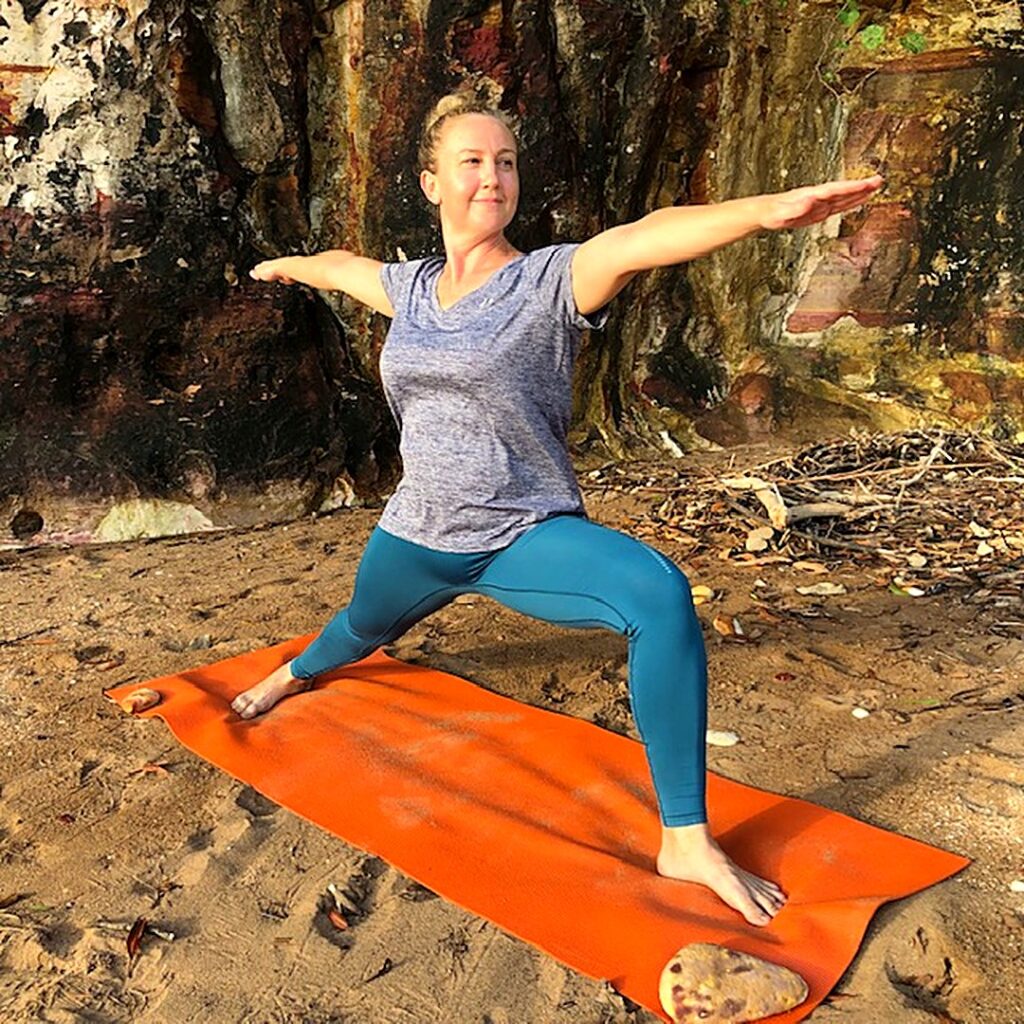
A standing pose. Kim with her front knee bent and her back leg straight: standing poses like this build the thighs and hips that carry you into a deep lunge and push you back out.
Want to try it? Start with 2 free classes, then 10 half price classes plus 2 free, $59.50, in our Darwin studios or live online. Every option is in how to start, further down.
What does badminton ask of your body?
Badminton asks for short, fast bursts again and again: lunging, jumping and powerful overhead strokes.
A review of the science of the game found a typical rally lasts about 7 seconds, with about 15 seconds of rest. Players’ hearts run at more than 90% of their maximum on average, and the game is built on lunges, jumps and powerful strokes (Phomsoupha and Laffaye, 2015).
- The lunge. Your front leg takes your weight low and fast, then pushes you back. That is leg strength.
- The jump and landing. You land, often on one leg, and change direction. That is balance.
- The overhead shot. Your arm and shoulder reach high and hit hard. That is shoulder range and strength.
- The next point. A tight rally ends and the next one starts within seconds. That is a calm head.
Most badminton injuries are in the legs. A 2025 review of 19 studies found the lower body accounted for 41% to 92% of injuries (Stepper and colleagues, 2025). The good news: leg strength and balance can be trained, at any age, and in a trial of 30 club players, three weeks of yoga went with better agility and endurance than in the comparison group (see the studies below).
Badminton is growing fast. About 427,000 Australians aged 15 and over played at least once in 2025 (AusPlay, via the Australian Sports Commission).
Yoga for badminton: shoulders and balance in one pose
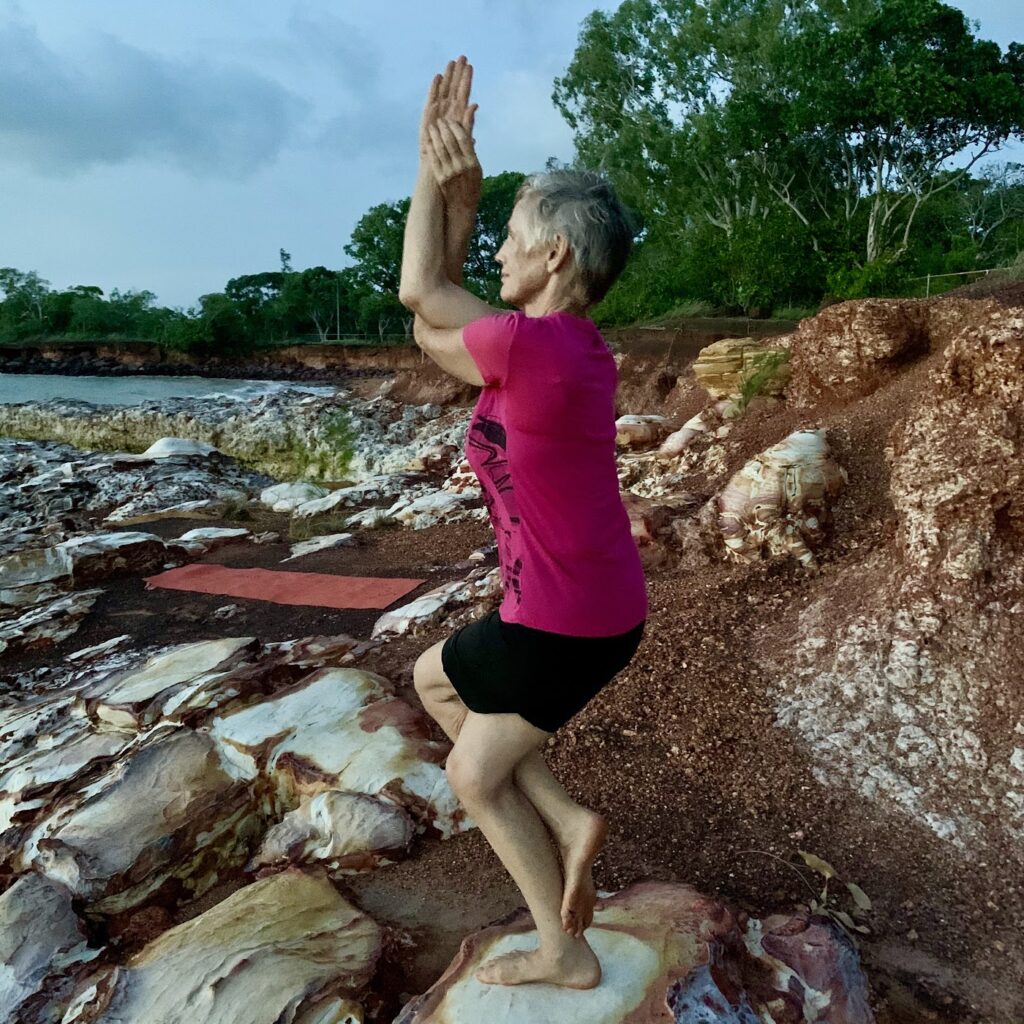
A standing balance with the arms wrapped. Chris on one bent leg at East Point, Darwin: poses like this build balance on one leg and work the shoulders and upper back that every overhead shot uses.
What does the research show about yoga for badminton players?
Two Yoga Trials In Badminton Players Found Better Agility, Endurance, Mood And Confidence
Two trials have tested yoga in badminton players, and both found gains over the comparison group. Both are early work: 20 and 30 players, over three to eight weeks. Two more trials tested mindfulness training in elite players.
- Yoga went with lower competition nerves and more confidence. 20 provincial-squad candidates in Semarang, Indonesia (12 men, 8 women), 10 in each group. The yoga group did an hour of yoga poses, pranayama (yogic breathing) and meditation, three times a week, for six to eight weeks (the paper gives both). The comparison group did a talking-based mental skills programme. In the yoga group, worrying thoughts fell by 21% and body tension by 27%, and self-confidence rose by 12%. In the comparison group, worrying thoughts barely changed and body tension rose. On a badminton skills test the authors designed, the yoga group improved and the comparison group did not. Kusuma and Wang, KEMAS: Jurnal Kesehatan Masyarakat, 2017. Read the study
- Three weeks of yoga went with better agility, endurance and mood. 30 club players aged 18 to 25 in Udupi, India, 15 in each group. The yoga group did 60-minute sessions of yoga poses, breathing and meditation with a certified instructor, three times a week for three weeks, on top of their usual badminton. The other group kept to their usual training. The yoga group did better on a badminton shuttle-run endurance test, a badminton agility test and a mood questionnaire. Nayak, International Journal of Creative Research Thoughts, 2016. Read the study
- Mindfulness training lifted mood in elite players. 49 elite Chinese players (25 trained, 24 did not). After a seven-week mindfulness and acceptance programme, the trained group’s mindfulness, acceptance and satisfaction with training rose, and their anxiety and low mood fell, compared with the others. Bu and colleagues, Chinese Journal of Sports Medicine, 2020. Read the summary
- Ten days of mindfulness raised mindfulness scores, but not scores on a planning test. 28 elite badminton players. Their mindfulness scores rose after a 10-day course, but their accuracy and speed on a planning puzzle did not change compared with the other group. Song and colleagues, BMC Psychology, 2026. Read the study
What has not been tested yet: no trial we have found has tested Iyengar yoga in badminton players, or followed players for a full season, or looked at injuries or match results. The two yoga trials tested yoga in general. Not yet tested is not the same as not working. Why the style matters: Yoga Or Iyengar Yoga?
The last two trials tested mindfulness training, not yoga. That still counts for our classes, because yoga poses and yogic breathing build that same steady attention.
Badminton Players Who Did Yoga Gained Over The Comparison Groups
players: lower nerves, more confidence, with yoga.
players: better agility, endurance and mood after 3 weeks of yoga.
elite players: better mood after mindfulness training.
Kusuma and Wang 2017; Nayak 2016; Bu and colleagues 2020. A simplified picture.
Early studies, all pointing the same way.
What kinds of yoga poses help a badminton player, and why?
Seven kinds of practice do most of the work for a badminton player: standing poses, balance work, hip work, shoulder work, twists, restorative poses and breath work. We name the kinds here. Your teacher shows you the poses themselves in class, adjusted to your body.
What we find: flexibility comes from extending your range of movement, and that means straightening your legs and arms. Many people in sport, and in gyms, Pilates and CrossFit, cannot fully straighten their legs or arms, because strong, short muscles hold them a little bent. For a badminton player that is the lunge leg and the racket arm, and they never get enough flexibility there until they build that straightness through yoga. Hips are often stiff too, from short muscles and short, tight tendons.
- Standing poses build strong legs. They work the thighs, hips and ankles, one leg and then the other, and hold the knee in line over the foot. That is the base for a deep lunge and a quick push back to the middle of the court.
- Balance work with a wall or chair trains the landing. You start with support and use less as you get steadier. It builds the control you need when you land from a jump and change direction.
- Seated and hip work frees the hips. Free hips let you lunge low without your knees and back taking the strain.
- Shoulder work and supported backbends open the chest and shoulders. With props such as a chair, a belt or the wall, they build range and strength for reaching high on the overhead shot.
- Twists keep the spine turning, to both sides. Badminton is a one-sided game: the same arm and the same turn, thousands of times. Twists to both sides even it out.
- Supported restorative poses help you recover. With props holding you, tired legs and a busy mind can settle after a long session on court.
- Breath work (yogic breathing) steadies the mind. A slow, steady breath steadies your attention, which is what you want between points.
That is our teaching, known from practice. Every pose is done on both sides, with props so a stiff body can do it well. Iyengar yoga builds strength and flexibility together, including the muscle pull that bone responds to.
Yoga for badminton players: arms, shoulders and legs together

Chris with her hips high, arms and legs straight, head resting on a block. Poses like this work the shoulders with the arms reaching overhead, and the backs of the legs at the same time.
How does yoga help a player stay calm between points?
A steady breath steadies the mind, and a held pose trains you to stay in the present. That is what we see in our students. A morning pranayama (yogic breathing) class before you play leaves you calmer and more focused. That is our experience as teachers, not a badminton trial.
It is also what the players above describe: calmer on court, more present in matches. And in the Indonesian trial, the yoga group’s competition nerves fell while their confidence rose.
Breath work for a calm head

Breath work. Chris sitting on a cushion with her hands covering her eyes and ears, turning her attention inward: the kind of practice that steadies the mind.
How much yoga does a badminton player need?
One class a week helps, and more helps more. This is Flametree’s view as teachers, from many years of classes:
- One class a week works.
- Two or three a week work better.
- Five or six a week work better again.
The same holds for pranayama (yogic breathing) classes. Regular classes are the point. A quick routine before a game, with no classes behind it, makes very little difference. Do we practise what we teach? Yes. Stuart does at least an hour of yoga and an hour of pranayama every day. Chris practises between one and three hours a day, and does pranayama almost every day.
Which classes should a badminton player start with?
Start with a beginner class, then add what suits you. Come along, learn more about yoga, build your strength, fitness, flexibility and mindfulness, and then you can see for yourself whether it works. Darwin time, from the beginner timetable updated 12 November 2026:
- Beginner 1 classes: every day of the week, at Woolner (19B Bishop St, near Parap) and Coolalinga (Shop T31, Coolalinga Central), and some live online. Standing poses, balance work with props, twists and more, set for your body.
- Gentle Yoga: Fridays 10.15 to 11.15am, Woolner and live online. Slow and easy, with plenty of props, for stiff bodies and tired days.
- Yoga For Backs: Wednesdays 7.15 to 8.15pm, Woolner, open level. The whole back, from the lower back up through the neck and shoulders.
- Restorative Yoga: Saturdays 4 to 5.15pm, Woolner and live online, open level. Supported poses that rest and restore, good after a tournament.
- Restorative Yoga and Immune System Yoga: Thursdays 5.45 to 7.15pm, Woolner and live online, open level. The timetable asks for 3 months of yoga first, or your teacher’s OK.
- Pranayama (yogic breathing): for calm and focus. Once you have some beginner classes behind you, your teacher will tell you when to add one.
Want to learn much more about how this yoga works? Once you have started, our 2027 masterclasses with Chris Lalor go deeper: six Sunday afternoon sessions from 28 December 2026 to 18 April 2027, in Darwin or live online, on arthritis, sleep and energy, pelvic floors, backs, wisdom, and anxiety, upsets and anger.
A word on Darwin heat. Pace yourself in a hot hall, and stop when you need to.
Can badminton players do yoga online?
Yes. You can join our live interactive online classes from anywhere, with a teacher who can see you and guide you. Badminton clubs can book a live online group class that comes straight into the clubrooms on a big screen.
Live in a regional or remote area? Online, Iyengar-trained teachers can come to you. See our live online classes.
Yoga for badminton clubs: a group class at your club, at our Woolner studio or live online, is a simple way for players to try it together. Badminton in the Territory is run by the NT Badminton Association, the peak body for the sport in the NT. Details of club classes are in the offers below.
How do I start yoga for badminton in Darwin or online?
- 2 free classes, plus 2 free ebooks. New to Flametree, or back after 3 months or more? Choose 2 free ebooks (the sport and men’s book is Stay In The Game) and get 2 free classes, live online or in our Darwin studios. Claim them here
Or just come along, at the studio or online, and your first class is free. That is one free class. Register first and you get two free classes and two free ebooks, plus a few short reminders and tips to help you get started. So registering gets you more.
- Then the half price beginner 10-pass with 2 free. 10 half price classes plus 2 free, $59.50. That is 12 classes, $4.96 a class, in our Darwin studios or live online.
- Then the unlimited beginner weekly pass, to come as often as you like: studio, $17.95 a week; studio and online, $21.95 a week; online only, $10.95 a week.
- A private lesson: private class pass, $109, or 5 private lessons at 10% off. Talk to us to set a time.
- For badminton clubs: group class, $149 a session, at your club, at our Woolner studio or live online. Book 10 sessions together for 10% off: contact us.
Start free, then pick the option that suits you.
Yoga for badminton players: questions, answered
Is yoga good for badminton players?
Yes. Badminton asks for strong legs, free shoulders, steady balance and a calm head, and Iyengar yoga builds all of these together. In two trials of badminton players, those who did yoga did better than the comparison groups: one found better agility, endurance and mood, the other lower nerves and more confidence.
Can yoga help badminton players with sore wrists and shoulders?
Yoga is well worth trying. Shoulder work with props builds range and strength for the overhead shot, and twists to both sides even out a one-sided game. Tell your teacher about your wrists or shoulders, and they will adjust the poses to suit you. No trial has tested this in badminton players yet.
Does yoga help with quick lunges and changes of direction?
Yes. Standing poses build the legs that carry a lunge, and balance work trains control on one leg. In a trial of 30 club players, three weeks of yoga went with better results on a badminton agility test and an endurance shuttle run than in the comparison group.
Can yoga help players stay calm in a close match?
Yes, in our experience. A steady breath steadies attention. In a trial of 20 players, the yoga group’s competition nerves fell and their confidence rose, and top players credit breath work and meditation for staying calm on court.
How do badminton players recover after a long tournament day?
Supported restorative poses let tired legs and a busy mind settle, with props doing the holding. Our Saturday Restorative Yoga class is built around them. That is our teaching, known from practice.
Is yoga good for veteran and senior badminton players?
Yes. Many people start yoga in their fifties, sixties or later. Iyengar yoga uses chairs, blocks, belts and the wall so a stiff body can do each pose well, and it builds leg strength and balance for staying on court for years. Start with Gentle Yoga or a Beginner 1 class.
Where can a badminton player try yoga in Darwin?
At Flametree’s studios at Woolner (19B Bishop St, near Parap) and Coolalinga (Shop T31, Coolalinga Central). Badminton clubs can book a group class at the club, at our Woolner studio or live online, at $149 a session.
Can badminton players do yoga online from home?
Yes. Our live interactive online classes work from anywhere in Australia, with a teacher who can see and guide you. A club can also have a live online group class shown on a big screen in the clubrooms.
More for sportspeople: golf yoga, yoga for lawn bowls, and the whole Yoga For Sport section.
Sources: Madhusudan T. Tijoriwala, “Memoirs of my Days with Guruji”, Yoga Rahasya, Vol 11 No 3, 2004 (print journal, read for Flametree); DT Next, “Yoga is part of badminton training: Gopichand”, 15 October 2016; BWF, “HS Prannoy and the art of breathing right to stay calm”, 14 August 2022; Telangana Today, “PV Sindhu says meditation has changed her life”, 10 August 2021; Lena Smirnova, Olympics.com, badminton, mindfulness and meditation interviews; Phomsoupha and Laffaye, Sports Medicine, 2015; Stepper and colleagues, BMJ Open Sport and Exercise Medicine, 2025; AusPlay data via the Australian Sports Commission (2025); Kusuma and Wang, KEMAS: Jurnal Kesehatan Masyarakat, 2017; Nayak, International Journal of Creative Research Thoughts, 2016; Bu and colleagues, Chinese Journal of Sports Medicine, 2020; Song and colleagues, BMC Psychology, 2026. Research via PubMed and the journals’ own pages. Players’ stories are their own accounts, not proof. This page is general information.
