
What Is Restorative Yoga? The Science Behind Lying Still
Restorative yoga: the short answer
Tired all the time, even though you exercise? You may be short of rest, not short of effort. Restorative yoga is the prop-supported, long-held practice that grew out of the teaching of Mr BKS Iyengar. You lie on bolsters and blankets, you stay there for minutes rather than seconds, and your body is held so completely that it can finally stop working. It looks like doing nothing. It is not.
Iyengar yoga is the style developed by Mr BKS Iyengar. In the 20th century he did more than anyone to set down traditional Indian yoga, through his books and his teaching, and he pioneered the use of props. It is sometimes called modern classical yoga, and it’s the style we teach at Flametree.
This note is part of our Yoga Notes for beginners.
Restorative yoga in short form
- It is a different job from a normal class. Ordinary yoga asks your muscles to work. This invites them to stop.
- Props do the holding. Poses are held for minutes, with the body fully supported.
- Calm is the aim. It is a practice for the rest and digest side of the nervous system.
- One yoga session raised brain GABA in a small trial. That trial tested a standard yoga class, not a restorative one.
- Many students tell us they sleep better. Research on sleep and menopause is encouraging but still mixed in quality.
- You may be under-recovered, not under-exercised. That is the gap this practice fills.
- Newcomers are welcome. Beginner restorative classes run at Woolner and Coolalinga, with props supplied.
What restorative yoga actually is
In a restorative class you might do five or six poses in an hour. Each one is set up with bolsters, blankets, blocks and belts so that your body is fully supported. Nothing is held up by muscle. Then you stay.
The precise prop placement is not fussiness. It is the whole method. If your body has to hold any part of itself up, your nervous system stays switched on, and the point of the practice is lost. When the support is exactly right, something lets go that you did not know was gripping.
Mr Iyengar built this out of necessity. He was a sickly child who took up yoga as a teenager, and he spent decades working out how to make poses available to people who were injured, ill or exhausted. His daughter Geeta Iyengar went further and developed sequences for women’s health.
Mr Iyengar described the aim of yoga as bringing the mind back to simplicity, peace and poise.
Is restorative yoga just a nap?
No. In the Iyengar tradition it is a discipline. The props are placed so the bones are supported and the muscles are no longer needed to hold the body up. Poses are usually held for 5 to 10 minutes, or 2 to 3 minutes for newcomers, which gives the breath time to soften. Even with perfect prop placement the mind has to agree to the pose, and letting go is an awake, intelligent release of effort, not collapse. Geeta Iyengar described asana as the mind reaching inside the body to find a quiet space.
Restorative yoga and anxiety
Some of the better known research here is on yoga in general, not restorative yoga alone, so please read it that way. In a small randomised trial at Boston University, a 60-minute yoga session was followed by a rise in brain GABA, a chemical that helps quieten the nervous system. The comparison group walked. The trial used a standard yoga class, not a restorative one. According to PubMed, the trial is Streeter and colleagues, 2010, Effects of yoga versus walking on mood, anxiety, and brain GABA levels (doi 10.1089/acm.2010.0007).
Other studies of yoga for anxiety and low mood have reported improvements over eight to twelve weeks, though the programmes, the people and the quality vary a lot, so we do not put a number on it.
One way to see it is structural rather than mystical. Long holds in a fully supported position, in a quiet room with nothing to achieve, make it easier for the mind to move out of worry. You cannot instruct someone to stop being anxious. You can put their body somewhere that makes calm more likely.

Reclining Bound Angle Pose (Supta Baddha Konasana), fully supported. Nothing is held up by muscle, so the nervous system can let go.
Restorative yoga and stress hormones
Cortisol is your main stress hormone. A 2017 review of 42 trials of yoga (Pascoe and colleagues) reported lower cortisol, and some drops in blood pressure and heart rate, in several of the studies. Those trials covered many kinds of yoga and many kinds of people, so the result is encouraging rather than settled, and it was not about restorative yoga alone.
One way to describe what is happening is a switch from fight or flight into rest and digest. Most of us spend the day in the first mode and never properly enter the second, and then wonder why we are tired all the time.
That matters in Darwin in particular. Between the heat, the humidity and the build up, the nervous system is already working overtime before you add work and family to it. Adding a harder workout to that is not always the answer. Many people find adding recovery helps.
Restorative yoga for sleep
Many students tell us they sleep better the night after a class, which makes this one of the easiest things on the whole list to test for yourself.
Some studies of yoga over about eight weeks have reported people falling asleep faster, staying asleep longer and feeling more rested. The research is mixed in quality, so treat it as a reason to try it rather than a promise.
What it teaches is how to actually rest. Chris Lalor, our senior teacher, says relaxing is a learnt skill, and that the most common sound in a restorative class is a long, quiet sigh. Lying on the couch with a phone is not quite the same thing. Our note on how to relax properly in savasana shows how we teach it.
If you want one pose to try at home on a restless night, Legs Up The Wall is a favourite of ours. Stuart’s own rule of thumb is to stay in it for 10 minutes or until sleepy.

A seated forward bend with the head resting on a bolster. Head-supported forward bends are a quiet way to end the day.
Restorative yoga and trauma
Dr Bessel van der Kolk and colleagues have studied trauma-sensitive yoga for women with long-standing post-traumatic stress, and reported encouraging results in a small trial. We have not been able to check the exact figures for this note, so we leave them out.
When distress lives in the body, talking about it is not always enough on its own. Supported poses can give the nervous system repeated experience of feeling safe enough to let go.
This is a serious area. Please talk to your yoga teacher, your yoga therapist, and your doctor or psychologist if you wish, and let yoga sit alongside proper professional support.
Restorative yoga for menopause and perimenopause
For women from their mid thirties onward, reviews of yoga for menopause have reported lower hot flush frequency and better mood and sleep in some of the trials, though the trials differ a lot in quality. A 2024 review of 24 trials (Cheng and colleagues) is one of them.
Geeta Iyengar, who developed yoga for women’s health, taught that cooling, head-supported forward bends and supported inversions suit this stage of life. Many women tell us the practice helps them with both the physical and the emotional side of the transition.
Can restorative yoga help with hormones?
It may support the hormonal system indirectly, by moving the body toward rest and digest, and the long holds give that time to happen. Stress hormones such as cortisol rise when we feel under threat. Restorative poses, with the body fully supported, signal that the coast is clear. That nervous system side of the story is the part research supports best, as the stress hormone section above shows.
Why are restorative poses held for 5, 10 or 15 minutes?
In Chris Lalor’s words: “It’s not just about relaxation. It’s about biology. While the nervous system can react quickly, the hormonal system is much slower. Hormones need time to travel through the bloodstream and reach the cells they act on. Hormones are the invisible conductors of the body’s orchestra. When just one instrument goes out of tune, like cortisol, thyroid or oestrogen, the whole symphony can feel off.”
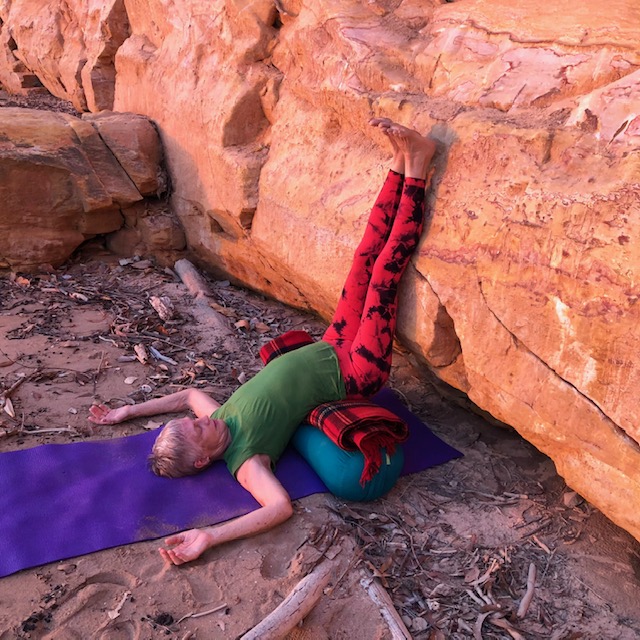
Legs Up The Wall (Viparita Karani) over a bolster. A long, fully supported hold gives the body time to settle.
Which restorative poses does Chris use for hormonal balance?
- Legs Up The Wall (Viparita Karani), held for a long time, to let the body settle, which many people find leads to better sleep and steadier energy.
- Supported Bridge Pose (Setu Bandha Sarvangasana). Iyengar teaching describes a gentle “squeeze and soak” here, in which the front of the throat is gently compressed and then refreshed when you come out.
- Mild inversions with the head supported, which Iyengar teaching, following Geeta Iyengar, uses to steady the glands in the brain that direct the others.
The squeeze and soak effect and the effect on the master glands are known from long practice in the Iyengar tradition, and many women tell us these sequences help with the ups and downs of the menstrual cycle and menopause. Modern research has not yet tested those mechanisms directly. Please talk to your yoga teacher, your yoga therapist, and your doctor if you wish. For more, see Yoga Notes on menopause and yoga for menopause and perimenopause.
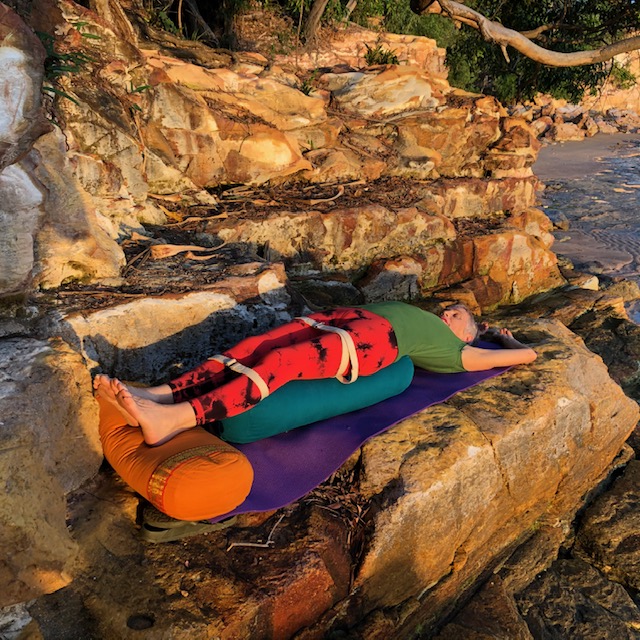
Supported Bridge Pose (Setu Bandha Sarvangasana) along a bolster. In restorative yoga, you let the pose happen to you.
As Chris puts it: “In restorative yoga, we aren’t doing the pose. We are letting the pose happen to us. That stillness? That’s where you recharge.”
Why lying still can work when moving does not
Two ideas are worth knowing. They are explanations that teachers and researchers offer, not proven mechanisms.
Fascia. Fascia is the connective tissue that wraps the muscles. A common teaching idea is that it responds to sustained, unforced support and stillness, which is one reason restorative poses are held for minutes. Research on fascia is still developing, and we do not put figures on it.
The vagus nerve. The vagus nerve is the main nerve of the rest and digest system, running from the throat to the gut. Chris explains that this is why upsets are felt in both the mind and the gut. Studies of Iyengar yoga and vagal tone (Khattab and colleagues, 2007) point in this direction.
What to expect, week by week
These are the kinds of changes students tell us about. They vary from person to person.
- First session. Many people feel calmer, and some sleep better that night.
- The first few weeks. Stillness gets easier, and you may start to enjoy it rather than fidget through it.
- A couple of months in. Many students say they cope better with stress and feel more rested in everyday life.
Why Stuart went from avoiding restorative yoga to doing it every week
Stuart McGill, who runs Flametree with Chris and often sits at its market stall in Darwin, used to dislike restorative yoga. He thought exercise needed intensity, and that lying about in easy poses could not be useful. He avoided restorative classes and once stopped going to another class when the teacher added a more restorative sequence.
The first change came on a Friday afternoon in Melbourne, when he went to a restorative class only because no other class was on. Walking down the street afterwards he realised he felt calm and energised, and had to admit it was the class.
The second was practical. After a hard day outdoors in the heat of the Darwin build-up, restorative poses were something he could still face. Once he started, time passed quickly and he often ended up with a good practice. The long, propped holds also let him work on his stiffest areas, such as forward bends, with his head resting on a chair or bolster. A back bend over a chair with the head on a bolster gave him a lift in energy as well as calm.
The third was a talk from Chris on the two sides of the nervous system. Fast walking, gym work and active yoga mainly stimulate the fight or flight side. Restorative poses are the ones aimed at rest and digest.
He now does restorative poses most weeks, and sometimes more, at home and at the studio. He drives rather than flies on remote work trips so he can carry his props.
What if restorative yoga feels too slow or boring?
This is common, and some people feel restless in their first few classes. Chris has heard students say they cannot see the point, and that they will not get a workout from it. Stuart felt the same. It can help to think of it as training for the nervous system rather than the muscles.
If the stillness is hard, you may be getting a useful look at how busy your mind is. Take it gently, and talk to your yoga teacher, your yoga therapist, and your doctor if you wish.
A story from the US psychotherapist and yoga teacher Bo, in her book Yoga for Emotional Balance, makes a related point. She describes a client who kept wanting to analyse why restorative yoga helped. The more he analysed, the more the calm slipped away, and it returned when he simply stayed present in his body. Her view is that for some people the body-based route does something talking does not.
Do newcomers need other classes as well?
Restorative classes are open to beginners and experienced students alike. We do suggest that newcomers also try our other beginner classes, either first or at the same time. The more active poses help you learn to quieten the body and mind, and that helps you get more from restorative yoga.
If you do online classes, have the props you see in the pictures, or improvise them from things around the house.
Restorative yoga classes at Flametree
Beginner level restorative yoga runs at our Woolner studio (19B Bishop St) and at Coolalinga Central, and you can join online as well. Props and mats are supplied in the studio, so bring nothing but yourself.
New to Flametree? Your first class is free. The half price 10 class pass, with 2 extra classes free, is for newcomers and for anyone who has been away three months or more.
See the newcomer deal, check the timetable for restorative class times, or get an online class link.
Questions? Call or message 0468 362 641 or 0448 11 22 51, or email [email protected].
Restorative yoga: questions people ask
What is restorative yoga, in one sentence?
Yoga done lying down on props, holding each pose for several minutes, so the body is completely supported and the nervous system can switch off. Five or six poses in an hour is normal. It is the opposite of a workout, and that is the point.
Is restorative yoga the same as yin yoga?
No, and the difference matters. Yin yoga holds poses for a long time in order to load the connective tissue, so you feel a stretch and there is a deliberate edge to it. Restorative yoga removes the stretch as far as possible. Everything is propped so nothing is being worked. Yin is a practice of mild discomfort held patiently. Restorative is a practice of complete support.
Does restorative yoga count as exercise?
Not in the way a standing class does, and you should not treat it as your only practice. Stuart finds it still helps his flexibility, especially for forward bends, but it is doing a different job from a workout. Think of it as the other half of training, not a soft option.
Is restorative yoga good for beginners?
It is one of the gentler ways into yoga, because little is demanded of you physically. The hard part is mental, and it is simply staying still. Plenty of people find their first few sessions restless, and that often settles with practice. We also suggest newcomers try other beginner classes first or at the same time.
How often should you do restorative yoga?
Many students start with one class a week, and some add a second. A short practice at home on other evenings can add to it, and Legs Up The Wall for ten minutes counts. Aim for a regular rhythm that suits you, and ask your teacher if you are unsure.
Is restorative yoga hard?
Physically, no. Nothing hurts and nothing is held up by muscle. What people find hard is the stillness, and particularly the first few minutes of each pose when the mind is still going. That is not a sign you are bad at it. That is the practice.
What is yoga nidra, and is it the same thing?
Yoga nidra is a guided lying down practice that takes you to the edge of sleep without going over. It is often used at the end of a restorative class. Restorative yoga is the poses. Yoga nidra is the guided attention. They fit together well.
Can I do restorative yoga if I have an injury or a health condition?
Often yes, and it can be the form of practice that is still available when others are not. Tell your teacher before the class starts so the setup can be adjusted. Chris Lalor is an accredited yoga therapist as well as a senior teacher, so this is ordinary conversation at Flametree. You can also talk to your doctor if you wish.
Can I do restorative yoga at home without special props?
Yes. A lot of restorative yoga can be done with improvised props from around the house, such as firm cushions for a bolster, a folded blanket, a chair and something to cover the eyes. Hold each pose for the time your teacher suggests, and give your body time to unwind. In the studio, all props and mats are supplied.
Where can I do restorative yoga in Darwin?
Flametree runs restorative classes at Woolner (near Parap) and Coolalinga Central, and teaches online as well. Check the timetable for class times.
Last updated October 2026: added Stuart’s story, the short form summary, and softened the research claims. General information, not medical advice.
Research sources
Brain chemistry and mental health
- Streeter et al. (2010), Boston University. Yoga versus walking, mood, anxiety and brain GABA. PubMed.
- Pascoe et al. (2017). Review of 42 trials on yoga and stress hormones.
Trauma and PTSD
- van der Kolk et al. (2014). Trauma-sensitive yoga for chronic PTSD (figures not verified for this note).
Women’s health and menopause
- Cheng et al. (2024). Review of 24 trials of yoga for menopause.
- Geeta Iyengar (1983). Yoga: A Gem for Women.
Physical mechanisms
- Khattab et al. (2007). Iyengar yoga and vagal tone.
Iyengar teachings
- Iyengar BKS (1966, 2005). Light on Yoga; Light on Life.
- Yoga for Emotional Balance (book by Bo).
New to Flametree? Your first class is free. Darwin and online.
Already practising yoga? The same half price 10 class pass for new students, and for anyone away three months or more, is also available as the non-beginner half price pass.



