
Yoga Equipment For Home: Blocks, Belts And Sandbags, And Why Iyengar Yoga Uses Them
Can’t reach the floor? Can’t reach your feet? Can’t switch off at the end of class? Three cheap pieces of yoga equipment fix all three: a block, a belt and a bag of sand.
Yoga equipment for home: the short answer
The yoga equipment that does the most work at home is small and cheap. Yoga blocks bring the floor up to your hands. A yoga belt (also called a yoga strap) makes your arms longer and holds your legs steady. A yoga sandbag adds a gentle weight that helps tight muscles let go. In Iyengar yoga these props are not extras. Mr BKS Iyengar built them into the method so that stiff, tired or unsure bodies could do the real pose well, at home as well as in class. Here is the article in short form:
- Props let you do the real pose properly, from the first class.
- Mr Iyengar said props stop mistakes and act as self-guides at home.
- Blocks bring the floor up; belts make arms longer; sandbags help you let go.
- Two blocks and one belt cover most home practice.
- Blankets do most of a bolster’s work, for less money.
- Our starter pack is $79 with free shipping Australia-wide.
- In Darwin, studio classes supply all the props.
Last updated: 4 November 2026.
A quick word on Iyengar yoga. Iyengar yoga is the style developed by Mr BKS Iyengar. In the 20th century he did more than anyone to set down traditional Indian yoga, through his books and his teaching, and he pioneered the use of props. It is the style we teach at Flametree, in Darwin and live online.
Yoga blocks bring the floor up to you
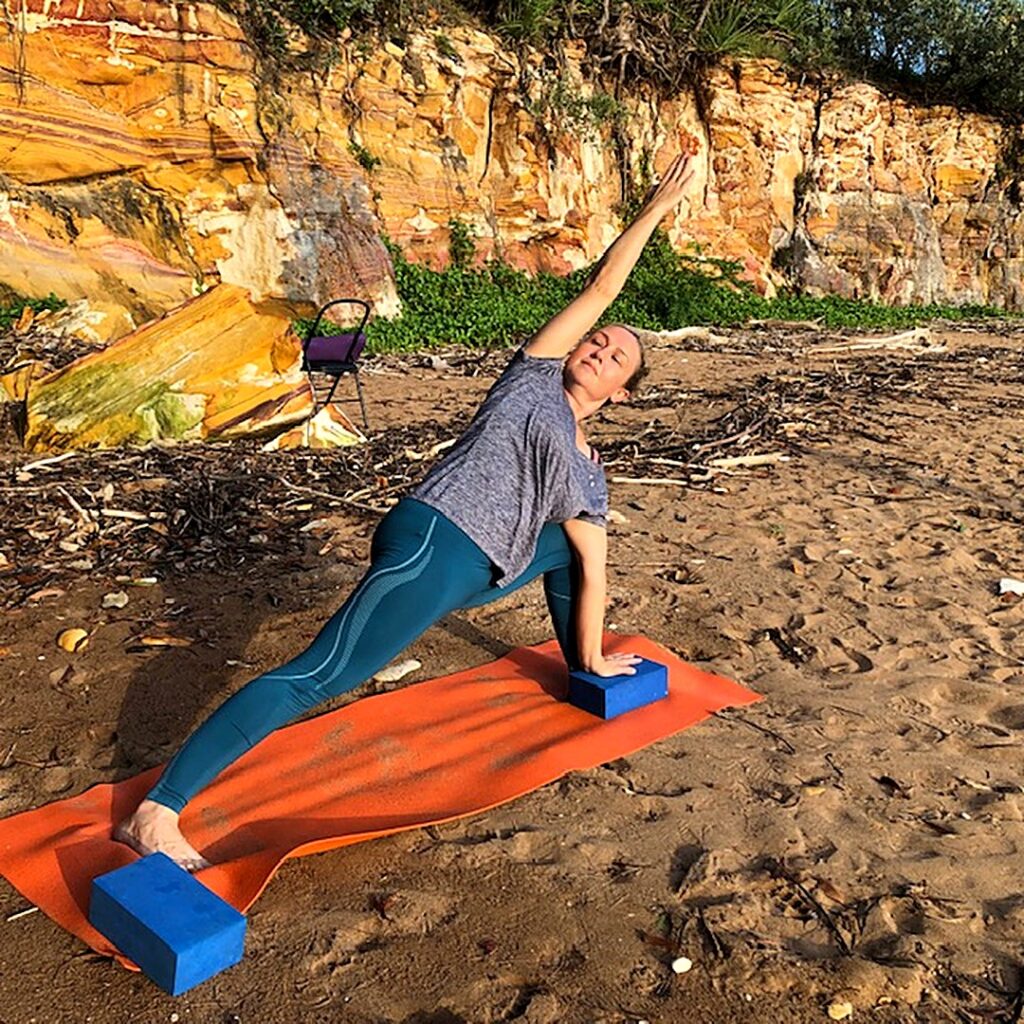
Kim in Extended Side Angle Pose (Utthita Parsvakonasana). One block under the hand keeps the chest open and the legs working.
Why does Iyengar yoga use so much yoga equipment?
Because Mr Iyengar wanted everyone to be able to do the pose, not just the flexible few. He said so plainly in an interview reprinted in Yoga Vaani (the journal of Iyengar Yoga Australia), issue 95, September 2008. The interview first ran in Yoga Rahasya, the Iyengar journal published from Pune, India.
His explanation, in our words: good teachers are rare, so he made props to give people a sense of the right direction in a pose. The prop does the guiding when no teacher is standing beside you. In his words, the props “do not allow mistakes to happen”. And: “Props are self-help and self-guides for self-practice.”
He named who gains most. People who are physically stiff, or shaky, or living with a disability, or simply confused about what to do, often cannot do a pose on their own. He compared props to the monitors in a hospital ward. They watch over the body and stop wrong practice before it starts.
There is a second gain, and it is the one students feel first. In a talk from his 2005 United States tour, reprinted in the same issue, he said that with props people “get two things, extension and relaxation, at the same time.” The body stretches, and the mind settles, in the one pose. That is why a supported pose can be held for minutes rather than seconds.
A block between the thighs wakes the legs up

Chris in Mountain Pose (Tadasana) with a block between the upper thighs. Geeta Iyengar used this same set-up, with a belt around block and thighs, in a demonstration recorded in Yoga Vaani 95.
What are yoga blocks used for?
Yoga blocks fill the gap between you and the floor. If your hand cannot reach the floor in Triangle Pose, a block meets it. If your hips sit lower than your knees, a block lifts them. If your head hangs in a forward bend, a block holds it. The pose keeps its shape, and you keep breathing easily.
Mr Iyengar’s first blocks were bricks. A list of his props in Yoga Vaani 42 (December 1995), edited by his daughter Geeta Iyengar, says he began with earthen bricks. They broke too easily, so he had wooden ones made. The same list says bricks build strength and endurance, and names their use in standing poses, twists, and seated poses such as Bound Angle Pose (Baddha Konasana). Today most students use foam or cork.
Cork or foam yoga blocks?
Foam blocks are light, soft on the hands and easy to post. Cork blocks are heavier and firmer, so they squash less under your weight. Either does the job if it is firm and does not slide on your mat. We supply foam, because it travels well. Our full guide to yoga blocks covers sizes, heights and how many you need.
A block makes balance poses steadier
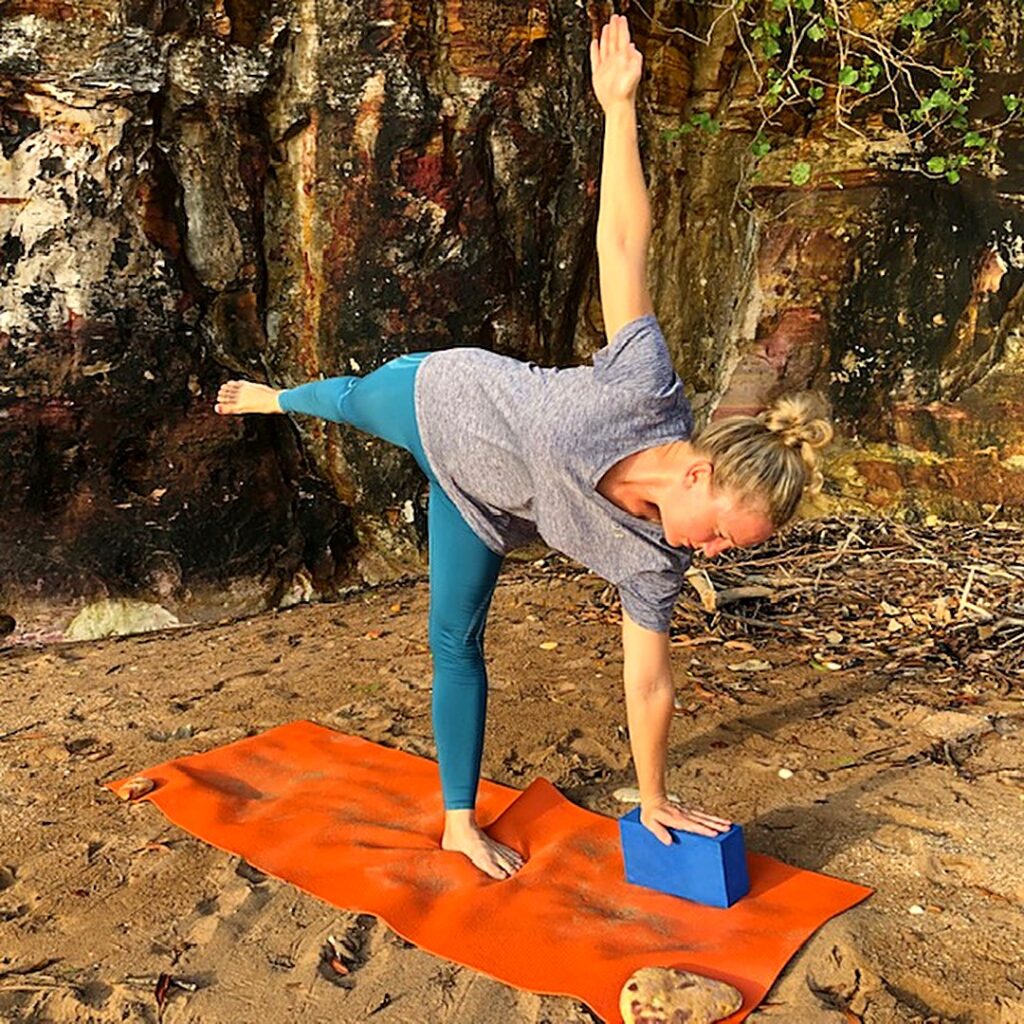
Kim in Half Moon Pose (Ardha Chandrasana). The block gives the lower hand a floor it can reach, so the top of the body can turn open.
What is a yoga belt for, and do I need a yoga strap?
A yoga belt is a strong cotton strap with a buckle. Iyengar teachers usually call it a belt; most shops call it a yoga strap. It does two jobs. It makes your arms longer, so you can hold your feet without rounding your back. And it holds joints in place, so muscles can work or rest without effort.
The Yoga Vaani 42 list gives the reason in one line. People who start yoga late in life have less control over their muscles, so belts are tied to the legs or around joints to give them a grip on the pose. In Shoulderstand (Sarvangasana), a belt keeps the elbows from sliding apart.
A later article on props, in Yoga Vaani 82 (June 2005), adds a detail any student can feel. Tie a belt loosely around the calves in Shoulderstand and press the legs out into it. The front thighs stop gripping, and the pose stops tiring them.
So, do you need a yoga strap? If your hands cannot reach your feet in a seated forward bend or a lying leg stretch, yes. It is the cheapest prop with the biggest effect. Our guide on how to use a yoga strap shows six ways Iyengar teachers use it.
A belt makes the arm longer

A lying leg stretch with a belt around the foot. The belt reaches the foot, so the leg can straighten and the back stays on the floor.
Block and belt together

Chris seated on a block with a belt around her legs. Sitting higher lets stiff hips tip forward, and the belt holds the legs so they can rest.
What is a yoga sandbag for?
A yoga sandbag is a cloth bag of sand laid across the thighs, the feet, the back or the hands. The weight does what muscles alone find hard: it lets them stop holding on. Lying in a resting pose with a sandbag on the thighs, the hips sink and the breath slows by itself.
The idea came from Mr Iyengar’s own body. Yoga Vaani 42 tells how, as a young man who cycled long distances each day, he developed sciatica (nerve pain running down the leg). He eased it by lying for hours under heavy weights: loads, pillows, even a pair of grinding stones. From that he learned how weight placed carefully can soften spasm and release tight muscles. In his institute in Pune, he went on to use weights in remedial classes. The same article says the right weight, placed well, quietens the front of the brain, where worry starts.
That is the experience students describe: heavier body, quieter mind. Read more in our article on the yoga sandbag.
A sandbag across the back in a forward bend

A sandbag across the upper back in a seated forward bend over a chair. The weight lets the back of the body lengthen without effort.
A sandbag in a restful pose

Reclining Bound Angle Pose (Supta Baddha Konasana) with a sandbag. The steady weight helps the hips and the mind settle.
Are props a crutch?
At first, sometimes. That is fine. The props article in Yoga Vaani 82 says a belt, a rope or a block can be a life-support system for someone who could not otherwise do the pose at all. Then it says students should grow beyond that. Prashant Iyengar, Mr Iyengar’s son, put it in one line: “A prop is a prop when it is no longer a prop.”
What that means in practice: notice what the prop does to the pose, then try to find the same action without it. The same article points out that props also take away fear, such as the fear of falling in a balance pose, so you can learn what steadiness feels like. It also warns against using a prop as “a sofa to flop” on. Use it to learn, not to collapse.
Which props help which problem?
Props are how Iyengar yoga reaches people who are stiff, sore or starting late. A few common examples:
- Stiff hamstrings and hips: sit on one or two blocks, and use a belt to reach the feet. See our guide to stiff joints and flexibility.
- A sore back: a block under the hand keeps the spine long in standing poses instead of bending sideways. See our back pain guide.
- Knees and hips: blocks under the knees let the hips open slowly in lying poses. See our guide to knee and hip pain.
- Tight shoulders: a belt between the hands lets the arms lift without straining. See our guide to shoulder pain.
Studies of yoga for these problems usually test yoga in general. Iyengar yoga, with its props, is a particular way of teaching it. Our page Yoga or Iyengar yoga? explains why that difference matters.
What yoga equipment do I need at home?
Less than you might think. Two blocks and one belt cover most of what you meet in a beginner class. Add blankets for resting poses and breathing practice. A sandbag is a lovely extra, not a must.
Our beginner yoga props pack gives you a foldable mat, two foam blocks, a 180 cm cotton belt and an eye cover for $79, with free air shipping anywhere in Australia. Add 12 beginner classes and the pack is $139; add 22 classes and it is $189. Props arrive in about 14 days, and you can start classes straight away.
Flametree’s starter yoga equipment pack

The beginner yoga props pack: foldable mat, two blocks, a belt and an eye cover. Free shipping Australia-wide.
For resting poses, our yoga blanket pack gives you three firm acrylic blankets and one more block for $119, with free air freight. Folded, the blankets do most of what a bolster does, and they cost less, pack flatter and suit more poses. With both packs you have three blocks, which is what Reclining Bound Angle Pose needs. Our article on the yoga bolster explains what a bolster is for, and Yoga Blanket Or Yoga Bolster? shows how to fold three blankets into one.
Sandbags are not in our packs at present. At home, a firmly tied bag of rice or a folded heavy blanket gives a similar gentle weight while you learn.
Blankets: a cheaper, more versatile bolster

Three firm blankets and a block. Stack them for height in resting poses, breathing practice and Shoulderstand.
Where can I use Iyengar yoga props in Darwin?
At Flametree Yoga Studio’s classes in Woolner and Coolalinga. Blocks, belts, blankets, chairs and sandbags are all supplied, so you can learn each prop before you buy anything. Your teacher sets the height of each block for your body. Online students across Australia use the same props at home, and the teacher shows how to improvise with chairs, towels and walls.
Feeling too stiff for yoga? New to Flametree, or away for 3 months or more? Get 2 free classes + 2 free ebooks, including Too Stiff For Yoga?, which shows how props help stiff bodies.
Questions people ask
What yoga equipment do I need at home?
Two yoga blocks and one yoga belt cover most home practice. Add two or three firm blankets for resting poses and breathing. A sandbag is a useful extra. Flametree’s starter pack has a mat, two blocks, a belt and an eye cover for $79.
Do I need a yoga strap?
If your hands cannot reach your feet in a forward bend or leg stretch, yes. A yoga strap (or belt) makes your arms longer, so your back can stay straight. It is the cheapest prop with the biggest effect.
What does a sandbag do in a yoga pose?
Its steady weight helps tight muscles let go. Laid on the thighs, feet or back in a resting pose, it helps the body sink and the breath slow. Mr Iyengar first used weights to ease his own sciatica.
Why did Mr Iyengar invent yoga props?
So that everyone could do the poses well. He said good teachers are rare, and props guide the body in the right direction, stop mistakes, and help people who are stiff, shaky or unwell practise on their own.
Is a yoga belt the same as a yoga strap?
Yes. Iyengar teachers usually say belt; shops usually say strap. Both mean a strong cotton strap with a buckle, often about 180 cm long.
Can I use things around the house instead of yoga equipment?
Yes, to start. A chair, a wall, a dressing gown cord, a firm cushion and folded towels all work. Proper blocks and belts are steadier, and they last.
What is in Flametree’s yoga props pack?
A foldable 4 mm mat, two foam blocks, a 180 cm cotton belt and an eye cover, for $79 with free shipping Australia-wide. The $119 blanket pack adds three blankets and a third block.
Where can I try Iyengar yoga props in Darwin?
At Flametree Yoga Studio’s classes in Woolner and Coolalinga, where all props are supplied, or live online from anywhere in Australia.
Where to next
- New to yoga, or coming back after 3 months or more? Start with our half price 10 class beginner pass with 2 classes free, in Darwin or live online.
- Done yoga before? Our non-beginner deal gives 2 classes free plus 10 classes at half price.
- Want to see class times first? Look at the beginner timetable.
- More on props: yoga props to buy, make or improvise, and Iyengar quotes on props, explained.
Flametree Yoga Studio, Darwin and live online. This article is general information, not medical advice.
Sources: Iyengar Yoga Australia e-Library. Yoga Vaani 95, September 2008: BKS Iyengar, “The use of props: pillows, blankets, belts, or blocks” (interview reprinted from Yoga Rahasya Vol 15 No 2), and a talk on yoga practice and props (2005 US tour, transcribed by Jacqueline Austin). Yoga Vaani 42, December 1995: BKS Iyengar, “Different props: their use and effects” (edited by Geeta S Iyengar), sections on bricks, weights and belts. Yoga Vaani 82, June 2005: “Why do we use props?” (reprinted from Yoga Rahasya Vol 11 No 1, 2004), quoting Prashant S Iyengar. Yoga Vaani 77, March 2004: on how Mr Iyengar came to make props. Product details and prices from Flametree’s product pages, read 4 November 2026.



