
Yoga For Haemophilia: What Mr Iyengar, The Yoga Doctors And The Research Say
By Chris Lalor, Certified Senior Iyengar Yoga Teacher and Certified Yoga Therapist, and Dr Stuart McGill, Yoga Teacher, Flametree Yoga Darwin
Haemophilia lives in the joints. A knee, an elbow or an ankle that has bled before can stay stiff, sore and weak, and every movement can come with a question: will this start another bleed? This guide brings together what Mr BKS Iyengar, Dr Timothy McCall and the research say about yoga for haemophilia, and about pranayama (yogic breathing), meditation and relaxation, for people living with haemophilia and other bleeding disorders, and the families who support them. Last updated: 8 November 2026.
Get 2 Free Yoga Classes And 2 Free Ebooks
Yoga for haemophilia: the short answer
Yes, gentle, supported yoga, an easy breath and deep relaxation are well worth adding to life with haemophilia, alongside your factor medicines and your haemophilia team’s care. In a study of 27 boys with haemophilia, 14 weeks of yoga lifted every part of their quality of life, and during the study they also had fewer bleeds, fewer days off school and fewer clinic visits. A daily relaxation practice eased joint pain in a randomised trial of 80 adults. And across 15 trials of exercise and physiotherapy (not yoga), moving the joints with care eased pain and improved movement, strength and joint health. The yoga research is still early. The key is support: props that take the strain, so a damaged joint moves without being forced.

A seated forward bend with the chest resting on a bolster on a chair. Props take the weight, so no joint is strained.
Overall evidence: Limited
The research here is still limited: early pilots, a single trial, or evidence from a related condition. Not yet tested is not the same as does not work.
Best study (single trial): A randomised trial in Iran of 80 adults with haemophilia. A recorded relaxation practice (Benson’s relaxation response: sitting quietly, letting the muscles go and resting attention on the breath), done twice a day for 8 weeks, eased pain more than usual care. It tested a relaxation practice, not a yoga class.
The yoga in the haemophilia study was yoga in general, taught by a yoga instructor trained at a haemophilia centre. No trial has yet tested Iyengar yoga in haemophilia. In our view as certified Iyengar teachers, careful, well-taught yoga with props, where each pose is adapted to the joint in front of us and nothing is forced, suits joints damaged by bleeds better than most. Why the kind of yoga matters.
The bottom line: five key moves for yoga with haemophilia
- Move every joint gently, every day. A joint that is not moved gets stiffer and weaker, and weak muscles protect a joint less. Easy, supported movement keeps it working.
- Use props, never force. A chair, blocks, a bolster, a belt and the wall take the strain, so a damaged knee, elbow or ankle never meets its end of range under load.
- Build the muscles around the joints. Standing poses with a chair strengthen the thighs and hips that guard the knees and ankles.
- Calm the mind on purpose. A slow out-breath and deep, supported relaxation. Relaxation eased pain in a trial of 80 adults.
- Start now. New, or away 3 months or more? 2 free classes, then 10 at half price, LIVE online or in Darwin.
Five Key Moves For Yoga With Haemophilia
1. Move gently, daily
Every joint, through an easy range.
2. Props, never force
A chair, blocks, a bolster, a belt.
3. Build the muscles
Strong thighs and hips guard the joints.
4. Calm the mind
A slow out-breath, deep rest.
5. Start now
2 free classes, then 10 at half price.
Yoga for haemophilia in five moves: gentle, supported, strong and calm.
Who was Mr BKS Iyengar? Iyengar yoga is the style we teach at Flametree. During the 20th century, Mr BKS Iyengar was the major teacher who codified traditional Indian yoga, through his seminal books and widespread teaching. He also pioneered the use of props, so poses can be adapted to almost any body, including a body with knees, elbows and ankles that cannot bear much load. His style is sometimes called modern classical yoga. This guide is part of our encyclopaedia of yoga for health conditions.

A standing stretch with the hands on a chair. The chair holds part of the weight, so the legs and spine work without strain on the joints.
This guide in short
- Overall evidence: Limited. Best study (single trial): A randomised trial in Iran of 80 adults with haemophilia. A recorded relaxation practice (Benson’s relaxation response: sitting quietly, letting the muscles go and resting attention on the breath), done twice a day for 8 weeks, eased pain more than usual care. It tested a relaxation practice, not a yoga class.
- Mr BKS Iyengar: we have not found anything he wrote on haemophilia, but he built props into yoga so that a joint can move without strain, and he taught that nothing is forced.
- Dr Timothy McCall, an American medical doctor and yoga therapist who studied with Mr BKS Iyengar, author of Yoga as Medicine: haemophilia is no. 40 on his list of conditions helped by yoga.
- The research: one yoga study in boys, a randomised relaxation trial, early work on mind-body care after knee surgery and on hypnosis, and many exercise and physiotherapy trials (not yoga).
- Related guides: arthritis, stiff joints, chronic pain, knee and hip pain and bones and balance.
- Take it further: our free ebook Too Stiff For Yoga?, the 2027 masterclass on arthritis and stiff, achy joints, and classes LIVE online or in Darwin.
Yoga For Haemophilia On One Page
Mr BKS Iyengar
Props let a joint move without strain.
Dr Timothy McCall
Haemophilia is no. 40 on his list.
The research
Better quality of life, less pain.
Exercise trials
Not yoga: less pain, better movement.
Yoga for haemophilia at a glance. Each source is set out in full below.
Living with haemophilia
Haemophilia is an inherited bleeding disorder. The blood is low in, or missing, a clotting factor: factor VIII in haemophilia A, factor IX in haemophilia B. Bleeds happen most often inside the joints, above all the knees, elbows and ankles, and inside muscles. Over the years, repeated bleeds into one joint damage it. Doctors call this haemophilic arthropathy (joint damage from bleeds): pain, stiffness, less movement, weaker muscles and poorer balance.
Modern factor medicines, given regularly to stop bleeds before they start, have changed life with haemophilia. Physiotherapy and exercise are part of good haemophilia care. Other bleeding disorders, such as von Willebrand disease, are more common, and are often milder. Much of what follows about gentle, supported movement applies to them too.
Haemophilia In Australia
3,543
Australians with haemophilia in the national registry at 30 June 2025: 2,874 with haemophilia A and 669 with haemophilia B.
Source: Australian Bleeding Disorders Registry, Annual Report 2024-25 (National Blood Authority). 8,487 people with any bleeding disorder.
Joint pain is common. In a United States study of 381 men with haemophilia, about two in three had chronic pain (on its own or with flare-ups) over six months. Worry and low mood are common too. In a European study of 381 men with haemophilia A, 54% reported at least some anxiety or low mood. And bone density is lower: a review of 19 studies found about four times the risk of low bone density, which makes balance and falls matter more.
Pain And Worry In Haemophilia
Witkop 2017 (P-FiQ study); Ferri Grazzi 2024 (CHESS II); Iannone 2012. Bars drawn from zero.
How a bleed, pain and guarding feed each other
The Joint Bleed Loop
A joint bleed
Into a knee, elbow or ankle.
Pain and swelling
The joint is sore and full.
Guarding
Moving less, out of fear.
Weaker, stiffer
Muscles waste, the joint tightens.
↻ Gentle, supported movement, strength and calm ease each link.
A simplified picture, from the haemophilia and exercise research and known from practice. Your haemophilia team sets when to rest and when to move again.
“Your brain may say, ‘We can do it.’ But the knee may say, ‘Who are you to dictate to me? It is for me to say whether I can do it or not.’”
What did Mr BKS Iyengar teach that bears on haemophilia?
In short: we have not found anything he wrote about haemophilia. What he did leave was a way of moving every joint with full attention, with props taking the strain, and never forcing. That is what a joint damaged by bleeds needs. This is known from long practice. Not yet tested is not the same as wrong.
- Props first. He began using bricks and ropes for his own stiff body, and built them into his teaching so that people who could not do a pose unaided could still do it. A chair under the hand, a block under the hip, a belt around the foot.
- Listen to the joint. He taught that the knee, not the brain, decides how far it can go. That is the attitude a damaged joint needs.
- Length and space, not crushing. In Iyengar standing poses the knee is held straight but not locked, and the joint is lifted and spread rather than pressed.
- Rest is part of the practice. Supported lying poses and deep relaxation calm the body and mind.

A supported reclining pose. Bolsters and blankets hold the body, so the hips and knees rest without strain.
“My props became my guru and taught me how to use the body.”
Forcing A Joint Or Supporting It
Forcing
Pushing to the end of the range.
Body weight on a damaged joint.
Holding the breath, gritting through.
Supporting
A prop takes part of the weight.
An easy range, muscles working.
The breath stays soft.
Yoga for haemophilia supports the joint every time. Known from practice in the Iyengar tradition.
What Dr Timothy McCall says
In short: haemophilia is on his list. Dr Timothy McCall, an American medical doctor and yoga therapist who studied with Mr Iyengar and wrote Yoga as Medicine, published a list of 117 health conditions helped by yoga in June 2019. “Hemophilia” (the American spelling) is no. 40. Our encyclopaedia uses his list as its backbone and builds on it with newer research.
His reference list for no. 40 names one study: the 2015 study of yoga in 27 boys with haemophilia in Shiraz, Iran, described below. Since then, a randomised relaxation trial, early work on mind-body care after knee replacement and many trials of exercise and physiotherapy have been added to the picture.
“Props benefit in two ways; one is extension and the other is relaxation, taking place at the same time.”
What does the research say about yoga for haemophilia?
Here is every study we found where yoga, pranayama, meditation, mindfulness or relaxation was tested in haemophilia, with the bottom line first. Each was looked up in PubMed in November 2026 and checked for retraction notices; none had one. Where a study tested something other than yoga, we say so. Yoga or Iyengar yoga? Why the difference matters in the research.
The Research At A Glance
Yoga, 27 boys
Better quality of life in 14 weeks.
Relaxation, 80 adults
Less pain, randomised trial.
Mind-body care, 62 men
Less pain after knee replacement.
Exercise, 15 trials
Not yoga: less pain, more movement.
Yoga for haemophilia research at a glance, conclusion first. Details below.
Yoga studies
- Yoga lifted quality of life in boys with haemophilia, with fewer bleeds, school absences and clinic visits during the study, and no harm. Beheshtipoor and others, 2015, Shiraz, Iran: 27 boys aged 8 to 16 with haemophilia A or B, mild to severe. 14 weeks: 8 weeks of classes (an hour, twice a week) then 6 weeks at home with a video, twice a week. Warm-ups, poses, simple pranayama and relaxation, chosen with a sports medicine doctor and a yoga specialist, and partly adapted from yoga videos made by Haemophilia Foundation Australia. Every part of a haemophilia quality of life score improved (total problem score 54.1 at the start, 43.0 at 8 weeks, 40.1 at 14 weeks). None dropped out and no harm was reported. There was no comparison group, so we cannot say how much was the yoga alone. This is the study on Dr McCall’s list. Read the study.
Quality Of Life Problems Fell Over 14 Weeks Of Yoga
Haemo-QoL problem score, 27 boys. Lower is better.
Beheshtipoor 2015. No comparison group. Bars drawn from zero.
No trial has yet tested Iyengar yoga in haemophilia, and no trial has compared any yoga with exercise or physiotherapy. So Iyengar yoga has not been tested against exercise on its own. In a survey of 59 physiotherapists at United States haemophilia treatment centres, about 1 in 3 recommended yoga for pain. Read the survey.

Seated on a bolster, a belt holding the legs so the muscles can let go and no joint is held at its limit. Support first, then the breath.
Breathing and pranayama
No trial has yet tested breathing practices on their own in haemophilia. Not yet studied is not the same as not working. The yoga study included simple pranayama, and the relaxation trial below rests attention on the breath. In our classes, pranayama begins lying down and supported, watching the breath, then lengthening the out-breath, then staircase breath (Viloma) and ocean breath (Ujjayi) as you are ready. Nothing is forced or held.
“Nothing pertaining to pranayama can be forced. That is why it teaches humility.”
Meditation, mindfulness and relaxation
None of these studies tested yoga. Each tested a relaxation, mindfulness or hypnosis practice, and we say which.
- A daily relaxation practice eased pain and helped people accept it, in a randomised trial. Molazem and others, 2021, Shiraz, Iran: 80 adults with haemophilia, randomised to a recorded relaxation practice (Benson’s relaxation response) twice a day for 8 weeks, or usual care. Pain after 8 weeks averaged 4.3 out of 10 with relaxation and 5.9 with usual care. Pain beliefs and pain acceptance improved too. Relaxation, not yoga. Read the study.
Pain After 8 Weeks: Relaxation Or Usual Care
Average pain, 80 adults with haemophilia. Lower is better.
Molazem 2021, randomised trial. Relaxation, not yoga. Bars drawn from zero.
- Mind-body care after knee replacement was linked with less pain, less pain medicine, less anxiety and better sleep, with no more bleeding. Feng and others, 2026, Beijing: 62 men having a knee replaced because of haemophilia, looked back over records; 29 had relaxation, guided imagery and mindfulness from a specialist nurse, 33 had routine care. Pain at rest on the first day averaged 3.2 v 4.6 out of 10. Not randomised, so early work. Mindfulness and relaxation, not yoga. Read the study.
- Hypnosis eased how much pain got in the way of work, and lifted quality of life, for three months. Paredes and others, 2019 and 2021, Portugal: a randomised pilot of 20 adults, four weekly sessions. No harm reported. Hypnosis, not yoga, but its modern forms lean on deep relaxation. Read the study.
- Across 37 papers, hypnosis and relaxation improved quality of life in bleeding disorders, with mixed results on bleeding itself. Porzi and others, 2026, a review, including 4 randomised trials of 90 people. Hypnosis, not yoga. Read the study.

Supported relaxation with a bolster under the knees, so they rest slightly bent. Relaxation eased pain in a trial of 80 adults with haemophilia.
Exercise and physiotherapy trials (exercise, not yoga)
Exercise is not yoga, and we label it clearly. We include these trials because they show that moving joints damaged by bleeds, with care, helps and is safe, which is what a good yoga class does too.
- Physiotherapy eased joint pain and improved range of movement, joint health, strength and walking. Chen and others, 2023, a review of 15 randomised trials of 595 males with haemophilia. Exercise, manual therapy and other physiotherapy. Exercise, not yoga. Read the study.
- Physiotherapy, especially therapeutic exercise, lifted quality of life. Chen and others, 2025, a review of 8 randomised trials of 298 males. Exercise, not yoga. Read the study.
- Most exercise programmes improved pain, range of movement, strength or walking, and no harm was reported. Strike and others, 2016, Cochrane review of 8 studies, 233 males aged 8 to 49. Exercise, not yoga. Read the study.
- Exercise or water exercise for 4 weeks eased knee pain and improved knee movement, compared with no programme. Mazloum and others, 2014, Iran: a randomised trial of 40 men with haemophilia A. Exercise, not yoga. Read the study.
- Supervised aerobic exercise did not raise bleeding rates or factor use. Tomschi and others, 2022, a review of 7 studies. Exercise, not yoga. Read the study.
What Exercise Trials Found (Not Yoga)
Less joint pain
15 trials, 595 males.
More movement
Range of movement improved.
Stronger, walking better
Muscles and walking improved.
Safe when supervised
No rise in bleeds.
Exercise, not yoga. Iyengar yoga has not been tested against exercise on its own.
Balance and falls
Joint damage and weaker bones make balance matter. An exercise programme (not yoga) of balance and strength for 12 weeks, in 22 adults with haemophilia in Spain, improved dynamic balance, leg strength and everyday function, and lowered falls risk, compared with usual exercise. Read the study. A randomised trial of 35 adults in Turkey found manual therapy with structured exercise (not yoga) improved joint health, pain, walking and dynamic balance in 6 weeks. Read the study.
For yoga and falls, the best study is an Iyengar yoga pilot from Sydney. In 54 people with an average age of 68, 12 weeks of Iyengar-based yoga improved balance, walking speed, getting up from a chair and balance with the eyes closed: the main risk factors for falls. It tested Iyengar yoga taught by trained Iyengar teachers. It was not a haemophilia study, but those are the same risk factors. Read the study.
Sydney Iyengar Pilot: Falls Risk Factors Improved
Balance
Better standing balance.
Walking
Faster walking speed.
Chair
Quicker up from a chair.
Eyes closed
Better balance, eyes closed.
Tiedemann 2013, Iyengar-based yoga, 54 people, average age 68. Not a haemophilia study.

A lunge with a chair for support, the front knee over the ankle, never past it. Standing work with a chair builds the legs that guard the knees.
Practising yoga safely with haemophilia
These points come from long teaching practice and from the haemophilia exercise research. They are about how to practise, so the joints are moved and strengthened without being strained.
- Never practise on a joint that is bleeding, or has just bled. Rest it, follow your haemophilia team’s plan for the bleed, and come back to gentle movement as it settles. Always follow the directions of any doctor you are consulting.
- Factor medicines and timing. Many people time their factor dose before exercise. Always follow the directions of any doctor you are consulting.
- No forcing at the end of the range. Kneeling, lotus, deep squats and full bends of a damaged knee are adapted with blocks, blankets and a chair, or left out.
- Take weight off damaged elbows and wrists. Poses on the hands, and inversions on the arms, are adapted or left out, as your teacher judges.
- Stop and rest if a joint becomes warm, swollen, tingly or harder to move, and tell your teacher.
Practising Well With Haemophilia
Before class?
Tell your teacher which joints are affected.
A bleed?
Rest it and follow your team’s plan.
A pose strains?
Come out, add a prop.
Warm or swollen?
Stop and rest.
Yoga for haemophilia is supported and never forced.
“Holding the trestler gives support and then the inner support of courage comes, giving them confidence.”
For men
Haemophilia mainly affects males, because the gene sits on the X chromosome. In the national registry, 2,793 of the 3,543 Australians with haemophilia are male. Women and girls can have it too, often more mildly. Men also do much less yoga than women. Many men with haemophilia grew up being told to avoid sport, and some carry that caution into adult life, with stiffer joints, weaker muscles and more pain as a result.
A yoga class is a good answer. It is not a contact sport, you go at your own pace, and the props mean you never have to match the person on the next mat. Standing poses with a chair build the thighs and hips that guard the knees. Supported rest and a slow out-breath bring down the worry that comes with every new twinge. Bring a mate or come alone, but give it 12 weeks.
Haemophilia Is Mostly A Male Condition
2,793
of the 3,543 Australians with haemophilia in the national registry are male.
Australian Bleeding Disorders Registry, Annual Report 2024-25: haemophilia A 2,290 males, haemophilia B 503 males.

Stuart in Tree Pose (Vrksasana). Balance poses can be done beside the wall, a hand on it, so a damaged ankle is never put at risk.
Yoga, pranayama and mindfulness: how they work together
Some of the studies above tested a relaxation practice, mindfulness or hypnosis, not a yoga class. That still counts for our classes. Mindfulness is steady, present attention, and yoga poses and pranayama (yogic breathing) are old routes to that same state. The haemophilia yoga study itself joined poses with simple pranayama and relaxation. No trial separates which part does the work.
Two routes to one steady mind
A steady body, with attention held on the pose.
A steady breath, with attention held on the breath.
Mindfulness: steady, present attention. Each makes the other easier.
A simplified picture, known from practice. No trial separates which part does the work.
We suggest coming to both a yoga class and a pranayama class. Mr Iyengar taught that asana (poses), pranayama and meditation are not divided, and in our experience the two together do more than either alone. See every class time. We trace the history and the links in Yoga And Mindfulness: Why The Mindfulness Research Points Back To Yoga And The Breath.
An Easy Breath And Deep Rest
1. Lie down, supported
A bolster under the knees.
2. Watch the breath
Do not change it yet.
3. Slow the out-breath
Long, soft and quiet.
4. Rest
Five to ten minutes of stillness.
A daily practice like this is close to the relaxation that eased pain in 80 adults with haemophilia.
How this comes together in a Flametree class
Everything above points the same way, and it is how we teach yoga in Darwin and online. Flametree classes adapt poses with chairs and props, so a damaged joint is supported in every pose. Our LIVE online classes let you practise at home, with a teacher watching and guiding you, on days when getting out is hard.
- Tell your teacher about your condition. Which joints have bled, which are damaged, what moves easily and what does not, and anything your haemophilia team has asked you to avoid.
- Standing poses with a chair: to strengthen the thighs, hips and calves that guard the knees and ankles, with the chair taking part of the weight.
- Gentle range for every joint: lying leg stretches with a belt, arm movements against the wall, ankles moved without load.
- Kneeling and sitting with props: blocks, bolsters and blankets so a damaged knee is never folded fully under load.
- Pranayama step by step: watching the breath lying down first, then a slow out-breath, then staircase breath (Viloma) and ocean breath (Ujjayi) as your teacher judges you ready. Our pranayama classes teach it step by step.
- Rest to finish: every class ends with supported relaxation.

A lying leg stretch with a belt. The floor supports the back, the belt sets the range, and nothing is pulled.
See the timetable and book a class. Online classes run LIVE, so your teacher can see you and adjust your poses.
“Health is a living force. Health is not static. You need not work at all if health is static. Health is motion.”
Read more on joints, pain and balance
- Arthritis: moving stiff, sore joints with props
- Stiff joints and flexibility: how a stiff body loosens a little at a time
- Chronic pain: calming a nervous system that is on guard
- Knee and hip pain, and joint replacement: the knee is a hinge
- Bones and balance: the Sydney Iyengar falls pilot in full
- Nearby guides: surgery, before and after, anxiety and anger, depression and low mood and healthy ageing
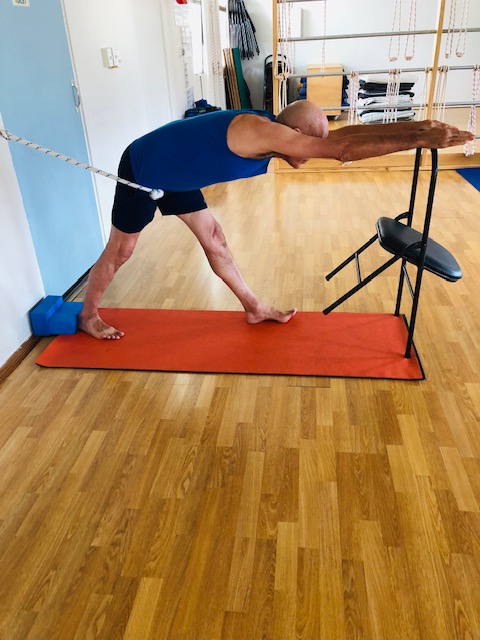
Working at the rope wall with the hands on a chair. Ropes and chairs let a body lengthen without loading any one joint.
Take it further
Free ebook: Too Stiff For Yoga? Joints that have bled are often stiff. This book has all the material on why stiff joints and muscles change with steady practice, the stories of students who loosened up, and how an Iyengar class works on a stiff body a little at a time. Then do the free classes, see what you think, and buy a pass that puts it into action.
New to Flametree, or away 3 months or more? 2 free classes + 2 ebooks, only available via this offer. Already a student? You can still get this book. Get your free copy of Too Stiff For Yoga?
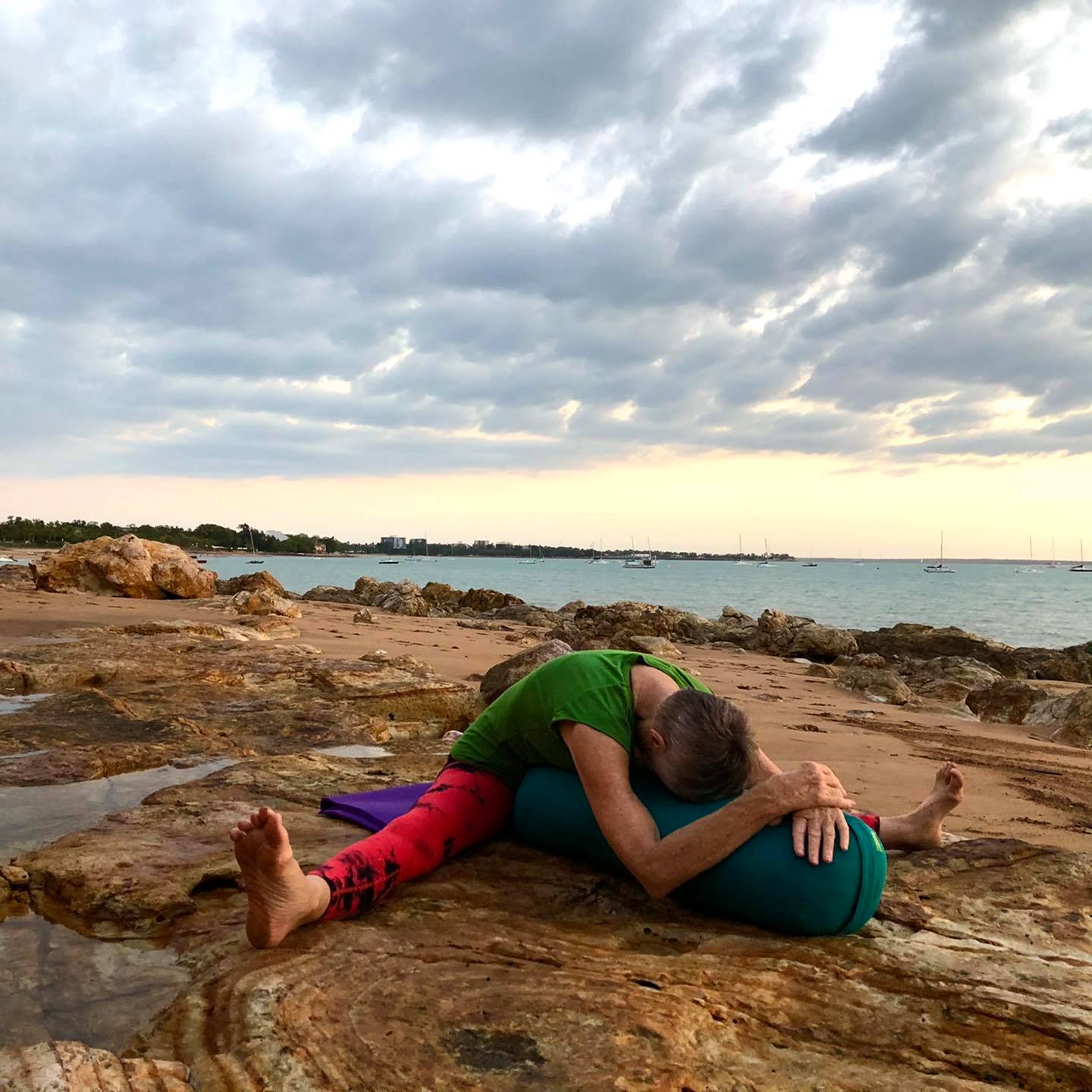
A seated forward bend resting over a bolster, by the sea in Darwin. Supported poses rest tired joints and a busy mind.
- Classes, LIVE online or in Darwin: new, or away 3 months or more? 2 free classes, then 10 at half price. Already practising yoga? See the non-beginner half price pass. See the timetable and book.
- Masterclass, in Darwin or LIVE online: Yoga for arthritis: easing stiff, achy joints, Monday 28 December, the first of our 2027 masterclasses with Chris Lalor. Each joint is taken gently through its range with props, so it is never forced or crushed, and you learn how to take the strain off a knee and which poses rest tired joints. That is what joints damaged by bleeds need too. See the 2027 masterclasses.
2027 Masterclasses From 28 December
Over four months, learn the poses and breath practices that make the biggest difference for a range of key health conditions: arthritis, sleep and energy, pelvic floors, backs, wisdom, and anxiety, upsets and anger. In Darwin or LIVE online.
“Do you teach a child to run as soon as it is born? You allow the child to have support whether it can stand or not.”
Yoga for haemophilia: questions people ask
Is yoga safe for haemophilia?
Gentle, supported yoga, taught with care, suits most people with haemophilia. In a study of 27 boys with haemophilia, 14 weeks of yoga caused no harm and none dropped out, and exercise trials found no rise in bleeds when exercise was supervised. The keys are props, never forcing a joint at the end of its range, and telling your teacher which joints are affected.
Can yoga cure haemophilia?
No. Haemophilia is an inherited bleeding disorder, and yoga does not change the clotting factor in the blood. What yoga can do is help the joints, muscles, balance and mind: in studies, yoga lifted quality of life in boys with haemophilia and relaxation eased pain in adults.
Can I do yoga during a joint bleed?
Not on the joint that is bleeding or has just bled. Rest it and follow your haemophilia team’s plan for the bleed, then come back to gentle, supported movement as it settles. Other parts of the body, and the breath and relaxation, can often still be practised. Always follow the directions of any doctor you are consulting.

Supported relaxation with the calves on a chair. On days when a joint needs rest, the breath and relaxation can still be practised.
Which yoga poses should people with haemophilia avoid?
There is no single list, because it depends on which joints are damaged. As a rule, avoid forcing a damaged knee into full kneeling, lotus or a deep squat, avoid taking body weight on a damaged elbow or wrist, and avoid anything that pushes a joint to the end of its range under load. In Iyengar yoga each of these is adapted with a chair, blocks or a bolster, or left out.

Triangle Pose (Trikonasana) with the lower hand on a chair. The chair shortens the reach, so neither knee nor elbow is pushed.
Can yoga help haemophilic arthropathy and stiff joints?
Gentle movement through an easy range, with props, is what joints damaged by bleeds need. Exercise trials (not yoga) found less joint pain and more range of movement, and the yoga study in boys found better physical quality of life. Iyengar yoga has not yet been tested in haemophilia. Read the stiff joints guide.
Can yoga help pain in haemophilia?
Yes, in the research so far. A daily relaxation practice eased pain in a randomised trial of 80 adults, and mind-body care after knee replacement was linked with less pain. Supported poses, a slow out-breath and deep rest are part of every Flametree class. Read the chronic pain guide.
Is yoga good for boys and teenagers with haemophilia?
Yes. The one yoga study in haemophilia was in boys aged 8 to 16, and their quality of life improved in every area, from physical health to school, sport and friends. A class with props lets a young person move with confidence, without the knocks of contact sport.

Legs up the wall with a bolster under the hips. A restful pose with no load on the knees or ankles.
Does yoga help balance and falls in haemophilia?
Balance work helps. An exercise programme of balance and strength lowered falls risk in adults with haemophilia, and in a Sydney pilot of older people, 12 weeks of Iyengar-based yoga improved balance, walking speed and getting up from a chair, the main risk factors for falls. Balance poses can be done beside the wall, with a hand on it. Read the bones and balance guide.

A standing forward bend with the head resting on blocks and the hands on a chair. Props give the legs work and the mind rest.
Can I do yoga for haemophilia online from Darwin or anywhere in Australia?
Yes. Flametree Yoga teaches Iyengar yoga LIVE online, as well as in Woolner and Coolalinga in Darwin. Flametree classes adapt poses with chairs and props, and your teacher can see you and adjust your poses. New students can begin with 2 free classes, then 10 at half price. Book a class
Where this comes from: BKS Iyengar, Light on Life (Kindle edition), Astadala Yogamala volumes 4 and 6, Yoga Wisdom and Practice, and Yoga Rahasya (2002); Geeta S Iyengar, props demonstration in Sydney, 1996. Timothy McCall MD, his June 2019 list of 117 health conditions helped by yoga and its reference list, and Yoga as Medicine (Bantam). Australian Bleeding Disorders Registry, Annual Report 2024-25 (National Blood Authority, read November 2026). Witkop and others, the P-FiQ study, Haemophilia, 2017; Ferri Grazzi and others, CHESS II, Haemophilia, 2024; Iannone and others, Haemophilia, 2012; Zhou and others, low bone density in haemophilia, Journal of Orthopaedic Surgery and Research, 2024. Studies as linked above, each looked up in PubMed in November 2026. Everything is summarised in our own words.
This page is general information, not medical advice. Flametree Yoga Studio, Darwin and LIVE online.
