Yoga Blanket Or Yoga Bolster? Why Three Folded Blankets Do More
Yoga blanket or yoga bolster: the short answer
A good yoga blanket does almost everything a yoga bolster does, and a lot more besides. Fold two or three firm blankets and you have a bolster for lying back, sitting tall or resting your head. Unfold them and you have height for a shoulderstand, a pad for a knee and warmth for the final rest. That is why our home prop kit is built around blankets, not a bolster: blankets cost far less to post to you, and they do more jobs. Here is the article in short form:
- Three firm yoga blankets can stand in for a bolster in most poses.
- Blankets fold to any height; a bolster has one shape.
- Bolsters are bulky, so they cost a lot to freight to Australia.
- Mr BKS Iyengar built props so people could learn well at home.
- Our blanket kit is 3 blankets, a block and a poster for $119.
- Our starter kit adds a mat, 2 blocks, a belt and an eye cover.
- Studio classes in Darwin supply every prop, so try before you buy.
A quick word on Iyengar yoga. Iyengar yoga is the style developed by Mr BKS Iyengar. In the 20th century he did more than anyone to set down traditional Indian yoga, through his books and his teaching, and he pioneered the use of props: blankets, blocks, belts, bolsters, chairs and wall ropes. It’s the style we teach at Flametree, in Darwin and live online.
A yoga blanket set, folded for a restful pose

Chris Lalor in Reclining Bound Angle Pose (Supta Baddha Konasana), lying on three folded yoga blankets, with three blocks and a belt. No bolster in sight.
What does a yoga bolster actually do?
A bolster is a long, firm cushion that holds part of the body up, so a pose can be rested in rather than worked at. It lifts the chest when you lie back, raises the hips when you sit, and holds the head in a forward bend. Our full guide, Yoga Bolster: What It Is, What It’s For, And Whether You Need One, walks through the five main uses with pictures.
The key word is firm. A prop that squashes flat under you cannot hold you up. What you need is firm, even height in the right place. A stack of well-folded blankets gives you exactly that.
Why does Flametree recommend yoga blankets instead of a bolster?
Because blankets do the same job, do more jobs, and cost far less to get to your door. We weighed this up carefully when we put our home prop kits together.
Bolsters are expensive to send across Australia
A bolster is big and bulky for its weight. Air freight is charged on the space a parcel takes up as well as what it weighs, so a bolster costs a lot to send, especially to Darwin and other places far from the big cities. Look at the price of a yoga bolster in Australia once delivery is added and you will often find the postage is close to the price of the bolster itself.
Three folded blankets pack flat. They travel well, store in a cupboard and come out when you need them.
Blankets fold to the height you need
A bolster has one height. Your body does not. Some days your hips are stiff and you want more lift; some days you want less. Blankets let you change the height a few centimetres at a time, by adding one, taking one away, or folding them differently.
Blankets do jobs a bolster cannot
A bolster cannot sit under your shoulders for a shoulderstand, pad a sore knee in a kneeling pose, or keep you warm in the final rest. A blanket can do all three. In our classes we use blankets in almost every session; we use bolsters far less often.
Yoga bolster vs yoga blankets, side by side
| HEIGHT | Bolster: one fixed height. Blankets: fold to any height, a few centimetres at a time. |
| JOBS | Bolster: lying back, sitting, head support. Blankets: all of those, plus shoulderstand, knee padding, neck support and warmth. |
| FREIGHT | Bolster: bulky, so costly to post. Blankets: pack flat and travel well. |
| STORAGE | Bolster: needs its own corner. Blankets: fold into a cupboard. |
| CARE | Bolster: cover off, filling stays. Our blankets: straight into the washing machine. |
| WHAT IT MEANS | For home practice, three firm blankets give you a bolster and much more, for less. |
What Mr BKS Iyengar said about props
Props are at the heart of Iyengar yoga, and Mr Iyengar explained why many times. Some of the clearest accounts are in Yoga Vaani, the journal of Iyengar Yoga Australia (the national association of certified Iyengar teachers), which is now in its online library. Here is what four issues say, in our words.
He made props because good teachers are hard to find
In a 2005 interview, given when his book Light on Life came out and reprinted in Yoga Vaani 95 (September 2008), Mr Iyengar said props were not a shortcut to mastering a pose. His reason was simple: “As true teachers are rare, I evolved these props to guide the doers.” A prop puts the body in the right place, so it is hard to go wrong.
He went on: “Props are self-help and self-guides for self-practice.” In other words, props are what let you practise well at home, with no teacher standing beside you. That is exactly what a home blanket kit is for.
Props help the body extend and the mind settle
In the same interview he said props do two things at once. They help the muscles, joints and organs extend and open, and they help the mind relax enough to look inward, in comfort. He likened props to a hospital’s intensive care unit: they watch over the body so that a stiff, shaky or unsteady student cannot practise in a harmful way.
Supported forward bend with blankets and a chair

Seated Forward Bend (Paschimottanasana) with folded blankets under the hips and the head resting on a chair. The blankets tilt the pelvis forward, so the back can lengthen instead of rounding.
He taught people how to fold a blanket
In a tribute to her father reprinted in Yoga Vaani 77 (March 2004), Geeta S Iyengar, Mr Iyengar’s eldest daughter and a great teacher in her own right, recalled watching him unfold ironed blankets and fold each one a particular way for each pose. A blanket for headstand was folded differently from one for shoulderstand, and differently again for a supported backbend. As she put it, “here is a person who has taught us how to fold a blanket!” The props, she said, came from his effort to help people who were suffering feel what a pose could do.
Blankets for breathing and rest
An interview with Mr Iyengar, edited by Geeta Iyengar and reprinted in Yoga Vaani 42 (December 1995), describes how he found special ways of folding and rolling blankets for different needs, including breathing problems and inverted poses. For lying-down rest and pranayama (yogic breathing), the blankets are set so the chest sits a little higher than the belly, and the head a little higher than the chest. That takes tension out of the head and throat and lets the breath become soft and full. In the article’s words, “Props help to remove the tension quickly.”
A blanket set-up for pranayama breathing
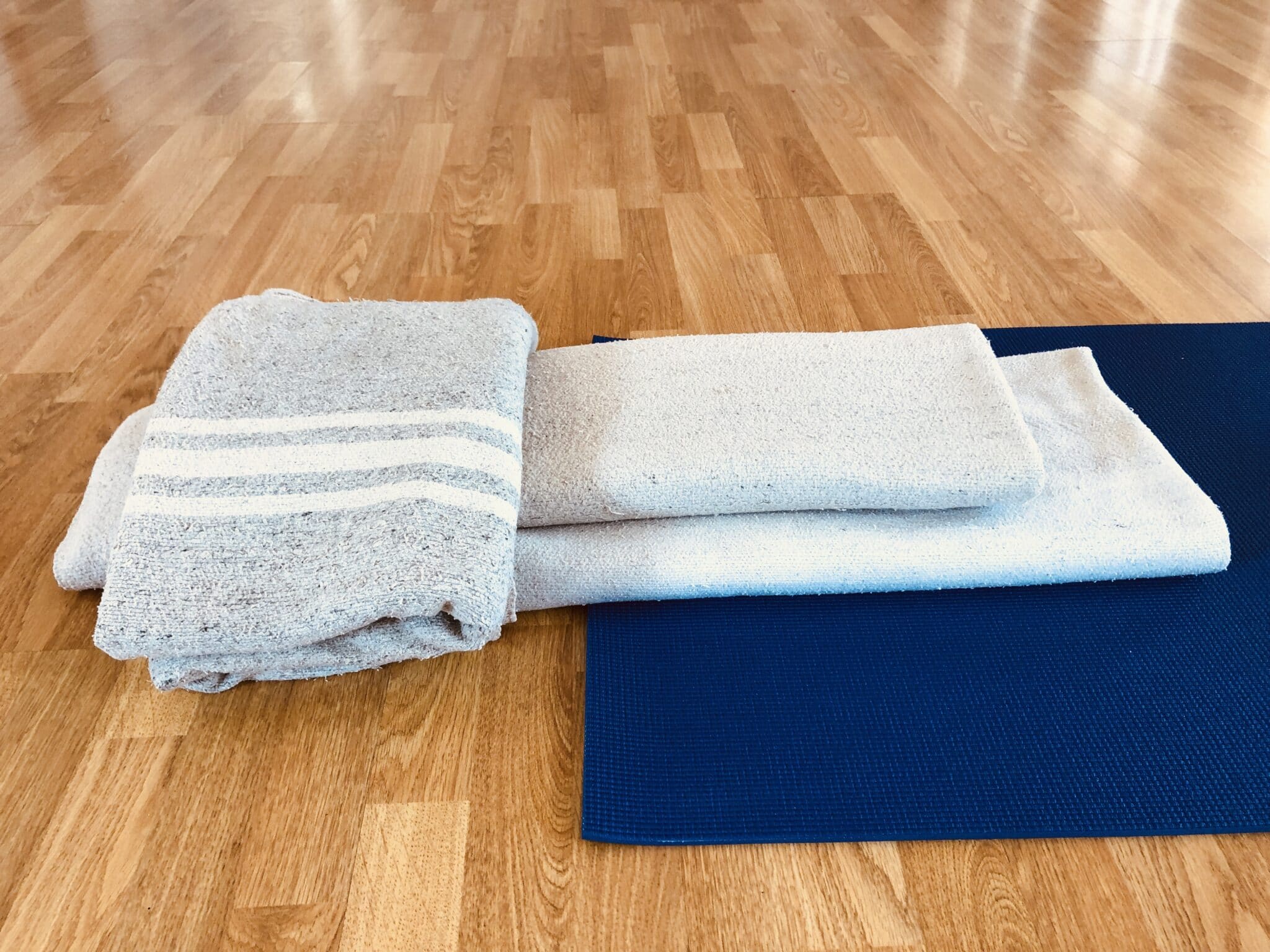
Folded blankets laid out for lying-down pranayama. One supports the back, a smaller fold lifts the head a little higher.
A prop is a teacher, not a crutch
An article on Mr Iyengar’s 85th birthday teachings, in Yoga Vaani 82 (June 2005), lists what props do: they ease fear, steady the body and mind, let you stay longer in a pose, and quieten a busy brain. It quotes his son, Prashant S Iyengar: “A prop is a prop when it is no longer a prop.” The idea is that a prop teaches you a pose until, one day, your body knows it. Our note Using Props In Yoga: Are They Cheating Or Teaching? says more, and you’ll find more of the Iyengars’ words on our Iyengar quotes on props page.
How do you fold yoga blankets into a bolster?
Here is the simplest way to turn three firm blankets into a bolster shape for lying back or sitting.
- Fold each blanket in half, then in half again, so you have a thick rectangle.
- Fold it in thirds along the long side, to make a long, narrow strip about the width of your back.
- Stack two or three strips, edges squared and smooth side up.
- Press down with both hands. The stack should hold your weight without sinking. If it does, add a blanket.
- For a round bolster, fold one blanket into a long strip and roll it tightly from one end. Our bolster guide shows the rolled version.
Lie back along the stack with your hips on the floor and a smaller fold under your head, and you have one of the most restful poses in yoga. Add a belt around the feet and a yoga block under each knee, and you have the pose in the first picture on this page.
Legs up the wall, hips on folded blankets

Legs Up The Wall (Viparita Karani) with the hips on folded blankets. A bolster is the usual prop here; firm blankets do the job just as well. Sandbags on the hands and feet are a pleasant extra.
How many yoga blankets do you need at home?
Three. Two folded together give enough height for most supported poses, and the third goes under your head or knees, or keeps you warm. That is why our blanket kit has three. See our notes on Legs Up The Wall and Savasana (the final rest) for two set-ups where blankets earn their keep every day.
Head To Knee Pose, sitting on folded blankets

Head To Knee Pose (Janu Sirsasana) with the hips lifted on folded blankets and the forehead resting on a chair. A block supports the bent knee.
Chris uses these same blankets at home for her own daily practice and her evening wind-down. If a Senior Iyengar Yoga Teacher with more than thirty years of teaching is happy with three blankets and no bolster, most of us will be too.
Flametree’s two home prop kits
We put together two kits for people who practise at home, take live online classes, or want props of their own alongside studio classes in Darwin. Prices below were checked in our shop on 4 November 2026.
The yoga blanket kit: our bolster alternative

The Flametree yoga blanket kit: three firm blankets and a block. Fold them into a bolster, or into a dozen other shapes.
Yoga blanket kit: 3 blankets, 1 block and a yoga pose poster, $119. Free air freight to your home anywhere in Australia. Each blanket is 200 cm by 150 cm, finely woven acrylic with edge binding, firm enough to stack and machine washable. Allow up to three weeks for delivery.
The starter kit: mat, blocks, belt and eye cover
The beginner yoga props starter kit gives you a foldable 4 mm mat, two foam blocks, a 180 cm belt and a cotton eye cover, with the yoga pose poster free. It’s $79 for the props, or $139 with 12 beginner classes and $189 with 22, with free air shipping Australia-wide. You can tick the blanket kit as an add-on at checkout. Together, the two kits cover every pose taught in our beginner classes. For more on blocks, belts and sandbags at home, see Yoga Equipment For Home.
Bridge pose supported on firm blankets

Supported Bridge Pose (Setu Bandha Sarvangasana) on firm, wide blankets, feet on a block, legs belted and an eye cover on. Everything here comes from the two kits.
Which props help with stiffness, back pain, sleep and stress?
Props are what make supported, restful poses possible, and those are the poses many people come to yoga for. Our Yoga For Health Conditions encyclopaedia gathers what Mr Iyengar, the yoga doctors and the research say about each one:
- Stiff joints and flexibility: blankets under the hips make forward bends possible for stiff bodies.
- Back pain: supported lying poses let a sore back rest in a good shape.
- Sleep and energy: a blanket-supported rest before bed helps the body wind down.
- Stress and burnout: when the prop does the holding, the nerves can let go.
Our article What Is Restorative Yoga? explains the restful style that uses props the most, and the yoga sandbag note shows the prop that pairs so well with blankets. For everything on Iyengar yoga props, from wall ropes to chairs, see our props page.
A wide-legged forward bend with blankets

Wide-Angle Seated Forward Bend (Upavistha Konasana), sitting on folded blankets with the forehead on a block. The blankets do what a bolster would, and the pose stays calm.
Blankets and a sandbag, working together

Chris Lalor in Reclining Bound Angle Pose, lying on folded blankets with a sandbag on the legs. The weight helps the hips release while the blankets hold the chest open.
Try yoga props in Darwin before you buy
At our studios in Woolner and Coolalinga, every class supplies the props: blankets, blocks, belts, bolsters, chairs and wall ropes. Beginner classes show you how to set each one up. Live online, our teachers show you how to use blankets, chairs, towels and walls at home. So you can try yoga props in Darwin, or online from anywhere in Australia, before you spend a cent.
New to Flametree, or away three months or more? Start with our half price beginner 10 class pass with 2 classes free. Already done some yoga? The non-beginner half price deal gives you 2 free classes and 10 more at half price. Or look at the beginner timetable and just come along.
Questions about yoga blankets and bolsters
What is a yoga blanket?
A firm, dense blanket used as a yoga prop. It is folded or rolled to give height under the hips, back, head or shoulders, and it can stand in for a bolster in most poses.
Is a yoga blanket better than a bolster?
For home practice, usually yes. Blankets fold to any height, do more jobs, cost less to post and store in a cupboard. A bolster is handy in a studio, where classes in Darwin supply them.
How do you fold yoga blankets into a bolster shape?
Fold each blanket in half twice, then in thirds lengthways to make a long strip. Stack two or three strips with square edges. Press down: the stack should hold your weight without sinking.
How many yoga blankets do I need?
Three. Two folded together give the height for most supported poses, and the third goes under the head or knees, or keeps you warm in the final rest.
What did Mr Iyengar say props are for?
In a 2005 interview he said he made props because good teachers are rare, so props guide the body into the right shape. He called them self-help for home practice.
Why are yoga bolsters expensive in Australia?
Mostly freight. A bolster is bulky for its weight, and air freight is charged on size as well as weight, so delivery can cost almost as much as the bolster. Folded blankets pack flat.
What is in Flametree’s yoga blanket kit?
Three 200 cm by 150 cm acrylic blankets, one yoga block and a yoga pose poster, for $119 with free air freight anywhere in Australia. Allow up to three weeks for delivery.
Where can I learn to use yoga props in Darwin?
At Flametree Yoga Studio in Woolner and Coolalinga, where every class supplies blankets, blocks, belts, bolsters and chairs, or in our live online classes from anywhere in Australia.
Where to next
- Want your own props? See the yoga blanket kit and the starter kit.
- New to yoga, or coming back? Start with our half price 10 class pass with 2 classes free, in Darwin or live online.
- Want to see class times first? Look at the beginner timetable.
Last updated: 4 November 2026. Flametree Yoga Studio, Darwin and live online. This article is general information, not medical advice.
Sources: Iyengar Yoga Australia online library: Yoga Vaani 42 (December 1995, “Different Props: Their Use And Effects”, an interview with Mr BKS Iyengar edited by Geeta S Iyengar, from 70 Glorious Years of Yogacharya BKS Iyengar), Yoga Vaani 77 (March 2004), Yoga Vaani 82 (June 2005, “Why Do We Use Props?”) and Yoga Vaani 95 (September 2008, a 2005 interview reprinted from Yoga Rahasya, the journal of the Iyengar institute in Pune). Product details and prices: Flametree shop, read 4 November 2026.