
Scoliosis And Yoga: What Mr Iyengar, The Yoga Doctors And The Research Say
Do you have a curve in your spine, one shoulder higher, or one side of your back that aches more than the other? That is scoliosis, a sideways curve of the spine, often with a twist through the ribs. It shows up in teenagers, and it can appear or grow in older adults as the spine wears. People call it a curved spine, a crooked back or uneven shoulders. The good news: yoga gives you ways to build strength on both sides, breathe into the squashed side of the ribs, and feel balanced in a body that is not symmetrical. This guide brings together what Mr BKS Iyengar, Geeta S Iyengar, the medical doctors who worked with Mr Iyengar and senior Iyengar teachers say about scoliosis, and what the research has found. Last updated: 1 November 2026.
Get 2 Free Yoga Classes And 2 Free Ebooks
Can yoga help scoliosis? The short answer
Yes. Yoga is very likely to help with scoliosis, and it is certainly worth trying. It strengthens the trunk evenly, lengthens the side that is squeezed, opens the breath into the collapsed side of the ribs, and teaches you to stand with your weight balanced. Dr Loren Fishman, a medical doctor who studied with Mr Iyengar, reports that one held pose, the side plank, made curves smaller: by 32% on average in 25 people who held it daily for about seven months, and by 9 degrees in teenagers with lower back curves, while curves in a comparison group grew. Elise Browning Miller, a senior Iyengar teacher who has scoliosis herself, sets a different aim: not a straight back, but a curved spine that feels balanced, strong and at ease. Both views are set out below.
One thing to keep in mind as you read: the yoga studies of scoliosis tested single poses taught by one doctor’s clinic, not Iyengar yoga classes. In our view as certified Iyengar teachers, well-taught Iyengar yoga, with its close eye on alignment, props for each side of the body and adapted poses, is likely to go further. Why the kind of yoga matters.
The bottom line: five key moves for scoliosis
- Go to a yoga class at your level, two or three times a week. Scoliosis needs a teacher who can see your curve and adapt each pose to it. Give it months, not weeks.
- Lengthen first. Lift the spine up out of the hips before you bend, twist or arch. Length gives the squashed side of the curve room.
- Build strength on the weak side. Held poses such as the side plank build the side of the trunk. In Dr Fishman’s view the outer, bulging side of the curve is the one to strengthen.
- Breathe into the collapsed side. Slow, full breathing (pranayama) widens the ribs from inside and calms the mind. Senior Iyengar teachers guide the breath to the side that is squeezed.
- Start now. New to Flametree, or away 3 months or more? 2 free classes, then 10 at half price, in Darwin or LIVE online.
Iyengar yoga is the style we teach at Flametree. During the 20th century, Mr BKS Iyengar was the major person who codified traditional Indian yoga, through his seminal books and widespread teaching. He also pioneered the use of props, so poses can be adapted to almost any body. His style is sometimes called modern classical yoga. This guide is part of our encyclopaedia of yoga for health conditions.
This guide in short
- Mr BKS Iyengar: work both sides of the body evenly, work from the edges towards the problem, and be patient. He wrote the foreword to a whole book on yoga and scoliosis.
- Geeta S Iyengar: standing poses to bring the spine towards straight, much use of ropes, chairs and walls, and long breathing into the hollow side.
- Dr Timothy McCall: scoliosis is no. 100 on his list of conditions helped by yoga. Each back needs its own assessment.
- Dr Loren Fishman: strengthen the outer side of the curve with the side plank, curve side down. In his view it suits lower and middle back curves.
- Elise Browning Miller: the aim is not to straighten the back, but to know it, accept it and balance it.
- The research: 12 studies listed below, from Dr Fishman’s side plank studies to reviews of 26 trials of scoliosis exercises.
- Take it further: a free ebook, Happy Backs, the 2027 backs masterclass, and classes in Darwin and online.
Scoliosis And Yoga On One Page
Different voices, one direction: lengthen, balance both sides, strengthen, breathe.
Work both sides equally. Build from the edges in. Healing takes time.
Standing poses, ropes and chairs to align the spine. Breathe into the hollow side.
Scoliosis is no. 100 on his list. Every back is assessed as an individual.
Side plank, curve side down, held daily. He reports curves grew smaller.
Not a straight spine: a curved spine that is balanced and at ease.
A simplified picture. Each view is explained in its own section below.
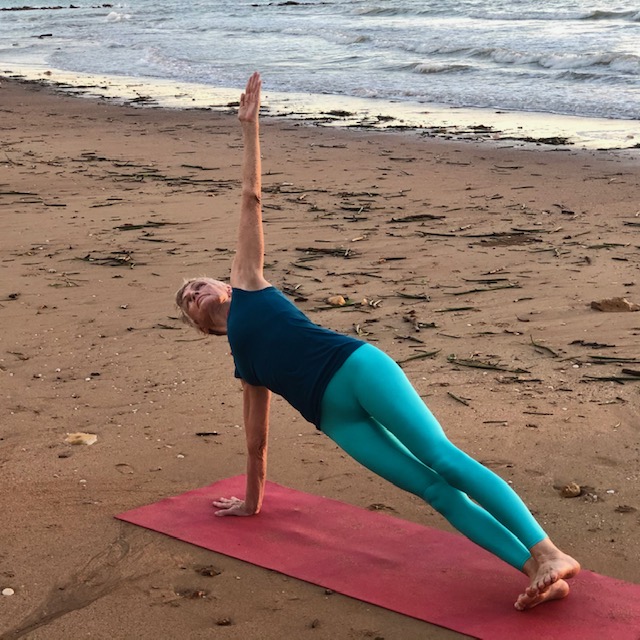
Chris Lalor, Certified Senior Iyengar Yoga Teacher and certified Yoga Therapist, in Side Plank (Vasisthasana). It is the pose Dr Fishman studied for scoliosis.
“It is the spine’s job to keep the mind alert.”
What is scoliosis?
Seen from behind, a spine should run fairly straight up the middle of the back. In scoliosis it bends sideways, into a C or an S shape, and the bones usually turn as well, so the ribs on one side push backwards. That is why one shoulder blade can stick out, one hip can look higher, or the waist creases more on one side.
The size of a curve is given as the Cobb angle, measured in degrees on an X-ray. The bigger the number, the bigger the curve. Every study below uses it.
- Idiopathic scoliosis (cause unknown) is the most common kind. It usually appears between about 10 and 14, and the spine is most likely to change while young people are still growing.
- Degenerative scoliosis appears in older adults as the discs and joints of the spine wear. Dr Fishman’s first study included both kinds.
- Functional (habit) curves come from how we stand and use the body, such as always carrying a bag on one shoulder. Elise Browning Miller wrote that these are more common than structural (bony) curves.
Scoliosis pain. Many people with a curve have no pain. Others get back pain, tight muscles or spasms, mostly on the squeezed side. Dr Timothy McCall lists scoliosis among the many causes of back pain, which is why he favours looking at each back as an individual.
Two Sides Of A Curve
Every curve has an inside and an outside. Yoga works on both.
Squeezed and short. The ribs crowd together and the breath goes in less. Teachers lengthen it and breathe into it.
Bulging and stretched. In Dr Fishman’s view it is the weaker side, so he strengthens it with held poses.
Yoga answers both: length and breath for the inside of the curve, held strength for the outside, and standing poses to spread the weight evenly through both feet.
After Elise Browning Miller (Yoga Journal, 1990), Geeta S Iyengar (Pune notes, 1996) and Dr Loren Fishman (introduction to Yoga and Scoliosis, Marcia Monroe). A simplified picture.
“Normally, we are not aware of how we stand or that we distribute the weight unevenly.”
What Mr BKS Iyengar taught about a curved spine
In short: work both sides of the body evenly, build strength around the problem area first, and be patient.
In Yoga: The Path to Holistic Health, Mr Iyengar sets out a yoga approach for 72 health conditions. Scoliosis is not one of them by name. The nearest are his courses for lower, middle and upper backache (pp. 319 to 322), where he names poor posture as a cause. His general ideas, in our words:
- Match the poses to the person. Wrongly chosen poses can do harm (p. 260), so a teacher adapts each pose to the curve in front of them.
- Work from the edges in. Build strength around a sore or weak area first, then work towards it (p. 263).
- Be patient. In his words, “Do not get discouraged if the healing of your ailment takes time” (p. 263). In his view yoga “can alleviate some of the suffering” (p. 260).
- Both sides, evenly. In The Tree of Yoga (pp. 93 to 96) he asks for even work on both sides of the body, and says a fresh problem can still be shaped, while an old, set one can be held steady. That is our summary.
In Light on Yoga, his ailments appendix has no entry for scoliosis. Its nearest entry is Backache (p. 416), and he works it through standing poses, inversions, forward bends, twists and backbends. We do not reproduce his lists.
A whole book with his foreword. Mr Iyengar wrote the foreword to Yoga and Scoliosis: A Journey to Health and Healing by Marcia Monroe, with an introduction by Dr Fishman. We hold the book and are reading it now. More from it will be added to this guide.
We do not publish sequences. A sequence for a curved spine needs a teacher who can see your back and change each pose for it, which is what a class is for.
“Yoga is working your body equally on both sides.”
Geeta S Iyengar’s approach to scoliosis
In short: use the standing poses and lots of support to bring the spine towards straight, and breathe into the hollow side.
Geeta S Iyengar, Mr Iyengar’s daughter, taught for decades at the Iyengar institute in Pune, where people with scoliosis came to the medical classes. Notes from her teachers’ exchange in 1996 set out her approach. In our words, with no sequence:
- Standing poses first. They adjust the straightness and the twist of the spine, and teach even weight through both legs.
- Props everywhere. Ropes, chairs, walls and benches support the body, so each side can be worked as it needs.
- Supported backbends and inversions. Passive backbends over support, and shoulder stand with a chair.
- Long breathing lying down. A folded cloth under the hollow of the back, with the in-breath made longer on the squeezed (concave) side.
A case-study list in the same Pune notes includes the side plank, the pose Dr Fishman later studied.
“Unevenness is always there. In that unevenness, you bring evenness with understanding.”
What Dr Timothy McCall says
In short: scoliosis is on his list of conditions helped by yoga, and every back needs its own assessment.
Dr McCall is a US medical doctor and yoga therapist, author of Yoga as Medicine and former medical editor of Yoga Journal. His June 2019 list of conditions studied in yoga research places scoliosis (curvature of the spine) at no. 100. His book has no chapter on scoliosis. What it does say, in our words:
- One back, many causes. In his back pain chapter he names scoliosis alongside discs, ligaments, joints and muscle spasm, and argues that a one-size-fits-all routine makes no sense. Yoga’s strength is that a good teacher looks at which muscles are tight and which are weak.
- A teacher who knows scoliosis from the inside. One of his expert teachers is Elise Browning Miller, a senior Iyengar teacher since 1976, who found Iyengar yoga eased the painful back spasms her scoliosis caused. One of her long-time students first came to her with migraines and back pain from scoliosis.
“In the beginning the spine is stiff, but with practice it becomes flexible.”
What Dr Loren Fishman says about side plank for scoliosis
In short: in his view the outer side of the curve is the weak side. Strengthen it with the side plank, curve side down, held daily.
Dr Loren Fishman is a New York rehabilitation physician at Columbia University who studied with Mr Iyengar in Pune. He has done more research on yoga for scoliosis than anyone. His ideas, from his introduction to Marcia Monroe’s book (pp. 21 to 24) and his papers, are his claims, in our words:
- The spine as a balance of pulls. He sees the spine as held up by balanced tension, like a tent held by its ropes. On this view the bulging (convex) side of the curve looks bigger but is the weaker side, pulled harder than it pulls back (pp. 22 to 23).
- Strength, not just stretch. His aim is to strengthen the convex side with held, one-sided poses. He says stretching alone lets gravity take up the slack and can deepen the curve (p. 23).
- Side plank (Vasisthasana), curve side down. His main pose, with easier versions lying sideways against a wall, forearm and hips on the floor (p. 24).
- Lower and middle back curves. In a 2021 letter he writes that the side plank is meant only for lumbar and thoracolumbar curves (lower back, and where the lower back meets the middle back), and that it exaggerates curves high in the chest (thoracic). So the side plank is not for every curve, and the right side to lie on depends on your curve.
- Why yoga suits it. In his view yoga strengthens without wearing the joints, people can do it themselves, poses are held so they train the posture muscles, and it is free and adaptable (pp. 23 to 24).
- What he has seen. He says he has seen perhaps 75 to 100 people with curves. He reports that his first such patient, a frail older woman with a 113 degree curve who practised devotedly, measured 68 degrees on a later X-ray, and about 30 degrees after three more years (pp. 22 to 23). That is one person, as he reports it.
Side Plank For Scoliosis, In Dr Fishman’s View
Which curves it is meant for, and how it is done.
Curves in the lower back (lumbar) and where the lower and middle back meet (thoracolumbar).
Curves high in the chest (thoracic). He writes that the side plank exaggerates them.
Lie on the side where the curve bulges (convex side down). Hold steadily, once or more a day, building time slowly.
Forearm and hips on the floor, or lying sideways at a wall. A teacher picks the version for you.
From Dr Fishman’s 2021 letter (Glob Adv Health Med) and his introduction to Yoga and Scoliosis. His claims, in our words. Check your curve type with your teacher.
“You should work to obtain a perfect balance between both sides of the body.”
Other yoga voices on scoliosis
In short: senior Iyengar teachers with scoliosis themselves aim for balance and ease, using props, breath and both sides of the body.
Elise Browning Miller, a senior Iyengar teacher in Palo Alto, California, wrote “Scoliosis and Yoga” for Yoga Journal in 1990. Her own story: a fall down stairs as a baby, a curve that grew through childhood, the threat of a brace and surgery, then painful back spasms as a Peace Corps volunteer in Brazil. Yoga brought relief, and she went on to study and teach the Iyengar method. Her approach, in our words, with no sequence:
- The aim. Not to straighten the back, but to understand it with awareness. Of our curves, she wrote, “we must learn to accept them as they are” (p. 3). She found she could have a curved spine and still be balanced.
- Five places to work. The feet and legs (equal weight on both), the spine (lengthening), the psoas (a deep muscle joining the spine to the legs), the shoulder blades (so the upper back does not round), and the breath, sent into the collapsed side of the ribs (p. 3).
- Her teaching ideas. Stretch the inside and outside of the curve differently; use a wall, rope or chair; use inversions to feel alignment without the usual pull of gravity; passive backbends over a bolster; twists, which she says help turn the spine back the other way; and rest with breath awareness, with a folded towel in the hollow of the back (pp. 4 to 7). Her claims.
Dr Krishna Raman, a Chennai physician who trained in yoga under Mr Iyengar, writes of back pain in general that yoga’s special gift is alignment: pain can ease even where a bony curve does not change (Yoga and Medical Science: FAQ, Q243 to Q251). His claim, about backs in general.
Marcia Monroe wrote a whole book on yoga and scoliosis, with Mr Iyengar’s foreword and Dr Fishman’s introduction. Her approach will be added here once we have read it.
A story: the good side teaches the other side
Stephanie, an experienced Iyengar teacher who runs a studio in Toronto, has scoliosis, and her curves change from day to day. A photo once showed her lopsided shape so clearly that she feared her progress was slipping. Now she works on evenness: levelling the hips, balancing the shoulders, and making space where her spine tends to sink. She lets her more sensitive right side guide the left, and uses straps and the wall for feedback. When one area strengthens and another shows weakness, she sees it as information, not going backwards. In her words, “the ‘good side’ must teach the ‘bad side.'”
Source: Stephanie, Studio Po, Toronto, “Progress in Disguise”, Iyengar Yoga Association of Canada, 4 December 2025. Read her article.
What does the research say about yoga for scoliosis?
In short: Dr Fishman reports that the side plank made curves smaller, in adults and teenagers, and reviews of scoliosis exercises find that steady, targeted work makes curves smaller too. Women with spine problems say yoga gives them better posture, calm and quality of life. The studies are small, and none tested Iyengar yoga. Small studies still count: yoga for scoliosis has had very little funding. Why the kind of yoga matters.
The Research At A Glance
Four studies that sum up the evidence. All of them, with links, are listed below.
Side plank made curves 32% smaller. Fishman 2014: 25 adults and teenagers, about 1.5 minutes a day for about 7 months. 41% smaller in the 19 who kept it up.
Teenagers’ lower back curves shrank 9 degrees with yoga poses, while curves without them grew. Fishman 2021: 56 teenagers, side plank and related poses, not randomised.
Scoliosis exercises made curves smaller. Sun 2025: 16 studies of teenagers. Curves 4.5 degrees smaller on average, trunk rotation better.
Women with spine problems found calm, posture and quality of life in yoga. Akyol 2025: interviews with 15 women with scoliosis and other spinal conditions.
Every study is listed in full in this section, with a link to read it.
Yoga for scoliosis
All three yoga studies come from Dr Fishman’s clinic in New York.
- The side plank made the main curve 32% smaller on average, and 41% smaller in the 19 people who kept it up. Both teenagers with idiopathic scoliosis and adults with degenerative scoliosis improved. Fishman, Groessl and Sherman 2014, a case series of 25 people with curves of 6 to 120 degrees, who held the side plank once a day, curve side down, for an average of 1.5 minutes, over about 7 months. No comparison group; the authors say the results warrant further testing. Read the study. This was general yoga-style work, not Iyengar yoga, which has not yet been tested for scoliosis on its own. Why it matters.
- Teenagers doing the side plank and related poses saw lower back curves shrink by 9.2 degrees and upper back curves by 7.1 degrees, while curves in the comparison group grew by 5.4 and 9.3 degrees. Fishman 2021, a controlled trial, not randomised, of 56 teenagers (41 did the poses, 15 did not), with X-rays measured blind. The poses were the side plank, half moon and a raised side plank, as suited each curve. Teaching in the clinic worked better than teaching over the internet. Read the study.
- Teenagers who did the side plank three times a day after a muscle-relaxing injection saw lower back curves shrink from about 37 to 26 degrees in three months. This tested the side plank combined with a botulinum toxin injection into the muscles on the inside of the curve, so it is not a result for yoga alone. Fishman 2024, a randomised pilot of 24 people aged 12 to 18 with lower back curves (11 in the side plank and injection group, 13 in placebo groups). Two had brief shoulder soreness. Read the study.
- Hatha yoga is worth considering alongside other care for teenage scoliosis, and the field needs larger trials. Si 2024, a short review and commentary. It notes that no large randomised trials exist yet and that yoga routines differ from study to study. Read the study.
Iyengar yoga studies
Iyengar studies test Iyengar yoga taught by trained Iyengar teachers, with props and adapted poses. No trial of Iyengar yoga for scoliosis has yet been published. Not yet studied is not the same as not working. Mr Iyengar, Geeta Iyengar, Elise Browning Miller and Marcia Monroe built their approaches from years of teaching people with curves. Why the kind of yoga matters.
Scoliosis exercises
These trials tested scoliosis-specific exercise programmes, most often the Schroth method, rather than yoga. Many of the moves are close to what a yoga class does: lengthening the spine, strengthening one side, turning the trunk the other way, and breathing into the collapsed ribs.
- Scoliosis exercises made curves 4.5 degrees smaller on average, improved trunk rotation by 2.3 degrees and lifted quality of life a little. Sun 2025, a review of 16 studies (12 randomised) in teenagers. Exercise plus a brace helped moderate curves. Read the study.
- Several exercise approaches, alone or combined, helped the curve, trunk rotation or quality of life, with Schroth-based methods ranking well. Cao 2026, a network review of 26 randomised trials and 1,384 teenagers. Read the study.
- Bracing and Schroth-based exercise showed the best trend for short-term curve control. Yang 2026, a network review of 13 studies and 709 teenagers. The evidence was thin and varied. Read the study.
- Schroth exercise combined with balance and body-awareness training, about three times a week for 12 to 18 weeks, ranked best for shrinking the curve. Wang 2026, a network review of 24 randomised trials and 1,149 people. Read the study.
- Supervised exercise for 8 weeks made the curve 2.1 degrees smaller and improved trunk rotation, lung capacity and chest expansion; exercise alone at home did not. Dimitrijevic 2025, a randomised trial of 34 people aged 11 to 16. A point for classes over practising alone. Read the study.
- Schroth exercise beat core-strength training for the curve, trunk rotation, breathing muscle strength and how teenagers felt about their appearance. Yildirim 2026, a randomised trial of 38 teenagers over 12 weeks. Read the study.
What The Work That Helped Had In Common
Across the side plank studies and the exercise trials.
Every day or most days
Short daily holds in the side plank studies; three times a week in the best exercise programmes
Months, not weeks
About 7 months in the 2014 series; 12 to 18 weeks in the top-ranked exercise plans
One side worked differently
Strength for the outside of the curve, length and breath for the inside
A teacher who sees you
Clinic teaching beat internet teaching; supervised exercise beat home exercise
Fishman 2014 and 2021, Wang 2026, Dimitrijevic 2025, all linked in this section. A simplified picture.
Yoga and the spine more widely
- Women with scoliosis and other spinal conditions described mental and physical relaxation, better stress management, better posture, better quality of life and more kindness to themselves after yoga. Akyol 2025, interviews with 15 women who had practised yoga for at least 3 months. Read the study.
- All 52 studies of yoga for muscle, bone and joint problems reported benefits in some or all measures. Gandolfi 2025, a review of 52 clinical studies and 4,151 people. Protocols varied a lot. Read the study.
Pranayama, meditation and mindfulness. No trial has yet tested pranayama, meditation or mindfulness on their own for scoliosis. Not yet studied is not the same as not working. The breathing in the Schroth trials above is taught as part of exercise, and it improved chest expansion and lung measures. Geeta Iyengar and Elise Browning Miller both teach breath sent into the collapsed side of the ribs. The pranayama we teach (staircase, ocean, alternate nostril, humming and a gentle shining skull breath) is slow, nasal and taught step by step, and it starts with lifting and widening the chest. “Breathing exercises” in research can mean many things, so we look at what was actually taught. Why the kind of breathing matters.
Studies we do not list above
We list studies where yoga, pranayama, breathing or mindfulness helped. One is left out:
- Sarkisova 2019, a randomised trial of the side plank in 64 teenagers, found no change in the curve after 6 months; only 22 kept up the practice, and Dr Fishman replied that almost no lower back curves, the kind the side plank is meant for, were in its side plank group. Read the study.
“Do not get discouraged if the healing of your ailment takes time.”
Where can I do yoga for scoliosis in Darwin?
At Flametree, in Darwin and LIVE online. Everything above points the same way, and it is how we teach people with a curved spine.
- From the feet up. Mountain Pose and the standing poses teach even weight through both feet, so the spine can rise from a level base.
- Length first. Every pose starts by lifting the spine out of the hips, so the squeezed side of the curve gets room.
- Each side worked as it needs. A teacher may give you more time, a block or a different version on one side. Props such as the wall, chairs, belts and blocks make that possible.
- Held strength. Poses such as the side plank, in the version that suits your curve, build the side of the trunk.
- Breath into the collapsed side. Lying over support, with the breath guided into the squeezed ribs.
- Classes adapted to the people in them. No one-size-fits-all. Tell your teacher about your curve and where it is, and the poses are changed for you.
- Breath and calm: every class ends in rest, and our pranayama classes go further. On tired days, try gentle yoga or restorative yoga.
Classes run at Woolner and Coolalinga in Darwin, and LIVE online across Australia.

Chris Lalor in Triangle Pose with a chair. The chair supports the trunk, so both sides of the waist can lengthen.
Read more on scoliosis and the spine
- Back pain and yoga: the full guide
- Kyphosis and a rounded upper back: the full guide
- Yoga for posture: what the research shows, and how to stand taller
- Deep core exercises: six Iyengar moves, including side plank
- Uneven shoulders
- Stiff joints and flexibility: the full guide
- Bone health, balance and falls: the full guide
Take it further
Free ebook: Happy Backs. Iyengar yoga for the upper back, neck and lower back: the trials, and real stories of backs that came good. By Chris Lalor, Certified Senior Iyengar Yoga Teacher and certified Yoga Therapist.
New to Flametree, or away 3 months or more? 2 free classes + 2 ebooks, only available via this offer. Already a student? You can still get this book. Get your free copy of Happy Backs
Here are the facts on what helps. The ebook has even more, including stories of how it has helped people. Then do the free classes, see what you think, and buy a pass that puts all of this into action for you.
- Classes, in Darwin or LIVE online: new, or away 3 months or more? 2 free classes, then 10 at half price. Already practising yoga? See the non-beginner half price pass. See every class time.
- Masterclass: backs are one of our 2027 Sunday Arvo Masterclasses with Chris Lalor, in Darwin and online, where you get the poses, sequences and breathing that put this guide into action.
- Retreats: a week of daily, adapted yoga in Bali. See the retreats.
Other conditions are in our encyclopaedia of yoga for health conditions.
Scoliosis and yoga: questions people ask
What is scoliosis?
Scoliosis is a sideways curve of the spine, often with a twist, so the ribs on one side push back. It can make one shoulder or hip look higher. The most common kind, idiopathic scoliosis (cause unknown), usually appears between about 10 and 14. Degenerative scoliosis appears in older adults as the spine wears. The size of a curve is measured in degrees, as the Cobb angle.
Can yoga straighten scoliosis?
Dr Loren Fishman, a medical doctor who studied with Mr Iyengar, reports that it can make curves smaller. In his study of 25 people, holding the side plank daily for about seven months made the main curve 32% smaller on average. In his trial of 56 teenagers, lower back curves shrank 9 degrees with the poses while curves without them grew. Elise Browning Miller, a senior Iyengar teacher with scoliosis, sets a different aim: a curved spine that feels balanced and at ease.
What are the best scoliosis exercises?
The research points to steady, curve-specific work kept up for months: lengthening the spine, strengthening the outside of the curve, turning the trunk and breathing into the collapsed ribs. Reviews of up to 26 trials found scoliosis exercises such as the Schroth method made curves smaller, and supervised work did better than exercise alone at home. Iyengar yoga covers the same ground with props and a teacher who adapts each pose to your curve.
Why is the side plank done with the curved side down, and does it suit every curve?
Dr Fishman sees the bulging (convex) side of a curve as the weaker side, so the side plank is done with that side down to strengthen it. In his view it suits lower back (lumbar) and lower-middle back (thoracolumbar) curves, and he writes that it exaggerates curves high in the chest (thoracic). So which side, and whether to use it at all, depends on your curve. A teacher picks the version for you.
Can adults with scoliosis do yoga?
Yes. Dr Fishman’s first study included adults with degenerative scoliosis, and they improved as the teenagers did. Elise Browning Miller, a senior Iyengar teacher with scoliosis, has practised and taught for decades. In Iyengar yoga, props such as chairs, walls and ropes let poses be adapted to any curve and any age. Tell your teacher about your curve.
How does breathing help a curved spine?
On the inside of a curve the ribs are squeezed together and take in less breath. Geeta S Iyengar and Elise Browning Miller both teach breathing into that collapsed side, often lying over support with a folded cloth under the hollow of the back. In trials of the Schroth method, which includes this kind of breathing, supervised exercise improved chest expansion and lung measures. Slow pranayama also calms the mind.
What does a Cobb angle mean?
The Cobb angle is the number of degrees a spine curves sideways, measured on an X-ray. The bigger the number, the bigger the curve. Studies of yoga and scoliosis exercises use it to show change: in Dr Fishman’s study of 25 people, the average curve became 32% smaller; in reviews of scoliosis exercises, curves became about 4.5 degrees smaller on average.
Does yoga help scoliosis pain?
Many people find it does. Elise Browning Miller found yoga brought relief from the painful back spasms her scoliosis caused, and went on to teach it. In interviews, women with scoliosis and other spine problems described relaxation, better posture, better stress management and a better quality of life after yoga. Dr McCall lists scoliosis among the causes of back pain and favours yoga fitted to each back. Our back pain guide has more.
Where this comes from: BKS Iyengar, Yoga: The Path to Holistic Health (Dorling Kindersley), the general chapters and the backache courses; Light on Yoga, ailments appendix; The Tree of Yoga; Light on Life (Rodale edition). Geeta S Iyengar, teachers’ exchange notes on scoliosis (Pune, 1996), her Sydney teachers’ course of 1996 and Yoga in Action for Beginners. Timothy McCall MD, Yoga as Medicine (Bantam), and his June 2019 list of health conditions helped by yoga. Loren Fishman MD, introduction to Marcia Monroe, Yoga and Scoliosis: A Journey to Health and Healing (Demos Health, 2012, foreword by BKS Iyengar), and his papers. Elise Browning Miller, “Scoliosis and Yoga”, Yoga Journal, May/June 1990. Krishna Raman MD and S. Suresh MD, Yoga and Medical Science: FAQ. Stephanie of Studio Po, Toronto, Iyengar Yoga Association of Canada. Flametree’s ebook Happy Backs. Studies as linked above. Everything is summarised in our own words.
This page is general information, not medical advice. Flametree Yoga Studio, Darwin and LIVE online.
