
Too Stiff For Yoga? Free Ebook On Yoga For Stiff Bodies
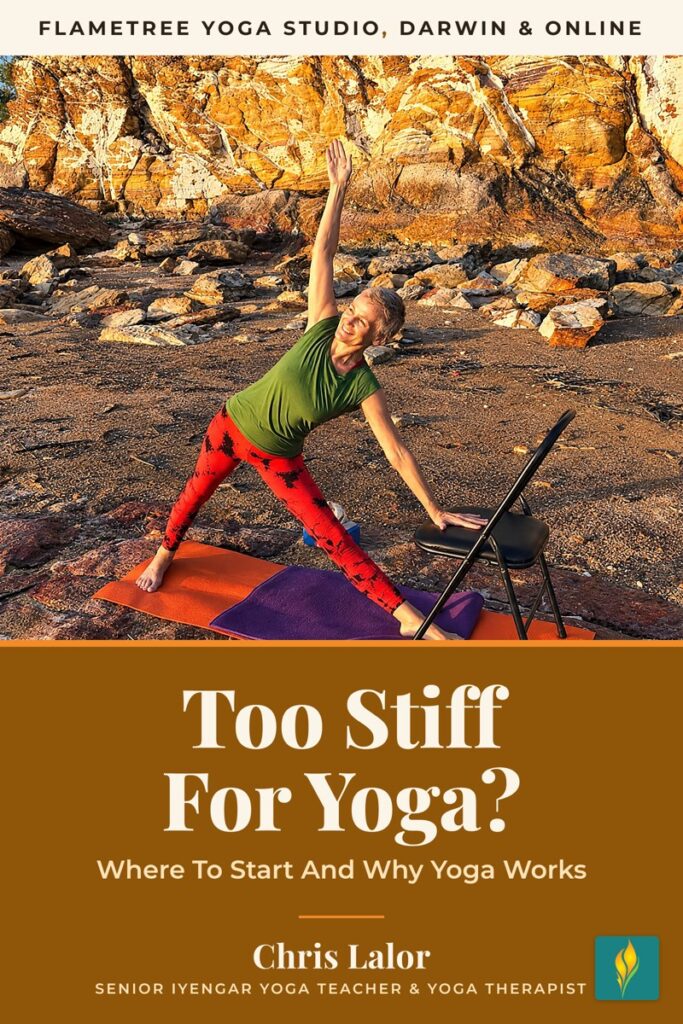
Think you are too stiff for yoga? That is the best reason to start. Stiffness is one of the things yoga changes most, and it starts to change within weeks. This free ebook on yoga for stiff bodies explains why.
New to Flametree, or away for 3 months or more? You get 2 free classes + 2 ebooks, only available via this offer. Choose this book and one more. Already a student? You can still get this book free. Jump to the form.
Iyengar yoga is the style developed by Mr BKS Iyengar. In the 20th century he did more than anyone to set down traditional Indian yoga, through his books and his teaching, and he pioneered the use of props. It’s the style we teach at Flametree, in Darwin and live online.

Too Stiff For Yoga? Where To Start And Why Yoga Works. By Chris Lalor, Senior Iyengar Yoga Teacher.
What’s inside Too Stiff For Yoga?
The book is about 60 pages, with pictures and simple diagrams. Here is a taste.
- Sam’s “concrete hamstrings”. A runner who could not bend forward. Eighteen months of classes later: “Now that I can touch my toes, there’s no stopping me.”
- “For you, it’s probably never!” What a teacher once told Chris about her heels in Downward Dog, and why the heels were never the point.
- Mr Iyengar started stiff too. At fifteen, after years in bed, his arms barely reached his knees.
- Why people bend further under an anaesthetic, and what that tells you about where stiffness really lives.
- The stiffness that is not “just age”. Up to 74, most joints lose only a few degrees. One movement loses far more, and a chair is the reason.
- The floor test. What getting down to the floor and up again says about your health.
- Hot, humid and stiff. Why many people feel stiffer in Darwin’s build-up and wet season, and why air-conditioning adds to it.
- Hold or bounce? What a review of 77 studies found, and why we hold.
- How we do it at Flametree: stand first, short holds repeated, props that bring the pose to you, and no prizes for going deepest.
- Dino, 52, and his golf drive. From toes to palms flat on the floor, and at least 20 metres more off the tee, in his own words.
Key findings on yoga for stiff bodies
- Most stiffness is a guard, not a short muscle. A 2025 Australian review of 65 studies, with 1,542 adults, found that after weeks of regular stretching people could accept a bigger stretch, but their muscle fibres did not get longer at all. The brain’s “stop” point moved.
- It changes in weeks. A 2018 review of 26 stretching studies, each three to eight weeks long, found people moved further and tolerated more stretch. A 2023 review of ten studies found the muscle itself became less stiff over three to twelve weeks.
- Getting up off the floor matters. In a Brazilian study of 2,002 adults aged 51 to 80, those who needed the most help to sit on the floor and stand up again had more than five times the risk of dying over about six years. It is a sign of strength, flexibility and balance, not a cause.
- Iyengar yoga has been tested in older people. In a 2005 American study, 19 people aged 62 to 83 did eight weeks of Iyengar yoga. Their hips extended further and their stride grew longer. In a 2013 Sydney trial of 54 people, twelve weeks of Iyengar-based yoga improved balance, walking speed and getting up from a chair.
The executive summary, in full
This is the opening of the book, the whole thing on two pages. The rest is in the free download.
Too stiff for yoga? That is the best reason to start. Stiffness is one of the things yoga changes most, and it starts to change within weeks.
Flexibility is not the whole point. The major benefits of yoga that people seek most are more strength, flexibility, calmness and wellness. In the process, by quietening the chatter of the mind, people often find it brings useful transformations, as well as more contentment and happiness.
What the research says
- Most stiffness is a guard, not a short muscle. When people stretch regularly, most of the new range comes from the nervous system letting the muscle go further.
- It changes in weeks, not years. Stretching programmes of three to eight weeks reliably add range. Over three to twelve weeks, the muscle itself also becomes less stiff.
- Age is not the main cause. A large American survey found that, up to age 74, most joints lose only a few degrees with age. The big loss was hip extension (taking the leg back behind you), the very movement that a life in chairs stops us doing.
- Getting down to the floor and up again is worth keeping. In a yoga class you go down to the mat and back up again, over and over.
- Yoga makes older people more flexible, stronger and steadier. A 2019 review of 22 trials in people over 60 found yoga improved lower body flexibility, leg strength and balance. It beat other exercise for leg strength and flexibility.
- Yoga eases stiff, sore joints. Reviews of knee osteoarthritis (wear and change in the joint) trials found less pain, less stiffness and better function with yoga, often more than with other exercise.
- Not yet tested does not mean wrong. The Iyengar way of working with a stiff body has been tested in yoga classes for generations. Research is still catching up.
How yoga does it
- Show the guard it is safe. Slow, steady poses teach the nervous system to let a muscle go a little further. Fear and force make it hold on.
- Stand first. A class starts with Mountain Pose and standing poses, not sitting cross-legged. They wake up every joint and build the strength that a stiff body needs.
- Sequence, repeats, technique, timing. For a stiff body, that means short holds of ten to twenty seconds, repeated, going a little further each time.
- Hold, don’t bounce. In a review of 77 studies, held stretches gave more lasting range than bouncing.
- Props bring the pose to you. A wall, a chair, a belt and a block let a stiff body do the real pose, correctly, today.
- Breathe out into it. A held breath tightens the body. A slow out-breath lets it soften.
- Use every direction. Daily life moves joints in a narrow range. A good class takes each joint through all of its movements.
- Strength and stretch together. A joint needs both. Iyengar poses build them at the same time.
- Keep coming. Range grows in weeks and fades a little when you stop. Regular practice keeps it.
- No prizes for going deepest. A long spine in a modest pose beats a rounded back in a deep one.

Get your free copy
2 free classes + 2 ebooks only available via this offer.
What happens next: we email you a link straight away. Click it, choose your two books, and download them on the spot. No payment, no card.
Want to see the other seven books first? See all eight free yoga ebooks.
Questions about yoga for stiff bodies
Am I too stiff to start yoga?
No. Stiff is the usual starting point, not a barrier. Most of the extra range people gain in yoga comes from the nervous system relaxing its guard, which a 2025 Australian review of 65 studies confirmed, and that starts to change within weeks. Props such as a chair, a belt and a block let a stiff body do the real pose from the first class.
Is yoga good for flexibility?
Yes. A 2019 review of 22 trials in people over 60 found yoga improved lower body flexibility, leg strength and balance, and beat other exercise for leg strength and flexibility. Flexibility is not the only gain: the same classes build strength and calm.
Is yoga good for stiff joints?
Yes, gently done. Reviews of trials in knee osteoarthritis found less pain, less stiffness and better function with yoga, often more than with other exercise. In an Iyengar class each joint is taken through all of its movements, with props so nothing is forced.
Why do I feel stiffer in Darwin’s build-up and wet season?
You are not imagining it. Heat brings fluid into the hands, ankles and feet, sweat drains you, and going from hot outside to air-conditioning cools the muscles, and a cooler muscle is a stiffer one. A European study of 810 older people found joint pain rose a little on humid days. A class in the cooler part of the day, plenty of water and steady movement all help.
Should I bounce or hold when I stretch?
Hold. In a review of 77 studies, held stretches gave more lasting range than bouncing. A steady pose keeps the muscle’s guard quiet, so it lets go further over time.
Is stiffness just part of getting older?
Less than most people think. A large American survey of 1,683 people found that up to age 74, most hip and knee movements lose only 3 to 5 degrees. The big loss is hip extension, the movement a chair stops us using, and eight weeks of Iyengar yoga gave some of it back in older adults.
Is this ebook for men too?
Yes. Many men are sure they are “too stiff for yoga”, and they are exactly who it helps. Several of the stories in the book are men who started stiff, including a runner, an all-round sportsman and a golfer.
Where can a stiff beginner do yoga in Darwin?
At Flametree’s beginner classes in Woolner and Coolalinga, or live online from anywhere. Some classes are gentler, such as Monday 8.30am Beginner 1 and Friday 10.15am Gentle Yoga at Woolner. See the beginner timetable. New students get 2 free classes with this offer.
More on stiffness from Flametree
- Starting yoga stiff, in your late 30s, 40s or beyond: Chris Lalor’s story
- Does alcohol make you stiff? What food and drink do to a yoga body
- How long to hold yoga poses
- Yoga for Darwin’s build-up
- Yoga for flexibility: your muscles don’t get longer, so what actually changes?
- All eight free yoga ebooks and the beginner timetable
