
Yoga For Muscular Dystrophy: What Mr Iyengar, The Yoga Doctors And The Research Say
Muscular dystrophy is progressive, and you deserve facts, not false hope. So here is what yoga, yogic breathing and mindfulness have been found to do, and what they have not. Whether you are the parent of a boy with Duchenne, or an adult living with Becker, myotonic, facioscapulohumeral (FSHD) or limb-girdle muscular dystrophy, this guide brings together what Mr BKS Iyengar, Dr Timothy McCall and the research say about yoga for muscular dystrophy, including pranayama (yogic breathing), meditation and mindfulness. Last updated: 8 November 2026.
By Chris Lalor, Certified Senior Iyengar Yoga Teacher and certified Yoga Therapist, Flametree Yoga Darwin.
Get 2 Free Yoga Classes And 2 Free Ebooks
Yoga for muscular dystrophy: the short answer
No study shows that yoga changes the course of muscular dystrophy, and we will not suggest it does. What the research does show is narrower. In a randomised trial of 124 boys with Duchenne, yoga added to home physiotherapy was safe, and boys in both groups held or improved their lung function over a year. In a Brazilian study, boys who kept up yogic breathing for 10 months breathed out more air than when they started. And in adults with other muscular dystrophies, a talking therapy built on mindfulness lifted quality of life and mood, and the gain lasted. Gentle yoga with props, a slow, easy breath and steady attention fit those findings. They work on comfort, breathing, rest, worry and how daily life feels.

Seated on a chair, a belt around the back lifts the chest. Much of yoga for muscular dystrophy can be done sitting.
Overall evidence: Limited
The research here is still limited: early pilots, a single trial, or evidence from a related condition. Not yet tested is not the same as does not work.
Best study (single trial): A randomised trial at a national neuroscience institute in Bengaluru, India, gave 124 boys with Duchenne muscular dystrophy either home physiotherapy, or home physiotherapy plus yoga (gentle movement, poses, pranayama and guided relaxation), for one year. Lung function and the heart’s nerve control held steady or improved in both groups, and yoga was safe, but yoga did not add a measurable benefit over physiotherapy alone.
That trial tested yoga in general, not Iyengar yoga, and no trial has yet tested Iyengar yoga in any muscular dystrophy. In our view as certified Iyengar teachers, yoga where the pose is adapted to the person with props, and the effort is kept moderate, suits muscles that tire and weaken. Why the kind of yoga matters.
The bottom line: five key moves for yoga with muscular dystrophy
- Choose supported yoga. Chairs, the wall, belts and bolsters take the weight, so weak muscles can work gently without strain.
- Keep the effort moderate. In the trials that went well, the work was regular and moderate, never to exhaustion.
- Learn a slow, easy breath. Yogic breathing was tested in boys with Duchenne; in class we start gently and never force the breath.
- Look after the mind too, parents included. Mindfulness-based therapy lifted mood and quality of life in adults with muscular dystrophy.
- Start now. New to Flametree, or away 3 months or more? 2 free classes, then 10 at half price, in Darwin or LIVE online.
Five Key Moves For Yoga With Muscular Dystrophy
1. Supported yoga
Chairs, the wall, belts and bolsters.
2. Moderate effort
Regular, never to exhaustion.
3. A slow breath
Gentle, never forced.
4. The mind too
For people with MD and for parents.
5. Start now
2 free classes, then 10 at half price.
Yoga for muscular dystrophy in five moves: supported, moderate, with the breath and the mind looked after.
Who was Mr BKS Iyengar? Iyengar yoga is the style we teach at Flametree. During the 20th century, Mr BKS Iyengar was the major teacher who codified traditional Indian yoga, through his seminal books and widespread teaching. He also pioneered the use of props, so poses can be adapted to almost any body, including a body whose muscles are weak or tire quickly. His style is sometimes called modern classical yoga. This guide is part of our encyclopaedia of yoga for health conditions.

Chris Lalor seated on a bolster, a belt holding the legs so the muscles can let go. Support first, then the breath.
This guide in short
- Overall evidence: Limited. Best study (single trial): A randomised trial at a national neuroscience institute in Bengaluru, India, gave 124 boys with Duchenne muscular dystrophy either home physiotherapy, or home physiotherapy plus yoga (gentle movement, poses, pranayama and guided relaxation), for one year. Lung function and the heart’s nerve control held steady or improved in both groups, and yoga was safe, but yoga did not add a measurable benefit over physiotherapy alone.
- Mr BKS Iyengar: we have found nothing he wrote on muscular dystrophy itself. He built props into yoga so the pose comes to the person, and taught that the breath cannot be forced.
- Dr Timothy McCall, an American medical doctor and yoga therapist who studied with Mr BKS Iyengar, author of Yoga as Medicine: Duchenne Muscular Dystrophy (no. 27) and Muscular Dystrophy (no. 60) are on his list of conditions helped by yoga.
- The research: one randomised yoga trial in boys with Duchenne, one yogic breathing study, one randomised trial of a mindfulness-based therapy in adults, and exercise trials (not yoga).
- For parents: no trial has yet tested yoga or mindfulness for parents of children with muscular dystrophy. Trials in stress, anxiety and low mood are in our other guides.
- Take it further: our free ebook Cutting Stress With Yoga, the 2027 masterclass on anxiety, upsets and anger, and classes in Darwin and online.
Yoga For Muscular Dystrophy On One Page
Mr BKS Iyengar
Props make the pose fit the person.
Dr Timothy McCall
Nos. 27 and 60 on his list.
Yoga trial
Safe, and as good as physiotherapy alone.
Mindfulness-based trial
Better quality of life in adults.
Yoga for muscular dystrophy at a glance. Each source is set out in full below.
What is muscular dystrophy?
Muscular dystrophy is a group of inherited conditions in which muscles slowly weaken and waste over time. The main types differ a great deal:
- Duchenne: almost always in boys, because the gene is on the X chromosome. The muscles lack a protein called dystrophin. Weakness shows in early childhood, and over the years it reaches the breathing muscles and the heart.
- Becker: the same gene, but some dystrophin is made, so it is usually milder and starts later.
- Myotonic dystrophy type 1: the most common muscular dystrophy in adults. Muscles weaken and are slow to relax, and severe fatigue is common.
- Facioscapulohumeral (FSHD): weakness of the face, shoulder blades and upper arms, often with fatigue and pain.
- Limb-girdle: weakness around the hips and shoulders, with many genetic types.
There is good news in the Australian record. A 50-year study of 356 Australians with Duchenne found that people are diagnosed younger and live longer, into adulthood, as medical care has improved. An Australian review puts Duchenne at about 1 in 4,400 to 5,400 boys born.
Duchenne Muscular Dystrophy In Australia
1 in 4,400 to 5,400
boys born in Australia has Duchenne muscular dystrophy.
Lee 2025, BMJ Neurology Open: 18.6 to 22.7 per 100,000 male births in Australian studies.
Pain, tiredness and worry
Weakness is only part of it. In a study of 110 boys with Duchenne aged 8 to 17, pain went with lower quality of life, through its effect on daily activities and worry. A year-long study of 73 boys found that distress and lower physical function went with chronic pain a year later. In adults with myotonic dystrophy and FSHD, severe fatigue is common. These are the parts that a calm breath, supported poses and steady attention can work on.
How pain, worry and tiredness feed each other
A Loop Worth Breaking
Weak muscles
They tire and ache.
Daily life
Pain and tiredness get in the way.
Worry
Poor rest and a held breath.
More ache
A tight body and shallow breath.
↻ Supported poses, a slow breath and steady attention ease the loop.
A simplified picture, drawn from studies of pain and worry in Duchenne. It eases the loop; it does not change the disease.
For parents and carers
If you are caring for a boy with Duchenne, your own health matters too. In a 2025 Australian survey of 73 carers of people with Duchenne, most of them mothers, most had clinically relevant symptoms of low mood: 46 of 54 caring for someone not on a breathing machine, and 13 of 19 caring for someone who was. In interviews, carers said what helped them was looking after their own health, skills for handling strong feelings, a hopeful outlook and other people.
We found no trial yet of yoga, pranayama or mindfulness for parents of children with muscular dystrophy. Not yet tested is not the same as does not work. A 2026 review of support for carers of people with neuromuscular conditions, some of it mindfulness-based, found mixed but generally helpful effects on carer burden and confidence. The trials for stress, worry and low mood in general are strong, and are set out in our guides to stress and burnout, anxiety and anger and low mood. A class is an hour that is yours.
An Hour For The Carer
A carer day
Always on call.
The breath held high.
Sleep broken.
An hour of yoga
Supported poses.
A slow out-breath.
Rest at the end.
Yoga for parents of a child with muscular dystrophy: the stress and low mood trials apply; parents of children with MD are not yet tested.
“Do you teach a child to run as soon as it is born? You allow the child to have support whether it can stand or not.”
What did Mr BKS Iyengar teach that bears on muscular dystrophy?
In short: we have found nothing he wrote about muscular dystrophy itself. What bears on it is his teaching on support, on effort, and on the breath. This is known from long practice. Not yet tested is not the same as wrong.
- Support comes first. He compared props to the support you give a child learning to stand. Belts, blocks, bolsters, ropes and the chair let a pose be done by people who could not do it unaided.
- Neither too much nor too little. He warned that too much tension is aggression and too little is weakness. With muscles that tire quickly, that middle way matters.
- The breath cannot be forced. He taught pranayama slowly, once the body was steady, and wrote that nothing in pranayama can be forced.
- Rest is part of the practice. Supported forward bends and supported lying poses give rest without effort.

Kim in a supported seated forward bend, chest resting on a bolster on a chair. The props take the weight so tired muscles can rest.
The Classic Pose And The Adapted Pose
The classic pose
Standing free or on the floor.
Needs strength and balance at once.
Easy to overdo.
The adapted pose
A chair, the wall, belts and bolsters.
Weak muscles work gently.
Rest between poses.
Yoga for muscular dystrophy adapts the pose to the person. Known from practice in the Iyengar tradition.
“Too much tension is aggression. Injuries come by aggression, by doing aggressive movements, not by doing yoga. But too little tension is weakness.”
What Dr Timothy McCall says
In short: both are on his list. Dr Timothy McCall, an American medical doctor and yoga therapist who studied with Mr Iyengar and wrote Yoga as Medicine, published a list of 117 health conditions helped by yoga in June 2019. “Duchenne Muscular Dystrophy” is no. 27 and “Muscular Dystrophy” is no. 60. Our encyclopaedia uses his list as its backbone and builds on it with newer research.
His reference list names three studies, all set out below: the Brazilian yogic breathing study in boys with Duchenne (2014), the Bengaluru trial’s report on the heart’s nerve control (2019), and a short 2011 letter from India. Since his list, the Bengaluru trial has reported on lung function and quality of life, and a 2026 review has brought the yoga studies together.

Chris Lalor in a supported reclining pose. The bolster lifts and opens the chest, so breathing is easier without effort.
What does the research say about yoga for muscular dystrophy?
In short: the yoga research is all in boys with Duchenne, and it is early. Yoga was safe and was learnt at home, and lung function held or rose, but in the one randomised trial yoga plus physiotherapy did as well as physiotherapy alone, not better. In adults with other muscular dystrophies, a mindfulness-based therapy improved quality of life and mood. No trial tested Iyengar yoga. Why that matters.
The Research At A Glance
Safe, as good as physio
Yoga trial, 124 boys with Duchenne.
Lung function rose
Yogic breathing, 26 boys, 10 months.
Better quality of life
Mindfulness-based therapy, 155 adults.
Fitness up (not yoga)
Moderate cycling trials.
The research for yoga for muscular dystrophy, conclusion first. Only the first two cards tested yoga.
Iyengar yoga trials
No trial of Iyengar yoga in any muscular dystrophy has been published that we could find. Not yet tested is not the same as does not work. The nearest is a related finding, in older people without muscular dystrophy:
- Twelve weeks of Iyengar yoga improved the main risk factors for falls. Tiedemann and others, 2013, a pilot randomised trial in Sydney of 54 older people, average age 68, twice a week. Standing balance, getting up from a chair and walking speed improved. It tested Iyengar yoga taught by trained Iyengar teachers. People with muscular dystrophy were not studied. Read the study.

Triangle Pose, pressing the back heel into the floor. With weak muscles, standing poses are done by the wall or with a chair for support.
Yoga trials in Duchenne
- Yoga added to home physiotherapy was safe, and lung function improved in both groups over a year. Dhargave and others, 2021, the Bengaluru randomised trial: 124 boys with Duchenne, average age about 8, 88 finished all five check-ups. One group did home physiotherapy, the other physiotherapy plus up to 45 minutes of yoga: gentle loosening movements, breathing with movement, simple poses such as Mountain, Tree, Cobra and Bridge, pranayama including humming breath (Bhramari), chanting and a guided relaxation. Parents were trained alongside. Lung function rose in both groups, with no difference between them. Children’s lungs still grow until about 10 to 12 years of age, which may explain part of the rise. This was yoga in general, not Iyengar yoga. Read the study.
- Heart rate variability, a marker of the heart’s nerve control, held steady or improved with yoga and with physiotherapy. Pradnya and others, 2019, the same trial. Both groups were stable or better over the year, with no difference between groups. The authors found the home yoga programme feasible and harmless. About 3 in 10 boys in each group dropped out. Read the study.
What The Yoga In The Duchenne Trial Included
Loosening
Gentle movement, with the breath.
Simple poses
Mountain, Tree, Cobra, Bridge.
Pranayama
Including humming breath.
Relaxation
Chanting and a guided rest.
The yoga in the Duchenne trial: up to 45 minutes at home, parents trained alongside. Dhargave 2021.
- Quality of life improved in both groups. A third report from the same trial, in an Indian physiotherapy journal in 2022, found quality of life rose within both groups, again with no difference between them (summarised in the 2026 review below).
- Boys who kept up yogic breathing for 10 months breathed out more air. Rodrigues and others, 2014, a study in São Paulo, Brazil, with no comparison group: 76 boys entered and 26 finished, average age 9.5, all on corticosteroids. Many who dropped out lived too far away to come back for check-ups. A yoga instructor taught three yogic breathing practices, three times a day. Forced vital capacity (how much air you can blow out) rose from 82% to 90% of the expected value for their height. This was yoga in general, not Iyengar yoga. Read the study.
Lung Function After 10 Months Of Yogic Breathing
Forced vital capacity, % of the expected value. Rodrigues 2014, Brazil. Bars drawn from zero. No comparison group.
- An 18-month report mixed yoga with herbal medicines, so it cannot tell us what yoga did. Telles and others, 2011, a letter from India about 16 young people with Duchenne. Of the 10 followed up, the 3 who practised regularly were reported to move and breathe more easily; no measurements were given. Read the study.
- A 2026 review found early support for yoga alongside usual care in Duchenne, with modest gains in lung function and wellbeing. Roche and others, 2026, a scoping review of six studies: four reports of the Bengaluru trial, the Brazilian study and the Indian letter. Five were rated fair quality. Yoga added to physiotherapy did not do better than physiotherapy alone. The reviewers called for larger, more careful trials. Read the study.
A note on how the breathing was taught. The Brazilian study used fast, forced out-breaths (kapalabhati, 120 at a time) and holding the breath out after a forced exhalation. In our view as certified Iyengar teachers, that is not where we would start someone whose breathing muscles are weak. In Iyengar teaching, pranayama comes in slowly, the breath is soft and long, and nothing is forced. The study does show that boys with Duchenne could learn yogic breathing and keep it up.

Humming breath (Bhramari): slow, quiet and soothing. Iyengar pranayama starts with the gentle breath.
Breathing practice without a device
- Pursed-lips and deep breathing moved more air and raised oxygen levels in myotonic dystrophy. Ugalde and others, 2000, a single-session study of 11 adults with myotonic dystrophy and 13 without. Breaths got deeper and slower, and oxygen levels rose. Pursed-lips breathing felt slightly more effortful. A physiotherapy technique, not pranayama. Read the study.
- Deep, diaphragmatic breathing exercises raised breathing-out strength in limb-girdle and Becker muscular dystrophy. Yeldan and others, 2008, a 12-week study of 23 adults who could walk (17 limb-girdle, 6 Becker), against device training. Breathing-out strength rose in the breathing exercise group. Physiotherapy breathing, not pranayama. Read the study.
Breathing devices, kept separate. These tested a breathing device or a bag, not pranayama, and they are not counted in our rating.
- Breathing-muscle training with a device may improve lung capacity and strength in some neuromuscular conditions. Silva and others, 2019, a Cochrane review. For Duchenne, two trials gave low-certainty results, and in one there was no clear difference. Read the study.
- In myotonic dystrophy, nine months of home training with a device raised breathing-in strength. Wenninger and others, 2025, a randomised trial; 26 adults finished, with no serious adverse events. Read the study.
- Twice-daily lung volume recruitment with a bag for two years did not change quality of life in boys with Duchenne. Tsampalieros and others, 2025, a randomised trial of 62 boys. Read the study.

Sitting on a bolster with the attention on the breath. In Iyengar teaching, the slow, easy breath is learnt step by step.
Mindfulness and meditation
- A mindfulness-based talking therapy improved quality of life and mood in adults with muscle diseases. Rose and others, 2023, the ACTMuS randomised trial in the UK: 155 adults with low mood or worry, half with FSHD and the rest with limb-girdle, Becker or inclusion body myositis (Duchenne was not included). Acceptance and commitment therapy (ACT), done as guided self-help, began with mindfulness, then stepping back from difficult thoughts and acting on what matters, with five short phone calls. After nine weeks, quality of life was clearly better than with usual care alone, with moderate to large effects. It tested a talking therapy, not yoga. Read the study.
- Six months later the gains held, and a third of people had improved reliably. Graham and others, 2025, the same trial. Quality of life and mood were still better; reliable improvement was seen in 33.9% with ACT against 5.7% with usual care. Read the study.
- Men with Duchenne who were most satisfied with life did what mattered to them while accepting hard thoughts and feelings. Graham and others, 2017, a survey of 16 men with Duchenne aged 18 to 43, a first step towards tailoring support. Read the study.
No trial of meditation, yoga nidra or mindfulness courses on their own in muscular dystrophy has been published that we could find. Not yet tested is not the same as does not work.
Reliable Improvement At Six Months
Share with reliable improvement at six months, Graham 2025 (ACTMuS). Bars drawn from zero. A talking therapy, not yoga.
Talking therapy for fatigue (not mindfulness)
- In myotonic dystrophy, cognitive behavioural therapy raised people’s capacity for activity and social life. Okkersen and others, 2018, the OPTIMISTIC randomised trial in four European centres: 255 adults with severe fatigue, 10 to 14 sessions over 10 months, some with graded exercise. The difference against usual care was 3.3 points on a 100-point scale. Falls were the most common adverse event in both groups. Read the study.
- In FSHD, both cognitive behavioural therapy and cycling lowered severe fatigue. Voet and others, 2014, a randomised trial of adults with FSHD and severe fatigue. The effects lasted 12 weeks after the programmes ended. Read the study.
“With problems, go down, stretch, but don’t strain.”
Exercise trials, for comparison
These are exercise trials, not yoga. Iyengar yoga has not been tested against exercise on its own. They matter because they show that moderate, regular movement was safe in muscular dystrophy, which was once in doubt.
- In boys with Duchenne, assisted leg and arm cycling for 24 weeks kept motor function steady while it fell in boys who did not cycle. Jansen and others, 2013, the “No Use Is Disuse” randomised trial of 30 boys, some still walking and some in wheelchairs. No serious adverse events. Read the study.
- In Becker, 12 weeks of moderate cycling raised fitness by 47% and leg strength by 13 to 40%, without signs of muscle damage. Sveen and others, 2008, a study of 11 men with Becker. The authors noted that mouse studies had raised the worry that exercise harms dystrophic muscle; in these men it did not. Read the study.
- In FSHD, 12 weeks of cycling raised fitness and walking speed, with no muscle damage. Andersen and others, 2015, a randomised trial of 41 adults. Read the study.
- Across muscle diseases, the evidence for strength and aerobic training is still uncertain. Voet and others, 2019, a Cochrane review of 14 trials and 428 people: aerobic training may raise fitness, strength training alone may do little, and adverse events were few. Read the study.
What The Practice That Helped Had In Common
Regular
Done at home or close to home.
Moderate
Never to exhaustion.
Supported
Adapted to the person.
The mind too
Attention, acceptance and rest.
What the practice that helped in muscular dystrophy had in common. Our summary of the studies above.

Lying back over bolsters, eyes covered, for supported breathing. The body is fully held, so the attention can rest on the breath.
Yoga, pranayama and mindfulness: how they work together
The trial that lifted quality of life in adults with muscular dystrophy tested a mindfulness-based talking therapy, not yoga. That still counts for our classes. Mindfulness is steady, present attention, and yoga poses and pranayama (yogic breathing) are old routes to that same state. So that study also shows what a good yoga and pranayama class can build, alongside the yoga and yogic breathing studies in Duchenne. No trial separates which part does the work.
Two routes to one steady mind
A steady body, with attention held on the pose.
A steady breath, with attention held on the breath.
Mindfulness: steady, present attention. Each makes the other easier.
A simplified picture, known from practice. No trial separates which part does the work.
We suggest coming to both a yoga class and a pranayama class. Mr Iyengar taught that asana (poses), pranayama and meditation are not divided, and in our experience the two together do more than either alone. See every class time. We trace the history and the links in Yoga And Mindfulness: Why The Mindfulness Research Points Back To Yoga And The Breath.
“Nothing pertaining to pranayama can be forced. That is why it teaches humility.”
How this comes together in a Flametree class
Everything above points the same way, and it is how we teach yoga in Darwin and online. Flametree classes adapt poses with chairs and props, so people whose muscles are weak or tire quickly can take part. Muscular dystrophy can affect the heart and the breathing muscles, and many boys with Duchenne take corticosteroids. Always follow the directions of any doctor you are consulting.
- Tell your teacher about your condition. Which type of muscular dystrophy, which muscles are weak, what tires you, and how you are on the day. Classes are adapted to the people in them.
- Chairs and props: many poses can be done seated or with the wall, belts, blocks and bolsters taking the weight.
- Moderate, never to exhaustion: you can stop, sit or rest at any point. If you ache more the next day, do less next time.
- Balance with support: falls were the most common problem in the myotonic dystrophy trial, so standing poses are done by the wall or with a chair.
- A gentle breath: no forced breathing or hard breath-holds. Our pranayama classes teach the slow breath step by step.
- Parents welcome: if you are caring for a child with muscular dystrophy, a class of your own is a good place to start.

Legs up the wall with a bolster under the hips. A restful pose for tired legs, with the wall doing the work.
See the timetable and book a class. Online classes can be done from home, from your own chair, so you save energy on travel.
Practising Well With Muscular Dystrophy
Before class?
Tell your teacher your type of MD and how you are today.
A muscle shakes or aches?
Ease off and rest.
Sore or tired the next day?
Do less next time.
Breathing feels strained?
Go back to normal breathing.
Yoga for muscular dystrophy is supported, moderate and never forced.
Read more on related conditions
- Motor neurone disease (ALS): yoga, the breath and the mind with another progressive condition
- Post-polio syndrome: paced, supported yoga with weak muscles
- Cerebral palsy: adapted yoga for children and adults with movement difficulties
- Guillain-Barré syndrome: supported yoga during a long recovery
- Anxiety and anger, stress and burnout and low mood: for parents and carers, and for anyone with MD
- Nearby guides: breathlessness, fatigue, scoliosis and bones and balance
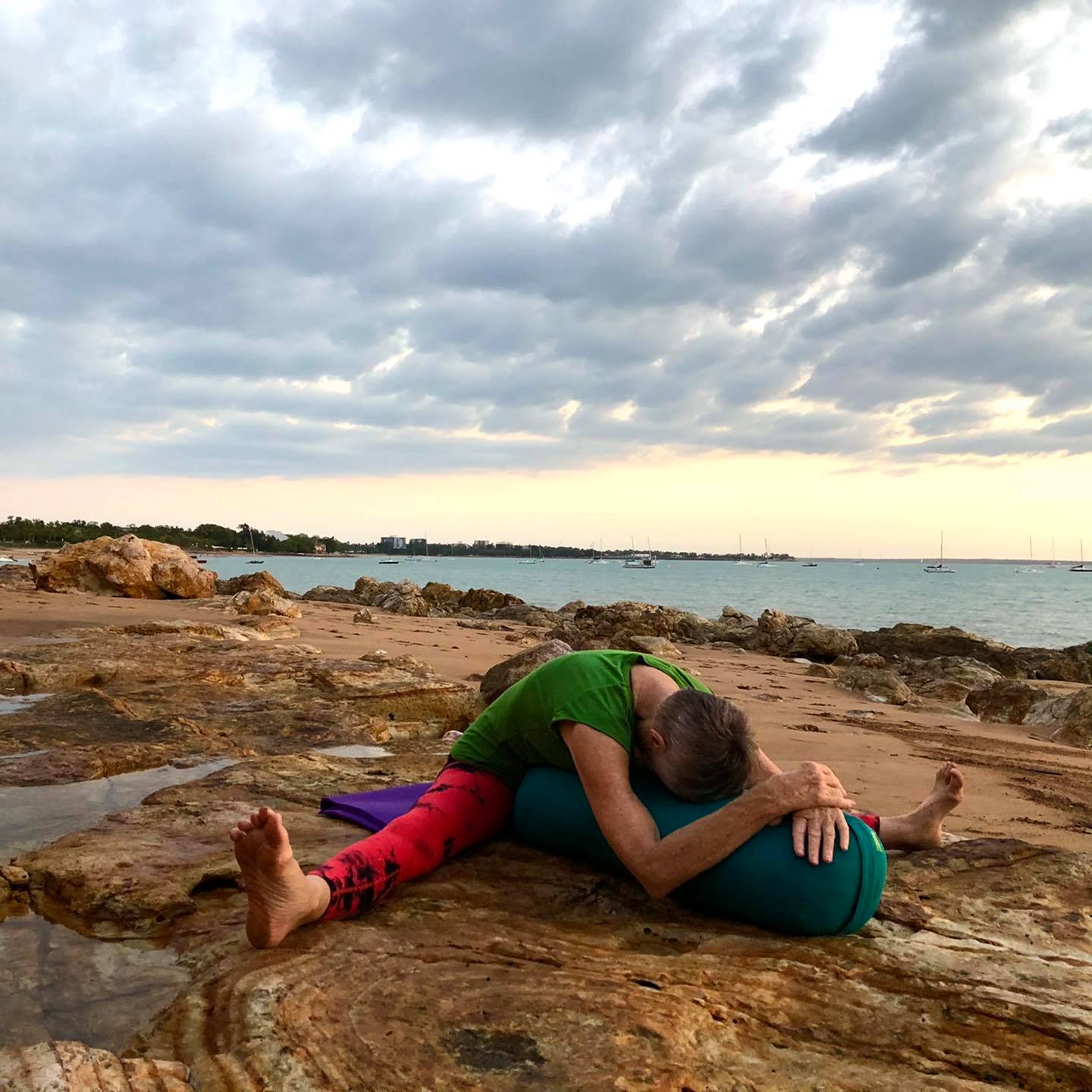
A seated forward bend resting over a bolster, by the sea in Darwin. Supported poses let tired muscles rest.
Take it further
Free ebook: Cutting Stress With Yoga. Living with muscular dystrophy, or caring for someone who does, brings stress. This book has all the material on stress, worry and sleep, with the stories of how it has helped people, and why the out-breath is the brake. Then do the free classes, see what you think, and buy a pass that puts it all into action.
New to Flametree, or away 3 months or more? 2 free classes + 2 ebooks, only available via this offer. Already a student? You can still get this book. Get your free copy of Cutting Stress With Yoga
- Classes, in Darwin or LIVE online: new, or away 3 months or more? 2 free classes, then 10 at half price. Already practising yoga? See the non-beginner half price pass. See the timetable and book.
- Masterclasses: Yoga for anxiety, upsets and anger, Sunday 18 April 2027, one of our 2027 masterclasses with Chris Lalor, where you learn the calming breath and the supported forward bends that settle a body held tight with worry: the part of muscular dystrophy, for parents and for people living with it, where the mindfulness research found the clearest gains. See the 2027 masterclasses.
2027 Masterclasses From 28 December
Over four months, learn the poses and breath practices that make the biggest difference for a range of key health conditions: arthritis, sleep and energy, pelvic floors, backs, wisdom, and anxiety, upsets and anger. In Darwin or LIVE online.
Other conditions are in our encyclopaedia of yoga for health conditions.
Yoga for muscular dystrophy: questions people ask
Is yoga good for muscular dystrophy?
Gentle, supported yoga is worth trying for comfort, breathing, rest and mood. In a randomised trial of 124 boys with Duchenne, yoga added to home physiotherapy was safe, and lung function improved in both groups, with no extra benefit from yoga. In adults with other muscular dystrophies, a mindfulness-based therapy improved quality of life and mood.
Can yoga cure or slow muscular dystrophy?
No. No study shows that yoga cures muscular dystrophy or slows it down. Yoga works on what can still be worked on: comfort, breathing, rest, worry and how life feels day to day.

Kim in supported relaxation (Savasana). Rest is part of every class, not an extra.
Can yoga help a boy with Duchenne muscular dystrophy?
Yoga has been tested in boys with Duchenne. In a randomised trial in India, a home yoga programme with gentle movement, simple poses, breathing and relaxation was safe and was learnt with parents alongside. Boys did as well as with physiotherapy alone over a year. Tell the teacher about the condition, and keep the effort moderate.
“Holding the trestler gives support and then the inner support of courage comes, giving them confidence.”
Are breathing exercises good for muscular dystrophy?
Gentle breathing practice is worth learning. In a Brazilian study, boys with Duchenne who kept up yogic breathing for 10 months breathed out more air than at the start, though there was no comparison group. In class, the breath is slow and soft, never forced or held hard. Read the breathlessness guide.
An Easy Breath From Your Chair
1. Sit tall
Support behind the back, feet steady.
2. Lift the chest
Shoulders soft, collarbones broad.
3. Slow the out-breath
Let each breath out grow long and quiet.
4. Rest when needed
Go back to normal breathing any time.
An easy yogic breath for muscular dystrophy, from a chair: known from practice, gentle and never forced.

Seated humming breath (Bhramari), a gentle pranayama used in the Duchenne yoga trial, and easy to do from a chair.
Is exercise safe with muscular dystrophy?
Moderate, regular exercise was safe in the trials. Assisted cycling kept motor function steady in boys with Duchenne, and moderate cycling raised fitness in Becker and FSHD without signs of muscle damage. Exercise to exhaustion is avoided. These were exercise trials, not yoga.
Can yoga help fatigue in myotonic dystrophy or FSHD?
No yoga trial has tested fatigue in these conditions yet. In trials, cognitive behavioural therapy and moderate cycling lowered severe fatigue in FSHD, and therapy raised activity in myotonic dystrophy. Supported rest poses and a slow breath are part of every class. Read the fatigue guide.
Can yoga help parents of a child with Duchenne?
No trial has yet tested yoga or mindfulness for parents of children with muscular dystrophy. In an Australian survey, most carers of people with Duchenne had symptoms of low mood. Yoga, pranayama and mindfulness have strong trials for stress, worry and low mood in general, and an hour of class is time that is yours. Read the stress and burnout guide.
“Fear and fatigue block the mind. Face both, then courage and confidence flow into you.”
Is yoga safe with muscular dystrophy?
Yoga that is adapted and moderate suits muscular dystrophy. Poses are done with chairs, the wall and props, effort stays moderate, and you rest whenever you need to. Standing poses are done with support, as falls are common. Tell your teacher about your condition and how you are on the day.

A seated forward bend with the head resting on a support. Restful, and easy to adapt.
Can I do yoga for muscular dystrophy in Darwin or online?
Yes. Flametree Yoga teaches Iyengar yoga in Woolner and Coolalinga in Darwin, and LIVE online, so you can practise from your own chair at home and save energy on travel. Flametree classes adapt poses with chairs and props. New students can begin with 2 free classes, then 10 at half price. Book a class
Where this comes from: BKS Iyengar, Astadala Yogamala (volume 4), Light on Life (Kindle edition) and Iyengar: His Life and Work; Geeta S Iyengar, a props demonstration and women’s class questions, both in Sydney in 1996. Timothy McCall MD, his June 2019 list of 117 health conditions helped by yoga and its reference list, and Yoga as Medicine (Bantam). Australian figures: Lee 2025 (BMJ Neurology Open) and Davidson 2025 (Lancet Regional Health Western Pacific); carers: Kim 2026 (Healthcare) and Clarke 2026 (Patient Education and Counseling); carer support review: Assalone 2026 (Journal of Health Psychology). Pain and worry in Duchenne: Varni 2023 and Li 2026. Studies as linked above, each looked up in PubMed in November 2026. Everything is summarised in our own words.
This page is general information, not medical advice. Flametree Yoga Studio, Darwin and LIVE online.
