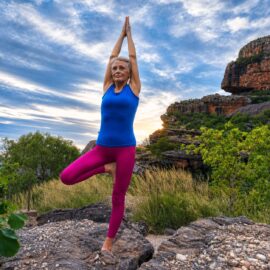
Types Of Yoga: How Iyengar Compares With Hatha, Vinyasa, Ashtanga, Yin, Hot And Kundalini
By Chris Lalor, Certified Senior Iyengar Yoga Teacher and Certified Yoga Therapist, and Dr Stuart McGill, Yoga Teacher, Flametree Yoga Darwin
Which type of yoga is right for you? Hatha, vinyasa, Ashtanga, yin, hot, Kundalini, Iyengar: most share the same poses.
The difference is how each style teaches those poses. Iyengar yoga, the style we teach, adds props so every body can do the full pose, precise alignment, sequences that build from simple to complex, longer holds, and teachers trained for years and independently assessed.
Types of yoga in short: the same poses, taught in very different ways
These types of yoga differ in speed, heat, how long each pose is held, and how much the teacher corrects you. Iyengar yoga builds strength, flexibility, balance and calm together. If you are comparing types of yoga Darwin offers, you can learn Iyengar with us in the studio or live online.
- Hatha is the family. Iyengar is its most precise branch.
- Vinyasa, flow and power yoga link poses with the breath, at pace.
- Ashtanga is a set series, in the same order each time.
- Yin holds relaxed floor poses. Iyengar holds poses long, muscles working.
- Hot and Bikram yoga add heat. In one trial the heat added no benefit to blood vessels.
- Kundalini centres on breath, chanting and repeated movement.
- Start with 2 free classes and 2 free ebooks, or just come along and your first class is free.
Every Style Shares The Poses. Iyengar Yoga Adds Five Things
So every body can do the full pose.
So the right muscles work.
Simple first, then complex.
Strength builds while you stay.
Trained for years, independently assessed.
Types of yoga in one picture: five things Iyengar adds.
Who was Mr BKS Iyengar, and what is Iyengar yoga?
Iyengar yoga is the style developed by Mr BKS Iyengar. In the 20th century he did more than anyone to set down traditional Indian yoga, through his books and his teaching. He pioneered the use of props such as chairs, blocks, belts and the wall.
His style is sometimes called modern classical yoga, and we teach it in Darwin and live online. Why style matters in research: Yoga Or Iyengar Yoga?
Looking for the eight limbs of yoga (the eight parts of the path in Patanjali’s Yoga Sutras)? See our 8 Limbs Of Yoga Course.
Yoga styles compared: what each one works on
| What you get | Flow styles (vinyasa, power, Ashtanga) | Yin and hot styles | Iyengar yoga |
|---|---|---|---|
| What it works | Stamina, poses linked by breath | Yin: relaxed floor holds. Hot: a series in heat | The whole body, standing to resting |
| Strength | Yes, through movement | Yin: muscles relaxed by design. Hot: yes | Yes, through long holds, loading the bones |
| Balance | Some, at pace | Yin: mostly on the floor. Hot: some | Standing poses, with a wall or chair |
| Breath | Breath sets the pace | Slow, natural breathing | Pranayama (yogic breathing), step by step |
| Calm | Often, afterwards | Yin: still and quiet | Focused attention, restorative poses, pranayama |
| Props | Few | Yin: cushions and blocks | Chairs, blocks, belts, bolsters, the wall |
| Who it suits | The already fit and supple | Yin: stillness seekers. Hot: heat lovers | Any age, any body, stiff or supple |
A broad guide from our teaching. Classes vary.
Types of yoga: a standing pose done the Iyengar way

Triangle Pose: every style has it; Iyengar yoga holds it long enough to build strength.
Want to try it? Start with 2 free classes and 2 free ebooks, or just come along, at the studio or online, and your first class is free if you are new to Flametree. More in how to start.
Iyengar vs hatha: hatha is the family, Iyengar is its most precise branch
Hatha yoga is the umbrella name for yoga that uses physical poses and breath. A “hatha” class today is usually gentle to moderate, a good broad introduction.
What Iyengar yoga adds: it is a hatha style set down in detail by Mr Iyengar. Each pose has a precise shape, and props let a stiff or injured body do the full pose, not a partial one.
Hatha vs vinyasa, flow and power yoga: speed against precision
Vinyasa yoga links one pose to the next with the breath, so the class flows. Power yoga is a vigorous version. On hatha vs vinyasa: hatha holds each pose; vinyasa keeps moving.
What Iyengar yoga adds: time in each pose. When you hold a standing pose, your legs carry your weight while they straighten, so strength and flexibility grow together, and the teacher can correct your alignment. Love moving? We also run Iyengar Yoga Flow classes: flowing sequences with Iyengar precision.
Iyengar vs vinyasa: a strong standing pose, held

Warrior 2, held, so the legs, arms and upper back all work.
Iyengar vs Ashtanga: two students of the same teacher, two different roads
Ashtanga yoga is a set series of poses, always in the same order, linked by flowing movements and steady breathing.
Mr Iyengar and Ashtanga’s founder, Mr K. Pattabhi Jois, both learned from Mr T. Krishnamacharya, then went different ways.
What Iyengar yoga adds: a sequence chosen for the class in front of the teacher, not a fixed series. Props adapt each pose, so a beginner, a 70-year-old and an athlete can share a class and each get the full pose.
Iyengar vs yin yoga: both hold poses long, but Iyengar works as well as rests
Yin yoga holds mostly seated and lying poses for three to five minutes or more, with the muscles relaxed. It aims at the deep tissues around the joints, and many find it calming.
Iyengar yoga holds poses long too. The difference is what the body is doing. In an Iyengar standing pose the muscles are working while they lengthen, so the pose builds strength, bone load and balance as well as range.
For deep rest we use props, which hold you so you can let go. Restorative yoga, built on this, grew largely out of Mr Iyengar’s use of props: see What Is Restorative Yoga and our Restorative Yoga classes. More: Yin Yoga Near Me? Why Straight Legs Matter.
If you already do yin, add Iyengar for standing strength, balance and bone load.
Iyengar vs yin yoga: a long hold, fully supported

A long, quiet hold, with a belt, blocks and blankets doing the holding.
Hot yoga and Bikram vs Iyengar: the heat added no benefit in the heart study
Bikram yoga is a fixed series of 26 poses done in a room heated to about 40°C. Other hot classes use heat with different sequences.
The research: in the Bikram yoga heart study, 52 inactive adults aged 40 to 60 did the Bikram series at 40.5°C or at 23°C, three times a week for 12 weeks. Blood vessel function improved at room temperature and tended to improve in the heat, with no significant difference between them. The authors concluded the heat was not necessary. They note heat tolerance falls with age (Hunter and colleagues, Experimental Physiology, 2018. Read the study).
And Darwin is hot enough already. Through the build-up and the wet, it is hot and humid before you step on a mat. Iyengar classes give you the poses in an ordinary room.
Kundalini vs Iyengar: breath and chanting, or breath learned step by step
Kundalini yoga centres on breath work, chanting, meditation and repeated movements called kriyas (set sequences). Many find it uplifting.
What Iyengar yoga adds: poses first, so you can sit and breathe well, then pranayama (yogic breathing) taught slowly, through the nose, lying down first and never forced. Read Is Pranayama Safe? Tell your teacher if you are having treatment for any significant mental health issue, so that he or she can advise you on the breath practices that may be best for you.
Yoga poses and yogic breathing both produce mindfulness. Read Yoga And Mindfulness.
Yoga styles and props: a belt and a bolster so the leg can stay straight

With a belt and a bolster, both legs stay straight, even for a stiff body.
What does the research show about Iyengar yoga?
What The Research Shows
No trial has compared Iyengar yoga head to head with another style. Here is what Iyengar yoga itself has been tested for, and found.
- Iyengar yoga eased long-term back pain. 60 adults with long-term low back pain did 16 weeks of Iyengar yoga or an education program. The yoga group reported 64% less pain, 77% less disability and 88% less pain medication use, holding three months later. Williams and colleagues, Pain, 2005. Read the study
- A bigger back pain trial confirmed it. 90 adults did 24 weeks of twice-weekly Iyengar yoga or usual medical care. Disability, pain and low mood fell more with yoga, and stayed lower six months later. Williams and colleagues, Spine, 2009. Read the study
- Iyengar yoga cut stress as much as mindfulness training. In the German RELAX trial, 102 stressed adults did 12 weeks of Iyengar yoga, integrative yoga or mindfulness training. All three brought large, lasting falls in stress, equally. Fischer and colleagues, Journal of Clinical Medicine, 2022. Read the study
- Iyengar yoga improved balance and walking speed. 54 people, average age 68, took part. After twelve weeks of twice-weekly Iyengar standing poses, they had better standing balance, did the sit-to-stand test 3.4 seconds faster and walked 4 metres half a second faster: main risk factors for falls. A Sydney pilot trial. Tiedemann and colleagues, Journals of Gerontology, 2013. Read the study
Still being studied: how the styles compare directly. Not yet studied is not the same as not working.
Iyengar Yoga In Four Trials: Backs, Stress And Balance All Improved
Back pain: 64% less pain, 77% less disability.
Back pain, disability, low mood: all fell more.
Large, lasting falls in stress.
Better balance, faster sit-to-stand and walking.
Williams 2005, 2009; Fischer 2022; Tiedemann 2013.
The style matters, and Iyengar yoga has the trials.
Which yoga style suits you? Iyengar works for almost everyone
In our teaching, Iyengar yoga suits the widest range of people, because props adjust every pose to the body.
- Stiff or starting late? Props give you the full pose from week one.
- Over 50? Standing poses work balance and bones.
- Old injury? Tell your teacher; poses are adapted.
- Do flow or Ashtanga? Add Iyengar for precision.
- Love yin? Add Iyengar for standing strength.
- Weighing yoga against Pilates? Read Yoga Vs Pilates.
Types of yoga in Darwin and live online: where to start
Flametree teaches Iyengar yoga in Darwin at Woolner (19B Bishop St, near Parap) and Coolalinga (Shop T31, Coolalinga Central), and live online across Australia. Beginner classes run every day. See every class time.
Live online means a teacher who can see and guide you. Videos and home practice are good for practising; a teacher who can see you is where you learn properly, and many do both. See our live online classes.
More: Iyengar Yoga Darwin: Classes, Teachers And How It Works.
How do I start Iyengar yoga in Darwin or online?
Come to classes, learn more about yoga, and build your strength, fitness, flexibility and mindfulness. Then you can see for yourself which style suits you.
- 2 free classes, plus 2 free ebooks. New to Flametree? Choose 2 free ebooks and get 2 free classes, live online or in our Darwin studios. Claim them here
- New to Flametree? Your first class is free, at the studio or online. Or register for 2 free classes plus 2 free ebooks. See class times
- Then the half price beginner 10-pass with 2 free. For newcomers, and for anyone back after 3 months or more: 10 half price classes plus 2 free, $59.50. That is 12 classes, $4.96 a class, in our Darwin studios or live online.
- Then the unlimited beginner weekly pass, to come as often as you like: studio, $17.95 a week; studio and online, $21.95 a week; online only, $10.95 a week.
- A private lesson: private class pass, $109, or 5 private lessons at 10% off. Talk to us to set a time.
Start free, then pick the option that suits you.
Types of yoga questions, answered
What are the different types of yoga?
Hatha, vinyasa, power, Ashtanga, yin, restorative, hot or Bikram, Kundalini and Iyengar. Most share the same poses and differ in speed, heat, hold times and props.
What is the best type of yoga?
No trial compares the styles head to head. Iyengar yoga has positive trials for back pain, stress and balance, and its props let almost any body do the full pose.
What is the difference between Iyengar and yin yoga?
Both hold poses long. Yin holds relaxed floor poses. Iyengar holds poses with the muscles working, building strength, balance and flexibility together, and uses props for supported rest.
What is the difference between hatha and vinyasa yoga?
Hatha is the broad family of physical yoga, with each pose held. Vinyasa links poses with the breath and keeps moving. Iyengar is a precise hatha style with longer holds.
Does yin yoga build muscle?
Yin is done with the muscles relaxed, so strength is not its aim. In an Iyengar standing pose your body is the weight and your muscles hold it, so strength builds.
Is hot yoga better than normal yoga?
In the Bikram yoga heart study, 52 adults did the same series at 40.5°C or 23°C for 12 weeks. Blood vessel function did not differ significantly between them; the authors said the heat was not necessary.
Which type of yoga can I do in Darwin?
Iyengar yoga, at Flametree’s studios in Woolner (19B Bishop St, near Parap) and Coolalinga (Shop T31, Coolalinga Central). Newcomers’ first class is free.
Is there a type of yoga I can learn live online in Australia?
Yes. Flametree’s live interactive online Iyengar classes reach anywhere in Australia, with a teacher who can see and guide you.
Last updated: 25 November 2026
Sources: Williams and colleagues, Pain, 2005; Williams and colleagues, Spine, 2009; Fischer and colleagues, Journal of Clinical Medicine, 2022; Tiedemann and colleagues, Journals of Gerontology, 2013; Hunter and colleagues, Experimental Physiology, 2018. Research via PubMed. This page is general information.