
Iyengar Quotes On Yoga Props, Explained

Iyengar quotes on yoga props: the short version
Would you believe a yoga teacher once used street bricks as his first prop? Mr BKS Iyengar did, and people thought he was mad. These Iyengar quotes on yoga props, from Mr Iyengar and Geeta Iyengar, explain why blocks, belts, walls and ropes are in an Iyengar class. They are there to teach, not to rescue.
This page in short form
- Where props began: a brick from the street, in 1948.
- What props do: help a pose be found, not forced.
- Why they teach: they show you the truth about your body.
- How to use them: try the pose first, then repeat the set-up.
- Courage: a firm support helps you try something new.
- Try it: your first class is free if you are new, props included.
Iyengar yoga is the style developed by Mr BKS Iyengar. In the 20th century he did more than anyone to set down traditional Indian yoga, through his books and his teaching, and he pioneered the use of props. It is sometimes called modern classical yoga, and it’s the style we teach at Flametree. His daughter Geeta and his son Prashant trained with him and became senior teachers in their own right, and you will meet their words on this page too.
Quotes appear here in the words of Mr Iyengar, Geeta Iyengar and Prashant Iyengar, each with where it comes from. Our notes underneath say what it means and where you may meet it in a class. All the quotes are short, credited extracts. Pages for the other topics are listed at the bottom, and the main quotes page has them all.
Why did Mr Iyengar start using props?
Mr Iyengar began with whatever he could find. These quotes tell the story in his own words.
I first used a prop in 1948 when I was not getting Baddha Konasana at all. I started using bricks, the heavy stones which were available in the street.
What it means: Mr Iyengar’s first prop was a brick from the street. He could not get Baddha Konasana (Bound Angle Pose, sitting with the soles of the feet together), so he built up the floor underneath himself. That is still what a block or folded blanket does today. It brings the floor up to you, so you can sit tall in the pose instead of sagging or forcing it.
Read more: Are props cheating or teaching? | Iyengar yoga props in our Yoga Notes.

A sandbag on the legs in reclining bound angle pose.
People called me “raving mad” when I picked up odd size stones and weights, using them for obtaining alignments and freedom in my practice which you call as props now.
What it means: New ideas often look strange at first. Stones and weights in a yoga room made people talk. Look at what Mr Iyengar wanted from them, though: alignment and freedom in his own practice. Today belts, blocks and wall ropes are part of many classes, and the reason is the same. A prop is a tool for finding the pose, not a gadget.
Read more: Rope yoga and the Iyengar wall ropes | Buying or improvising your own props.
My props became my guru and taught me how to use the body.
What it means: A good prop tells you the truth. A wall does not flatter you and a belt does not pretend. When your hips tip back or one side sags, the prop shows it straight away. Mr Iyengar said his props taught him how to use the body. In class you may find a block does more teaching than a long explanation.
Read more: Six ways Iyengar teachers use the belt.
Do you teach a child to run as soon as it is born? You allow the child to have support whether it can stand or not and you hold the child to take one step after the other and make the child to learn the art of walking.
What it means: Nobody teaches a baby to run on day one. We hold a hand, then the child takes a step, then another. Mr Iyengar used the same picture for yoga. Support comes first, and skill grows on top of it. Needing a prop is not a failing. It is how most of us learn anything difficult.
Read more: Gentle yoga for beginners.
What are props meant to do?
Props are not a way of avoiding the pose. These quotes say what they are for.
Props benefit in two ways; one is extension and the other is relaxation, taking place at the same time.
What it means: This is a clever idea. With a prop, one part of you can lengthen while another part rests. Picture lying back over a bolster (a firm cushion) with the chest lifting. The front of the body opens and the back is held up, so you are not working hard to stay there. It is a lovely example of effort and ease happening together.
Read more: What restorative yoga actually is | Legs up the wall, step by step.

Supported reclining pose with a belt and blocks.
The use of props stimulates the practitioner’s body and mind and creates the zeal to stay longer and longer.
What it means: A pose you can stay in is a pose you can learn from. When a prop takes away the strain, you can stay longer without gritting your teeth. You start to notice things: where your weight is, how your breath moves, which side is stiffer. Mr Iyengar said props bring a keenness to stay, because the pose stops being a fight.
Read more: How long to hold yoga poses.
The supports are not meant just to rest and relax or to do in a lazy way. They are meant to obtain the feeling of the correct asana from inside so we can improve ourselves.
What it means: Geeta was clear that props are not for flopping. A support is there so you can feel the correct pose from the inside. Take Triangle Pose (Utthita Trikonasana) with a hand on a chair. The chair stops you collapsing toward the floor, and you can feel the chest turn open and both legs stay straight. Once you know that feeling, you can look for it again without the chair.
Read more: Triangle pose: why it feels hard, and how props help.
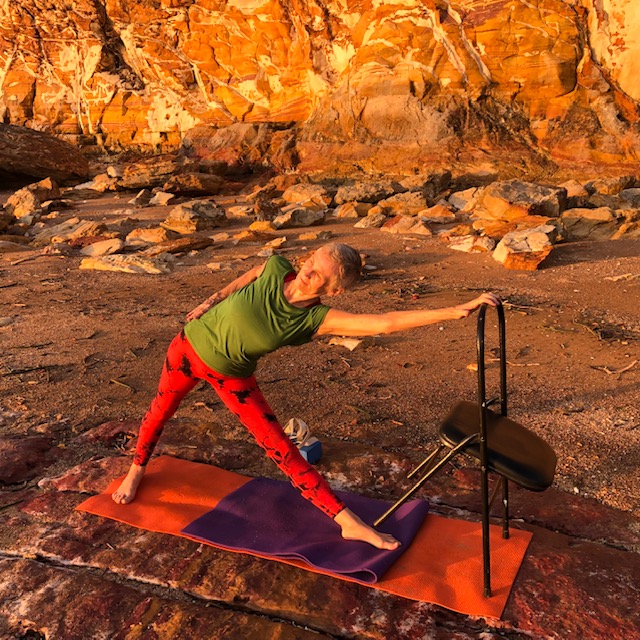
Chris Lalor in Triangle Pose with a hand on a chair.
The brick itself opens the chest. Be passive. The brick does the rest of the job.
What it means: Here Geeta gives a very short instruction: be passive, let the brick work. A common set-up is to rest the upper back on a brick or bolster. Many people try to open the chest by pulling hard and tensing the neck. The prop does that job for you, so your task is just to stay relaxed and alert. “Passive” here does not mean asleep. It means you stop fighting.
Read more: Backbend yoga with props.
Now that props have become so popular there are many who want to do yoga. Those who were unwilling to do yoga have started taking an interest in it since the props make it easier.
What it means: Geeta noticed something simple. Props made yoga easier to reach, so people who had kept away began to try it. That is still what we see. Someone who cannot yet touch the floor can use a block, and someone who feels unsteady can use a chair. The pose is the same pose. The prop just opens the door.
Read more: The wonders of chair yoga.
How should you use a prop well?
Geeta Iyengar often spoke to teachers, but her advice works for any student.
Don’t just use a blanket underneath the buttock like a ritual. But first make them work and then give them blanket.
What it means: This line was for teachers, but students can use it too. Do not reach for a prop out of habit. Try the pose first and see what your body actually needs. If you sit on a folded blanket every time without asking why, it becomes a ritual. A good question is: what am I trying to lift or support here, and does it work?
Read more: Using props: cheating or teaching?.
So when you think of these props you should see that you have done it 100 times to find out what exactly is being conveyed to you.
What it means: Understanding a prop takes repetition. Set it up the same way many times and notice what changes. Geeta said to do it a hundred times to find out what the prop is trying to tell you. One try only shows you the shape. The tenth or fiftieth try shows you what is happening inside it.
Read more: Yoga practice at home | Building a daily yoga habit.
Learn with the props and that will guide you to further understand where there was no freedom, how to bring freedom.
What it means: Where you need a prop is often where you are missing freedom. If a block is needed under the hand, that is useful news. Geeta said to learn from the props so they guide you toward freedom in that spot. Over time, you may need less in some poses and still be glad of it in others. Both are fine.
Read more: Props in our Yoga Notes.
You don’t know how to use your own body properly. When something doesn’t turn you can use your hand as a prop and move it.
What it means: Your own body can be a prop. If a part of you will not turn, a hand can help it along. In a seated twist, for example, a hand on the opposite knee can help turn the ribs. Geeta’s lesson is that the idea behind props is helping the body move where it is stuck. The equipment is only one way to do it.
Read more: Yoga twists: lengthen before you turn.
Can a prop give you courage?
Sometimes the biggest thing a prop gives you is the feeling that you may try.
Sometime back, while teaching in England, he said “Wall, my Guru”. “The wall is my Guru”. He said this for the simple reason that the wall taught him to a great extent, for example the alignment of the body.
What it means: Geeta is passing on a saying of Mr Iyengar’s from a teaching trip to England. A wall is a very patient teacher, because it does not move. Press your heels, hips and shoulder blades against it and you can feel which part of you does not reach. He said the wall taught him a great deal about alignment (how the body lines up). Try standing in Mountain Pose (Tadasana) with your back to a wall and see what you find.
Read more: Mountain pose: how to stand properly | The wall ropes at Flametree.

Stuart McGill with the wall ropes at his hips, hands to a chair.
Holding the trestler gives support and then the inner support of courage comes, giving them confidence.
What it means: A trestler is a sturdy frame that a student can hold. Geeta’s point is about the mind. When your hands know they are on something solid, you feel safe enough to try. The outer support comes first. Then a quieter, inner support appears, which she called courage. Many people feel this the first time they hang on a rope or put their heels to a wall.
Read more: Wheel pose: props, ropes and fear of dropping back | Handstand at the wall, without fear.
Related Flametree pages
- Iyengar Yoga Props: Ropes, Belts, Sandbags And Chairs Explained By Flametree
- Using Props In Yoga: Are They Cheating Or Teaching?
- How To Use A Yoga Strap: 6 Ways Iyengar Teachers Use The Belt
- Yoga Sandbag: Why Iyengar Yoga Uses Weights To Help You Let Go
- Yoga Barrel: What It Does And How To Make One At Home
More Iyengar quotes, by topic
Frequently asked questions
What did BKS Iyengar say about yoga props?
He said his props taught him how to use his body, and that they bring extension and relaxation at the same time. He first used a prop in 1948, when he could not do Baddha Konasana (Bound Angle Pose) and started using bricks. Geeta added that props are there to help you feel a pose correctly from the inside.
Did Mr Iyengar really start with bricks from the street?
Yes, by his own account. He said he first used a prop in 1948, when Baddha Konasana (Bound Angle Pose) would not come, so he started using bricks, the heavy stones available in the street. He also said people called him raving mad for using odd-sized stones and weights. Whether props are cheating is a separate question, which our note on using props answers.
Do I need to buy props to practise yoga at home?
Not at the start. A belt, two blocks and a firm blanket go a long way, and household items such as a sturdy chair or a wall also work. Flametree’s guide to buying or improvising props has the details.
Where can I try yoga with props in Darwin?
Flametree Yoga Studio teaches Iyengar yoga with props, such as blocks, belts, chairs and wall ropes, in Darwin and LIVE online. Your first class is free if you are new to Flametree, so you can just come along and try them. The timetable is linked in the box below.
Practise this at Flametree
Your first class is free if you’re new to Flametree. New students, and anyone who has been away three months or more, can also get a half price 10 class pass, in the studio or LIVE online.
- Beginners: see the half price 10 class pass for new and lapsed students
- Already done some yoga: see the half price 10 class pass for new and lapsed students
- See the timetable, including online classes
Can’t make a class? Practise at home with our video courses.
Flametree Yoga Studio teaches Iyengar yoga in Darwin and LIVE online. This page is general information about Iyengar yoga props, not medical advice. Every quote is a short, credited extract, and the notes under each one are Flametree’s own words.
