
Shoulder Pain And Frozen Shoulder: What Mr Iyengar, The Yoga Doctors And The Research Say
Can’t reach the top shelf, do up a bra or sleep on one side? Shoulder pain stops ordinary life in its tracks. It might be a stiff, frozen shoulder, a sore rotator cuff, or neck and shoulder pain from hours at a desk. The great yoga teachers and the medical doctors who worked with Mr BKS Iyengar agree on the way through: move the shoulder steadily, with support, and work on the whole body, not only the sore spot. This guide brings together what each of them says about shoulder pain and frozen shoulder, and what the research has found. Last updated: 1 November 2026.
Get 2 Free Yoga Classes And 2 Free Ebooks
Can yoga help shoulder pain? The short answer
Yes. Yoga is well worth trying for shoulder pain, and the research backs it. In trials of neck and shoulder pain, Iyengar yoga cut pain far more than home exercise did. In 444 women after breast cancer surgery, 12 weeks of yoga improved shoulder movement more than an exercise video. And in a frozen shoulder study, yoga matched physiotherapy and did better for lifting the arm out to the side. Mr Iyengar’s method suits a sore shoulder well: props hold the arm, so it moves a little further each week without being forced.
As you read, keep one thing in mind: most trials tested “yoga” of many styles, taught by teachers with very different training. Several of the neck and shoulder trials below tested Iyengar yoga, taught by trained Iyengar teachers, and they did well. In our view, well-taught Iyengar yoga is likely to go further than the average. Why the kind of yoga matters.
The bottom line: five key moves for shoulder pain
- Go to a yoga class at your level, two or three times a week. The neck and shoulder trials ran for 4 to 12 weeks, and the best gains came with steady, weekly classes. Tell your teacher about your shoulder.
- Move it, don’t force it. A sore shoulder wants movement every day, with belts, blocks, a chair or the wall, so the arm goes only as far as it can. No weight on a painful shoulder until your teacher says otherwise.
- Work on the upper back and chest, not only the shoulder. When the upper back rounds, the shoulder blade cannot glide, and the shoulder takes the strain. Standing poses and chest openers change that.
- Add breath work (pranayama). Tight shoulders often sit with a held breath and a tense neck. Slow breathing softens the muscles across the top of the shoulders, and calms the nerves that set how much pain you feel.
- Start now. New to Flametree, or away 3 months or more? 2 free classes, then 10 at half price, in Darwin or LIVE online.
Iyengar yoga is the style we teach at Flametree. During the 20th century, Mr BKS Iyengar was the major person who codified traditional Indian yoga, through his seminal books and widespread teaching. He also pioneered the use of props, so poses can be adapted to almost any body. His style is sometimes called modern classical yoga. This guide is part of our encyclopaedia of yoga for health conditions.
This guide in short
- Mr BKS Iyengar: work from the edges in, move the arm gradually, and build the whole body around a sore shoulder. His book has no frozen shoulder course; its shoulder material is under osteoarthritis.
- Geeta S Iyengar: careful upper arm rotation, with props so the arm is never left hanging, and patience.
- Dr Timothy McCall: frozen shoulder is on his 2019 list of conditions helped by yoga. Yoga works best tailored to each person.
- Dr Krishna Raman: keep the muscles across the top of the shoulders soft, breathe freely, and strengthen the shoulder girdle.
- The research: 13 studies listed below, including Iyengar yoga trials for neck and shoulder pain.
- For men: shoulders lose range faster than most joints, men lose it faster than women, and men do far less yoga.
- Take it further: a free ebook, Too Stiff For Yoga?, the 2027 masterclasses, and classes in Darwin and online.
Shoulder Pain And Yoga On One Page
Five sources, one answer: move steadily, support the arm, and work on the whole body.
Work from the edges towards the sore area. Move the arm gradually, with standing poses and twists around it.
Proper upper arm rotation, with props holding the arm. Patience, never force.
Frozen shoulder is on his list of 117. The best yoga is tailored to the person.
Soft trapezius, free breath, a strong shoulder girdle.
Iyengar yoga cut neck pain about 20 points in 100 more than self-care. Yoga improved shoulder movement in 444 women.
Each source is set out in full below. Research: Michalsen 2012 and Lam 2025, linked in the research section.
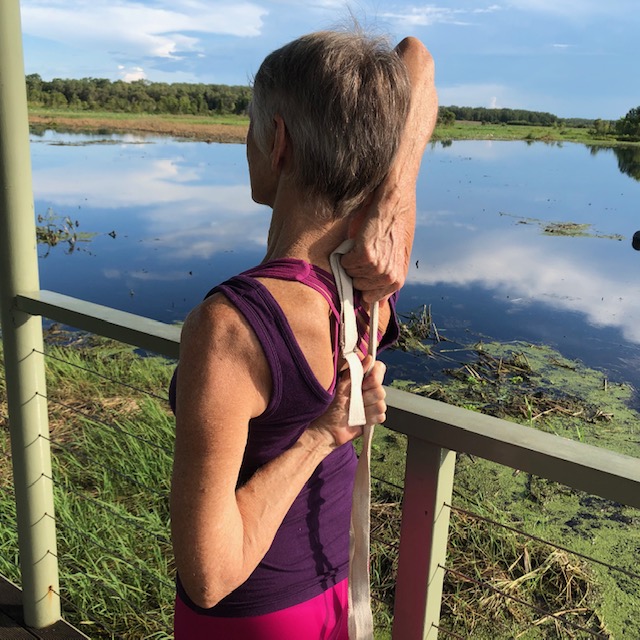
Cow face arms (Gomukhasana) with a belt. The belt lets each shoulder go only as far as it can, so a stiff shoulder opens without strain.
“Shoulders are not meant to hang the overcoat on but to carry responsibilities.”
What causes shoulder pain?
The shoulder is the most mobile joint in the body. A shallow socket lets the arm swing in almost every direction, and a ring of muscles and tendons holds it there. That freedom is why shoulders get sore so easily. The main kinds of shoulder pain:
- Rotator cuff trouble. The rotator cuff is four small muscles whose tendons wrap the top of the arm bone and hold it in the socket. They can get sore, worn or torn, from a fall, a lift, sport or years of wear. A rotator cuff injury often hurts when you lift the arm or lie on that side.
- Shoulder impingement. The cuff tendons get pinched under the bony roof of the shoulder as the arm lifts, usually somewhere between waist and head height. A rounded upper back and a shoulder blade that does not glide make room in there tighter.
- Frozen shoulder (adhesive capsulitis). The bag around the joint thickens and tightens, so the shoulder becomes painful and stiff in every direction. It passes through three stages, freezing, frozen and thawing, often over one to three years. It is most common between about 40 and 60, in women, and in people with diabetes.
- Neck and shoulder pain from desks, screens, driving and carrying. The muscles across the top of the shoulders stay switched on for hours, the head drifts forward and the upper back rounds.
- Wear in the joint (osteoarthritis of the shoulder). Our arthritis guide covers joint wear in full.
Shoulder pain at night is common with all of these. Lying on a sore shoulder presses on it, and in the freezing stage of a frozen shoulder the ache is often worst at night.
Where Shoulder Pain Comes From
Four places, and one thing they share: the shoulder cannot work well on a rounded, tight upper body.
Four small muscles that hold the arm in its socket. Sore, worn or torn tendons hurt as the arm lifts.
The bag round the joint. In frozen shoulder it thickens and tightens, and every direction gets stiff.
It should glide on the back of the ribs. A rounded upper back pins it, and the tendons get squeezed.
Hours at a desk keep the muscles across the top of the shoulders working. Neck and shoulder pain follows.
So the yoga works on all four. It moves the arm in its socket, opens the chest, frees the shoulder blade and lengthens the upper back.
A simplified picture. The rotator cuff and frozen shoulder are described more fully in the questions at the end.
“My props became my guru and taught me how to use the body.”
What did Mr BKS Iyengar teach about shoulder pain?
In short: work from the edges towards the sore area, move the arm gradually, and keep the whole body working around the shoulder.
In Yoga: The Path to Holistic Health, Mr Iyengar sets out a yoga approach for 72 health conditions. The book has no entry for frozen shoulder. Its shoulder material is in the course for osteoarthritis of the shoulders (p. 328), and in the courses for neck wear and upper backache. His ideas, in our words:
- The shoulder joint, described. For osteoarthritis of the shoulders he describes the smooth lining of the joint wearing thin, the joint space narrowing, the tendons thickening and severe pain (p. 328).
- Move the arm gradually. His course moves the arm and shoulder a little at a time, together with standing poses, twists and inversions, rather than working the shoulder alone (p. 328).
- Work from the edges in. Build strength and movement around a sore area first, then work towards it, unless the problem is fresh (p. 263).
- The upper back carries the shoulders. He links upper backache with a sitting life, extra weight, weak muscle tone and inflamed muscles and tendons, and works the shoulders and spine together through standing, twisting, back-bending and reclining poses (p. 322).
- Protect the neck. For neck wear, with pain into the arms, his course builds from the trunk and shoulders first and keeps away from forceful neck work (p. 326).
- The right poses for the person. Poses must suit the person, because wrongly chosen ones can do harm (p. 260). And in his view, practice can raise the threshold of pain and calm the brain, which lowers the fear of pain (p. 261).
In a class in Australia in 1992, as recorded in our notes, he made a point every stiff shoulder will recognise: when the upper back rounds, the lower back and neck take over its job, and the shoulder blades cannot slide as they should. We do not publish his sequences. A sequence needs a teacher who can see your shoulder and adapt each pose, which is what a class is for.
In Light on Yoga, his first book, Mr Iyengar’s appendix of asanas for ailments has an entry for arthritis of the shoulder joints (printed p. 415), next to one for the arms (p. 415) and one for deformity in the arms (p. 420). For the shoulder joints he draws on standing poses, inversions, arm work, seated poses with the arms bound, twists and backbends. Like the later book, it has no entry for frozen shoulder. He advises learning these with an experienced teacher, according to your own ability.
From The Edges In
How Mr Iyengar works on a sore shoulder: the shoulder is the last place, not the first.
Standing poses build a strong base, so the shoulder is not asked to carry the body.
Twists and gentle back bends lift and open the chest, so the shoulder blade can glide.
The arm is moved gradually, with props, a little further each week. Never forced.
After Mr BKS Iyengar, Yoga: The Path to Holistic Health, pp. 263, 322 and 328. A simplified picture.
“Props benefit in two ways; one is extension and the other is relaxation”
What did Geeta S Iyengar say about frozen shoulder?
In short: careful upper arm rotation, with props holding the arm, and patience.
Geeta S Iyengar, Mr Iyengar’s daughter, taught for decades beside him in Pune. Frozen shoulder is more common in women, and often strikes around menopause, so her view matters here. In 1996 she replied by letter to a student with a painful, stiffening shoulder, and the letter is kept with the Pune medical class notes. It is the only Iyengar material we hold that is about frozen shoulder itself. Her approach, in our words:
- Not frozen yet, but on the way. From the photographs, she judged the shoulder was heading towards freezing rather than frozen, and thought the muscles had been strained by forcing the movements. That, in her view, kept the swelling going.
- Rotate the upper arm, properly. Her answer was careful rotation of the upper arm in the socket. Her claim: that is all the shoulder needs.
- Support, never hang. She used props (bricks, belts, a wall, a bar, a rope) to hold the upper arm and draw the shoulder blade in, so the arm was never left hanging in the air, and she warned against simply flinging the arms up.
- Patience. It was an individual plan for one experienced student, built up over time, not a general course.
In our classes that same care means no weight on a painful shoulder, such as downward dog, plank or a full shoulderstand, until your teacher says otherwise. Our post on yoga for frozen shoulder sets out what we do and what we leave out.
In Yoga: A Gem for Women she adds, in our words: the shoulders should spread sideways, away from the neck, not tensed or pulled up to the ears; rope and wall work eases shoulder and neck pain; and back bends lift drooping shoulders and a stoop. These are her claims for the poses. Our post on frozen shoulder and menopause covers why it so often comes at midlife.
“When the shoulder blade goes into the body, the arm goes further down”
What does Dr Timothy McCall say?
In short: frozen shoulder is on his list of conditions helped by yoga, and the best yoga is fitted to the person.
Dr McCall is a US medical doctor and yoga therapist, author of Yoga as Medicine and former medical editor of Yoga Journal. Frozen Shoulder (Periarthritis) is no. 35 on his June 2019 list of 117 health conditions helped by yoga. It was added to the list after his book, which has no shoulder chapter. Neck pain (no. 62) is the nearest neighbour for desk shoulders, and it is on the list too. Two points from his book, in our words, matter for a sore shoulder:
- Fit the yoga to the person. In his experience, the best yoga therapy is tailored to each student. A trial has to give everyone the same set of poses, so it often tests a weaker version of what a good teacher would do.
- Small studies still count. He is candid about small and imperfect studies, and still makes a confident case for yoga, from modest evidence, a sound mechanism and the experience of real students.
That first point explains a lot about the shoulder research below. The same set of poses for everyone, done for four weeks, is not how an Iyengar teacher works with a frozen shoulder.
What does Dr Krishna Raman say?
In short: keep the muscles across the top of the shoulders soft, breathe freely, and build strength around the shoulder girdle.
Dr Raman is a Chennai physician who trained in yoga under Mr Iyengar. His question-and-answer book on yoga and medical science covers the neck, the shoulders and posture at work. His views, in our words:
- Soften the trapezius. Neck pain and headaches in standing poses come from a held breath and a tight head and neck. Keep the trapezius, the muscle across the top of the shoulders, soft (Q127, Q128).
- Strength around the joint. Neck strain in the headstand eases as the deltoids, the muscles that cap the shoulder, get stronger. This is Iyengar teaching he reports (Q184).
- Supported poses for a frozen shoulder. Massage is rarely used, and only in severe cases; specific supported poses are his approach (Q252 to Q254). This is his own view.
- Sport can unbalance the shoulder. He names throwing sports, such as shot put, javelin and discus, as ones that unbalance the shoulder (Q307 to Q317).
- Posture at work. He takes up posture at work, repetitive strain and frozen shoulder together (Q244).
“The brick itself opens the chest. Be passive. The brick does the rest of the job.”
Other yoga voices on shoulder pain
- Dr Loren Fishman, a New York rehabilitation physician who studied with Mr Iyengar in Pune, gives shoulder pain a chapter of its own in his book Healing Yoga (W. W. Norton, 2014). We will add his approach here once that chapter is summarised.
- A torn rotator cuff, and a whole practice. Leslie Hogya, a senior Iyengar teacher in Victoria, Canada, tore her rotator cuff in a yoga injury and could not lift her arm. In 2013 she went to Pune, where Mr Iyengar told her recovery would not be quick. She credits the whole practice, not only arm and shoulder movements: over time, she found, other muscles took over the work of the damaged ones. Read her story at Iyengar Yoga Canada.
- Both shoulders froze, then moved again. In Mary Flaherty’s book Does Yoga Work?, a man in New Zealand found both shoulders froze three weeks after heart bypass surgery. Over about two years, yoga alongside his other care got him pain free and moving, with some limits left.
- Shoulders are a weak link, and a teacher helps. Flaherty reports a German survey of 1,702 people with about 0.6 injuries per 1,000 hours of yoga. Knees, necks, shoulders, wrists and low backs were the weak points, and the risk was higher for those practising alone without a teacher (pp. 193 to 197).

Arms up (Urdhva Hastasana) beside a chair. With a sore shoulder, the arms rise only as far as is comfortable, often with a belt between the hands.
Frozen Shoulder Stages, And What The Yoga Does In Each
The three stages of frozen shoulder, and how a careful Iyengar class meets each one.
Painful, often worst at night. Gentle, supported work in an easy range. Arms rested on blankets. No weight on the shoulder.
Less pain, much stiffness. Steady, held movement with belts and the wall, a little further each week.
Movement returns. More stretching and strength, building range back towards normal.
The stages often run over one to three years. Gentle and supported early, more stretching later. A simplified picture.
“To master an asana, you need patience and discipline.”
A story: the former Marine’s shoulder
Alexander Litvak is a former Marine from Brooklyn, New York. In The Yoga Diaries, he lists what he brought to his first yoga class: a dislocated shoulder, worn knee cartilage, knots of tight muscle along his neck and spine, and arthritis in both knees and one shoulder. It was a beginners’ class. He says the pain eased right away, and the inflammation went down. He kept going, and went on to teach yoga himself. His own summing up: “Yoga is not magic; but it is a science.”
Source: Alexander Litvak, “Former Marine Finds Peace in Yoga”, in Jeannie Page (editor), The Yoga Diaries: Stories of Transformation Through Yoga, Kindle edition, p. 42 (quote p. 43).
What does the research show about yoga for shoulder pain?
In short: yoga eases neck and shoulder pain, improves shoulder movement, and Iyengar yoga has done especially well. The strongest research is on neck and shoulder pain, where the shoulders share the load, and on shoulder movement after surgery. For frozen shoulder there are only small studies, and none of Iyengar yoga. Most of these studies tested yoga in general, of many styles; the Iyengar yoga trials are listed on their own. Why the difference matters.
The Research At A Glance
Four studies that sum up the evidence. All of them, with links, are listed below.
Iyengar yoga cut neck pain about 20 points in 100 more than self-care exercise. Michalsen 2012: 77 people, nine weekly classes. Pain at rest fell from 44 to 13.
Twelve weeks of yoga improved shoulder movement more than an exercise video. Lam 2025: 444 women after breast cancer surgery, in Hong Kong.
Yoga matched physiotherapy for frozen shoulder, and did better for lifting the arm to the side. Pitchai 2021: 40 adults aged 35 to 60, four weeks.
Five minutes of meditation with gentle pressure points eased shoulder pain and freed the arm. Kang 2022: 65 adults with shoulder pain, compared with rest.
Every study is listed in full in this section, with a link to read it.
Iyengar yoga studies
These studies tested Iyengar yoga specifically, taught by trained Iyengar teachers, with props and adapted poses.
- Iyengar yoga cut neck pain at rest by about 20 points out of 100 more than a self-care exercise programme, with gains in disability, quality of life and mood. Nine weekly 90-minute classes. Michalsen 2012, a trial of 77 adults with long-term neck pain, in Germany. Read the study.
- Iyengar yoga eased neck pain more than home exercise, with less disability, better neck movement and a higher pain threshold. Nine weeks. Cramer 2013, a trial of 51 adults with long-term neck pain. Read the study.
- In all six trials, the Iyengar yoga group did better on back or neck pain, or disability, than the comparison group. Crow 2015, a review of six trials and 570 people with back and neck pain. Read the study.
- A 67-year-old man whose shoulder had been stuck for 14.5 years, after an injury and 1.5 years of physical therapy, regained the ability to raise his arm from 110 to 170 degrees. One year of Iyengar group classes, from 2023. Kanwar 2025, a case report written by his Iyengar teacher. Read the study.
Neck and shoulder pain
- Yoga gave large short-term drops in neck pain and disability, and better quality of life and mood, with no serious harms. Cramer 2017, a review of three trials and 188 people. Read the study.
- Yoga lowered neck pain and disability, and improved neck movement, quality of life and mood, compared with other approaches. Li 2019, a review of 10 trials and 686 people with long-term neck pain. Read the study.
- Yoga, like other exercise, eased neck pain in the short term compared with no exercise. Rasmussen-Barr 2023, a review of 25 reviews covering 17,321 people. Read the study. Note: this was yoga in general. Iyengar yoga has not yet been tested on its own against other exercise in this kind of review. Why it matters.
- Four weeks of yoga eased neck and shoulder pain in office workers, raised their pain threshold, and improved neck movement and quality of life, as much as Thai traditional stretching and plain stretching. Thanasilungkoon 2023, a trial of 80 office workers. Read the study. Note: this was yoga in general, not Iyengar yoga, which has not yet been tested against stretching in office workers. Why it matters.
Shoulder movement and frozen shoulder
- Adding slow breathing exercises to usual treatment improved shoulder reach and quality of life in frozen shoulder, and pain eased about equally in both groups. Lifting the arm out to the side and turning it outward gained most. Celik Benli 2026, a randomised trial of 40 adults with frozen shoulder, diaphragmatic and costal breathing over 15 sessions. Read the study.
- Twelve weeks of yoga improved shoulder rotation, and reaching up behind the back with the right hand, more than a post-surgery exercise video. Lam 2025, a trial of 444 Chinese women after breast cancer surgery. Read the study.
- Eight weeks of daily yoga made the shoulders stronger at lifting the arm out to the side, in both arms, and improved posture. Loudon 2016, a pilot trial of 23 women with arm swelling after breast cancer, in Tasmania. Read the study.
- Yoga and physiotherapy both improved pain, movement and function in frozen shoulder, and yoga did better for lifting the arm out to the side. Four weeks. Pitchai 2021, a study of 40 adults aged 35 to 60, not fully randomised. Read the study.
One more frozen shoulder trial is worth knowing about. Jain 2019 added one set of standing poses to usual care for 72 adults, for four weeks. Both groups improved a lot, and the poses gave no extra gain over that short time. It was one set of poses for everyone, not Iyengar yoga adapted to each shoulder, which is Dr McCall’s point above. No trial has yet tested yoga for rotator cuff tears or shoulder impingement. Not yet studied is not the same as not working.
Weeks, Not Years
How soon the studies in this guide found change.
5 minutes
Less shoulder pain and freer lifting after one short session of meditation with pressure-point touch (Kang 2022)
4 weeks
Less neck and shoulder pain in office workers; better arm lifting in frozen shoulder (Thanasilungkoon 2023, Pitchai 2021)
9 weeks
Neck pain cut by about 20 points in 100 with Iyengar yoga (Michalsen 2012)
1 year
A shoulder stuck for 14.5 years raised from 110 to 170 degrees (Kanwar 2025)
Studies as listed in this section. Results vary by person; regular classes matter more than any one session.
Breathing practice (pranayama), meditation and mindfulness
- Five minutes of meditation with gentle acupressure-like touch eased shoulder pain and improved lifting the arm forward and out to the side, compared with resting. Kang 2022, a trial of 65 adults with shoulder pain, in Korea. Read the study.
- Breathing exercises eased long-term neck pain and disability in the short term, and improved breathing strength. Cefalì 2025, a review of five trials. Read the study.
Neither study tested pranayama as we teach it. The meditation was paired with pressure-point touch, and “breathing exercises” covered several methods. The pranayama we teach (staircase, ocean, alternate nostril, humming and a gentle shining skull breath) is slow, nasal and taught step by step. It works on the same thing these studies found: a calmer nervous system, softer muscles across the top of the shoulders, and less pain. Why the kind of breathing matters.
“The shoulders should be extended sideways away from the neck”
Shoulder pain: for men
In short: shoulders lose range faster than most joints, men lose range faster than women, and men do far less yoga.
- Shoulders stiffen first. In a study of 6,000 people aged 5 to 92, the shoulders and trunk lost the most range with age, and men lost flexibility faster than women: about 0.8% a year against 0.6%.
- Sport and the gym load the shoulder. Dr Raman names throwing sports as ones that unbalance the shoulder. In Yoga for Sports, Mr Iyengar argues that routine training shortens muscles and stiffens joints.
- Men do far less yoga. In a national survey of 2,567 Australian yoga practitioners, 85% were women.
What men can do: come to a beginner class and use the props without embarrassment. Belts, blocks and the wall are how a stiff shoulder gets into the poses. Bring a mate or come alone, but give it 12 weeks. Our yoga for men page covers sport and life after 40.
- Flexibility fell about 0.8% a year in men and 0.6% in women, with the shoulders and trunk losing the most. Medeiros 2013, a study of 6,000 people aged 5 to 92. Read the study.
- 85% of Australian yoga practitioners surveyed were women. Penman 2012, a national survey of 2,567 practitioners. Read the survey.
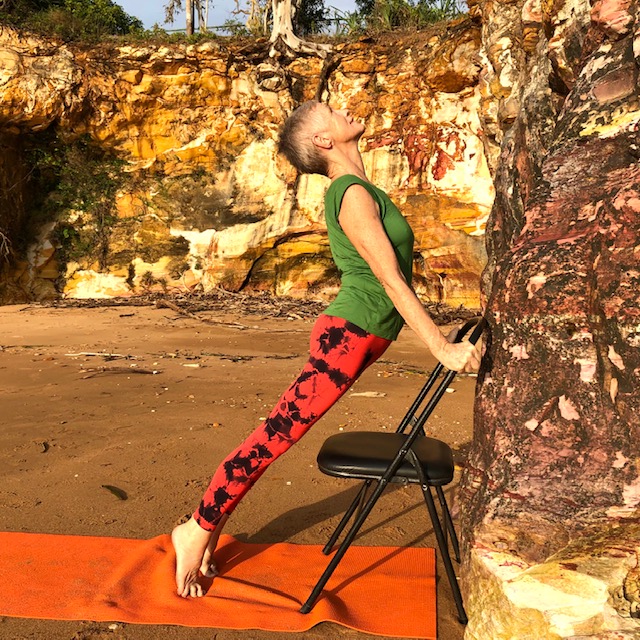
Hands on a chair to lift and open the chest. The chair takes the weight, so the shoulders and upper back open without strain.
How this comes together in a Flametree class
Everything above points the same way, and it is how we teach.
- Props for the arms: belts, blocks, chairs, blankets and the wall, so a sore shoulder moves in its range and a little further each week.
- Upper back and chest first: standing poses, twists and gentle back bends lift the chest and free the shoulder blades, in line with Mr Iyengar’s “from the edges in”.
- No weight on a painful shoulder. Downward dog, plank, arm balances and full shoulderstand wait until your teacher says the shoulder is ready, and you get a supported alternative.
- Classes adapted to the people in them. No one-size-fits-all. Tell your teacher about your shoulder before class, and the poses are changed for you.
- A class for backs, necks and shoulders: our back, neck and shoulder focus class with Chris Lalor, Certified Senior Iyengar Yoga Teacher and certified Yoga Therapist, and our gentle yoga and restorative yoga classes for sore days.
- Breath and calm: every class ends in rest, and our pranayama classes go further.
Classes run at Woolner and Coolalinga in Darwin, and LIVE online across Australia.

Chris Lalor with the arms raised in a wide stance. Lifting the arms from the sides of the chest, not hitching the shoulders, is a daily part of Iyengar practice.
Read more on shoulders, necks and upper backs
- Yoga for frozen shoulder: what helps and what to avoid
- Frozen shoulder and menopause: why it strikes at midlife
- Shoulder mobility: five supported moves for shoulders that will not lift
- Uneven shoulders: why one sits higher
- Cow face pose: are your arms too short, or is your chest closed?
- Plank pose (Chaturanga Dandasana) with a belt, without strain
- Yoga for neck pain
- Stiff neck: why it keeps coming back
- Tech neck: what the reviews say
- Forward head posture, starting with the upper back
- Upper back pain and a rounded upper back
- Back stretches for the upper and mid back
- Menopause joint pain
- Thinking of a physio? Consider yoga as well
- Stiff joints and yoga: the full guide
- Arthritis and yoga: the full guide
- Yoga for cricketers: shoulders, backs and the throwing arm
Take it further
Free ebook: Too Stiff For Yoga? Why stiff shoulders, stiff joints and stiff muscles change with steady practice, the stories of students who loosened up, and how an Iyengar class works on a stiff body a little at a time.
New to Flametree, or away 3 months or more? 2 free classes + 2 ebooks, only available via this offer. Already a student? You can still get this book. Get your free copy of Too Stiff For Yoga?
Here are the facts on what helps a sore shoulder. The ebook has even more, including stories of how it has helped people. Then do the free classes, see what you think, and buy a pass that puts all of this into action for you.
- Classes, in Darwin or LIVE online: new, or away 3 months or more? 2 free classes, then 10 at half price. Already practising yoga? See the non-beginner half price pass. See every class time.
- Masterclasses with Chris Lalor, 2027: shoulder joints are part of Yoga for arthritis (Monday 28 December), and a stiff upper back gets its own version in Yoga for backs (Sunday 21 February). Six afternoons, in the studio or LIVE online, each with the poses and a paper to take home.
- Retreats: a week of daily, adapted yoga in Bali, a fast way to free up tight shoulders. See the retreats.
Other conditions are in our encyclopaedia of yoga for health conditions.
Shoulder pain and yoga: questions people ask
What is the difference between frozen shoulder and a rotator cuff injury?
A frozen shoulder is stiff in every direction, because the bag around the joint has thickened and tightened; it barely moves even when someone else lifts the arm. A rotator cuff injury affects the tendons that hold the arm in its socket; it usually hurts when you lift or turn the arm yourself, and often at night. Both do well with steady, supported movement and no forcing, which is how an Iyengar class works with a sore shoulder.
What are the stages of frozen shoulder?
There are three: a painful freezing stage, often worst at night; a frozen stage with less pain but much stiffness; and a thawing stage when movement comes back. The whole course often takes one to three years. In our classes the work is gentle and supported early on, with more stretching and strength in the frozen and thawing stages.
Why does my shoulder hurt at night?
Shoulder pain at night is very common. Lying on a sore shoulder presses on the tendons and the joint, and at night there is nothing to take your mind off it. Night pain is common with rotator cuff trouble and in the freezing stage of a frozen shoulder. Moving the shoulder gently through the day, and resting the arm supported on a pillow, often makes nights easier.
Can shoulder pain come from the neck or upper back?
Often, yes. Neck and shoulder pain from desks and screens comes from the muscles across the top of the shoulders working for hours, and a rounded upper back stops the shoulder blade gliding, which squeezes the rotator cuff. Mr Iyengar worked from the edges in: the upper back and chest first, then the shoulder. In two Iyengar yoga trials, neck pain fell far more with yoga than with home or self-care exercise.
Why does it hurt when I lift my arm to the side?
A painful lift, often between waist and head height, is the classic sign of shoulder impingement: the rotator cuff tendons get pinched under the bony roof of the shoulder. A rounded upper back makes that space tighter. Yoga that lifts the chest and frees the shoulder blade gives the tendons more room, and in a frozen shoulder study yoga improved lifting the arm to the side more than physiotherapy did.
Is yoga good for a rotator cuff injury?
Yoga is well worth trying, with care. No trial has yet tested yoga for rotator cuff tears, but a senior Iyengar teacher in Canada who tore her rotator cuff credits a whole, adapted practice for her recovery, and an Iyengar case report found a shoulder stuck for 14.5 years rose from 110 to 170 degrees in a year of classes. Keep weight off a painful shoulder, use props, and tell your teacher about it.
How is Mr Iyengar’s approach different from ordinary shoulder stretches?
Ordinary shoulder stretches work on the sore spot. Mr Iyengar worked from the edges in: strong legs and trunk, an open chest and a free upper back, then the arm, moved gradually. Props hold the arm so it is never forced, and Geeta S Iyengar stressed careful rotation of the upper arm. Each pose is adapted to the shoulder in front of the teacher.
Where can I do yoga for shoulder pain in Darwin or online?
Flametree Yoga Studio teaches Iyengar yoga at Woolner and Coolalinga in Darwin, and LIVE online across Australia, including a back, neck and shoulder focus class with Chris Lalor, Certified Senior Iyengar Yoga Teacher and certified Yoga Therapist. New, or away 3 months or more? You get 2 free classes, then 10 at half price.
Where this comes from: BKS Iyengar, Yoga: The Path to Holistic Health (Dorling Kindersley), the general chapters and the courses for osteoarthritis of the shoulders, cervical spondylosis and upper backache; Light on Yoga, Appendix II (printed pp. 413 to 433); Yoga Wisdom and Practice; Light on Life; Astadala Yogamala; Yoga for Sports. Geeta S Iyengar, Yoga: A Gem for Women, her Sydney classes of 1996, and her 1996 letter on a frozen shoulder (Pune medical class notes, student study material, described in our words only). Prashant S Iyengar, class in Pune, 2002. Timothy McCall MD, Yoga as Medicine (Bantam), and his June 2019 list of health conditions helped by yoga. Krishna Raman MD and S. Suresh MD, Yoga and Medical Science: FAQ. Loren Fishman MD, Healing Yoga (W. W. Norton, 2014). Mary Flaherty, Does Yoga Work?. Leslie Hogya, “Beyond the Shoulder”, Iyengar Yoga Canada, 13 November 2025. Flametree’s ebook Too Stiff For Yoga?. Studies as linked above. Everything is summarised in our own words.
This page is general information, not medical advice. Flametree Yoga Studio, Darwin and LIVE online.
