
Yoga For Intellectual Disability: What Mr Iyengar, The Yoga Doctors And The Research Say
By Chris Lalor, Certified Senior Iyengar Yoga Teacher and Certified Yoga Therapist, and Dr Stuart McGill, Yoga Teacher, Flametree Yoga Darwin
Balance that wobbles, a body that tires quickly, worry that builds, and days that ask a lot of the whole family. Life with an intellectual disability, or caring for someone who has one, can be all of these. This guide brings together what Mr BKS Iyengar, Dr Timothy McCall and the research say about yoga for intellectual disability, including Down syndrome, and about pranayama (yogic breathing), meditation and mindfulness, for people with an intellectual disability and the parents, carers and support workers beside them. Last updated: 8 November 2026.
Get 2 Free Yoga Classes And 2 Free Ebooks
Yoga for intellectual disability: the short answer
Yes. Yoga, taught clearly, shown rather than only told, and adapted with props, helps people with an intellectual disability with balance, coordination, strength, fitness and calm. A review of 10 studies with 518 people found yoga improved balance, body measures, and lung and heart fitness, and did better than no programme. In trials, yoga improved balance, eye-hand coordination, flexibility and attention, and a year of yoga in 90 children was linked with better thinking scores and social skills. Mindfulness and relaxation eased anxiety and anger. And for parents and carers the research is clear too: yoga and mindfulness lowered stress, anxiety and low mood, and improved sleep.

A standing stretch with the hands on a chair. The chair gives balance and a clear place to put the hands.
Overall evidence: Moderate
The research here is moderate. Several trials, or reviews with a more modest result, point to a benefit.
Best study (review of many trials): A review of 10 yoga studies with 518 people with intellectual disability, published in 2026. Yoga programmes of 5 weeks to 10 months improved balance, body measures, and lung and heart fitness, and did better than no programme.
A word on words. We use today’s term, intellectual disability. Dr McCall’s 2019 list, and some older research, use older terms (his list says “mental developmental impairment”). Down syndrome is one of the most common known causes, and we cover it here too.
The yoga in these studies was yoga in general. No trial has yet tested Iyengar yoga in intellectual disability. In our view as certified Iyengar teachers, a style built on clear demonstration, precise, simple instruction and props suits people who learn best by seeing and doing. Why the kind of yoga matters.
The bottom line: five key moves for yoga with an intellectual disability
- Come to a class at your level, two or three times a week. The studies that helped ran for 5 weeks or more, most with several sessions a week.
- Learn by watching. A teacher who shows each pose, then helps you into it, makes yoga easy to follow.
- Use props for balance and confidence. A chair, the wall, blocks and a belt make each pose steady, so you can succeed from the first class.
- Breathe out slowly when upset. A slow out-breath, and moving the attention to the soles of the feet, calm worry and anger.
- Start now, and bring your carer. New, or away 3 months or more? 2 free classes, then 10 at half price, LIVE online or in Darwin.
Five Key Moves For Yoga With An Intellectual Disability
1. Class at your level
Two or three times a week.
2. Learn by watching
The teacher shows each pose.
3. Props for balance
A chair, the wall, blocks, a belt.
4. Breathe out slowly
When worried or angry.
5. Start now
Bring your carer too.
Yoga for intellectual disability in five moves: regular, shown, supported and calm.
Who was Mr BKS Iyengar? Iyengar yoga is the style we teach at Flametree. During the 20th century, Mr BKS Iyengar was the major teacher who codified traditional Indian yoga, through his seminal books and widespread teaching. He also pioneered the use of props, so poses can be adapted to almost any body and any learner. His style is sometimes called modern classical yoga. This guide is part of our encyclopaedia of yoga for health conditions.

A supported reclining pose. Bolsters hold the body, so anyone can rest in it from the first class.
This guide in short
- Overall evidence: Moderate. Best study (review of many trials): A review of 10 yoga studies with 518 people with intellectual disability, published in 2026. Yoga programmes of 5 weeks to 10 months improved balance, body measures, and lung and heart fitness, and did better than no programme.
- Mr BKS Iyengar: we have not found anything he wrote on intellectual disability, but he built yoga around demonstration, clear instruction and props, which is how many people with an intellectual disability learn best.
- Dr Timothy McCall, an American medical doctor and yoga therapist who studied with Mr BKS Iyengar, author of Yoga as Medicine: it is no. 56 on his list of conditions helped by yoga, resting on a one-year study of 90 children in India.
- The research: a review and several trials of yoga; trials of mindfulness and relaxation; and trials and reviews of yoga and mindfulness for parents, carers and support staff.
- Related guides: cerebral palsy, anxiety and anger, stress and burnout and bones, balance and falls.
- Take it further: our free ebook Cutting Stress With Yoga, the 2027 masterclass on anxiety, upsets and anger, and classes LIVE online or in Darwin.
Yoga For Intellectual Disability On One Page
Mr BKS Iyengar
Shown clearly, with props.
Dr Timothy McCall
No. 56 on his list.
The research
Balance, coordination, fitness, attention.
Parents and carers
Less stress, better sleep.
Yoga for intellectual disability at a glance. Each source is set out in full below.
Living with an intellectual disability
An intellectual disability means learning, understanding and managing everyday tasks take more time and support. It begins in childhood and lasts through life, and it ranges from mild to profound. People with an intellectual disability are often less active than other people, and are more likely to have poorer balance, lower fitness, weight gain, anxiety and low mood. Families and carers often carry high stress for many years.
Down syndrome, caused by an extra copy of chromosome 21, is one of the most common known causes. People with Down syndrome often have softer muscle tone and looser joints, which make balance and strength work especially useful. Some also have a looser joint at the top of the neck, which matters for yoga (see “Practising safely” below).
Intellectual Disability In Australia
589,000
Australians with an intellectual disability, about 3% of the population (estimate, 2003, all levels).
Source: AIHW, Disability in Australia: intellectual disability. Down Syndrome Australia estimates 13,000 to 15,000 Australians with Down syndrome (2019).
How less movement, worry and wobbly balance feed each other
The Less Movement Loop
Fewer chances
Less sport and exercise on offer.
Lower fitness
Poorer balance and strength.
Less confidence
More worry about falling or failing.
Holding back
Moving even less.
↻ Clear, supported yoga breaks each link.
A simplified picture, from the research on activity and intellectual disability, and known from practice.
“My props became my guru and taught me how to use the body.”
What did Mr BKS Iyengar teach that bears on intellectual disability?
In short: we have not found anything he wrote about intellectual disability or Down syndrome. What he left is a way of teaching that fits people who learn best by seeing and doing. This is known from long practice. Not yet tested is not the same as wrong.
- Show, then do. Iyengar teachers demonstrate each pose before the class does it, then go round and adjust. Seeing the pose makes it clear without long explanations.
- One clear point at a time. Instruction is precise and simple: “press the heel”, “lift the chest”. One action, done well, then the next.
- Props first. A chair, the wall, blocks and a belt let a pose be done steadily and safely, so each person succeeds and gains confidence.
- The same poses, practised again and again. Repetition builds skill and memory, and a familiar sequence feels safe.

Chris shows Triangle Pose (Trikonasana) with the hand on a chair. Seeing the pose first makes it easy to follow.
Told Or Shown
Told only
Long spoken instructions.
Many points at once.
A pose that wobbles.
Shown, with props
The teacher demonstrates.
One clear point at a time.
A chair or wall for balance.
Yoga for intellectual disability works best when it is shown. Known from practice in the Iyengar tradition.
“Now that props have become so popular there are many who want to do yoga.”
What Dr Timothy McCall says
In short: it is on his list. Dr Timothy McCall, an American medical doctor and yoga therapist who studied with Mr Iyengar and wrote Yoga as Medicine, published a list of 117 health conditions helped by yoga in June 2019. Intellectual disability is no. 56, under an older name, “mental developmental impairment”. Our encyclopaedia uses his list as its backbone and builds on it with newer research.
His reference list for no. 56 names one study: a one-year study of 90 children in Bangalore, India, published in 1989, described below. Since then, a review, several trials of yoga, trials of mindfulness and relaxation, and many trials for parents and carers have been added to the picture.

Seated on a bolster, a belt holding the legs so the body is steady. A steady seat comes before the breath.
What does the research say about yoga for intellectual disability?
Here is every study we found where yoga, pranayama, meditation, mindfulness or relaxation was tested in intellectual disability, with the bottom line first. Each was looked up in PubMed in November 2026 and checked for retraction notices; none had one. Where a study tested something other than yoga, we say so. Yoga or Iyengar yoga? Why the difference matters in the research.
The Research At A Glance
Review, 518 people
Better balance and fitness.
Trial, 66 people
Balance, coordination, attention.
Mindfulness trials
Less anxiety, better motor skills.
Parents
Less stress, anxiety, low mood.
Yoga for intellectual disability research at a glance, conclusion first. Details below.
Yoga studies
- Yoga improved balance, body measures, and lung and heart fitness, and did better than no programme. Blanco-Martínez and others, 2026, a review of 10 studies with 518 people with intellectual disability. Programmes ran from 5 weeks to 10 months. Yoga often did about as well as other exercise. The authors suggest at least 5 weeks, three or more sessions a week of 45 to 60 minutes, as a safe and practical plan. Read the study.
- A year of yoga was linked with better thinking scores and social skills in children. Uma and others, 1989, Bangalore, India: 90 children with mild, moderate or severe intellectual disability from four special schools. 45 did yoga for a school year, 5 hours a week: breathing and pranayama, loosening movements, sun salutation, poses and meditation. They improved more in IQ scores and social adaptation than 45 matched children on the usual school routine. Matched, not randomised. This is the study on Dr McCall’s list. Read the study.
- One month of adapted yoga improved balance, eye-hand coordination, flexibility and attention. Sriharisukesh and others, 2024, India: 66 people with mild or moderate intellectual disability, divided at random into yoga and no yoga. The yoga group improved on reaching balance, catching, finger tapping, sit-and-reach and a letter-spotting attention test; the other group did not. Read the study.

A lunge with a chair for support. Standing poses with a chair build strength and balance safely.
- Twelve weeks of yoga improved balance, eye-hand coordination, agility and reaction time in children. Pise and others, 2018, India: 70 children with intellectual disability, an hour of yoga at a time over 12 weeks, compared with a group without yoga, which did not change. Read the study.
- Seven weeks of yoga made adults stronger and steadier. Reina and others, 2020, United States: 8 adults with intellectual and developmental disabilities, twice a week for 7 weeks. Leg strength rose 28%, arm strength 27%, and agility and balance improved 29%. No comparison group. Read the study.
- Adults said yoga gave them more choice, confidence and belonging. Allison and others, 2021, United States: interviews with 8 adults after a yoga programme that let them make choices in class. Read the study.
- Children learnt yoga poses when their mothers guided them step by step. Gruber and others, 2016: 3 children with developmental delays. Mothers showed each pose and guided the body, then stepped back as the child learnt. Read the study.
What Improved With Yoga
Balance
Standing and reaching balance.
Coordination
Eye and hand together.
Strength and flexibility
Legs, arms and spine.
Attention
Quicker, steadier focus.
From Sriharisukesh 2024, Pise 2018 and Reina 2020. Yoga in general, not Iyengar yoga.
No trial has yet tested Iyengar yoga in intellectual disability. The review found yoga often did about as well as other exercise, but that was yoga in general. Iyengar yoga has not been tested against exercise on its own.
“Do you teach a child to run as soon as it is born? You allow the child to have support.”
Breathing and pranayama
Breathing was part of the yoga in most of these studies, including the one-year study of 90 children. One study tested a breath on its own.
- A fast bellows breath sharpened reaction time straight afterwards. Bhavanani and others, 2012, India: 34 teenagers at a special school who had done yoga weekly for years. After nine rounds of mukha bhastrika (a fast, forceful bellows breath), they reacted faster to lights and sounds than after a rest. An immediate effect only. Read the study.
That was a forceful breath, and we do not start beginners with it. In our classes, pranayama begins lying down and supported, watching the breath, then lengthening the out-breath, then staircase breath (Viloma) and ocean breath (Ujjayi) as each person is ready. No trial has yet tested slow pranayama on its own in intellectual disability. Not yet studied is not the same as not working.
“Nothing pertaining to pranayama can be forced. That is why it teaches humility.”
Meditation, mindfulness and relaxation
None of these studies tested a yoga class. Each tested mindfulness, meditation or relaxation, and we say which.
- Eight weeks of mindfulness improved motor skills, balance and coordination. Ben Mansour and others, 2026, a randomised trial of 47 teenage boys with intellectual and developmental disabilities: mindfulness, a physical activity programme or nothing. The mindfulness group improved in fine hand control, coordination, balance, running speed and strength. Mindfulness, not yoga. Read the study.
- Ten relaxation sessions eased anxiety and lifted self-esteem. Bouvet and others, 2016, France: a randomised pilot of 30 adults with mild or moderate intellectual disability in supported work, relaxation or a waiting list. Relaxation, not yoga. Read the study.
- Moving the attention to the soles of the feet helped people control anger and aggression. Singh and others, 2003 and 2011, United States: a man with an intellectual disability learnt to shift his attention from what was making him angry to the soles of his feet. He stayed free of aggression for a year living in the community, then taught three friends, whose anger and aggression fell to very low levels within five months and stayed there for two years. Case reports, meditation, not yoga. Read the study.
The Soles Of The Feet: A Calming Step
1. Notice
I am upset.
2. Feet flat
Standing or sitting.
3. Attention down
To the soles of the feet.
4. Breathe out slowly
Until calm comes.
Adapted from Singh 2003. A simple step, and close to how every Iyengar standing pose starts: from the feet.
- A group laughing exercise eased anxiety and loneliness in teenagers. Lee and others, 2025, Hong Kong: a randomised pilot of 45 young people aged 10 to 19 with intellectual or developmental disabilities, 8 sessions of “laughter yoga” (laughing exercises with breathing) or nothing. A laughing exercise, not a yoga class. Read the study.
“Take each pore of the skin for a conscious eye.”
Exercise trials (exercise, not yoga)
Exercise is not yoga, and we label it clearly. We include these reviews because they show that balance and strength work helps people with an intellectual disability and Down syndrome, which is what a good yoga class builds too.
- Exercise improved standing and moving balance in young people with an intellectual disability. Maïano and others, 2019, a review of 15 studies. Exercise, not yoga. Read the study.
- Exercise improved balance in children with Down syndrome. Lei and others, 2025, a review of 8 randomised trials with 260 children. Exercise, not yoga. Read the study.
- Physical recreation, yoga among the most common, improved mobility, walking endurance and balance in adults with disabilities. Hassett and others, 2024, a review of 74 trials with 2,954 adults, mostly with physical disabilities. Yoga was 27% of the programmes. Read the study.

Stuart in Tree Pose (Vrksasana). Done beside the wall with a hand on it, balance poses are safe for anyone.
Balance and falls
For yoga and falls, the best study is an Iyengar yoga pilot from Sydney. In 54 people with an average age of 68, 12 weeks of Iyengar-based yoga improved balance, walking speed, getting up from a chair and balance with the eyes closed: the main risk factors for falls. It tested Iyengar yoga taught by trained Iyengar teachers. It was not a study of intellectual disability, but those are the same risk factors. Read the study.
Sydney Iyengar Pilot: Falls Risk Factors Improved
Balance
Better standing balance.
Walking
Faster walking speed.
Chair
Quicker up from a chair.
Eyes closed
Better balance, eyes closed.
Tiedemann 2013, Iyengar-based yoga, 54 people, average age 68.
For parents, carers and support workers
Caring for someone with an intellectual disability, often for many years, is demanding. Here the research is clearest of all, and most of it tested yoga or mindfulness for the carer.
- One month of yoga eased anxiety, low mood and stress, and improved sleep, in mothers. Ullas and others, 2021, India: 53 mothers of children with an intellectual disability. 28 did 90 minutes of yoga (poses, breathing, relaxation and meditation) every other day for a month; 25 met for group discussion. The yoga group improved more in anxiety, low mood, stress and sleep. Read the study.
- Yoga and compassion meditation lowered stress in mothers. Pradhan and others, 2026, Nepal: a randomised study of 103 mothers of children with an intellectual disability. Mothers who did a short programme with home practice had lower stress than the others, and less anxiety and low mood than before. Read the study.
- A weekly yoga class and support group lowered stress hormones in family carers. Bodde and others, 2026, United States: 20 family carers, 12 weeks. Cortisol (a stress hormone) fell 24% and felt stress fell; 19 of 20 stayed to the end. No comparison group. Read the study.
Mindfulness For Parents
1,124 parents
in 15 studies: mindfulness lowered stress, low mood and anxiety.
Yang 2026, a review of mindfulness for parents of children with intellectual or developmental disabilities.
- Mindfulness lowered stress, low mood and anxiety in parents. Yang and others, 2026, a review of 15 studies with 1,124 parents of children with intellectual or developmental disabilities. Mindfulness, not yoga. Read the study.
- Mindfulness led by trained peer mothers eased stress, low mood and anxiety, and improved sleep. Dykens and others, 2014, United States: a randomised trial of 243 mothers of children with disabilities, 6 weeks of mindfulness-based stress reduction or a positive psychology course. Both helped; mindfulness helped more with anxiety, low mood, sleep and wellbeing. Read the study.
- Mindful support staff meant less restraint and less aggression for the people they cared for. Singh and others, 2016: a randomised trial in a care home for people with severe and profound intellectual disabilities. Staff trained in mindfulness had less stress, used fewer physical restraints and emergency medicines, and saw fewer aggressive incidents. A review by Sturgeon and others, 2023, of 9 studies found the same pattern. Mindfulness, not yoga. Read the study.
One Month Of Yoga For Mothers
Improvement after one month, 53 mothers. Longer is better.
Ullas 2021. Bars drawn from zero.
Carers are welcome in our classes in their own right. A class is an hour that is yours. And if you come with the person you care for, you learn the poses and the breath together, and can practise them at home.
“Holding the trestler gives support and then the inner support of courage comes, giving them confidence.”

Supported relaxation. For carers, ten quiet minutes like this is part of every class.
Practising yoga safely
These points come from long teaching practice and from the research. They are about how to practise so every class is safe and successful.
- Down syndrome and the neck. Some people with Down syndrome have a looser joint at the top of the neck. In a study of 80 adults, 9 had this on X-ray, and only 3 had any symptoms. So we leave out poses that put weight on the head or neck, such as Headstand, Shoulderstand and Plough, and never push the neck. Read the study.
- Loose joints. Softer muscle tone and loose joints mean we work to build strength and steadiness, not to stretch further. Joints are kept firm, not pushed to the end of their range.
- Balance with support. Standing and balance poses are done at the wall or with a chair.
- Short, clear, repeated. Short holds, the same sequence each week, and one point at a time.
- Tell your teacher about any heart, breathing, epilepsy or neck condition, and what helps you learn.
Practising Well
Down syndrome?
No weight on the head or neck.
Loose joints?
Build strength, not stretch.
Wobbly?
Use the wall or a chair.
Upset?
Feet flat, breathe out slowly.
Yoga for intellectual disability is supported, steady and calm.
Yoga, pranayama and mindfulness: how they work together
Some of the studies above tested mindfulness, meditation or relaxation, not a yoga class. That still counts for our classes. Mindfulness is steady, present attention, and yoga poses and pranayama (yogic breathing) are old routes to that same state. The one-year study of 90 children joined poses, pranayama and meditation, and the “soles of the feet” step is close to how every standing pose begins. No trial separates which part does the work.
Two routes to one steady mind
A steady body, with attention held on the pose.
A steady breath, with attention held on the breath.
Mindfulness: steady, present attention. Each makes the other easier.
A simplified picture, known from practice. No trial separates which part does the work.
We suggest coming to both a yoga class and a pranayama class. Mr Iyengar taught that asana (poses), pranayama and meditation are not divided, and in our experience the two together do more than either alone. See every class time. We trace the history and the links in Yoga And Mindfulness: Why The Mindfulness Research Points Back To Yoga And The Breath.
How this comes together in a Flametree class
Everything above points the same way, and it is how we teach yoga in Darwin and online. Flametree classes adapt poses with chairs and props, and our teachers show each pose before you do it. Our LIVE online classes let you practise at home, with a carer beside you, and a teacher watching and guiding.
- Tell your teacher about your condition. What helps you learn, anything that worries you, and any heart, breathing, neck or epilepsy condition.
- Shown, then done: the teacher demonstrates, the class follows, and the teacher comes round to help.
- Standing poses with a chair or the wall: for balance, strong legs and confidence.
- Simple, repeated sequences: the same poses each week, so they become familiar.
- Pranayama step by step: watching the breath lying down first, then a slow out-breath. Our pranayama classes teach it step by step.
- Rest to finish: every class ends with supported relaxation.

Supported relaxation with the calves on a chair. Every Flametree class ends with rest.
See the timetable and book a class. Online classes run LIVE, so your teacher can see you and help.
An Easy Breath To Calm Down
1. Lie down, supported
A bolster under the knees.
2. Hand on the belly
Watch it rise and fall.
3. Slow the out-breath
Long, soft and quiet.
4. Rest
Five minutes of stillness.
An easy breath to share at home. Relaxation eased anxiety in adults with an intellectual disability.
Read more on calm, balance and carers
- Cerebral palsy: adapted yoga, mindfulness and parents
- Anxiety and anger: calming a racing mind and a short fuse
- Stress and burnout: for carers who are running on empty
- Bones, balance and falls: the Sydney Iyengar falls pilot in full
- Nearby guides: epilepsy, sleep and energy, depression and low mood and weight and stress eating
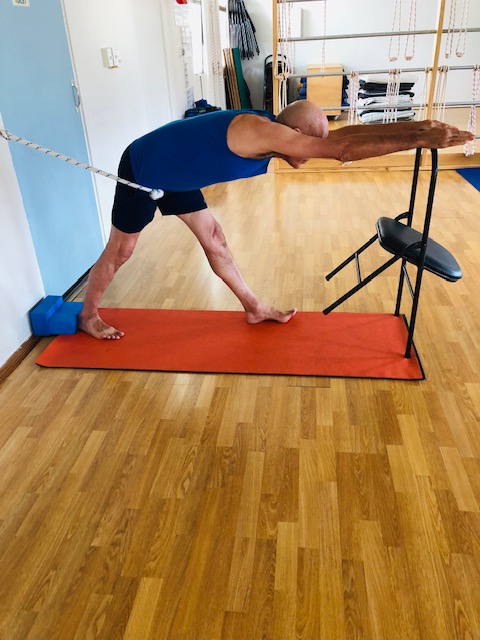
Working at the rope wall with the hands on a chair. Ropes and chairs make a pose steady and safe.
“Health is a living force. Health is not static. You need not work at all if health is static. Health is motion.”
Take it further
Free ebook: Cutting Stress With Yoga. Worry, upsets and tired carers run through life with an intellectual disability. This book has all the material on how yoga brings stress down, with the stories of people who did it, and why the slow out-breath calms. Then do the free classes, see what you think, and buy a pass that puts it into action.
New to Flametree, or away 3 months or more? 2 free classes + 2 ebooks, only available via this offer. Already a student? You can still get this book. Get your free copy of Cutting Stress With Yoga
- Classes, LIVE online or in Darwin: new, or away 3 months or more? 2 free classes, then 10 at half price. Already practising yoga? See the non-beginner half price pass. See the timetable and book.
- Masterclass, in Darwin or LIVE online: Yoga for anxiety, upsets and anger, Sunday 18 April 2027, with Chris Lalor. It starts from being upset, not from a label, and shows the poses and the long, soft out-breath that settle it. A good fit for carers, and for anyone whose worry or anger builds fast. See the 2027 masterclasses.
2027 Masterclasses From 28 December
Over four months, learn the poses and breath practices that make the biggest difference for a range of key health conditions: arthritis, sleep and energy, pelvic floors, backs, wisdom, and anxiety, upsets and anger. In Darwin or LIVE online.
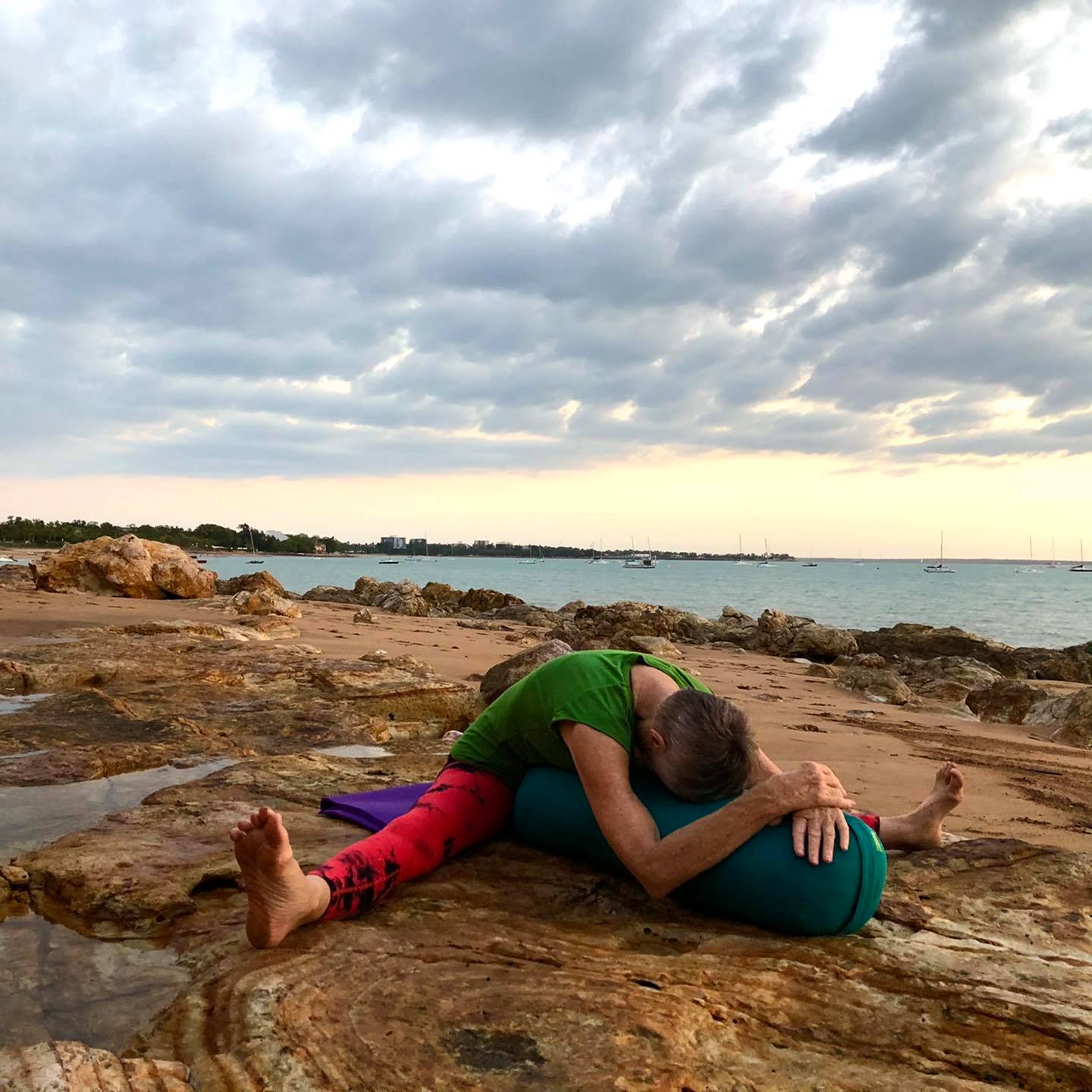
A seated forward bend resting over a bolster, by the sea in Darwin. Supported poses quieten a busy mind.
Yoga for intellectual disability: questions people ask
Is yoga good for people with an intellectual disability?
Yes. A review of 10 studies with 518 people found yoga improved balance, body measures and fitness, and trials found better coordination, flexibility, strength and attention. Classes with clear demonstration and props make yoga easy to follow and safe.
Can yoga cure an intellectual disability?
No. An intellectual disability is lifelong, and yoga does not change its cause. What yoga can do is build balance, strength, coordination and calm: in studies it improved all of these, and a year of yoga in 90 children was linked with better thinking scores and social skills.
Is yoga safe for people with Down syndrome?
Yes, taught with care. Because some people with Down syndrome have a looser joint at the top of the neck, poses that put weight on the head or neck, such as Headstand and Shoulderstand, are left out. Loose joints are kept firm rather than stretched further, and balance poses are done at the wall or with a chair.

A standing forward bend with the head resting on blocks and the hands on a chair. Props make it steady.
Can yoga help balance and coordination in intellectual disability?
Yes. Trials found yoga improved balance, eye-hand coordination and agility in children and adults with an intellectual disability, and exercise reviews (not yoga) found balance work helps in Down syndrome too. Standing poses with a chair or the wall build balance safely. Read the bones and balance guide.
Can yoga help anxiety and anger in people with an intellectual disability?
The research is encouraging. Relaxation eased anxiety and lifted self-esteem in a randomised pilot of 30 adults, and a simple step of moving the attention to the soles of the feet helped people control anger and aggression. A slow out-breath is part of every Flametree class. Read the anxiety and anger guide.
Does yoga help parents and carers?
Yes, and here the research is clearest. One month of yoga eased anxiety, low mood and stress and improved sleep in mothers of children with an intellectual disability, and a review of 15 studies with 1,124 parents found mindfulness lowered stress, low mood and anxiety. Read the stress and burnout guide.

Legs up the wall with a bolster under the hips. A restful pose for tired carers.
How should yoga be taught to someone with an intellectual disability?
Shown, not only told. The teacher demonstrates each pose, gives one clear point at a time, and uses props so the pose is steady. A familiar sequence repeated each week builds skill and confidence. This is how Iyengar yoga is taught.

A seated forward bend with the chest resting on a bolster on a chair. Simple, supported and easy to copy.
Can a carer come to class too?
Yes. Carers are welcome in their own right, and coming together means you both learn the poses and the breath and can practise at home. Tell your teacher what helps the person you care for learn.
Can I do yoga for intellectual disability online from Darwin or anywhere in Australia?
Yes. Flametree Yoga teaches Iyengar yoga LIVE online, as well as in Woolner and Coolalinga in Darwin. Flametree classes adapt poses with chairs and props, and your teacher can see you and help. New students can begin with 2 free classes, then 10 at half price. Book a class
Where this comes from: BKS Iyengar, Light on Life (Kindle edition), Astadala Yogamala volumes 4 and 6, Sparks of Divinity and Yoga Rahasya (2002); Geeta S Iyengar, class and props demonstration in Sydney, 1996. Timothy McCall MD, his June 2019 list of 117 health conditions helped by yoga and its reference list, and Yoga as Medicine (Bantam). Australian Institute of Health and Welfare, Disability in Australia: intellectual disability (read November 2026); Down Syndrome Australia, population statistics (read November 2026). El-Khouri and others, World Neurosurgery, 2014. Studies as linked above, each looked up in PubMed in November 2026. Everything is summarised in our own words.
This page is general information, not medical advice. Flametree Yoga Studio, Darwin and LIVE online.
