
Yoga And Sleep, Insomnia And Fatigue: What Mr Iyengar, The Yoga Doctors And The Research Say
Awake at 2am, and running on empty by 2pm? Poor sleep and low energy usually come as a pair, and many people feel tired all the time without knowing why. The great yoga teachers and the medical doctors who worked with Mr BKS Iyengar agree on where to start: calm the over-alert brain, and rest the body properly. This guide brings together what each of them says about yoga and sleep, insomnia and fatigue, and what modern research has found. Last updated: 31 October 2026.
Get 2 Free Yoga Classes And 2 Free Ebooks
Yoga and sleep: the short answer
Is yoga good for sleep? Yes. Yoga helps sleep, and it helps energy. Across 22 trials of people with sleep problems, yoga added about 111 minutes of sleep a night, and it came out among the three best of seven kinds of exercise compared. Meditation lifted fatigue across 29 trials and over 4,000 people, most of all mental tiredness. Mr Iyengar set out a yoga approach for insomnia, physical fatigue and mental fatigue, and the yoga doctors explain why it works: yoga turns down the body’s alarm system, so sleep can come and rest can do its job.
One thing to keep in mind as you read: almost all of these trials tested “yoga” of many styles, taught by teachers with very different training. The Iyengar yoga trials below, taught by trained Iyengar teachers, found tired people after cancer got their energy back, and in our view well-taught Iyengar yoga is likely to go further than the average. Why the kind of yoga matters.
The bottom line: five key moves for sleep and energy
- Go to a yoga class at your level, about three times a week. The reviews favoured three sessions a week, kept up for three to six months, and more class time went with better sleep. Give it time.
- Add slow breath work (pranayama) in the evening. A long, soft out-breath calms the over-alert nervous system that keeps you awake. On a worn-out day, rest in supported poses first and leave formal breathing for another day.
- Match the practice to the time of day. Active, standing poses earlier in the day lift energy. Restful, supported poses in the evening settle you. Leave strong backbends and fast breathing for the morning.
- Do not take the day to bed with you. Mr Iyengar’s advice, in our words: do not eat heavily or late, and do not go to bed with tomorrow’s work on your mind. Yoga makes it easier to put the day down.
- Start now. New to Flametree, or away 3 months or more? 2 free classes, then 10 at half price, in Darwin or LIVE online.
Iyengar yoga is the style we teach at Flametree. During the 20th century, Mr BKS Iyengar was the major person who codified traditional Indian yoga, through his seminal books and widespread teaching. He also pioneered the use of props, so poses can be adapted to almost any body. His style is sometimes called modern classical yoga. This guide is part of our encyclopaedia of yoga for health conditions.
This guide in short
- Mr BKS Iyengar: three yoga approaches, for insomnia, physical fatigue and mental fatigue. “The brain must be calm, the body active.”
- Dr Timothy McCall: insomnia is an over-alert nervous system. Yoga shifts it from alert to rest.
- Dr Krishna Raman: the right pose at the right time of day, and restful poses when you are exhausted.
- Other yoga voices: Geeta Iyengar on the busy brain, early Iyengar writers on active rest, and a careful review of the yoga research.
- The research: 18 studies listed below, from small trials to reviews of thousands of people.
- Take it further: a free ebook, our 2027 sleep and energy masterclass, and classes in Darwin and online.
Yoga And Sleep On One Page
Four sources, one answer: calm the brain, rest the body properly.
The brain calm, the body active. Use props when you are tired.
Insomnia is an over-alert nervous system. Yoga moves it from alert to rest.
The right pose at the right time of day. Restful poses renew the exhausted body.
About 111 extra minutes of sleep a night across 22 trials. In Iyengar yoga trials, fatigue fell and energy rose.
Each source is set out in full below. Research: Bu 2026, a review of 22 trials; Bower 2012, an Iyengar yoga trial.

Legs Up The Wall, with blankets under the hips. Supported inversions like this are a mainstay of the Iyengar approach to sleep.
“Good sleep makes consciousness brilliant. Poor sleep leaves it tarnished.”
What insomnia and fatigue are
Insomnia means trouble falling asleep, waking in the night and not getting back to sleep, or waking too early. Dr McCall notes that waking and not getting back to sleep is the most common kind. Fatigue is the other side of the coin: a tiredness that rest does not seem to shift. The main kinds are:
- Short-term insomnia: poor sleep around a crisis, a loss or a busy patch. Mr Iyengar says it can pass with the life crises that cause it.
- Long-lasting insomnia: poor sleep that stays for months or years.
- Physical fatigue: exhaustion after hard physical effort, with a reluctance to do anything at all.
- Mental fatigue: forgetfulness, irritability, boredom, confusion and low mood, often from poor sleep, loss or stress at work.
- Chronic fatigue syndrome: long-lasting, disabling tiredness. Dr McCall lists it as no. 17 on his list.
Living in Darwin brings its own twist: hot, humid nights in the Build-Up make sleep harder for many people.
What Mr BKS Iyengar taught about sleep and tiredness
In short: calm the brain, keep the body active, and lean on props when you are tired.
In Yoga: The Path to Holistic Health, Mr Iyengar sets out a yoga approach for 72 health conditions. Three of them are about sleep and energy: insomnia (pp. 362 to 363), physical fatigue (p. 312) and mental fatigue (p. 360). A few ideas run through all three.
- The brain calm, the body active. His words: “The brain must be calm, the body active” (p. 181). Too much lying around, he warns, can tip into lethargy and low mood.
- Props when you are tired. When fatigued or under great stress, he says to practise with props (p. 181), so the body is held and the nerves can let go.
- Rest restores energy. His physical fatigue approach leans on supported reclining poses and restful forward bends. In his view, energy comes back through rest and support.
- Mental fatigue is serious. He says its seriousness is underestimated. His approach mixes forward bends, backbends, supported inversions and reclining poses.
- A dull mind feeds on poor sleep. He links the dull, heavy state of mind with insomnia, oversleeping and comfort eating (pp. 50 to 51).
- Steady practice, not a quick trick. He is clear that yoga works through regular practice over time (p. 41).
Two Kinds Of Tired
Mr Iyengar gives physical fatigue and mental fatigue their own approach.
After hard physical effort. You do not want to do anything.
The yoga: supported reclining poses, restful forward bends, a few gentle standing and inverted poses.
Forgetful, irritable, bored, foggy or low, from poor sleep, loss or work stress.
The yoga: forward bends, backbends, supported inversions and reclining poses.
Both start from the same place: props hold the body, so the brain can go quiet.
From Mr BKS Iyengar, Yoga: The Path to Holistic Health, pp. 312 and 360, in our words. A simplified picture.
His approach for each, in our words:
- Insomnia: forward bends, supported inversions and bridge-type poses, ending with quiet breathing lying down.
- Physical fatigue: rest and support first, with supported reclining poses and restful forward bends.
- Mental fatigue: a mix of forward bends, backbends, supported inversions and reclining poses.
- Poses to leave out: he lists a seated twist (Marichyasana) to avoid with insomnia or fatigue (p. 132).
He also names single poses for tiredness. In his view, Downward Dog (Adho Mukha Svanasana) held for about a minute restores energy (p. 88), and the standing forward fold (Uttanasana) eases mental and physical exhaustion (p. 92). We do not publish his sequences. A sequence needs a teacher who can see you and adapt each pose, which is what a class is for.
His own story: in the book he tells of the violinist Yehudi Menuhin, worn out by touring, whose regular sleep pattern he says yoga restored (pp. 12 to 13).

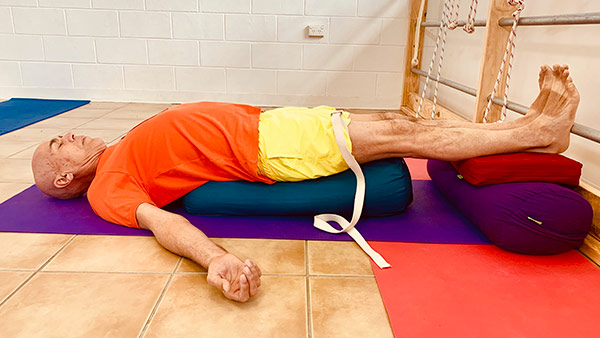
Lying back over a bolster. The chest opens and the breath slows, without any effort.
“If we toss and turn at night, we shall toss and turn in the day.”
What Dr Timothy McCall says
In short: insomnia is a brain stuck on alert, and yoga moves it towards rest.
Dr McCall is a US medical doctor and yoga therapist, author of Yoga as Medicine and former medical editor of Yoga Journal. His June 2019 list of conditions helped by yoga includes insomnia (no. 48), fatigue (no. 32) and chronic fatigue syndrome (no. 17). His chapter on yoga for insomnia is built around Roger Cole, PhD, an Iyengar yoga teacher and sleep researcher. His views, in our words:
- Insomnia is over-arousal. The nervous system is stuck on alert. Yoga shifts the balance from the alert side (sympathetic) to the rest side (parasympathetic), and lowers cortisol, the stress hormone.
- Let go of trying to sleep. The harder you push for sleep, the further it goes. Yoga helps take the pressure off.
- Restorative inversions calm. Supported poses with the legs up settle the system.
- Slow breathing. He suggests counting the breath, 4 in and 4 out, then slowly lengthening the out-breath.
- Timing matters. Active practice after work, restorative poses and pranayama in the evening. Strong backbends, Sun Salutations and fast breaths such as Kapalabhati or Bhastrika near bedtime can keep you awake.
- A doctor’s own story. His chapter opens with a hospital doctor on night call who used Legs Up The Wall in the call room, then a home practice. Counting breaths now gets him back to sleep.
From Alert To Rest
A brain stuck on alert cannot sleep. Poor sleep makes the next day harder, and round it goes.
and round again
- Supported poses let the body stop holding on
- A long, soft out-breath works the brake
- Legs up settles the system
- Less pressure to sleep, so sleep comes
Based on Dr Timothy McCall, Yoga as Medicine, chapter on insomnia (insomnia as over-arousal). A simplified picture.
“Fear and fatigue block the mind.”
What Dr Krishna Raman says
In short: the right pose at the right time of day, and restful poses when you are exhausted.
Dr Raman is a Chennai physician who trained in yoga under Mr Iyengar. His question-and-answer book on yoga and medical science covers insomnia, exhaustion and chronic fatigue. His views, in our words:
- Time of day changes the result. In his experience, strong inversions late in the day can make insomnia worse. What you practise, and when, both matter.
- Exhausted? Rest in the poses. When worn out, he uses relaxation poses with support, such as reclining over a pillow in Supta Virasana (Reclining Hero Pose), a supported Plough and Legs Up The Wall, to renew the body.
- Chronic fatigue syndrome: passive, supported poses, including Legs Up The Wall.
- No pranayama when you are spent. He leaves formal breathing practice out with fever, fatigue or after serious illness.
- Feeling flat after class? He traces lethargy after inversions to the wrong order of poses, holding too long, laboured breathing, a tense face, a collapsed upper back or poor sleep the night before.
- Good stress and bad stress. Healthy stress leaves you fresh; unhealthy stress tires you and spoils sleep. He suggests a steady routine and an early night, around 9.30pm.

The lower legs resting on a chair. A simple way to rest a tired body without falling asleep.
“When my body is tired, I say my body is tired; I never say that I am tired.”
Other yoga voices on sleep and energy
- A busy brain keeps you awake even when the body is ready. Geeta S Iyengar, Mr Iyengar’s daughter, put it this way in a class in Sydney in 1996: “the brain has been so active you find the brain is not resting.” More Iyengar quotes.
- When tired and low, wake the body first, then rest it. From Geeta Iyengar’s teaching on chronic fatigue (1996): where there is low mood too, quick standing poses come first, then restorative poses.
- Active rest beats passive rest. “A conscious, recuperative method of active rest is more essential than passive rest.” Motiwala and Mehta, Yoga Vaani, 1998, on chronic fatigue.
- In a supported pose, the props do the work. In restorative poses “the muscles remain quiet”, with the props deciding the shape. Dr Mary Pullig Schatz, a medical doctor and Iyengar-trained teacher, Yoga Journal, 1987.
- Yoga works for sleep for many people, most clearly in healthy adults and older people. In a US survey of over 34,000 adults, more than 55% of yoga users said it helped their sleep. Mary Flaherty, Does Yoga Work?, chapter 8.
Wake Up Or Settle Down
The same yoga can lift you or calm you. Timing decides which.
Morning and after work
Standing poses, Downward Dog, backbends. A lifted chest wakes you up.
Evening
Supported forward bends, legs up the wall, slow breathing with a long out-breath.
Leave for the morning
Strong backbends, Sun Salutations, fast breaths, strong inversions late at night.
After Dr Timothy McCall (Yoga as Medicine, insomnia chapter) and Dr Krishna Raman (Yoga and Medical Science: FAQ), in our words. A simplified picture.
“Yoga does not eat away energy; it supplies.”
What the research shows
In short: sleep has strong evidence, fatigue is close behind, and the trials keep coming. Most of these studies tested yoga in general, of many styles. The Iyengar yoga trials are listed on their own below. Why the difference matters.
The Research At A Glance
Four studies that sum up the evidence. All of them, with links, are listed below.
Yoga added about 111 minutes of sleep a night. Bu 2026: 22 trials, 1,348 adults with insomnia, seven kinds of exercise compared.
Iyengar yoga lowered fatigue and raised energy, and the gains held 3 months later. Bower 2012: 31 tired breast cancer survivors, 12 weeks.
Meditation lifted fatigue, most of all mental tiredness. Park 2024: 29 trials, 4,104 people.
After cancer care, yoga had the biggest effect on fatigue of any non-drug approach. Hilfiker 2017: a review of 245 studies.
Every study is listed in full in this section, with a link to read it.
Yoga and sleep
- Yoga added about 111 minutes of total sleep a night, and people fell asleep about 29 minutes faster. Yoga, Tai Chi and walking or jogging came out best of seven kinds of exercise. Bu 2026, a review of 22 trials and 1,348 adults with insomnia. Read the study.
- Yoga gave a bigger improvement in sleep than sleep hygiene lessons, and it lasted to 6 months. Sleep time and sleep efficiency both rose. Khalsa 2021, a trial of 40 adults with trouble getting to sleep for 6 months or more, 8 weeks of Kundalini yoga. Read the study.
- Yoga improved sleep quality in women, and more class time went with better sleep. Wang 2020, a review of 19 studies and 1,832 women. Read the study.
- Most trials of yoga, Tai Chi and qigong found better sleep quality. Wang 2015, a review of 27 trials. Read the study.
- Mind-body exercise improved sleep quality and eased fatigue in women around menopause. It also helped mood and anxiety. Xu 2024, a review of 11 trials and 1,005 women. Read the study.
- Yoga improved sleep quality in older adults, and lifted vitality. It helped balance, strength and mood too. Sivaramakrishnan 2019, a review of 22 trials of yoga in older adults. Read the study.
- Yoga improved sleep, worry, fatigue and mood in worried older adults, as well as talking therapy (CBT) did, and the gains held at 6 months. Danhauer 2022, a follow-up of a trial of yoga against CBT. Read the study. Note: this was yoga in general. Iyengar yoga has not yet been tested against talking therapy on its own. Why it matters.
What The Yoga That Worked Had In Common
Across the sleep and fatigue trials, regular practice did best.
About 3 classes a week
favoured by the sleep reviews
3 to 6 months
of steady practice
More practice
went with better sleep and bigger changes
A good teacher
expert guidance gave bigger gains for fatigue
Mary Flaherty, Does Yoga Work?, chapter 8; Wang 2020; Kiecolt-Glaser 2014; Park 2024.
Iyengar yoga studies
These trials tested Iyengar yoga specifically, taught by trained Iyengar teachers, with props and supported poses.
- Iyengar yoga lowered fatigue and raised vigour, and the gains held 3 months later. Twelve weeks of Iyengar yoga, against health lessons. Bower 2012, a trial of 31 breast cancer survivors with lasting tiredness after cancer care. Read the study.
- Fatigue fell, and physical function, mood and quality of life improved, with the gains still there 3 months on. Twelve weeks of Iyengar yoga built around supported inversions and backbends with props. Bower 2011, a pilot study of 12 tired breast cancer survivors. Read the study.
- Restorative Iyengar yoga calmed inflammation activity in tired breast cancer survivors, while it rose in the comparison group. Twelve weeks of classes, against health lessons. Bower 2014, a trial of 31 women with ongoing fatigue after breast cancer. Read the study.
No trial has yet tested Iyengar yoga on its own for insomnia, or for everyday tiredness outside cancer care. Not yet studied is not the same as not working. In our view as certified Iyengar teachers, the supported inversions and restful poses at the heart of the Iyengar approach are exactly what the sleep research points to.
Yoga for fatigue and energy
- Yoga had the biggest effect on fatigue of any exercise or non-drug approach, once cancer care had finished. Hilfiker 2017, a review of 245 studies of cancer-related fatigue. Read the study.
- Yoga lowered fatigue by 3 months after the course, raised vitality, and inflammation markers fell. The more often people practised, the bigger the changes. Kiecolt-Glaser 2014, a trial of 200 breast cancer survivors, 12 weeks of yoga twice a week. Read the study.
Meditation and mindfulness
These trials tested meditation and mindfulness programmes, not pranayama. The results are strong for sleep and for mental tiredness, and pranayama trains the same steady attention through the breath.
- Meditation lowered fatigue, most of all mental fatigue, and gains were bigger with expert guidance. Park 2024, a review of 29 trials and 4,104 people. Read the study.
- Meditation-based programmes lowered fatigue in people with an illness. Requier 2023, a review of 34 trials, mostly in cancer. Read the study.
- Mindful awareness practice improved sleep quality, insomnia symptoms, fatigue and low mood in older adults. It did better than sleep hygiene lessons. Black 2015, a trial in older adults with poor sleep. Read the study.
- Mindfulness meditation improved sleep quality, and the gain grew by follow-up. Rusch 2018, a review of mindfulness trials. Read the study.
- Yoga nidra (guided lying-down relaxation) improved sleep as well as CBT did, and also deepened sleep and lowered cortisol. Datta 2021, a trial in people with long-term insomnia. Read the study.
- Yoga nidra showed a large effect on sleep quality. The studies are small and early. Singh 2026, a review of five studies. Read the study.
The Research On Yoga, Sleep And Fatigue
Four reviews, over 8,000 people. Each one found a benefit.
Less fatigue, most of all mental. Park 2024, meditation: 4,104 people, 29 trials.
Better sleep quality. Wang 2020, yoga in women: 1,832 people, 19 studies.
About 111 extra minutes of sleep a night. Bu 2026, exercise including yoga: 1,348 people, 22 trials.
Better sleep, less fatigue. Xu 2024, mind-body exercise around menopause: 1,005 women, 11 trials.
Bar length shows the number of people in each review. Teal: sleep. Terracotta: fatigue. Reviews overlap, so some people are counted twice.
Breathing practice (pranayama)
No good trial has yet tested slow breathing on its own for sleep. Breathing practice was part of many of the yoga programmes that worked, though the papers rarely say which techniques were taught, or how. Not yet studied is not the same as not working. Fast, forceful breathing is a different thing from pranayama taught slowly, and it is best kept away from bedtime. The pranayama we teach (staircase, ocean, alternate nostril, humming and a gentle shining skull breath) is slow, nasal and taught step by step. Why the kind of breathing matters.
“Savasana is not about falling asleep.”
How this comes together in a Flametree class
Everything above points the same way, and it is how we teach yoga for insomnia and yoga for energy, in Darwin and LIVE online.
- Wake the body, rest it, then quieten the mind. Our classes move in that order, so you leave both calmer and brighter.
- Props in every class: bolsters, blankets, chairs, belts and the wall, so a tired body is held, not pushed.
- Classes adapted to the people in them. No one-size-fits-all. Feel free to tell your teacher you are sleeping badly or running on empty, and the practice is changed for you. When you are tired, we often teach you as a beginner for the day.
- Supported inversions: Legs Up The Wall and supported bridge-type poses, the poses known from long practice to settle the system.
- Rest that is real rest: every class ends in Savasana, and our restorative yoga and gentle yoga classes suit worn-out days.
- Breath and calm: our pranayama classes teach the slow, long out-breath step by step.
Supported Bridge Pose over bolsters. The chest lifts and the legs rest, which is why it suits both tired and wired days.
Read more on sleep and tiredness
- Sleep problems in Darwin: Iyengar yoga for better sleep
- Waking up at 3am and can’t get back to sleep?
- Breathing exercises for sleep
- Perimenopause insomnia
- Yoga when you are tired or travelling
- How to recover from burnout
- Legs Up The Wall and Savasana
- How to lower cortisol naturally
- Meditation for sleep
- Yoga after breast cancer
- All our notes on relaxation, stress and sleep, and Iyengar quotes on relaxation and sleep
“Don’t go to bed with tomorrow’s pressure of work.”
Take it further
This guide gives you the facts on what helps. Classes are how you put them into action.
Free ebook: Cutting Stress With Yoga. For stress, worry and sleep. Why the long out-breath settles a busy brain, with stories, including how Mr Iyengar put a worn-out Yehudi Menuhin to sleep in minutes.
New to Flametree, or away 3 months or more? 2 free classes + 2 ebooks, only available via this offer. Already a student? You can still get this book. Get your free copy of Cutting Stress With Yoga
- Classes, in Darwin or LIVE online: new, or away 3 months or more? 2 free classes, then 10 at half price. Sleeping badly through the Build-Up? Our yoga for sleep pass is the same deal, made for it. Already practising yoga? See the non-beginner half price pass. See every class time.
- Masterclass: sleep and energy is one of our 2027 Sunday Arvo Masterclasses with Chris Lalor, Certified Senior Iyengar Yoga Teacher and certified Yoga Therapist, running January to April. You learn the poses, sequences and pranayama that put this guide into practice. Bookings open soon.
- Retreats: a week of daily yoga and rest in Bali. See the retreats.
Other conditions are in our encyclopaedia of yoga for health conditions.
Yoga and sleep: questions people ask
What did Mr BKS Iyengar teach about insomnia and fatigue?
Mr Iyengar set out three yoga approaches in Yoga: The Path to Holistic Health: one for insomnia, one for physical fatigue and one for mental fatigue. They lean on forward bends, supported inversions and supported reclining poses, with props whenever you are tired. His guiding idea is that the brain must be calm while the body stays active.
Why am I tired all the time when I sleep enough?
Often it is the mind, not the body, that is worn out. Mr Iyengar describes mental fatigue as forgetfulness, irritability, boredom and low mood, from poor sleep, loss or stress at work, and says its seriousness is underestimated. Dr Krishna Raman notes that unhealthy stress tires you and spoils sleep. Yoga teachers also see that a sunken chest and shallow breathing leave people flat, and a lifted chest with slow breathing wakes them up.
Is lying flat the same as resting?
No. Many people lie down and stay tense, with a busy brain and a tight jaw. Supported yoga poses let the props carry the body so the muscles go quiet, and a long, soft out-breath settles the nerves. That is why Mr Iyengar says Savasana, the resting pose, is not about falling asleep. It is rest you are awake for.
Why do I feel flat after some yoga classes?
Dr Krishna Raman traces lethargy after inversions to the wrong order of poses, holding them too long, laboured breathing, a tense face, a collapsed upper back or poor sleep the night before. Mr Iyengar warns that too much passive practice can leave you dull. A well-taught class wakes the body first, then rests it, so you leave brighter.
Which yoga poses wake you up and which help you sleep?
Standing poses, Downward Dog and backbends lift energy, and suit the morning or after work. Supported forward bends, Legs Up The Wall and slow breathing settle you, and suit the evening. Dr Timothy McCall and Dr Krishna Raman both say timing matters: strong backbends, Sun Salutations, fast breaths and strong inversions are best kept away from bedtime.
How late can I do yoga before bed?
Keep strong, active practice to the morning or after work, and make the evening restful. Dr Timothy McCall suggests restorative poses and pranayama in the evening, and warns against overdoing active practice near bedtime. Gentle, supported poses and a long out-breath are fine right up to lights out.
How many yoga classes a week help sleep?
About three a week, kept up for three to six months. That is what the reviews favoured, as summarised in Does Yoga Work?. A 2020 review of 19 studies in women also found that more class time went with better sleep. Even one class a week is a start, and something is better than nothing.
Where can I do yoga for sleep and energy in Darwin or online?
Flametree Yoga Studio teaches Iyengar yoga at Woolner and Coolalinga in Darwin, and LIVE online across Australia, with bolsters, blankets and chairs in every class. New, or away 3 months or more? You get 2 free classes, then 10 at half price.
Where this comes from: BKS Iyengar, Yoga: The Path to Holistic Health (Dorling Kindersley), the insomnia, physical fatigue and mental fatigue courses and the introduction to yoga for ailments; Light on Life; The Tree of Yoga; Astadala Yogamala; Sparks of Divinity; Iyengar: His Life and Work. Timothy McCall MD, Yoga as Medicine (Bantam), chapter 23, Insomnia, and his June 2019 list of health conditions helped by yoga. Krishna Raman MD and S. Suresh MD, Yoga and Medical Science: FAQ. Geeta S Iyengar, teaching in Australia, 1996. Motiwala and Mehta, Yoga Vaani, 1998. Mary Pullig Schatz MD, Yoga Journal, 1987. Mary Flaherty, Does Yoga Work?, chapter 8. Studies as linked above. Everything is summarised in our own words.
This page is general information, not medical advice. Flametree Yoga Studio, Darwin and LIVE online.
