
Yoga For Post-Polio Syndrome: What Mr Iyengar, The Yoga Doctors And The Research Say
Polio was decades ago. So why are the tiredness, the weakness and the aching coming back now? Post-polio syndrome brings new muscle weakness, deep fatigue and pain to many people who had polio as children. This guide brings together what Mr BKS Iyengar, Dr Timothy McCall and the research say about yoga for post polio syndrome, and about pranayama (yogic breathing), meditation and mindfulness for the fatigue, the breath and the stress that come with it. Last updated: 8 November 2026.
By Chris Lalor, Certified Senior Iyengar Yoga Teacher and certified Yoga Therapist, Flametree Yoga Darwin.
Get 2 Free Yoga Classes And 2 Free Ebooks
Yoga for post polio syndrome: the short answer
Yes, gentle, well-paced yoga with chairs and props is well worth trying with post-polio syndrome. No trial has yet tested yoga for it. But the research on movement in post-polio syndrome points one way: the right dose of gentle, supported strength and fitness work helped. In trials and reviews, polio survivors gained strength and fitness, had less fatigue and less pain, and came to no harm when the work was paced. In multiple sclerosis, where fatigue and weak muscles are also central, a review of 10 trials found yoga lowered fatigue. Iyengar yoga is built on paced, supported work: the pose is adapted to you, and rest is part of the practice. Yoga will not change the old damage from polio. It works on what can still change: strength you can use, posture, balance, the breath, fatigue and mood.

Seated on a chair, a belt around the back lifts the chest. Much of yoga for post polio syndrome can be done sitting.
Overall evidence: Limited
The research here is still limited: early pilots, a single trial, or evidence from a related condition. Not yet tested is not the same as does not work.
Best study (review of many trials, in a related condition): No trial of yoga for post-polio syndrome has published results yet, so the best study is from a related condition. A 2020 review pooled 10 trials with 693 people with multiple sclerosis, where fatigue and weak muscles are also central. Yoga lowered fatigue compared with usual care, and did as well as other exercise. In post-polio syndrome itself, a 2021 review of 21 studies found that well-dosed strength and fitness work helped polio survivors.
None of the studies here tested Iyengar yoga in polio survivors. In our view as certified Iyengar teachers, careful, well-taught yoga with props, where the pose is adapted to the person and the effort is paced, fits what the post-polio research asks for better than most. Why the kind of yoga matters.
The bottom line: five key moves for yoga with post-polio syndrome
- Find a class that adapts the poses to you. Chairs, belts, bolsters and the wall take the weight, so you work the muscles you can use without overloading the weak ones.
- Pace it. Little and often beats long and hard. In the post-polio trials, the work that helped was moderate, regular and rested.
- Rest well, on purpose. Supported rest poses are part of every class. Good rest is what makes energy.
- Learn a slow, easy breath. Pranayama (yogic breathing) calms, and yoga breathing raised breathing-muscle strength in very frail older adults.
- Start now. New to Flametree, or away 3 months or more? 2 free classes, then 10 at half price, in Darwin or LIVE online.
Five Key Moves For Yoga With Post-Polio Syndrome
1. An adapted class
Chairs, belts, bolsters and the wall.
2. Pace it
Little and often, never to exhaustion.
3. Rest on purpose
Supported rest makes energy.
4. A slow breath
Easy, steady, never forced.
5. Start now
2 free classes, then 10 at half price.
Yoga for post polio syndrome in five moves: supported, paced work with rest built in.
Who was Mr BKS Iyengar? Iyengar yoga is the style we teach at Flametree. During the 20th century, Mr BKS Iyengar was the major teacher who codified traditional Indian yoga, through his seminal books and widespread teaching. He also pioneered the use of props, so poses can be adapted to almost any body. His style is sometimes called modern classical yoga. This guide is part of our encyclopaedia of yoga for health conditions.

Chris Lalor seated on a bolster, a belt holding the legs so the muscles can let go. Support first, then the breath.
This guide in short
- Overall evidence: Limited. Best study (review of many trials, in a related condition): No trial of yoga for post-polio syndrome has published results yet, so the best study is from a related condition. A 2020 review pooled 10 trials with 693 people with multiple sclerosis, where fatigue and weak muscles are also central. Yoga lowered fatigue compared with usual care, and did as well as other exercise. In post-polio syndrome itself, a 2021 review of 21 studies found that well-dosed strength and fitness work helped polio survivors.
- Mr BKS Iyengar: he taught children with polio in the 1940s, one of them sent to him by a surgeon, and built props and chairs into yoga so the pose comes to the person.
- Dr Timothy McCall, an American medical doctor and yoga therapist who studied with Mr BKS Iyengar, author of Yoga as Medicine: post-polio syndrome is no. 86 on his list of conditions helped by yoga.
- The research: no yoga trial with results yet; reviews and trials of paced strength, fitness and warm-water exercise in polio survivors; and yoga studies in related conditions, listed below.
- Related guides: fatigue, chronic pain, breathlessness, bones and balance and spinal cord injury.
- Take it further: our free ebook Strong Bones, Steady Feet, the 2027 masterclass on sleep and energy, and classes in Darwin and online.
Yoga For Post Polio Syndrome On One Page
Mr BKS Iyengar
Taught children with polio; props make the pose fit.
Dr Timothy McCall
Post-polio syndrome is no. 86 on his list.
Movement research
Paced work: more strength, less fatigue and pain.
Related yoga research
Yoga lowered fatigue in multiple sclerosis.
Yoga for post polio syndrome at a glance. Each source is set out in full below.
What is post-polio syndrome?
Polio is a virus that can damage the nerve cells in the spinal cord that drive the muscles. Many people who had paralytic polio recovered a great deal. Decades later, some polio survivors notice new weakness, deep fatigue, muscle and joint pain, and less endurance. That is post-polio syndrome. Poor sleep, weaker breathing and low mood are common too, and some people feel the cold badly.
Doctors still do not fully know why it happens. Reviews say there is no medicine that changes its course, and that the mainstay of care is individual rehabilitation: energy conservation (pacing your effort through the day) and well-dosed muscle strengthening. French guidelines published in 2026 add that non-drug pain care through physical therapy is crucial. In Australia, Polio Australia estimates that between 20,000 and 40,000 people had paralytic polio during the epidemics of the 1930s to 1960s, and many more were infected.
Polio In Australia
20,000 to 40,000
Australians had paralytic polio in the epidemics of the 1930s to 1960s.
Source: Polio Australia, a historical estimate. No Australian count of people with post-polio syndrome itself was found.
Why would yoga help? Not by changing the old nerve damage. In post-polio syndrome, both too little movement and too much can make things worse: muscles weaken from disuse, and over-used muscles tire and ache. Pain and fatigue each pull everyday life down, a survey of 446 people with post-polio syndrome found. The answer the research keeps coming back to is the middle path: regular, moderate, supported work with rest in between. That is how Iyengar yoga is taught.
How fatigue, overuse and weakness feed each other
The Boom And Bust Loop
A good day
You push on and do too much.
Overuse
Weakened muscles tire and ache.
Crash
Fatigue and pain for days.
Disuse
Resting too long weakens muscles further.
↻ Paced, supported practice with rest built in breaks the loop.
A simplified picture of boom and bust in post-polio syndrome. Reviews say pacing and well-dosed strengthening are the mainstay of care.
“My props became my guru and taught me how to use the body.”
What did Mr BKS Iyengar teach about polio?
In short: he taught children with polio in the 1940s, one of them sent to him by a surgeon, and he built props into yoga so the pose comes to the person. We have not found anything he wrote about post-polio syndrome itself. What follows is from his own account of his early teaching, and from his teaching on props and effort. This is known from long practice. Not yet tested is not the same as wrong.
- Surgeons sent him polio patients. In his own account (Astadala Yogamala, volume 1, “My Yogic Journey”), a surgeon from Madras sent a girl with polio of the spine to him in Pune in 1945 and asked him to teach her yoga. After a month the surgeon examined her and found that life had come into her spine. (His biography, Iyengar: His Life and Work, tells the same story and dates it 1947.)
- A second girl, walking and riding a bike. A hotel owner then asked him to teach his daughter, who had polio after an injection. Mr Iyengar writes that she improved faster than the doctors expected, and later walked and rode a bike. This is what he reported, not a trial, and these were children recovering from polio, not adults with post-polio syndrome.

Kim in a supported seated forward bend, chest resting on a bolster on a chair. The props take the weight so the muscles can lengthen and rest.
- His own childhood illness was not polio. Our sources say he had malaria, a long fever thought to be typhoid, and suspected tuberculosis. At about 16 he weighed 70 pounds and his chest expanded only half an inch. He knew what it was to start yoga from a weak body.
- Props began with his own limits. He first used a prop in 1948, bricks and stones from the street, when a pose would not come. Belts, blocks, bolsters, ropes and the chair followed, so that poses could be adapted to almost anyone.
- Neither too much nor too little. He warned that too much tension is aggression and too little is weakness. That is the balance post-polio syndrome asks for.
The mother who hid at home
Mr Iyengar tells how the mother of that first girl with polio tested him. She told her children to say she was out, and hid in the house to see whether he really worked hard. After a month she paid his fee and owned up. She had hired many teachers before, she said, and none had worked as hard. The surgeon found the girl’s spine had improved and told them to carry on. Retold from Mr Iyengar’s own account in Astadala Yogamala, volume 1. What happened, as he wrote it, not a medical claim.
“Too much tension is aggression. Injuries come by aggression, by doing aggressive movements, not by doing yoga. But too little tension is weakness.”
Geeta Iyengar on support and courage. Geeta Iyengar, his daughter and a senior teacher in her own right, used polio as a picture of real compassion: not carrying a child with polio everywhere, but helping that child stand and walk. Support first, then the person’s own strength, and with it courage and confidence.
The Classic Pose And The Adapted Pose
The classic pose
On the floor or standing free.
Asks a lot of every muscle at once.
Easy to overdo.
The adapted pose
A chair, the wall, belts and bolsters.
Weak parts supported, working parts do a moderate share.
Rest between poses.
Yoga for post polio syndrome adapts the pose to the person. Known from practice in the Iyengar tradition.
What Dr Timothy McCall says
In short: post-polio syndrome is on his list. Dr Timothy McCall, an American medical doctor and yoga therapist who studied with Mr Iyengar and wrote Yoga as Medicine, published a list of 117 health conditions helped by yoga in June 2019. “Post-Polio Syndrome” is no. 86. Our encyclopaedia uses his list as its backbone and builds on it with newer research.
His reference list for no. 86 names one paper: “Hatha yoga and meditation in patients with post-polio syndrome” by DeMayo and colleagues (2004). We could not find its results: the record has no summary, so we do not report what it found. No other yoga, pranayama or mindfulness trial in post-polio syndrome has been published since, as far as we can find. So this guide draws on the research on movement in post-polio syndrome, and on yoga in related conditions, and says which is which.
“With problems, go down, stretch, but don’t strain.”
What does the research say about yoga for post polio syndrome?
In short: no trial has yet reported on yoga for post-polio syndrome. What has been tested is movement: strength, fitness and warm-water exercise. Done at the right dose, it raised strength and fitness, eased fatigue and pain, and caused no harm. Yoga studies in related conditions, multiple sclerosis, frail older adults and ALS, show yoga and yogic breathing easing fatigue and building breathing strength. None tested Iyengar yoga in polio survivors. Why that matters.
The Research At A Glance
Helped polio survivors
Review of 21 studies of strength and fitness work (2021).
Less pain distress
Warm-water exercise, 28 people, no adverse effects.
Strength up 41%
Moderate strength training, no harm to nerve cells.
Less fatigue (related)
Yoga in multiple sclerosis, 10 trials, 693 people.
The research for yoga for post polio syndrome, conclusion first. The last card is a related condition.
Yoga and Iyengar yoga trials in post-polio syndrome
No trial of Iyengar yoga, or any other yoga, in post-polio syndrome has published results that we could find. The one paper on Dr McCall’s list (DeMayo 2004) has no published summary. Not yet tested is not the same as does not work.
Movement in post-polio syndrome: what the trials found
These studies tested exercise, not yoga. We include them because they show what kind of movement helps, and yoga is a paced, supported kind of movement.
- Strength and fitness work helped polio survivors. Ramachandran and others, 2021, a review and meta-analysis of 21 studies by researchers from Polio Australia and Australian universities: muscle strengthening and fitness work gave an overall benefit to body function, activity and taking part in life. The authors call for exercise suited to each person. Read the study.
- Moderate strength training raised strength by 41%, with no harm to the nerve cells. Chan and others, 2003, a randomised trial of 10 people with post-polio hand weakness: 12 weeks of moderate isometric (holding) exercise, three times a week. Strength rose more than in healthy older adults doing the same training. Read the study.
- Gentle exercise in warm water eased pain distress and lowered heart rate for the same effort, with no adverse effects. Willén and others, 2001, a controlled study of 28 people with late effects of polio: 40 minutes of non-swimming exercise in warm water, twice a week, for about 5 months. People also reported more well-being. In interviews, they said the benefit went beyond the body, and the group itself was part of it. Read the study.
Strength Gain After 12 Weeks Of Moderate Training
Average strength gain, Chan 2003. Bars drawn from zero. Moderate strength training, not yoga.
- Four weeks of rehabilitation improved walking and pain, more so in a warm climate. Strumse and others, 2003, a randomised trial of 88 people with post-polio syndrome. In the warm-climate group, the 6-minute walk rose from 347 to 431 metres and pain fell from 42 to 28 out of 100 three months later. The control group changed little. Read the study.
- Regular aerobic exercise improved fatigue and quality of life. Oncu and others, 2009, a randomised trial of 32 people with post-polio syndrome, comparing a hospital and a home programme. Fatigue and quality of life improved in both; fitness rose in the hospital group. Read the study.
- Leg-strengthening at home eased shoulder pain from overuse. Klein and others, 2002, a randomised study of 23 polio survivors with weak legs and sore shoulders from pushing up with the arms. The home exercise group had fewer and milder shoulder symptoms. Read the study.
- A 9-day programme with pacing lowered fatigue and low mood for 6 months. Davidson and others, 2009, a pilot study of 27 people: endurance, depression and fatigue were all better six months later. Read the study.
Walking Distance After Four Weeks Of Rehabilitation
Six-minute walk in the warm-climate group, Strumse 2003, post-polio syndrome. Bars drawn from zero. A rehabilitation programme, not yoga.
Results are not all one way. In a Dutch trial of 68 severely fatigued people, exercise therapy did not lower fatigue more than usual care, and a home arm-cycling programme in Ireland did not change a fitness test, though blood pressure was lower. The Cochrane review (2015) found too little good data to be sure about most treatments, with strength training among those that “may be beneficial”. European guidelines (2006) call supervised, individual training safe for people with moderate weakness, and say training can ease fatigue, weakness and pain, with non-swimming water exercise particularly useful, and group training good for well-being.
Yoga in related conditions
These studies were not in post-polio syndrome. They are in conditions that share its fatigue, weakness or breathing load, so they suggest what yoga could do.
- Yoga lowered fatigue in multiple sclerosis, as well as other exercise did. Shohani and others, 2020, a review of 10 randomised trials with 693 people with multiple sclerosis. Compared with usual care, the yoga groups were clearly less fatigued. This was yoga in general, not Iyengar yoga, and Iyengar yoga has not been tested against exercise on its own. Read the study.
- Iyengar yoga improved balance, walking speed and getting up from a chair. Tiedemann and others, 2013, a pilot randomised trial in Sydney of 54 people, average age 68: 12 weeks of Iyengar yoga, twice a week, improved the main risk factors for falls. No serious adverse events. Polio survivors were not studied, but falls and fear of falling are common after polio. Read the study.

Chris Lalor in a supported reclining pose. Rest poses like this are part of every class, so effort and recovery go together.
Twelve Weeks Of Iyengar Yoga
12 weeks
of Iyengar yoga improved balance, walking speed and getting up from a chair.
Tiedemann 2013, a Sydney pilot trial of 54 older adults. Not a study of polio survivors.
Breathing and pranayama
No trial of breathing practice or pranayama in post-polio syndrome has been published. Some polio survivors have weaker breathing muscles, so these related studies matter.
- Yoga breathing exercises raised breathing-muscle strength in very frail older adults. Cebrià i Iranzo and others, 2014, a randomised trial of 81 care-home residents, average age 85, who could not walk 10 metres: six weeks of yoga breathing exercises raised the strength and endurance of the breathing muscles more than no training, and in some measures more than a breathing device. Well tolerated. Read the study.
- Yogic breathing eased physical symptoms in ALS. Yuen and others, 2025, a pilot randomised trial of 13 adults with ALS (motor neurone disease): 12 online sessions of yogic breathing with a certified yoga therapist over six weeks. Physical symptom scores improved; people described more control over their breathing and calm from relaxation. Read the study.

Sitting on a bolster with the attention on the breath. Slow, easy breathing is learnt step by step.
Meditation and mindfulness
No mindfulness or meditation trial in post-polio syndrome has published results.
- A mindfulness course raised quality of life and lowered depression and anxiety in ALS. Pagnini and others, 2022, a randomised trial of 47 people with ALS: a 5-week online mindfulness course. Their carers felt less burdened, too. This tested a mindfulness course, not yoga. Read the study.
- Psychological support helped quality of life in the short term across muscle and nerve conditions, post-polio syndrome among them. Walklet and others, 2016, a review of 10 studies: 7 reported a short-term benefit to quality of life and well-being. The authors judged the studies weak. Read the study.
What The Movement That Helped Had In Common
Moderate
Steady effort, never to exhaustion.
Regular
Twice or three times a week, for months.
Supported
Warm water, a group, a guide.
Rested
Pauses between efforts.
What the movement that helped in post-polio syndrome had in common: the same principles as a supported Iyengar class.
Yoga, pranayama and mindfulness: how they work together
Some of the studies above tested yogic breathing or a mindfulness course, not yoga poses, and they were in related conditions. That still counts for our classes. Mindfulness is steady, present attention, and yoga poses and pranayama (yogic breathing) are old routes to that same state. So the breathing and mindfulness studies also show what a good yoga and pranayama class can build. No trial separates which part does the work.
Two routes to one steady mind
A steady body, with attention held on the pose.
A steady breath, with attention held on the breath.
Mindfulness: steady, present attention. Each makes the other easier.
A simplified picture, known from practice. No trial separates which part does the work.
We suggest coming to both a yoga class and a pranayama class. Mr Iyengar taught that asana (poses), pranayama and meditation are not divided, and in our experience the two together do more than either alone. See every class time. We trace the history and the links in Yoga And Mindfulness: Why The Mindfulness Research Points Back To Yoga And The Breath.
“Nothing pertaining to pranayama can be forced. That is why it teaches humility.”
How this comes together in a Flametree class
Everything above points the same way, and it is how we teach yoga in Darwin and online. Flametree classes adapt poses with chairs and props, so people with weak or uneven muscles can take part.
- Tell your teacher about your condition. Tell us which muscles polio affected, what tires you, any braces or aids you use, and how you are on the day. Classes are adapted to the people in them.
- Chairs and props: many poses can be done seated or with the wall, belts, blocks and bolsters taking the weight, so the stronger muscles work at a moderate level and the weaker ones are supported.
- Paced, never to exhaustion: you can stop, sit or rest at any point. Doing less on a good day is part of the skill.
- Warmth: some polio survivors feel the cold badly. Darwin helps, and blankets are always there for rest poses.
- Balance with support: standing poses are done by the wall or with a chair, which builds the balance and leg confidence that the falls research points to.
- Rest and breath to finish: every class ends with supported rest, and our pranayama classes teach the slow breath step by step.
See the timetable and book a class. Online classes can be done from home, from your own chair, so you can save energy on travel.

Legs up the wall with a bolster under the hips. A restful pose for tired legs, with no effort from the leg muscles.
Practising Well With Post-Polio Syndrome
Before class?
Tell your teacher what polio affected and how you are today.
A muscle shakes or burns?
Ease off and rest.
Tired the next day?
Do less next time, then build slowly.
End of class?
Take the full supported rest.
Yoga for post polio syndrome is supported, paced and never to exhaustion.
Read more on fatigue, pain, breathing and balance
- Chronic fatigue, fibromyalgia and fatigue: the wider research on yoga and deep tiredness
- Yoga for chronic pain: yoga, pranayama and mindfulness for long-lasting pain
- Asthma, COPD and breathlessness: the breathing practices in more depth
- Bone health, balance and falls: the Sydney Iyengar pilot and more on balance
- Spinal cord injury: adapted, seated yoga after another kind of nerve injury
- Nearby guides: sleep and energy and Parkinson’s and MS
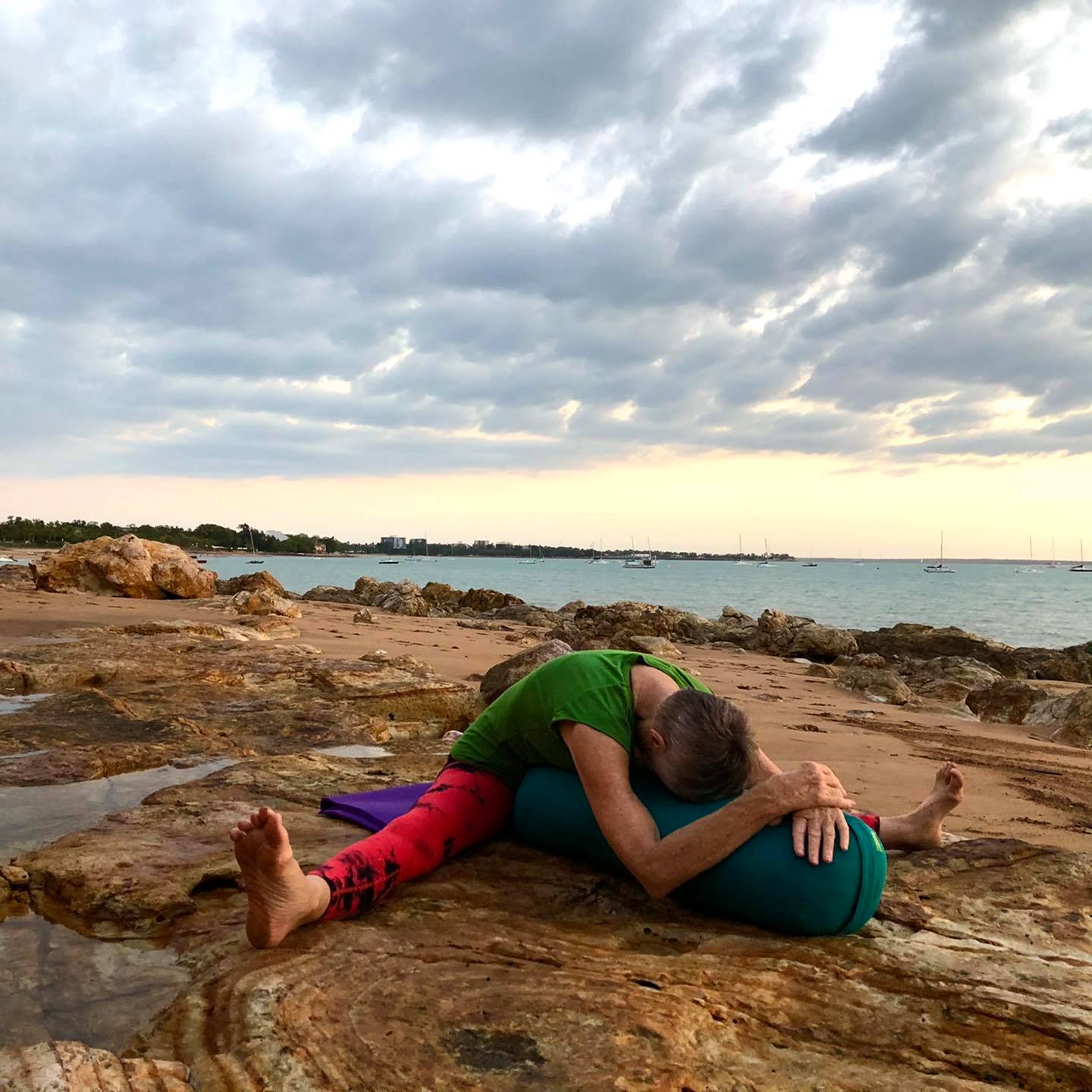
A seated forward bend resting over a bolster, by the sea in Darwin. Supported poses let tired muscles rest while the body lengthens.
Take it further
Free ebook: Strong Bones, Steady Feet. Weak legs and fear of falling are common after polio. This book sets out what the research says about yoga for balance, leg strength and bones, including stories about how it has helped people. Then do the free classes, see what you think, and buy a pass that puts it all into action.
New to Flametree, or away 3 months or more? 2 free classes + 2 ebooks, only available via this offer. Already a student? You can still get this book. Get your free copy of Strong Bones, Steady Feet
- Classes, in Darwin or LIVE online: new, or away 3 months or more? 2 free classes, then 10 at half price. Already practising yoga? See the non-beginner half price pass. See the timetable and book.
- Masterclasses: Yoga for sleep and energy, Sunday 10 January 2027, one of our 2027 masterclasses with Chris Lalor, where you learn the supported rest poses and the long, soft out-breath that turn rest into energy. See the 2027 masterclasses.
2027 Masterclasses From 28 December
Over four months, learn the poses and breath practices that make the biggest difference for a range of key health conditions: arthritis, sleep and energy, pelvic floors, backs, wisdom, and anxiety, upsets and anger. In Darwin or LIVE online.
Other conditions are in our encyclopaedia of yoga for health conditions.
Yoga for post polio syndrome: questions people ask
Is yoga good for post-polio syndrome?
Gentle, well-paced yoga with chairs and props is well worth trying. No trial has yet reported on yoga for post-polio syndrome, but trials of paced strength, fitness and warm-water exercise in polio survivors found better strength and fitness, less fatigue and less pain, with no harm when the dose was right. In multiple sclerosis, a review of 10 trials found yoga lowered fatigue.

Kim in supported relaxation (Savasana). Rest is part of every class, not an extra.
Can exercise make post-polio syndrome worse?
Too much can. Over-used muscles tire and ache, and many polio survivors know the boom and bust of a good day followed by days of fatigue. But too little movement weakens muscles too. In trials, moderate strength training raised strength without harming the nerve cells, and warm-water exercise caused no adverse effects. The key is a moderate dose, rest between efforts, and building slowly.
What is the best exercise for post-polio syndrome?
The research favours moderate, regular, individual work: gentle strengthening, light fitness work, and non-swimming exercise in warm water, with pauses between efforts. European guidelines call supervised, individual training safe for people with moderate weakness. Yoga with props fits those principles: the pose is adapted to you, effort is moderate, and rest is built in.
Can yoga help post-polio fatigue?
It may. In multiple sclerosis, which shares deep fatigue and weak muscles, a review of 10 trials with 693 people found yoga lowered fatigue compared with usual care. In post-polio syndrome itself, regular aerobic exercise improved fatigue in a trial of 32 people, and a 9-day programme with pacing lowered fatigue for six months. Supported rest poses are part of every class. Read the fatigue guide.
“The heart faces the floor in all the forward extensions and this gives rest and helps one recover from fatigue.”
Can breathing exercises help weak breathing after polio?
Breathing practice is worth learning, gently. In a trial of 81 very frail older adults, six weeks of yoga breathing exercises raised the strength of the breathing muscles more than no training. In a pilot trial in ALS, yogic breathing eased physical symptoms. Breathing in class is slow and easy, never forced or held hard. Read the breathlessness guide.
An Easy Breath From Your Chair
1. Sit tall
Support behind the back, feet steady.
2. Lift the chest
Shoulders soft, collarbones broad.
3. Slow the out-breath
Let each breath out grow long and quiet.
4. Rest when needed
Go back to normal breathing any time.
An easy yogic breath for post polio syndrome, from a chair: known from practice, in line with the breathing studies.

Seated humming breath (Bhramari), a gentle pranayama that can be done from a chair.
Did Mr Iyengar have polio?
No, not according to the sources we hold. As a boy he had malaria, a long fever thought to be typhoid, and suspected tuberculosis, and he started yoga weak and thin. He did teach children with polio in the 1940s, one of them sent to him by a surgeon, and he wrote that one later walked and rode a bike.
Can yoga help with balance and falls after polio?
Falls and fear of falling are common after polio, often because of a weak leg. In a Sydney pilot study, 12 weeks of Iyengar yoga improved balance, walking speed and getting up from a chair, the main risk factors for falls, in people with an average age of 68. In class, standing poses are done by the wall or with a chair. Read the bones and balance guide.
Is yoga safe with post-polio syndrome?
Yoga that is adapted and paced suits post-polio syndrome. Poses are done with chairs, the wall and props, effort stays moderate, and you rest whenever you need to. Tell your teacher about your condition: which muscles polio affected, any braces or aids, and how you are on the day.
“Holding the trestler gives support and then the inner support of courage comes, giving them confidence.”
Can I do yoga for post polio in Darwin or online?
Yes. Flametree Yoga teaches Iyengar yoga in Woolner and Coolalinga in Darwin, and LIVE online, so you can practise from your own chair at home and save energy on travel. Flametree classes adapt poses with chairs and props. New students can begin with 2 free classes, then 10 at half price. Book a class
Where this comes from: BKS Iyengar, Astadala Yogamala (volumes 1 and 6), Light on Life (Kindle edition), and Iyengar: His Life and Work; BKS Iyengar and Geeta S Iyengar, Basic Guidelines for Teachers of Yoga; Geeta S Iyengar, classes and a props demonstration in Sydney, 1996, and an interview in the Geeta Australia 2009 retreat booklet. Timothy McCall MD, his June 2019 list of 117 health conditions helped by yoga and its reference list, and Yoga as Medicine (Bantam). Polio Australia, “Australian polio survivors”. Reviews and guidelines: Lo and Robinson 2018, Li Hi Shing 2019, Farbu 2006 (European guidelines), Verschueren 2026 (French guidelines), Koopman 2015 (Cochrane), Jensen 2011. Studies as linked above, each looked up in PubMed in November 2026. Everything is summarised in our own words.
This page is general information, not medical advice. Flametree Yoga Studio, Darwin and LIVE online.
