Is Pranayama Safe? An Honest Answer To The ABC’s Meditation Article
Is pranayama safe? The short version
In September 2026 an ABC story put a number on meditation harm, and several students asked us the same thing: is pranayama safe? For most people, practised slowly and with a teacher guiding you, in the studio or LIVE online, yes. The research that says otherwise is mostly about intensive silent retreats and phone apps used alone, which is not what a guided Iyengar class looks like. There is one real caution, and it is breath holding (kumbhaka) for anyone with a history of trauma or panic. The way the practice is set up, lying down and supported, is the main safety feature.
Iyengar yoga is the style developed by Mr BKS Iyengar. In the 20th century he did more than anyone to set down traditional Indian yoga, through his books and his teaching, and he pioneered the use of props. It is sometimes called modern classical yoga, and it’s the style we teach at Flametree. This article sits in our breath and pranayama notes.
This note in short form
- The short answer: yes for most people, taught slowly, in an order, by a teacher who can see you.
- The “one in ten” figure: it comes from one small study with no comparison group.
- What went wrong in the ABC stories: sleep loss, silence for days, or practising alone from an app.
- The real caution: breath holding, if you have a history of trauma or panic.
- Signs to stop for the day: a short list of five, below.
- Who adjusts the practice: blood pressure, eye conditions, epilepsy, pregnancy and more.
- Next step: tell your teacher what is in your history, then start with the slow, lying down practices.

Seated pranayama on a bolster. The body is supported, so the breath has nothing to fight.
Free ebook: Breathwork’s Original Toolkit. Why calm practices come before strong ones, and what the research says about pranayama.
New to Flametree, or away 3 months or more? 2 free classes + 2 ebooks, only available via this offer. Already a student? You can still get this book. Get your free copy of Breathwork’s Original Toolkit
What did the ABC article actually say?
The ABC published “Meditation can help and it can harm” on 6 September 2026. It is built around Willoughby Britton, a psychiatry researcher at Brown University in the United States.
She spent twenty years promoting the benefits of meditation. Then one of her own studies went the wrong way, and she treated two hospital patients who had become seriously unwell after meditation retreats. She changed her mind, and she has studied meditation harm ever since.
The article gives one number. About one in ten meditators will have a bad effect that lasts more than a month or gets in the way of daily life.
It then tells two stories. A woman in her seventies in Florida found pranayama through a phone app and used it a couple of times a week. Alone in her car one day she felt herself dissolving into nothing. She did not feel right for about eighteen months.
The second woman, in her mid-seventies, had practised Zen meditation for years. On the first night of a five-day silent retreat she could not sleep and told the teacher the next morning. She says she was told she did not need sleep when she meditated. She later spent many years in and out of hospital.

A bolster gives the body something kind to rest on.
Is pranayama safe, or was the ABC right to worry?
Both, in different measures. The article is right that breathing and meditation practices are strong enough to affect people, and right that this has been under-reported for years. In our view it leaves the reader with no way to judge how often anything goes wrong.
Nicholas Van Dam, who runs the Contemplative Study Centre at the University of Melbourne, makes the best point in the piece. He says people should be told the risks before they start.
We agree with him. A breathing practice strong enough to change how you feel is strong enough to deserve some care. So the honest position is not to deny the risk. It is to say how big it is, how to reduce it, and what a teacher does about it.

Fold from the hips and keep the spine long.
Where does the “one in ten” figure come from?
It comes from a 2021 study by Britton’s own team, published in Clinical Psychological Science. That study followed 96 people. All of them were doing an eight-week mindfulness therapy course, and all of them were already anxious or depressed when they started. Four in ten met the criteria for major depression.
There was no comparison group. Nobody followed a similar set of people who were not meditating. So there is no way to know what would have happened to them anyway.
The authors noted that these rates are similar to what is reported for ordinary talking therapy, where between three and fourteen people in every hundred report a lasting bad effect. Their own conclusion was that meditation causes distress “at similar rates to other psychological treatments.” In our view, that gives a different picture from the headline.

Sit tall and let the breath do the work.
What happens to people who do not meditate at all?
Two studies have made that comparison. The first, published in Psychological Medicine in 2022, compared a mindfulness course with a waiting list. It found no evidence of extra harm on any measure it looked at, including paranoid thinking.
The second, published in JMIR Mental Health in 2026, ran two trials in distressed adults. The rate of bad experiences was the same in people who did the guided meditations and people who did not. So some of what gets counted as a meditation problem may simply be what happens to people over eight weeks. None of this makes the risk zero. It makes it look like the risk of other things that really do something.
What actually went wrong for the two women in the article?
In both stories, the safeguards were missing. The second woman lost sleep on the first night, stayed in silence for days, and may already have been unwell when she arrived. Several known risk factors came together in a single week.
The first woman was at home on her own, following a phone app. There was no teacher. Nobody could see her face, and nobody was there to tell when it started to feel strange.
Neither of those describes a pranayama class at Flametree Yoga, where you are seen and the practice is slow.

Supported lying down pranayama: a bolster under the chest, an eye cover, nothing to hold up.
Is pranayama the same thing as a meditation app?
No. The ABC describes pranayama as “a type of meditation involving modifying the length and timing of breaths.” That is one way to describe it. It leaves out where pranayama sits in yoga. As far as we can tell, the article’s main text does not mention yoga at all.
Pranayama is the fourth of the eight limbs of yoga. In the Iyengar method it comes after the poses, it carries a written list of who should adjust or avoid it, and it is taught by a person who can see you and guide you, in the studio or online.
Why does the set-up matter?
Because the set-up is the safety mechanism. The usual Iyengar start is lying down, with blankets under the head and chest so the throat is soft and the chest is open, and an eye cover. Nothing to hold up, nothing to brace against.
Supported like that, the breath has nowhere to strain. You can feel a rough breath the moment it happens, because nothing else is competing for your attention. Difficulties tend to be reported from long silent retreats, from nights without sleep, and from practising alone with nobody to ask. They are much less likely in a slow, supported practice with a teacher watching. The gentlest version is also the one we start everyone on, and that is not a compromise.
What did Mr Iyengar say about who should not practise?
He was blunter than the ABC. In Light on Yoga, published in 1966, Mr BKS Iyengar warned against trying to master pranayama in a hurry, because the breath is life itself. In Light on Pranayama, published in 1981, he advised against practising when the mind or body feels dull or depressed.
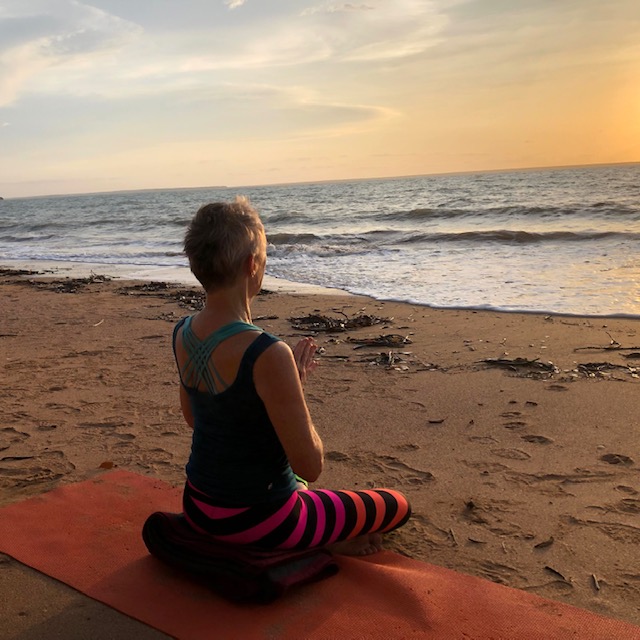
A steady, upright seat comes first, before any breathing practice.
Signs to stop pranayama for the day
Teachers in the Iyengar tradition train students to stop for the day if they notice any of these:
- Heaviness or tightness in the lungs.
- A harsh or rough breath.
- A tense face.
- Restlessness or irritability.
- Feeling faint, or swaying.
If any of those turns up, you stop. You do not push through. Pushing through is the mistake, not the practice. Open your eyes, breathe normally, rest, and tell your teacher afterwards. You will not be letting anybody down.
Is breath holding (kumbhaka) safe?
It is the part we treat with the most care. We would rather say so than leave it out. For more on how holding the breath is learned, see our note on stillness in yoga.
A German trial published in Frontiers in Psychiatry in 2023 added yoga breathing to therapy for 74 people with post-traumatic stress. Unwanted effects happened in 15 of the 40 people doing the breathing, against 1 of the 34 who were not. They were tied specifically to the breath holding.
The split in the results matters. People who found the practice comfortable did better than the control group. People who pushed on through a bad reaction during the breath holds ended up worse than if they had done no breathing at all.
If you have a history of trauma, panic attacks, or a mental health condition you are being treated for, please tell us before you begin pranayama. You do not have to explain anything you would rather not. We can teach the practice without the breath holds, which is a complete practice in its own right and not a watered-down version.
Who should adjust pranayama or leave parts out?
Asking whether pranayama is safe is really asking who it is safe for. The Iyengar answer has been in print for decades. Tell your teacher, and expect the practice to be adjusted, if any of these apply.
- High or low blood pressure, or a heart condition. Breath holding after an inhalation is not advised with high blood pressure or heart disease.
- Depression or very low mood. Breath holding after an exhalation is not advised. The Iyengar approach is to practise poses and relaxation instead until the mood lifts.
- Glaucoma, a detached retina, recent eye surgery, or ear disease. No breath holding, and no Skull-Shining Breath (Kapalabhati).
- Epilepsy. Fast breathing techniques are avoided.
- Pregnancy. No Skull-Shining Breath, no Bellows Breath, no long breath holding.
- Any acute illness, exhaustion, or a mind that is agitated today. Come to class and do the poses and relaxation instead.
- Under about sixteen years of age. No breath holding.
None of this is new, and none of it is ours. It has been in print for decades. If you have any of these, or any other medical condition, talk to your yoga teacher, and to your doctor if you wish.

Twist from the base of the spine and keep the chest lifting.
What is slow breathing good for?
The ABC gave the benefits about 250 words and no numbers. Here are some numbers, with the studies named, so you can check them yourself.
Blood pressure. Three research reviews since 2024 agree that slow breathing lowers the top number by roughly 7 mmHg and the bottom number by roughly 3.5 to 4. The most recent, in Clinical Cardiology in 2026, pooled 13 trials and 1,097 people. It is a supplement to medical treatment, not a replacement for it.
The nervous system. A review of 223 studies, by Laborde and colleagues in Neuroscience and Biobehavioral Reviews in 2022, found that slow breathing raises heart rate variability, one of the better markers of a settled nervous system. It rises during the practice, straight after it, and after a course of it.
That is the honest version. It is less exciting than the version you see on an app, and more likely to be true. For more on the blood pressure research, see how Iyengar yoga and breathing help lower blood pressure, and for the gentler practices, our notes on Viloma (staircase breath) and why pranayama is so hard at first.

The three stages of Viloma (staircase breath): interrupted inhalation, interrupted exhalation, and both.
What should you do if the article worried you?
Being worried by that article is a reasonable response to what it describes. Here is what we would say to three kinds of reader.
If you practise alone from an app, with nobody to ask, you are in the situation that produced the one pranayama story in the article. Come and learn it with a teacher, then practise at home knowing what you are doing.
If you already come to a pranayama class, nothing here changes. Supine Victorious Breath (Ujjayi) and Interrupted Breath (Viloma), with a teacher in the room or LIVE online, are a gentle way into breathwork. See our notes on Ujjayi and what pranayama is.
If something in a class ever feels wrong, stop. Open your eyes. Breathe normally. Then tell us. If there is something in your history you think we should know, have a quiet word with us before class. It stays with us, and it changes what we teach you.
Practise this at Flametree
Flametree Yoga Studio teaches Iyengar yoga, including pranayama, in the studio at Woolner and Coolalinga in Darwin, and LIVE online.
- New to Flametree? Your first class is free. In the studio, just come along. Online, go to our online class list, click the class time you want and we email you the link to join.
- Beginners: new students, and anyone who has been away three months or more, can get a half price 10 class pass with 2 extra classes free, to use online, in the studio, or both. See the beginner half price pass.
- Already practising yoga? The same half price 10 class pass with 2 extra classes free, for new students and for anyone away three months or more, is also available as the non-beginner half price pass.
- See every class time, including online classes, on the timetable.
Can’t make a class? Practise at home with our video courses.
Read more in our free ebook, Breathwork’s Original Toolkit. Stories, the science of breath, and how pranayama is learnt the Iyengar way.
2 free classes + 2 ebooks, only available via this offer, for new students or anyone away 3 months or more. Current students can still get the book. See what’s inside and get your copy
Is pranayama safe? Frequently asked questions
Is pranayama safe?
For most people, yes, when it is taught in the standard order. It usually starts with Victorious Breath (Ujjayi) and Interrupted Breath (Viloma), lying down, without any breath holding, with a teacher who can see you. Research does report unwanted effects, mainly with breath holding and with fast techniques, so tell your teacher about your health before you start.
What are the signs to stop pranayama for the day?
Teachers in the Iyengar tradition teach five: heaviness or tightness in the lungs, a harsh or rough breath, a tense face, restlessness or irritability, and feeling faint or swaying. If any appears, stop, breathe normally and rest. Do not push through.
Can pranayama cause anxiety or panic?
Fast breathing techniques can, because rapid breathing is used in research settings to bring on a panic attack. Slow breathing is a different matter. At Flametree we teach slow practices as the staple, and we teach the fast ones later and carefully. If you have a history of panic, tell your teacher before you begin.
Is breath holding (kumbhaka) safe?
It is the part that needs the most care. A 2023 German trial in Frontiers in Psychiatry, of 74 people with post-traumatic stress, tied unwanted effects specifically to breath holding. We can teach pranayama without breath holds to anyone with a history of trauma or panic, and it is a complete practice.
Is pranayama safe with high blood pressure?
The slow practices generally are, and breath holding after an inhalation generally is not. Mr BKS Iyengar listed high blood pressure and heart conditions as reasons to leave out breath holding. Slow Victorious Breath without holding is one of the practices the blood pressure research is built on. Tell your teacher before class, and follow their instructions.
Is meditation dangerous for people with mental illness?
The evidence points to caution rather than exclusion. Intensive retreats, sleep loss and unsupervised practice are the conditions where problems cluster, especially for people with a history of psychosis, bipolar disorder or trauma. A short, supervised, slow breathing practice is a different proposition. If you are being treated for a mental health condition, tell your teacher and speak to your own doctor.
Does slow breathing really lower blood pressure?
Three research reviews published since 2024 agree that it does, by roughly 7 mmHg on the top number. The open question is how long the effect lasts between practices, not whether it happens. It is a supplement to medical treatment, not a replacement for it, and you should not change any prescription without talking to your doctor.
Where can I learn pranayama safely in Darwin?
Flametree Yoga Studio teaches pranayama in Darwin, at Woolner and Coolalinga, and LIVE online. Your first class is free if you are new to Flametree (in the studio, if you have lived in the NT for three months or more; online, anyone new): in the studio you just come along, and online you click the class time you want and we email you the link to join. The half price 10 class pass is for newcomers and for students who have been away three months or more.
Do you teach Wim Hof, holotropic or 9D breathwork?
Not those branded methods. We teach traditional yoga breathing practices: alternate nostril breathing (Nadi Shodhana), Interrupted Breath (Viloma), ocean breath or Victorious Breath (Ujjayi), humming breath (Bhramari) and Skull-Shining Breath (Kapalabhati). They are taught in an order, slow practices first, with a certified teacher watching you in the studio or LIVE online.
Flametree Yoga Studio, Woolner and Coolalinga, Darwin NT, and LIVE online. This article is general information and not medical advice. The main sources, found through PubMed where indexed, are Britton and colleagues in Clinical Psychological Science, 2021; Hirshberg and colleagues in Psychological Medicine, 2022; Beloborodova and colleagues in JMIR Mental Health, 2026; Haller, Mitzinger and Cramer in Frontiers in Psychiatry, 2023; Cheng and colleagues in Clinical Cardiology, 2026; Laborde and colleagues in Neuroscience and Biobehavioral Reviews, 2022; and Mr BKS Iyengar, Light on Yoga, 1966, and Light on Pranayama, 1981. Full references are available on request.