Yoga For Pelvic Floor: What Research Shows For Leaks, Prolapse And Pelvic Pain
Yoga for pelvic floor: the short answer
Leaking when you laugh, sneeze or jump is common, especially after babies and around menopause, and most people never talk about it. Yoga for pelvic floor health can help as part of your care: a 2024 trial of 240 women found a pelvic yoga programme cut daily leaks by more than two a day, though general exercise did nearly as well. Yoga-type exercise also did about as well as pelvic floor muscle training in a 2026 review. Here is what the research says, what an Iyengar class does, when to see a pelvic health physiotherapist first, and how to start in Darwin or online.
Iyengar yoga is the style developed by Mr BKS Iyengar. In the 20th century he did more than anyone to set down traditional Indian yoga, through his books and his teaching, and he pioneered the use of props. It is sometimes called modern classical yoga, and it’s the style we teach at Flametree. This note sits in our menopause and women’s health notes.
Yoga for pelvic floor in short form
- What it is: the sling of muscles at the base of the pelvis, in women and men.
- 2024 trial: pelvic yoga cut leaks by 2.3 a day; general exercise by 1.9.
- 2026 review: yoga-type exercise about as good as pelvic floor training.
- Too tight or too loose: a pelvic floor needs to relax as well as lift.
- Breath: the pelvic floor moves with the diaphragm as you breathe.
- Honest limit: little research on prolapse; see a pelvic health physio.
- Next step: your first class is free if you are new to Flametree.
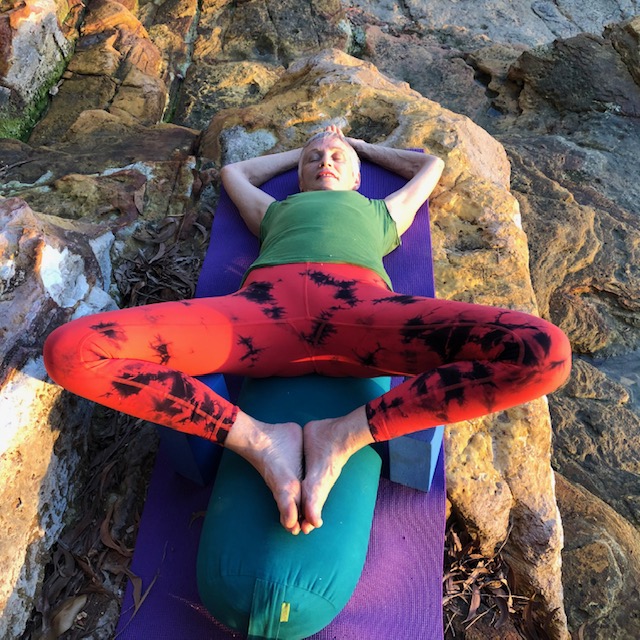
Supported bridge with the legs in bound angle, on a bolster. The pelvis is lifted and rested, with no effort.
Free ebook: Cool, Calm And Strong. Fewer leaks in twelve weeks, why a pelvic floor can be too tight, and yoga through the change.
New to Flametree, or away 3 months or more? 2 free classes + 2 ebooks, only available via this offer. Already a student? You can still get this book. Get your free copy of Cool, Calm And Strong
What is the pelvic floor?
The pelvic floor is a sling of muscles at the base of the pelvis, the bottom of the cylinder of core muscles around your trunk. It holds up the bladder, bowel and, in women, the uterus, and it helps control when you go to the toilet.
Pregnancy, childbirth, menopause, heavy lifting, chronic coughing and constipation can all weaken it. Sometimes it is too tight instead, which can cause pain. Both men and women have one.
Leaks are far more common than most people think. In a US study of nearly 65,000 nurses aged 36 to 55, about 1 in 7 started leaking over two years, and only 38% told a doctor. If it is happening to you, you are in very large company.
Dr Timothy McCall’s June 2019 list of 117 health conditions helped by yoga includes urinary incontinence, pelvic organ prolapse and pelvic pain. The last two were among his additions after 2016.

A forward bend with support lengthens the back of the legs.
Is yoga good for the pelvic floor? What the research says
Yoga can help, about as much as other structured exercise. Each finding below gives the year and what yoga was compared with.
- 2024 trial, Annals of Internal Medicine, USA: 240 women aged 45 to 90 with daily bladder leakage. Twelve weeks of pelvic floor yoga (twice a week in class, once at home) cut leaks by 2.3 a day. A general stretching and strengthening programme cut them by 1.9 a day. The difference between the two was too small to be sure of, so the authors said the yoga programme was not superior.
- 2026 review, International Urogynecology Journal: 14 randomised trials, 797 women with stress leakage (leaking with coughs, sneezes or effort). Other exercise, including yoga, breathing and Pilates-type programmes, worked about as well as pelvic floor muscle training, and much better than usual care. No adverse events were reported.
- 2026 trial, Istanbul: 46 women with stress or mixed leakage. Both yoga-based and Pilates-based breathing programmes improved leakage. The yoga-based group had better quality of life and lower resting pelvic floor muscle tension.
- Two earlier UCSF trials: the 2024 trial came from the University of California, San Francisco, after two smaller ones. In 2014, 19 women did six weeks of yoga or waited: leaks fell 70% with yoga and 13% while waiting. In 2018, 56 women did three months of Iyengar-based yoga or stretching: leaks fell 76% with yoga and 56% with stretching. Leslie Howard writes that she helped design the yoga for the first trial with Judith Hanson Lasater.
- 2019 Cochrane review: at that time only 2 small studies (49 women) existed, so the evidence was very uncertain. The larger trials above have been published since.
In plain terms: yoga is a reasonable way to work the pelvic floor, not a special cure. For prolapse and pelvic pain, there is very little yoga research yet. A pelvic health physiotherapist should be your first stop for any of these.

Fold from the hips and keep the spine long.
Can a pelvic floor be too tight as well as too loose?
Yes, and many people never hear this. In her book Pelvic Liberation (yoga teacher Leslie Howard), the author tells how a pelvic floor specialist explained to her that the pelvic floor can be too tight, too loose, or a mix of both. She had been doing daily squeezing exercises because she assumed hers was weak.
Howard describes the usual squeeze-and-hold exercises (named after Dr Arnold Kegel, an American obstetrician) as one tool, not the answer for everyone, and says they can do harm when used in the wrong situation. In our experience, that is why we teach the pelvic floor as something to release as well as lift. It is the same idea as the 2026 Istanbul trial above, where lower resting tension was part of the result.
This is not a reason to stop exercises a health professional gave you. It is a reason to ask them whether yours is weak, tight or both. Howard also writes about the habit of tucking the tailbone under, and our note on whether to tuck your tailbone looks at how to sit and stand without it.
How can I tell if my pelvic floor is too tight or too weak?
The type of leak is a good first clue, and a pelvic health physio can tell you for sure. Howard’s own story shows why it matters. In her 40s, after a year of daily strengthening, sex began to hurt and long drives brought a burning feeling between her sitting bones. A pelvic floor physiotherapist examined her and found her muscles were too tight. “I didn’t even know a woman could be too tight,” she writes.
- Stress leaks come with a cough, sneeze, laugh, jump or lift, often with no warning. They usually go with a weak, stretched pelvic floor, and building tone helps.
- Urge leaks come with a sudden, strong need to go, sometimes the moment the key is in the front door. In Howard’s experience they can go with a tight, over-busy pelvic floor, and learning to relax it can help.
Many women have both, and Howard’s advice is to deal with the urge side first. She also points to everyday habits that keep urge leaks going: going “just in case”, which teaches the bladder that any amount means “find a toilet”, and hovering over a public toilet, which asks the pelvic floor to hold you up and let go at the same time.
A healthy pelvic floor is springy: it lifts when you cough or lift, and lets go fully afterwards. If you are not sure which kind you have, a continence nurse or a pelvic floor physio in Darwin can check, and then a yoga class can work on whichever side needs it.

Too tight, too loose, or springy and just right. A good class works on lifting and letting go. (Source: Leslie Howard, Pelvic Liberation.)

Reclining bound angle (Supta Baddha Konasana) with bolsters and a belt. A restful pose for letting the pelvic floor soften.
How does breathing work with the pelvic floor?
The pelvic floor moves with your breath. In her book Science of Yoga, Ann Swanson describes the pelvic floor muscles moving down as you breathe in and up as you breathe out, following the diaphragm (the big breathing muscle under the lungs). A pelvic floor that moves freely through that range is a healthy sign.
A Yoga Journal article on the pelvic floor, which quotes the therapists Richard Sabel and Bill Gallagher, suggests an easy way to feel it: sit quietly and notice a gentle widening as you breathe in, and a slight lift at the end of the out-breath. This is why slow breathing is part of how we teach the pelvic floor, and why holding your breath is best avoided.

Lying down lets the body rest while it stretches.
What an Iyengar class does for the pelvic floor
An Iyengar class works the pelvic floor as part of the whole core: standing poses that lift from the legs and pelvis, inversions and backbends that ask for control, and restorative poses and slow breathing that let the muscles let go.
One woman in a Flametree women’s wellness class looked down at the block squeezed between her thighs and said, to everyone’s amusement, “If only my mother could see me now!” Odd as it looks, the block is a simple, well-loved prop for this work.
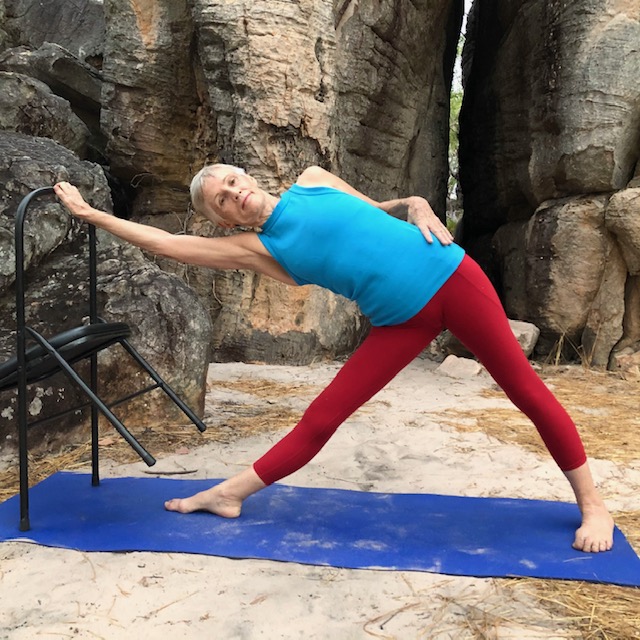
Reach long through both arms in triangle pose.
Yoga poses for pelvic floor that are commonly taught
- Standing poses with a block between the thighs: gripping the block lightly wakes up the inner thighs and pelvic floor together. It can also be done in a seated side twist on a chair.
- Chair Arch: a gentle backbend over a chair that asks the core, including the pelvic floor, to work. It suits most levels and prepares students for backbends and inversions.
- Bridge pose (Setu Bandha Sarvangasana): lifting the pelvis, then resting it supported on a bolster or block.
- Reclining bound angle (Supta Baddha Konasana): supported, so the pelvic floor can relax.
- Supported squat (Malasana): with the heels raised on a blanket if needed.
- Slow breathing: the pelvic floor is commonly taught to lift gently on the out-breath and soften on the in-breath.
Chris also teaches this in her women’s wellness classes, where the aim is a pelvic floor that is neither too loose nor too tight. That balance is known from long practice; research has only begun to look at it. Standing tall with the feet pointing straight ahead is a basic part of that teaching.

A deep squat (Malasana). Beginners often rest the heels on a folded blanket; staying low works the pelvic floor, hips and legs together.
How to practise safely
- See a pelvic health physiotherapist for leakage, prolapse or pelvic pain. They can check whether your pelvic floor is weak, tight or both.
- Prolapse: tell your teacher. Poses that bear down or strain, and some inversions, may need changing.
- Pelvic pain: focus on relaxing, not squeezing. Restorative poses and slow breathing come first.
- After childbirth or surgery: wait until your doctor or physio clears you. For pregnancy, see our pregnancy yoga page.
- Do not hold your breath or strain; breathe out on effort.
Yoga for the pelvic floor in men
Men have a pelvic floor too. It matters for bladder control, especially after prostate surgery, and for sexual function. A small 2026 trial in 40 men with chronic pelvic pain found six weeks of daily yoga improved symptoms about as much as medication, with fewer side effects, though medication was better for urinary symptoms. See yoga classes for men.
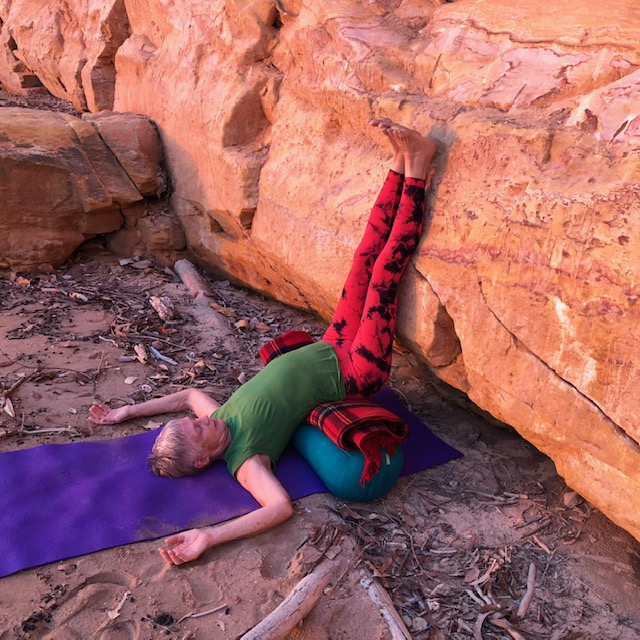
Legs up the wall with a bolster under the hips. Taking the weight off the pelvic organs is a restful way to end a practice.
Yoga for pelvic floor in Darwin and live online
Flametree Yoga Studio teaches Iyengar yoga at Woolner in Darwin and LIVE online. Christine (Chris) Lalor, Senior Iyengar Yoga Teacher and certified yoga therapist, runs women’s wellness classes and workshops where pelvic floor work is a focus, and beginner classes run every week.
- New to Flametree? Your first class is free. In Darwin, just come along to the studio. Online, click the class time you want and we email you the link to join. Get your link to join an online class here, or see the beginner timetable.
- Keep going at half price. See the half price pass: 10 classes at half price with 2 extra classes free, to use online, in the studio, or both. It is for new students, and for anyone who has been away three months or more.
- Already practising yoga? There is also a non-beginner half price pass.
Related pages: women’s wellness yoga, yoga for intimacy, yoga for menopause, yoga for back pain over 50, can yoga build muscle, and the benefits of yoga page, which carries Dr Timothy McCall’s June 2019 list of 117 health conditions helped by yoga.
Read more in our free ebook, Cool, Calm And Strong. Angie’s story, Geeta Iyengar’s own menopause, and what the trials show.
2 free classes + 2 ebooks, only available via this offer, for new students or anyone away 3 months or more. Current students can still get the book. See what’s inside and get your copy
Yoga for pelvic floor: frequently asked questions
Is yoga good for the pelvic floor?
It can help as part of your care. A 2024 trial of 240 women aged 45 to 90 with daily leakage found a 12-week pelvic floor yoga programme cut leaks by about 2.3 a day, but general stretching and strengthening did about as well. A 2026 review found yoga-type exercise worked about as well as pelvic floor muscle training for stress leakage.
Can yoga help bladder leakage?
Research suggests it can reduce leaks, about as much as other structured exercise. In the 2024 US trial, leaks fell by 2.3 a day with pelvic yoga and 1.9 a day with general exercise, a difference too small to be sure of. Pelvic floor muscle training taught by a health professional remains the first thing to try.
Is yoga better than Kegel exercises?
Not better, as far as the research shows. A 2026 review of 14 trials found yoga, breathing and similar exercise worked about as well as pelvic floor muscle training (Kegel exercises) for stress leakage. Many women find doing both, and doing them regularly, is what counts.
Can yoga help pelvic organ prolapse?
There is very little research on yoga for prolapse. Pelvic floor muscle training is the proven first step, so see a pelvic health physiotherapist. In class, tell your teacher: poses that bear down or strain, and some inversions, may need changing.
Which yoga poses are good for the pelvic floor?
Commonly taught poses include standing poses with a block between the thighs, bridge pose, supported bound angle (Supta Baddha Konasana), squatting with support, and slow breathing that lets the pelvic floor both lift and relax. No single pose has been proven best.
Can yoga help a tight or painful pelvic floor?
Some pelvic floors are too tight rather than too weak, and relaxation matters as much as strengthening. In a 2026 trial, yoga-based breathing lowered resting pelvic floor muscle tension more than a comparison breathing programme. Restorative poses and slow breathing are the usual starting point; see a pelvic health physiotherapist for pelvic pain.
How does breathing affect the pelvic floor?
The pelvic floor moves down as you breathe in and up as you breathe out, following the diaphragm. Ann Swanson describes this in her book Science of Yoga. Slow, easy breathing is a gentle way to notice that movement, and it is why holding your breath is best avoided.
Is yoga for the pelvic floor only for women?
No. Men have a pelvic floor too, and it matters for bladder control, especially after prostate surgery. A small 2026 trial in men with chronic pelvic pain found daily yoga did about as well as medication, with fewer side effects.
How common are bladder leaks in midlife?
Very common. In a US study of nearly 65,000 nurses aged 36 to 55, about 1 in 7 started leaking over two years, and only 38% told a doctor. A continence nurse or pelvic floor physio in Darwin can tell you whether yours are stress leaks, urge leaks or both.
Where can I do yoga for the pelvic floor in Darwin or online?
Flametree Yoga Studio teaches Iyengar yoga at Woolner in Darwin and LIVE online, including women’s wellness classes and workshops led by Christine (Chris) Lalor, Senior Iyengar Yoga Teacher and certified yoga therapist. Your first class is free if you are new to Flametree.
This article is general information, not medical advice. Talk to your yoga teacher, yoga therapist, and your doctor if you wish, and see a pelvic health physiotherapist about leakage, prolapse or pelvic pain. Flametree Yoga Studio, Darwin and live online.
Sources: Huang AJ and colleagues, Efficacy of a therapeutic pelvic yoga program versus a physical conditioning program on urinary incontinence in women: a randomized trial, Annals of Internal Medicine, 2024, doi 10.7326/M23-3051. Hao J and colleagues, Alternative exercise regimens for stress urinary incontinence in women: a systematic review and meta-analysis, International Urogynecology Journal, 2026, doi 10.1007/s00192-025-06445-y. Girit Ozden SZ and colleagues, Yoga- and Pilates-based respiratory training in individuals with urinary incontinence: a randomized controlled trial, International Urogynecology Journal, 2026, doi 10.1007/s00192-026-06680-x. Wieland LS and colleagues, Yoga for treating urinary incontinence in women, Cochrane Database of Systematic Reviews, 2019, doi 10.1002/14651858.CD012668.pub2. Gaur AS and colleagues, COPE trial: comparison of yoga therapy versus medical therapy in men with chronic pelvic pain syndrome, International Urology and Nephrology, 2026, doi 10.1007/s11255-026-05354-3. McCall T, 117 Health Conditions Helped by Yoga, Yoga As Medicine, June 2019, DrMcCall.com. Howard L, Pelvic Liberation: Using Yoga, Self-Inquiry and Breath Awareness for Pelvic Health. Swanson A, Science of Yoga. Huang AJ and colleagues, A group-based yoga therapy intervention for urinary incontinence in women: a pilot randomized trial, Female Pelvic Medicine and Reconstructive Surgery, 2014, doi 10.1097/SPV.0000000000000072. Huang AJ and colleagues, A group-based yoga program for urinary incontinence in ambulatory women, American Journal of Obstetrics and Gynecology, 2018, doi 10.1016/j.ajog.2018.10.031. Townsend MK and colleagues, Incidence and remission of urinary incontinence in middle-aged women, American Journal of Obstetrics and Gynecology, 2007, doi 10.1016/j.ajog.2007.03.041. Yoga Journal, article on the pelvic floor quoting R Sabel and B Gallagher (year not confirmed).