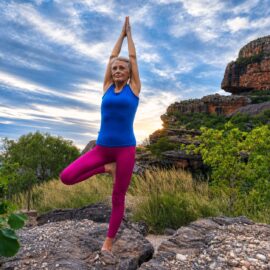
Yoga For Menopause And Perimenopause: What The Research Shows, And The Poses We Use
Yoga for menopause: the short answer
Chris Lalor remembers her mother, in her menopause years, as moody, tired and a bit red in the face, and her hair thinning, and nobody in the family knew why. It was menopause, and it was far harder on her than anyone could see. Yoga for menopause and perimenopause has a strong research base. A 2025 review of 24 trials with 2,028 women found yoga improved overall menopause symptoms, including mood, anxiety, sleep, body symptoms and bladder and vaginal symptoms, compared with usual care. The same review found no clear effect on hot flushes, and other reviews are mixed on them. So yoga can help with many menopause symptoms, it is safe, and it works best as part of a regular practice.
Iyengar yoga is the style developed by Mr BKS Iyengar. In the 20th century he did more than anyone to set down traditional Indian yoga, through his books and his teaching, and he pioneered the use of props. It is sometimes called modern classical yoga, and it’s the style we teach at Flametree. This page sits in our menopause notes.
Yoga for menopause in short form
- The research: a 2025 review of 24 trials found overall menopause symptoms improved.
- What improved: mood, anxiety, sleep and blood pressure.
- Hot flushes: the evidence is mixed, and the newest review found no clear effect.
- Against other exercise: yoga did about as well.
- Chris Lalor’s Iyengar sequence for menopause, pose by pose, below.
- Restorative poses and slow breathing help most with sleep and mood.
- Next step: your first class is free if you’re new to Flametree, in Darwin or LIVE online.

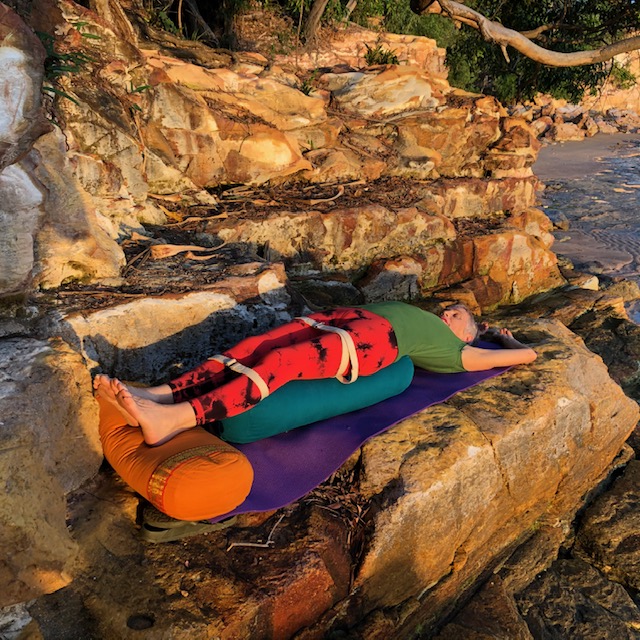
Yoga for menopause often starts here: Reclining Bound Angle Pose, lying back over a bolster. Hold 8 to 10 minutes.
Free ebook: Cool, Calm And Strong. Yoga for perimenopause, menopause and beyond: flushes, sleep, leaks and bones.
New to Flametree, or away 3 months or more? 2 free classes + 2 ebooks, only available via this offer. Already a student? You can still get this book. Get your free copy of Cool, Calm And Strong
Perimenopause and menopause, in plain words
Menopause is when periods stop for good. The years leading up to it are called perimenopause (the change leading to menopause), and they usually start in the mid to late forties and can last several years. Hormone levels swing up and down during this time, which is why symptoms can come and go.
Common symptoms include hot flushes and night sweats, broken sleep, tiredness, low mood, anxiety, brain fog, joint aches, weight changes, bladder changes and vaginal dryness. Every woman’s experience is different. For some the change is smooth, and for others it is a real challenge.
What does the research say about yoga for menopause?
- Wang 2025, International Journal of Nursing Studies. 24 randomised trials, 2,028 women. Compared with usual care, yoga improved total menopause symptoms, psychological, body and urogenital (bladder and vaginal) symptoms, sleep quality, anxiety, depression, body mass index and blood pressure. There was no significant effect on hot flushes or on quality of life (Wang 2025).
- Cramer 2018, Maturitas. 13 trials, 1,306 women. Compared with no treatment, yoga reduced total, psychological, body, hot flush and urogenital symptoms. Compared with other exercise, only the effect on hot flushes remained, and the authors concluded yoga’s effects were comparable to other exercise (Cramer 2018).
- Reed 2014, MsFLASH trial, American Journal of Obstetrics and Gynecology. 355 women aged 40 to 62. Twelve weeks of yoga improved menopause quality of life a little compared with usual activity. The authors said the clinical importance of that small change was uncertain (Reed 2014).
- Fan 2025, Frontiers in Public Health. 18 trials of mind-body therapies for menopausal women. Sleep, depression and anxiety all improved by moderate to large amounts, with yoga giving stable benefits for sleep (Fan 2025).
- Bruyneel 2026, Sleep Medicine. For chronic insomnia around and after menopause, non-drug treatments including yoga were judged among the most robust first-line options (Bruyneel 2026).
What about hot flushes?
Honestly, the evidence is mixed. The 2018 review found fewer hot flushes with yoga, but the larger 2025 review did not find a clear effect. Many women tell us cooling, restful poses help them feel calmer when a flush comes, and Iyengar teaching uses them for that reason. But if hot flushes are your main problem, talk to your doctor about all your options, and treat yoga as support for the whole body rather than a hot flush treatment.
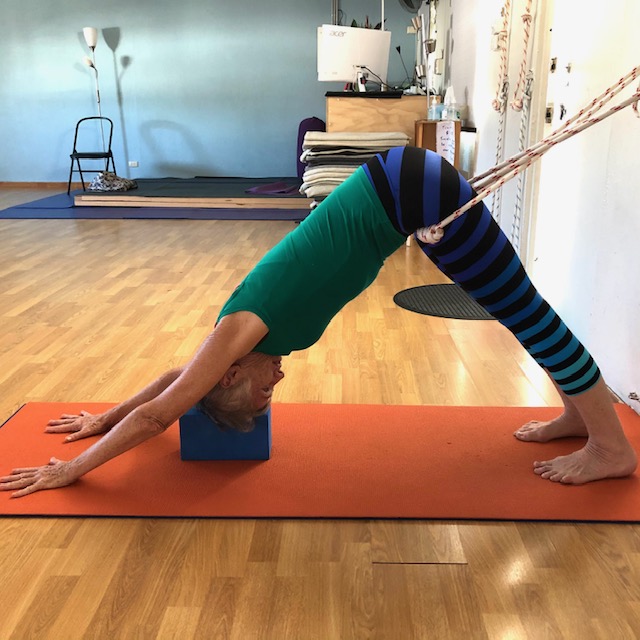
Downward Dog with the head supported and the hips held by ropes. Restful and refreshing at the same time.
Chris’s story
I (Chris Lalor) did not start yoga until my late 30s. I found it looking for help with sleep, after a very stressful time. For about 25 years before that I had difficult periods, and with yoga that problem eased within a year. By the time perimenopause came, I had a regular yoga and pranayama (breath meditation) practice, and I had a very easy time of it, with few symptoms that I noticed. I believe my practice made a big difference. That is my experience, and every woman’s is different. If you are already talking about menopause with a health professional, I suggest adding yoga to what you do, not replacing anything. I have told the full story in another post, menopause symptoms and my yoga story.
What an Iyengar class does for menopause
- Standing poses for strength and bones. Muscle and bone both decline faster after menopause. Standing poses load the legs and hips. See yoga for osteoporosis for more on bones.
- Restorative poses for sleep and mood. Supported poses, held for several minutes, help the body switch to “rest and digest”.
- Slow breathing. A longer out-breath calms the nervous system, and many women use it when a flush or a wave of anxiety arrives.
- Props, so you can stay. Bolsters, belts, blocks and chairs let you hold poses long enough to feel their effect, whatever your flexibility.
- Pelvic floor care. Many women notice bladder changes at this time. Our page on yoga for the pelvic floor explains what a class can do here.
A few safe practice notes. If you are bleeding heavily or irregularly in perimenopause, talk to your teacher, as some inversions (upside-down poses) are done differently at that time. If you have osteoporosis (thin, fragile bones), tell your teacher so deep forward bends and twists can be changed. And talk to your doctor about new or heavy bleeding, or symptoms that worry you.
Yoga poses for menopause: Chris’s sequence
I am a certified Senior Iyengar Yoga Teacher, and these are poses I teach in class and practise myself. What each pose is taught for comes from Iyengar teaching and long practice. The research above looked at yoga programmes as a whole, not at single poses. Talk to your teacher about any particular issue, so the sequence can be adjusted for you.
Seated and lying poses to begin
Reclining Bound Angle Pose (Supta Baddha Konasana), shown at the top of this page. A good pose to start or finish with. Iyengar teaching uses it to calm the nerves and for sleep. It is a cooling pose. Hold 8 to 10 minutes.
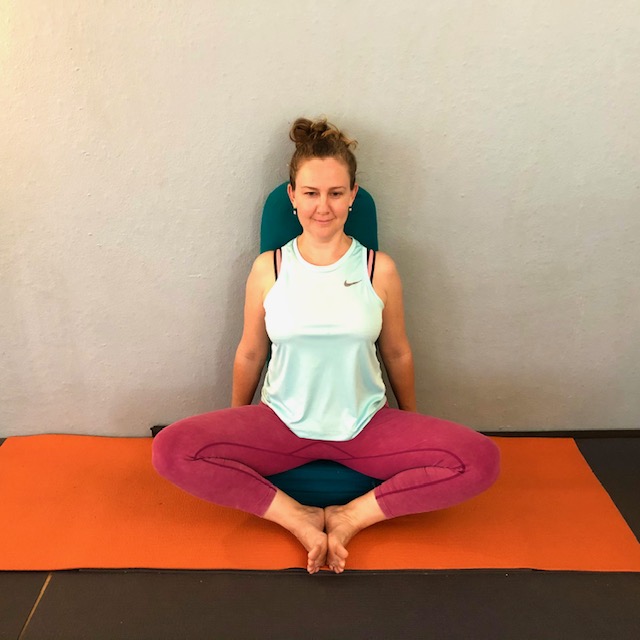
Seated Bound Angle Pose (Baddha Konasana), with support. Taught to bring circulation to the pelvis and to calm. Hold 1 minute.

Seated Wide Angle Pose (Upavistha Konasana). Taught for the pelvic area and for calm. Hold 1 minute.

Lying Big Toe Pose (Supta Padangusthasana) with a belt. Can ease back ache and keeps the hips moving. Hold 1 to 2 minutes each side.
Standing and forward bending poses

Downward Dog with the head on blocks. Taught to refresh the whole body and settle the mind. Hold 2 minutes.
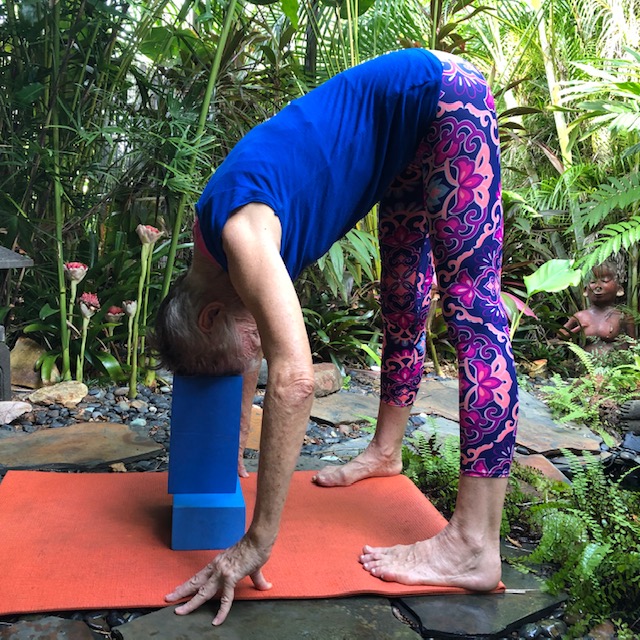
Standing forward bend with the head supported (Uttanasana). Quietens the mind and eases stress. Hold 2 minutes.

Wide leg standing pose, head up (Prasarita Padottanasana). Taught to reduce tiredness. Hold 1 minute.
Supported backbends and seated forward bends

Lying over crossed bolsters. Opens the chest and deepens the breath, and is taught for tiredness and low mood. Hold 5 to 8 minutes.

Bent knee forward bend with the head on a bolster over a chair. Quietens the nervous system and eases anxiety. Hold 2 to 3 minutes each leg.

A gentle chair twist (Bharadvajasana on a chair). Taught to restore energy and calm.
Supported inversions and resting poses
Supported Bridge Pose over a bolster. One of the best poses for quieting the nervous system and for sleep. Hold 5 to 10 minutes.
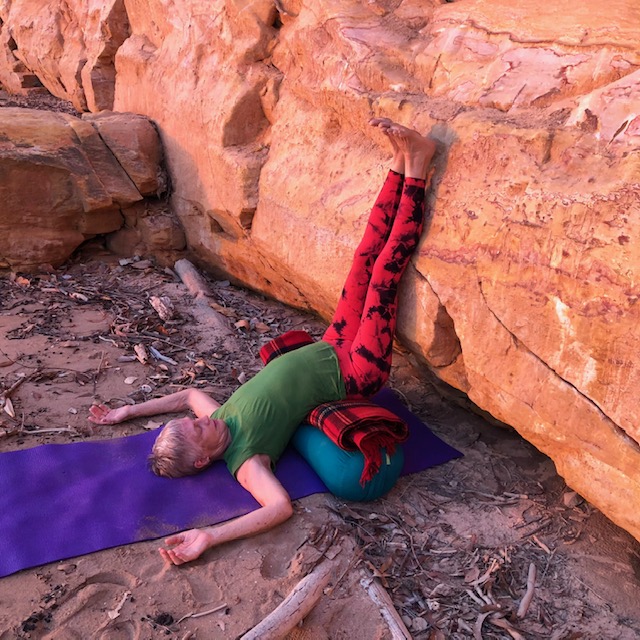
Waterfall Pose, legs up the wall with a bolster under the hips. Calms the mind and refreshes body and mind. Hold 4 to 5 minutes.

Corpse Pose (Savasana). A restful pose to end with, to let the whole system settle. Hold 5 to 10 minutes.
Shoulder stand, Plough Pose and headstand also form part of the Iyengar menopause sequence, done with props. They are learnt with a teacher first, so they are not described here as home practice.
Yin yoga, and other styles
People often ask which style of yoga suits menopause. The trials above looked at a range of styles. At Flametree we teach Iyengar yoga, where every class includes a lot of floor-based work and many include restorative poses, so you get long, supported holds taught with props and care.
Honest limits
- Most trials are small and people know they are doing yoga.
- Hot flushes did not clearly improve in the largest recent review.
- Against other exercise, yoga did about as well rather than clearly better.
- Much of the evidence is short term, around 8 to 12 weeks.
Yoga is not a replacement for medical care. Talk to your doctor about menopause symptoms if you wish, including all the treatment options. Yoga can sit alongside any treatment you choose.
Yoga for menopause in Darwin, or LIVE online
Flametree Yoga Studio teaches gentle and restorative classes, plus early morning pranayama, at Woolner and Coolalinga in Darwin and LIVE online. Chris Lalor, Senior Iyengar Yoga Teacher and certified yoga therapist, has taught women’s classes for many years.
- New to Flametree? Your first class is free. In the studio, just come along. Online, go to our online class list, click the class time you want and we email you the link to join.
- Keep going at half price. New students, and anyone who has been away three months or more, can get a half price 10 class pass with 2 extra classes free, to use online, in the studio, or both. See the half price pass.
- Already practising yoga? The same half price 10 class pass for new students, and for anyone away three months or more, is also available as the non-beginner half price pass.
- See every class time on the beginner timetable.
Read more: menopause symptoms and Chris’s yoga story, menopause home yoga practice sequence, yoga for anxiety and perimenopause anxiety, yoga for sleep, yoga for bones and osteoporosis, brain fog and menopause, and the benefits of yoga hub.
Yoga for menopause: questions people ask
Is yoga good for menopause?
Yes, for many women. A 2025 review of 24 trials found yoga improved overall menopause symptoms, mood, anxiety, sleep and blood pressure compared with usual care. It did about as well as other exercise, and it works best practised regularly.
Does yoga help with hot flushes?
The evidence is mixed. A 2018 review found fewer hot flushes with yoga, but a larger 2025 review found no clear effect. Many women find cooling, restful poses and slow breathing help them stay calm during a flush. If hot flushes are your main problem, talk to your doctor about all your options.
Which yoga poses are best for menopause?
Restorative poses such as Reclining Bound Angle Pose, supported Bridge Pose and legs up the wall help most with sleep and calm. Standing poses help strength and bones. Supported forward bends and slow breathing help with anxiety. An Iyengar teacher can put them in the right order for you.
Can yoga help perimenopause symptoms?
Many of the women in the trials were in perimenopause. Yoga improved psychological and body symptoms, anxiety and sleep. Because symptoms come and go in perimenopause, a regular practice you can adjust week to week works best.
Can yoga help menopause sleep problems?
Yes, according to newer reviews. A 2025 review found yoga improved sleep quality in women at menopause, and a 2026 review judged non-drug approaches including yoga among the best first options for menopause-related insomnia.
Can yoga help menopause weight gain?
The 2025 review found a small drop in body mass index with yoga. Yoga also builds muscle and helps with stress and sleep, which both affect weight. It is one part of the picture, alongside eating well.
Is it too late to start yoga for menopause?
No. The MsFLASH trial enrolled women aged 40 to 62, and many of our students start in their forties, fifties and beyond. Props let you hold poses comfortably whatever your flexibility. Chris suggests starting before perimenopause if you can, but a regular practice started at any time is worth having.
Where can I do yoga for menopause in Darwin?
Flametree Yoga Studio teaches gentle and restorative classes at Woolner and Coolalinga in Darwin and LIVE online. If you are new to Flametree your first class is free, then there is a half price 10 class pass with 2 free.
Sources
- Wang H et al. The effectiveness of yoga on menopausal symptoms. Int J Nurs Stud 2025. doi:10.1016/j.ijnurstu.2024.104928
- Cramer H et al. Yoga for menopausal symptoms: a systematic review and meta-analysis. Maturitas 2018. doi:10.1016/j.maturitas.2017.12.005
- Reed SD et al. Menopausal quality of life: RCT of yoga, exercise, and omega-3 supplements. Am J Obstet Gynecol 2014. doi:10.1016/j.ajog.2013.11.016
- Fan Z et al. Mind-body therapies for sleep disturbances, depression, and anxiety in menopausal women. Front Public Health 2025. doi:10.3389/fpubh.2025.1686981
- Bruyneel M et al. Treatments for chronic insomnia in perimenopausal and postmenopausal women. Sleep Med 2026. doi:10.1016/j.sleep.2026.109040
Flametree Yoga Studio teaches Iyengar yoga in Darwin, at Woolner and Coolalinga, and LIVE online anywhere.
Last updated 14 October 2026: added the hub link, short form, bones and pelvic floor links, and corrected when Chris started yoga. This article is general information, not medical advice. Talk to your yoga teacher, yoga therapist, and your doctor if you wish, especially about unusual bleeding.