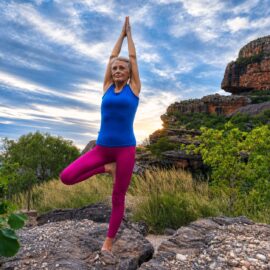
Can Yoga Build Muscle? Why Yoga Is Not Just Stretching
Can yoga build muscle? The short answer
In her thirties, Chris Lalor could lift, carry and dig for hours in her plant nurseries in Melbourne. She looked strong, and she was stiff. Can yoga build muscle? Yes, it builds muscle strength, and it does it in a way most people never notice, because a held yoga pose looks so still. Yoga is not just stretching. When you hold a yoga pose, your own body is the weight, and your muscles work hard the whole time you are there. That is why yoga for core strength and yoga poses for strength are a real part of every Iyengar yoga class at Flametree Yoga Studio, in Darwin and LIVE online.
Iyengar yoga is the style developed by Mr BKS Iyengar. In the 20th century he did more than anyone to set down traditional Indian yoga, through his books and his teaching, and he pioneered the use of props. It is sometimes called modern classical yoga, and it’s the style we teach at Flametree. This page sits in our bones and balance notes.
Can yoga build muscle? This note in short form
- Yoga is not just stretching. A still pose is full of muscle work.
- Holding a pose is strength work. Your body is the weight.
- Muscles work three ways in yoga: holding, lowering and lifting.
- Levers and props let the load grow step by step.
- Half Moon and Chaturanga show how the whole body works together.
- The research shows people get stronger, not bigger.
- You do not need to be strong first. A hand on the wall or a chair counts.
- Next step: your first class is free if you’re new to Flametree.

Yoga is not just stretching. In a held Warrior II, nothing moves, but the muscles, bones, balance and mind are all working.
Free ebook: Strong Bones, Steady Feet. How ordinary poses load bone and build leg strength, and what the research shows after 50.
New to Flametree, or away 3 months or more? 2 free classes + 2 ebooks, only available via this offer. Already a student? You can still get this book. Get your free copy of Strong Bones, Steady Feet
Why do so many people think yoga is only stretching?
Ask most people what yoga is, and they will say stretching. Touching your toes. Getting bendy. Lying on a mat.
It is easy to see why. From the outside, a yoga pose looks still. Nothing seems to be moving, so it looks as though nothing is happening.
But stillness is not the same as rest. Stand in Warrior II (Virabhadrasana II) for thirty seconds and your front thigh will tell you otherwise. It starts to burn, then to shake. That is muscle doing real work.
This matters, because the idea that yoga is only stretching keeps people away from it. A woman in her fifties who feels her strength slipping away may think, “Yoga is not for that.” So the people who could use yoga strength the most often walk straight past it.
Chris Lalor, who has taught Iyengar yoga for more than thirty years, puts the difference simply. Some people are strong, but they hold themselves up with grit and effort alone. Yoga asks for something smarter: strength that is used with intelligence.
A misperception with an old name: avidya
Yoga has a word for this kind of mistake. In the Yoga Sutras, the sage Patanjali calls it avidya (not seeing clearly). It means taking something for what it looks like, rather than what it really is.
“Yoga is just stretching” is a small, everyday avidya. It sees the shape and misses the work. And it keeps people from the many other things yoga offers: strength, steadiness, better balance and a quieter mind.
The rest of this article is about seeing a yoga pose clearly.
Can yoga build muscle? How a held pose does it
A held yoga pose is isometric work (a muscle working without changing length). Your muscles pull hard against your bones to hold you in shape, even though nothing moves.
Three things are happening while you hold:
- Your muscles burn fuel every second. A held muscle uses energy the whole time, even when it is still.
- More of the muscle joins in as you hold. As the first muscle fibres tire, your nervous system calls in fresh ones to keep you steady. A 2005 study in the Journal of Applied Physiology measured exactly this.
- Holding your own body is hard work. In a 2008 study of 15 adults, holding a load in position tired a muscle about twice as fast as pushing the same force against something fixed. A standing yoga pose is exactly that: your own body is the load, held in a shape.
So is yoga resistance training? In yoga, your own body is the weight. Holding a pose asks real work of your legs, hips, back and arms, and that work is what builds strength. The recipe is load, time and repetition: enough load to challenge the muscle, enough time for the effort to build, and coming back to it week after week.

Can yoga build muscle? Your own body is the load, the hold gives it time, and coming back week after week builds strength.
Stronger and better wired, not bigger
Here is the honest part. The research shows people get stronger with regular yoga. It does not show that yoga makes muscles bigger. No trial has measured that yet.
That is not a problem. Strength fades much faster than muscle size as we age: a 2012 review in Frontiers in Physiology found strength is lost two to five times faster than muscle mass. So strength, and how well your nervous system switches your muscles on, is the thing most worth training after 40. A held yoga pose trains exactly that.
Three ways a muscle works in a yoga pose
Muscles do not only hold. In a yoga class they work in three different ways, often in the same pose.
Holding (isometric: working without moving). The standing leg in Tree Pose (Vrksasana). The front leg in Triangle Pose (Utthita Trikonasana). The muscles stay on, and hold you steady.
Lowering (eccentric: working while the muscle lengthens). When you slowly bend your front knee into Warrior II, the front of your thigh controls the drop instead of letting you fall into it. This is one of the strongest signals a muscle can get.
Lifting (concentric: working while the muscle shortens). Rising up out of Chair Pose (Utkatasana), or straightening the front leg after a bent-knee standing pose. The muscles shorten to lift you against gravity.

Holding, lowering and lifting: the three ways a muscle works in a yoga pose. Most yoga poses use all three.
In Warrior II, the quadriceps (the muscles at the front of the thigh), the buttock muscles and the muscles of the trunk all work at once to hold you against gravity. The longer you hold, the longer the muscles stay under load.

Chris Lalor in Warrior II (Virabhadrasana II): the back leg straight, the front thigh working hard to hold the bend.
How leverage makes a still yoga pose harder
The further a limb reaches from the joint that holds it, the harder the muscles work. Think of holding a shopping bag close to your body, then at arm’s length.
Yoga uses this all the time. Raising the arms overhead in Warrior I (Virabhadrasana I), lifting the back leg in Warrior III (Virabhadrasana III), or balancing on one hand in Side Plank (Vasisthasana) all lengthen the lever. Same pose, more work.

Yoga poses for strength use leverage: the further the arms reach from the shoulders, the harder the muscles work.
Why Iyengar yoga uses props if the aim is strength
This is where the Iyengar style is different. A wall, a chair, a belt or a block can take load off at first, so you can find the right muscles without straining. Later, the same prop can add challenge, help you hold a pose for longer, or keep your alignment true so the right muscles do the work.
So strength builds step by step, rather than through brute effort. That is a big part of why yoga strength suits people over 40, and people coming back after a long break.
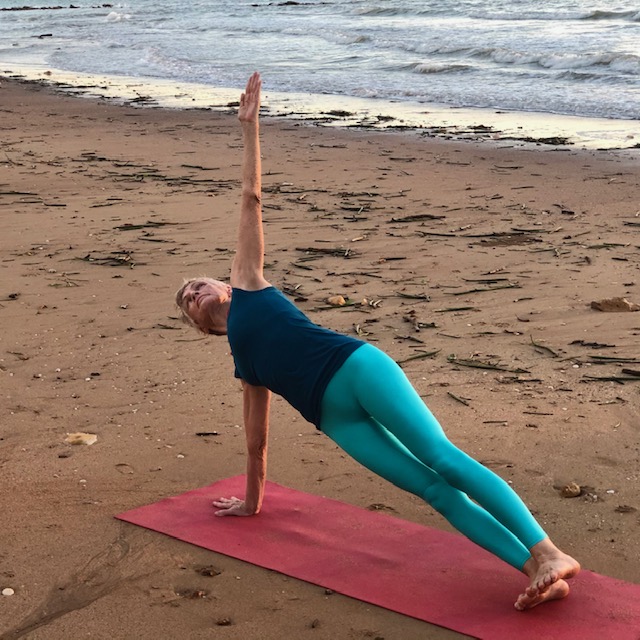
Side Plank (Vasisthasana): a long lever, with the whole side of the body working to hold the hips up.
Half Moon Pose: a still yoga pose full of work
Half Moon Pose (Ardha Chandrasana) is a beautiful example. You balance on one straight leg, with your trunk and your other leg stretched out level with the floor, and one hand lightly on a block.
Gravity is trying to tip you over, drop your pelvis and pull your chest down. Three systems work together to stop it:
- The foot. Pressing the big-toe mound and the outer heel evenly stops you rolling in or out.
- The standing hip. The side hip muscles hold the pelvis up, so the hip does not sag.
- The trunk. The obliques (the side waist muscles) and the back muscles stop the waist collapsing towards the floor.
The raised leg is not a passenger. It stays straight and active, and works as a long counterweight.

In Half Moon Pose, the foot, the standing hip and the trunk hold you up, and the raised leg works as a counterweight.
When all three systems work, the hand on the block becomes light. It is there for orientation, not to hold you up. That is when the pose stops being a wobble on one leg and becomes the whole body working as one.

Chris Lalor in Half Moon Pose (Ardha Chandrasana) at the Lost City, Litchfield: still on the outside, full of work on the inside.
Why Chaturanga is a core pose, not an arm pose
Four-Limbed Staff Pose (Chaturanga Dandasana) is often thought of as an arm pose. It is much more than that.
Your body hovers just above the floor, held up only by your hands and toes. Gravity is trying to bend you through the middle. The belly muscles stop that from happening.
Here is the part many people miss: the legs make the belly’s job easier. When the thighs are firm, the knees straight and the heels reaching back, the legs help carry the pelvis. The belly can then do its real job, which is holding the ribs and the pelvis together, so the body stays one firm staff.

Yoga for core strength in Chaturanga: strong legs help the belly hold the body as one firm staff.
So the core is not only strengthened by curling up. Sometimes its job is to stop unwanted movement. In Chaturanga, the whole job is: do not let gravity bend the body in the middle.
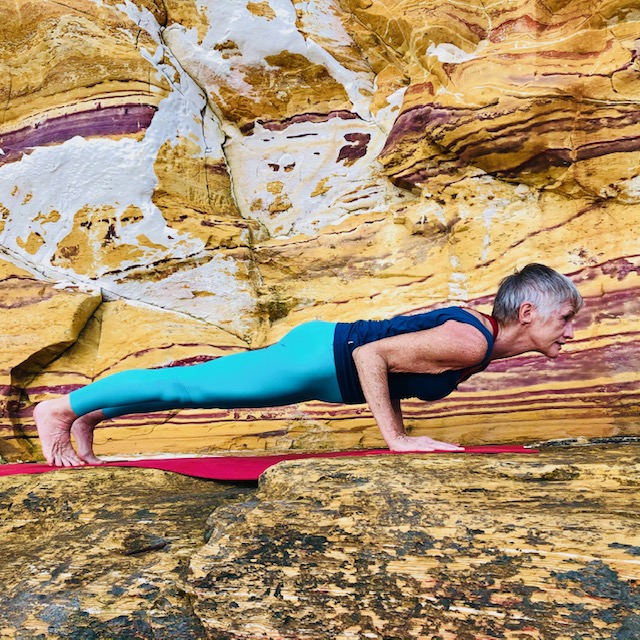
Chris Lalor in Chaturanga Dandasana: the body held as one straight line, just above the ground.
Which yoga poses build core strength?
In Iyengar yoga, the core is trained to steady the pelvis and spine, resist gravity, control twisting, and connect the legs to the trunk. That means yoga for core strength is much more than sit-ups.
The yoga poses for strength in the core fall into four families:
- Working the tummy directly: Boat Pose (Paripurna Navasana), Half Boat Pose (Ardha Navasana), and straight leg raises (Urdhva Prasarita Padasana).
- Holding you up against gravity: Plank, Chaturanga, Side Plank and Warrior III.
- Twisting: Revolved Triangle (Parivrtta Trikonasana) and the supine twist (Jathara Parivartanasana).
- The whole body together: the standing poses, Downward Facing Dog (Adho Mukha Svanasana) and Upward Bow (Urdhva Dhanurasana).

Four families of core yoga poses, from direct tummy work to the whole body working together.
These are not just ideas. In a 2023 study in the Journal of Bodywork and Movement Therapies, Boat Pose worked the front trunk muscles at more than half of their maximum effort. That is a lot of work from a pose where nothing moves.

Chris Lalor in Boat Pose (Paripurna Navasana), one of the most direct yoga poses for core strength.
Your core is a can, not a six pack
In Iyengar yoga the core is taught as a can: four walls working together to hold pressure. Your breathing diaphragm is the lid. Your pelvic floor is the base. The deep tummy muscles wrap round as the walls, and the small muscles either side of the spine make the back wall.
Squash any one of the four and the can buckles. A sit-up trains one wall. A held standing pose, a plank or Chair Pose asks all four to work at once, against each other, while you breathe. That is the support behind your low back when you carry the shopping in from the car.
The breath is the lid, so a good teacher keeps coming back to it. Hold your breath when a pose gets hard, and the lid jams shut, so the whole can goes rigid instead of steady. For a simple standing start, our note on how to stand in mountain pose shows the base every standing pose grows from. For the pelvic floor side of the story, see our page on yoga for the pelvic floor.
How can I feel my core working at home?
Try this beside a kitchen bench, with one hand resting on it.
- Step your feet wide apart and bend the front knee into Warrior II (Virabhadrasana II), knee over the ankle.
- Notice your breath. Is it held? Is it high in the chest?
- Let each out breath grow a little longer. As it ends, feel the lower belly draw gently in and up, without clenching.
- Keep the legs firm and breathe smoothly for five breaths. Then change sides.
Keep it soft and steady, and never force. If you have a back, pelvic floor or blood pressure concern, talk to your yoga teacher, yoga therapist, and your doctor if you wish, first.
Strong, not gripped: why yoga strength feels different
One more thing sets yoga strength apart. The aim is never to clench every muscle as hard as you can.
In a good yoga pose, the legs can be powerful while the throat stays soft. The belly supports the spine while the breath keeps moving. The arms reach strongly while the eyes stay quiet.
A clenched jaw, a wrinkled forehead or held breath is a sign that effort has turned into strain. Effort is needed. Strain is not. Learning where to work, and where to let go, is a big part of what an Iyengar yoga teacher teaches, and it is also where yoga starts to quieten the mind.
What the evidence shows, and where it is still thin
The research on how muscles work is strong. Held muscles work continuously, holding a position is demanding, and holding builds strength, mostly at the angles held.
The yoga trials are real, and modest:
- In a 2020 trial of 80 sedentary middle-aged women, six months of a flowing yoga series, three one-hour sessions a week, raised knee strength by 14.6% and elbow strength by 13.1%, while the comparison group, who did no training, did not change.
- An 8-week Iyengar yoga programme improved strength and range of movement in 38 inactive Queensland adults with an average age of 73 (2011).
- A 2019 review of 22 trials found yoga improved leg strength in older adults by a moderate amount, compared with doing nothing.
And the limits, stated plainly:
- No trial shows yoga makes muscles bigger. The claim is strength and control.
- Almost no research has studied the Iyengar style itself, with its long holds, props and precise alignment.
- Most studies of muscle activity in yoga poses used young, experienced people, not beginners over 40.
We sell yoga classes, so we would rather say that out loud. We also believe the honest version is strong enough on its own. For how the same muscle work helps bone, see our article on how a yoga pose makes energy, and builds muscle and bone.
Do I need to be strong before I start yoga?
No. Yoga can be one of the ways you get stronger. You do not need to begin with the full pose. A shorter hold counts. A hand on the wall counts. A chair counts. A well-taught beginning version still builds strength, step by step.
When Chris first practised Boat Pose (Paripurna Navasana), she used a belt. It let her hold the pose longer, so she could build core strength and stamina gradually, and it stretched her hamstrings at the same time. In forward bends the belt let her go slowly and soften into the pose instead of fighting it.

Boat Pose with a belt. The belt supports the legs so you can hold the pose longer and build core strength step by step.
Warrior III (Virabhadrasana III) shows strength, balance and steadiness working together. One standing leg is working, the hips are working, the back body is working, and your attention is working too. It also has doable entry points, such as the hands on a wall.

Chris Lalor in Warrior III (Virabhadrasana III): strength, balance and coordination at once. The beginner version uses a wall.
The steadier strength Chris found was not bulky, and not hard and tight. It helped her stand better, move better and feel more supported in her own body. That is one person’s experience, and it matches what the studies above point to.
Where can I learn strength-focused Iyengar yoga in Darwin or online?
Flametree Yoga Studio teaches Iyengar yoga at Woolner and Coolalinga in Darwin, and LIVE online across Australia. Every class includes standing poses, and every standing pose builds strength in the way this article describes.
If you are new, your first class is free. In the studio, check the beginner timetable and just come along. For a LIVE online class, go to our online class list, click the class time you want and we email you the link to join. New students, and anyone who has been away three months or more, can also get a half price 10 class pass with 2 extra classes free, to use online, in the studio, or both. See the half price pass.
Already practising yoga? The same half price 10 class pass for new students, and for anyone away three months or more, is also available as the non-beginner half price pass.
For more on strength yoga in Darwin, see Build Toward Stronger With Iyengar Yoga. And if you think you are too stiff to start, read Yoga For Stiff Guys.
Read more in our free ebook, Stay In The Game. Why yoga builds real strength for men, keeps you playing your sport, and moves the midlife numbers.
2 free classes + 2 ebooks, only available via this offer, for new students or anyone away 3 months or more. Current students can still get the book. See what’s inside and get your copy
Frequently asked questions
Can yoga build muscle?
Yes, yoga builds muscle strength. Holding a yoga pose makes your muscles work hard against your own body weight, and regular practice makes people measurably stronger. Research has not yet shown that yoga makes muscles bigger, so the honest claim is stronger and better controlled, not bulkier.
Is yoga just stretching?
No. Yoga stretches, but a held yoga pose also works many muscles at once, even though the body looks still. Standing poses, balances and core poses build strength in the legs, hips, back, arms and trunk.
Is yoga resistance training?
In yoga, your own body is the weight. Holding a pose, lowering into it slowly and lifting out of it all ask real work of your muscles, and that work builds strength. Props and leverage let the load grow step by step.
Does yoga tone your body?
Yoga builds strength and firmness in the muscles you use to hold each pose, especially the legs, hips and trunk. Regular practice also improves posture, which changes how the body looks and feels.
How long should I hold a yoga pose to build strength?
There is no magic number of seconds. What matters is how hard the muscles are working and how much holding time you build up over the weeks. In an Iyengar yoga class you hold long enough for the effort to build, then come out with control.
Which yoga poses build core strength?
Boat Pose, Half Boat Pose and straight leg raises work the tummy directly. Plank, Chaturanga, Side Plank and Warrior III hold you up against gravity. Twists train the side of the trunk, and the standing poses train the core together with the legs.
Can I build strength with yoga after 50?
Yes. Trials in middle-aged and older adults have found real gains in strength from regular yoga. In the Iyengar style the load is adjusted with props and timing, so you can start where you are and build up.
What is the core in yoga?
The core is a team of muscles around the middle of your body, not just the abs. In Iyengar yoga it is taught as a can: the diaphragm is the lid, the pelvic floor is the base, and the deep tummy and back muscles are the walls. Standing poses, planks and Chair Pose ask all four to work together while you breathe.
Do I need to be strong before I start yoga?
No. A shorter hold, a hand on the wall or a chair all build strength, and a well-taught beginner version of each pose is part of every class. Yoga can be one of the ways you get stronger.
Where can I learn Iyengar yoga for strength in Darwin?
Flametree Yoga Studio teaches Iyengar yoga at Woolner and Coolalinga in Darwin, and live online across Australia. Your first class is free if you are new to Flametree, and new students can then start with the half price 10 class pass.
Sources
- Adam A, De Luca CJ. Firing rates of motor units during fatiguing isometric contractions. Journal of Applied Physiology, 2005. doi.org/10.1152/japplphysiol.01344.2004
- Hunter SK et al. Time to task failure varies with load type. Journal of Applied Physiology, 2008. doi.org/10.1152/japplphysiol.90398.2008
- Mitchell WK et al. Sarcopenia, dynapenia, and the impact of advancing age on human skeletal muscle size and strength. Frontiers in Physiology, 2012. doi.org/10.3389/fphys.2012.00260
- Lum D, Barbosa TM. Effects of isometric strength training on strength and dynamic performance. International Journal of Sports Medicine, 2019. doi.org/10.1055/a-0863-4539
- Boraczyński MT et al. A 6-month Hatha yoga-based training program in middle-aged sedentary women. Journal of Sports Medicine and Physical Fitness, 2020. doi.org/10.23736/S0022-4707.20.10549-8
- Vogler J et al. A short-term Iyengar yoga program for physically inactive older adults. International Journal of Yoga Therapy, 2011. pubmed.ncbi.nlm.nih.gov/22398345
- Sivaramakrishnan D et al. The effects of yoga compared to active and inactive controls on physical function in older adults. International Journal of Behavioral Nutrition and Physical Activity, 2019. doi.org/10.1186/s12966-019-0789-2
- Dewan M et al. EMG of trunk and hip muscles during yoga poses. Journal of Bodywork and Movement Therapies, 2023. doi.org/10.1016/j.jbmt.2023.06.007
Flametree Yoga Studio teaches Iyengar yoga in Darwin, at Woolner and Coolalinga, and LIVE online anywhere.
Last updated 14 October 2026: added the core as a can, the belt and Warrior III beginner steps, and the size of the 2020 trial. This article is general information, not medical advice. If you have a health condition or injury, talk to your yoga teacher, yoga therapist, and your doctor if you wish, and tell your yoga teacher before class.