
Pelvic Floor Dysfunction And Yoga: What Mr Iyengar, The Yoga Doctors And The Research Say
By Chris Lalor, Certified Senior Iyengar Yoga Teacher and Certified Yoga Therapist, and Dr Stuart McGill, Yoga Teacher, Flametree Yoga Darwin
A leak when you laugh. A rush to the toilet. A heavy, dragging feeling, or an ache deep in the pelvis. These are all forms of pelvic floor dysfunction, and they are far more common than most people think. Mr BKS Iyengar and the medical doctors who worked with him saw them as things yoga can work on, and the research now agrees. This guide brings together what each of them says, and what the trials have found. Last updated: 7 November 2026.
Get 2 Free Yoga Classes And 2 Free Ebooks
Pelvic floor dysfunction and yoga: the short answer
Can yoga help pelvic floor dysfunction? Yes. Yoga helps. In the biggest trial so far, 240 women with daily urinary incontinence did 12 weeks of yoga based on Iyengar yoga: their leaks fell by about two thirds, and general exercise did less well. Women with an overactive bladder (a sudden, strong need to go) had three times the drop in bladder symptoms with yoga. In pelvic organ prolapse, a pelvic floor lift taught in yoga (mula bandha) eased the feeling of something coming down. In chronic pelvic pain, Iyengar-based yoga cut pain by about a third in six weeks.
Overall evidence: Strong
The research here is strong. Reviews or large trials mostly agree that yoga helps, so you can have plenty of confidence in it.
Best study (review of many trials): Hao 2026 pooled 20 trials with 2,002 older women with urinary leaks. Yoga and Pilates did about as well as pelvic floor muscle training. In Huang 2024, a trial of Iyengar-based yoga in 240 women aged 45 to 90, leaks fell by about two thirds.
One thing to keep in mind as you read: the leak and pain trials from the University of California used yoga built on Iyengar yoga, with props, alignment and slow, mindful attention. That is the yoga we teach. Most other trials tested “yoga” of many styles, taught by teachers with very different training, and in our view well-taught Iyengar yoga is likely to go further than the average. Why the kind of yoga matters.
Video: can yoga help bladder leaks? What the trials found
A five-minute look at yoga for the pelvic floor: a teacher’s story, the trials, and why letting go matters as much as lifting.
The bottom line: five key moves for the pelvic floor
- Go to a yoga class at your level, twice a week or more. The trials that worked ran classes twice a week for 6 to 12 weeks, with a little practice at home. Give it that long.
- Learn to let go as well as lift. A pelvic floor can be too weak, too tight, or both. Squeezing alone is not the answer. A good class teaches the floor to lift, and then to soften fully.
- Slow the breath, and lengthen the out-breath (pranayama). The pelvic floor moves with every breath. Slow breathing calms the nervous system, and a calm system means a calmer bladder.
- Stop straining. Breathe out as you lift, push or stand up, and do not hold your breath. Constipation, heavy lifting and a long cough all press down on the pelvic floor.
- Start now. New to Flametree, or away 3 months or more? 2 free classes, then 10 at half price, in Darwin or LIVE online.
Five Key Moves For The Pelvic Floor
1. Go to class at your level
Twice a week or more, for 6 to 12 weeks, with a little practice at home.
2. Learn to let go as well as lift
A pelvic floor can be too weak, too tight, or both. Squeezing alone is not the answer.
3. Slow the breath
Lengthen the out-breath. The pelvic floor moves with every breath.
4. Stop straining
Breathe out as you lift, push or stand up. Do not hold your breath.
5. Start now
2 free classes, then 10 at half price.
Yoga for pelvic floor dysfunction in five moves.
Iyengar yoga is the style we teach at Flametree. During the 20th century, Mr BKS Iyengar was the major person who codified traditional Indian yoga, through his seminal books and widespread teaching. He also pioneered the use of props, so poses can be adapted to almost any body. His style is sometimes called modern classical yoga. This guide is part of our encyclopaedia of yoga for health conditions.
This guide in short
- Overall evidence: Strong. Best study: Hao 2026 pooled 20 trials with 2,002 older women with urinary leaks. Yoga and Pilates did about as well as pelvic floor muscle training. In Huang 2024, a trial of Iyengar-based yoga in 240 women aged 45 to 90, leaks fell by about two thirds.
- Mr BKS Iyengar: a yoga approach for urinary incontinence and for a prolapsed uterus, with one clear caution for prolapse.
- Dr Timothy McCall, an American medical doctor and yoga therapist who studied with Mr BKS Iyengar, author of Yoga as Medicine: puts urinary incontinence, pelvic organ prolapse and pelvic pain on his list of conditions helped by yoga.
- Dr Krishna Raman, a medical doctor in Chennai who trained in yoga under Mr BKS Iyengar and has used yoga in his medical practice for decades: how and when to lift the pelvic floor (mula bandha), and why not to hold the breath when lifting.
- Geeta S Iyengar: lift the organs rather than press on them, use inversions, and rebuild slowly after birth.
- Other yoga voices: Leslie Howard on a pelvic floor that is too tight or too loose, and Ann Swanson on the pelvic floor and the breath.
- For men: the pelvic floor matters for men too, after prostate surgery and with pelvic pain. See also our guide to prostate health and men’s health.
- The research: 18 studies listed below, from the Iyengar-based trials in California to reviews of thousands of women.
- Take it further: a free ebook, our 2027 pelvic floor masterclass, and classes in Darwin and online.
The Pelvic Floor And Yoga On One Page
Five sources, one answer: a pelvic floor that can lift and let go.
A yoga approach for leaks and for prolapse: forward bends, supported inversions, standing poses and slow breathing.
Lift the organs, never press on them. Turn upside down. After birth, breath first.
Leaks, prolapse and pelvic pain are all on his list of conditions helped by yoga.
Lift the pelvic floor at the right time, and never hold the breath to lift.
Leaks fell by about two thirds in 12 weeks of Iyengar-based yoga. General exercise did less well.
Each source is set out in full below. Research: Huang and others, 2024, a trial of 240 women.

The pelvic floor is a dome of muscle across the base of the pelvis. It holds up the bladder, the bowel and, in women, the womb.
“Suppleness does not count. The organic strength counts.”
What pelvic floor dysfunction is
The pelvic floor is the group of muscles across the base of the pelvis. Women and men both have one. When it is not working as it should, that is pelvic floor dysfunction. It shows up in three main ways:
- Urinary incontinence (leaks): stress leaks come with a cough, sneeze, laugh, jump or lift. Urge leaks come with a sudden, strong need to go. Many people have both.
- Overactive bladder: needing to go urgently and often, day and night, with or without leaks.
- Pelvic organ prolapse: the bladder, womb or bowel slips down from its place, which can feel like heaviness or something coming down.
- Chronic pelvic pain: an ache or pain in the pelvis lasting six months or more. A pelvic floor held too tight is often part of it.
Leaks are very common. In a US study of 64,650 nurses aged 36 to 55, about 1 in 7 started leaking over two years (Townsend, 2007). Pregnancy, childbirth, menopause, heavy lifting, a long cough and constipation all load the pelvic floor. (For yoga through pregnancy and coming back after the birth, see our guide to yoga in pregnancy and postnatal yoga.) Men are affected too, especially after prostate surgery, and men get chronic pelvic pain as well.
Weak, Tight, Or Slipping
Three kinds of pelvic floor trouble, and what yoga works on in each.
Often a floor that is too weak to hold under pressure, or over-busy and urgent. Yoga builds tone, and calms the urge.
Organs slip when the muscles and ligaments go slack. Yoga lifts the floor and stops the straining.
Often a floor held too tight, all day. Yoga teaches it to let go.
A healthy pelvic floor is springy. It lifts when you cough or lift, and lets go fully afterwards.
A simplified picture. Many people have more than one of these at once.

Two kinds of leak. Stress leaks come with a cough or lift. Urge leaks, as in overactive bladder, come with a sudden need to go.
For men
Men have a pelvic floor too, and it is easy to forget. It holds up the bladder and bowel, and it matters for bladder control and sexual function. Leaks after prostate surgery are common, and men get chronic pelvic pain as well.
- Men do far less yoga than women, so a man’s pelvic floor rarely gets this kind of attention. At Flametree about a third of the people in class are men.
- Yoga did as well as two prescription medicines for men with chronic pelvic pain, with far fewer side effects, in a 2026 trial of 40 men (listed in the research below).
- Leaks after prostate surgery: not yet studied. No trial has yet tested yoga for them. Not yet studied is not the same as not working. The same work of lifting and letting go, with slow breathing, applies to men.
- Dr Raman, following Mr Iyengar, gives Baddha Konasana (Bound Angle Pose) for the prostate and urinary tract.
See yoga classes for men, in Darwin and LIVE online.
“Begin with small expectations. Restructuring muscles, bones, tissues, posture, and internal organs takes time.”
What Mr BKS Iyengar taught about the pelvic floor
In short: work the whole body to support the pelvis, use breath to calm the system, and take care with one pose if there is a prolapse.
In Yoga: The Path to Holistic Health, Mr Iyengar sets out a yoga approach for 72 health conditions. Two of them are pelvic floor problems.
- Urinary incontinence (p. 300). In our words, he describes it as an involuntary loss of urine that becomes more common with age. He names a weaker pelvic floor, strokes, an irritated bladder and loss of control in the nervous system as causes. His approach mixes forward bends, supported inversions and seated poses with breath practice, including Ujjayi (ocean breath) and Viloma (staircase breath, taken in steps).
- Prolapsed uterus (pp. 392 to 393). He describes the muscles and ligaments of the pelvis becoming weak and slack, so the womb slips out of place, and lists age, obesity and frequent childbirth as causes. His approach mixes inversions, standing poses and reclining leg poses.
- Pelvic pain. He has no separate chapter on it. The nearest is his work on menstrual cramps.
In Light on Yoga. His first book, from 1966, ends with an appendix of poses grouped under ailments (Appendix II). It has entries for a displaced uterus (p. 421), dribbling or excessive urine (p. 433), the prostate (p. 430) and hernia (p. 425). For these he leans on supported inversions and seated poses, with breathing and an abdominal lift (Uddiyana bandha) that is learned with a teacher. He asks students to work with an experienced teacher and to practise within their own ability.
A teaching point on prolapse. Mr Iyengar writes that Baddhakonasana (Bound Angle Pose: sitting with the soles of the feet together and the knees out to the sides) is not to be practised with a displaced or prolapsed uterus (p. 108). If you have a prolapse, be guided by your teacher.
Mr Iyengar On Incontinence And Prolapse
Urinary incontinence (p. 300)
Forward bends, supported inversions and seated poses, with breath practice: ocean breath (Ujjayi) and staircase breath (Viloma).
Prolapsed uterus (pp. 392 to 393)
Inversions, standing poses and reclining leg poses.
Pelvic pain
No separate chapter. The nearest is his work on menstrual cramps.
One caution (p. 108)
Bound Angle Pose is not to be practised with a displaced or prolapsed uterus. Be guided by your teacher.
Mr BKS Iyengar, Yoga: The Path to Holistic Health. In our words, from long practice.
We do not publish his sequences. A sequence needs a teacher who can see how your body responds and adapt each pose, which is what a class is for.
“…the internal organs, which have a tendency to drop and to sag…”
What Geeta S Iyengar taught about the pelvic floor
In short: lift the organs rather than press on them, turn the body upside down, and rebuild slowly after birth.
Geeta S Iyengar was Mr Iyengar’s daughter and, for decades, one of the leading teachers of his method. Her book Yoga: A Gem for Women was written for women, and for women’s conditions her work is as important as his. Her approach, in our words:
- Lift, don’t press. In standing poses she teaches drawing the abdominal muscles and organs back towards the spine and up towards the chest, so there is no undue pressure on the uterus (p. 86).
- Turn the body upside down. She writes that in upright daily life the internal organs tend to drop and sag, and that inverted poses counteract this (p. 188). Among the problems she lists inversions as easing are complaints of the bladder and a displaced or prolapsed uterus (p. 196). That is her claim, from long teaching.
- Leave the strong tummy work for later. With a displaced uterus, she says to avoid the strong abdominal poses, such as straight-leg lifts and Boat Pose, and to practise gentler poses first until the condition settles (pp. 87 and 217).
- After childbirth, breath comes first. After a fortnight’s rest she starts with lying rest and slow pranayama (Ujjayi and Viloma), which in her view tones the abdomen and helps the uterus return to normal. Poses come back week by week in the second month, and the full practice after three months. After a caesarean, rest and breath come first until the wound heals, usually about two months (pp. 91 to 92).
- In pregnancy, yoga strengthens the pelvic muscles and improves circulation in the pelvic region, she writes (p. 54).
Geeta Iyengar On The Pelvic Floor
Lift, do not press
In standing poses, draw the abdomen and organs back and up, so there is no undue pressure on the uterus (p. 86).
Turn the body upside down
Inversions counteract the dropping and sagging of the organs (p. 188). She lists bladder complaints and a displaced or prolapsed uterus among the problems they ease (p. 196).
Strong tummy work later
With a displaced uterus, avoid straight-leg lifts and Boat Pose until the condition settles (pp. 87 and 217).
After childbirth, breath first
After a fortnight’s rest: lying rest and slow pranayama, then poses week by week in the second month, and the full practice after three months (pp. 91 to 92).
In pregnancy
Yoga strengthens the pelvic muscles and improves circulation in the pelvic region (p. 54).
Geeta S Iyengar, Yoga: A Gem for Women. Her approach, in our words.
As with Mr Iyengar, we do not publish her sequences. They are taught in class, adapted to the person.
What Dr Timothy McCall says
In short: all three pelvic floor problems are on his list of conditions helped by yoga.
Dr McCall is a US medical doctor and yoga therapist, author of Yoga as Medicine and former medical editor of Yoga Journal. His June 2019 list of 117 health conditions helped by yoga, which is the backbone of this encyclopaedia, includes:
- Urinary incontinence (no. 117)
- Pelvic organ prolapse (no. 74)
- Pelvic pain (no. 75)
Prolapse and pelvic pain were among the conditions he added after 2016, as new research came in. Yoga as Medicine has no chapter on the pelvic floor. The nearest is his infertility chapter, in which John Friend, then an Anusara teacher who had trained in Iyengar yoga, describes the tightness and lack of feeling he often finds in the pelvic floor and lower belly, and a habit of gripping the abdomen that restricts the breath. His approach, in our words: build awareness of the pelvic floor and how to let it go, free the hips, teach slow belly breathing, and avoid over-effort. McCall also notes that habits such as high heels and locked knees are thought to tighten the pelvic floor, though he says this has never been tested scientifically.
“…learn first the principles of pranayama but forget about bandha for the time being…”
What Dr Krishna Raman says
In short: lift the pelvic floor at the right moment, in the right way, and do not hold the breath to lift.
Dr Raman is a Chennai physician who trained in yoga under Mr Iyengar. His question-and-answer book on yoga and medical science has a lot to say about the pelvic floor. His views, in our words:
- Mula bandha (a gentle lift of the pelvic floor) has its place. In the classical teaching it comes after a full in-breath, during a pause in the breath, once the breath itself is learnt.
- Squeezing is not the same as lifting. Ashwini mudra (rhythmic squeezing of the anal muscles) is a different practice from mula bandha.
- Not in every pose. In his view, holding the lift through all back bends is medically wrong.
- Not at first under heavy stress. He does not advise the locks (bandhas) at first for people who are very stressed.
- Do not hold the breath when lifting. He warns against breath-holding with weights, and against too much heavy weight training for women.
- For men: he gives Baddha Konasana for the prostate and urinary tract, following Mr Iyengar.
- After surgery or birth: he suggests coming back to yoga about three months after a caesarean, and about six months after hernia surgery.
“Relax the abdomen. Learn to make the abdomen soft.”
What Dr Shah recommends for the pelvic organs and pelvic floor: a yoga doctor’s view
In short: Dr J. T. Shah, a medical doctor who was also an Iyengar yoga teacher, who worked closely with Mr BKS Iyengar for many years, does not write about the pelvic floor muscles by name, but he lists poses that ease pelvic congestion and tone the pelvic organs, such as Bound Angle, Hero Pose and Bridge.
Who Dr Shah is: Dr J. T. (Jawahar) Shah, a Mumbai ear, nose and throat surgeon, practised yoga from 1963, studied with Mr BKS Iyengar and taught yoga himself from 1985. His book Therapeutic Yoga carries a foreword by Mr Iyengar and colour-codes every pose by the body systems it works.
Dr Shah does not use the words pelvic floor, and his charts have no entry for leaking. He does list poses for the pelvic organs and for bladder, uterus and prostate disorders, and those are the ones below.
From his list for the genito-urinary system (p. xvi) and his pose pages:
- Chair Pose (Utkatasana), p. 5: massages the pelvic organs and strengthens the legs and abdomen.
- Bound Angle Pose (Baddha Konasana), p. 23: relieves pelvic congestion and tones the pelvic organs; he lists it for bladder and prostate disorders.
- Hero Pose (Virasana), p. 25: massages the pelvic organs; he lists it for genito-urinary disorders.
- Gate Pose (Parighasana), p. 37: massages the abdominal and pelvic organs; he lists it for bladder, uterus and prostate disorders.
- Reclining Bound Angle Pose (Supta Baddha Konasana), p. 43: a supported rest that relieves pelvic congestion; he lists it for bladder, uterus and prostate disorders.
- Downward-Facing Dog (Adho Mukha Svanasana), p. 55: reduces congestion in the pelvic and abdominal organs.
- Bridge Pose (Setu Bandha Sarvangasana), p. 61: massages the pelvic organs and eases congestion in the gonads.
- Locust Pose (Salabhasana), p. 69: on his list for the genito-urinary system; it tones the abdominal organs and the whole spine.
- Upward-Facing Dog (Urdhva Mukha Svanasana), p. 71: massages the abdominal and pelvic organs; he lists it for bladder, uterus and prostate disorders.
- Yoga Mudra (Yoga Mudra), p. 93: tones the pelvic organs, including the bladder and colon; he lists it for bladder and prostate disorders.
Dr Shah’s Poses For The Pelvic Organs
Chair Pose
Massages the pelvic organs and strengthens the legs and abdomen (p. 5).
Bound Angle Pose
Relieves pelvic congestion and tones the pelvic organs (p. 23).
Hero Pose
Massages the pelvic organs (p. 25).
Gate Pose
Massages the abdominal and pelvic organs (p. 37).
Reclining Bound Angle Pose
A supported rest that relieves pelvic congestion (p. 43).
Downward-Facing Dog
Reduces congestion in the pelvic and abdominal organs (p. 55).
Bridge Pose
Massages the pelvic organs and eases congestion in the gonads (p. 61).
Locust Pose
Tones the abdominal organs and the whole spine (p. 69).
Upward-Facing Dog
Massages the abdominal and pelvic organs (p. 71).
Yoga Mudra
Tones the pelvic organs, including the bladder and colon (p. 93).
Dr J. T. Shah, Therapeutic Yoga. Known from practice; not yet tested by trials. He lists poses for the pelvic organs, not the pelvic floor muscles.
The body systems they work: the pelvic organs (his green P circles) and the gonads (pink G), with the spine and muscles.
Dr Shah’s cautions, kept as he gave them:
- Build up slowly: he advises easy poses for weeks or months before the harder ones (p. xv), and says not to force any pose and to know your limits (p. xiii).
- Serious problems: he says people with serious heart, lung, bone and joint or other whole-body problems modify their practice with an experienced teacher (p. xiii).
Known from practice; not yet tested by trials. Dr Shah’s list comes from clinical and teaching experience, and it speaks of the pelvic organs more than the pelvic floor muscles. The pelvic floor trials below tested yoga programmes, not his list.
Tell your teacher. If you have pelvic floor problems, tell your teacher before class. Your teacher will adapt each pose with props, which is how Dr Shah himself said therapeutic work should be done: with an experienced teacher. Classes run in Darwin and LIVE online.
Source: Dr J. T. Shah, Therapeutic Yoga (foreword by Mr BKS Iyengar), Vakils, Feffer and Simons, Mumbai, 1999, chart p. xvi, cautions pp. xii to xv, pose pages 5 to 93. Summarised in our own words.
Other yoga voices on the pelvic floor
Other Yoga Voices On The Pelvic Floor
Moves with every breath
Down a little as you breathe in, lifting as you breathe out (Ann Swanson).
Engage and relax
Gentle work that both engages and relaxes the pelvic floor helps with leaks. Her view.
Too tight, too loose
Often a combination of both. A tight muscle is not a strong muscle, so sometimes the job is to let go (Leslie Howard).
Two kinds of leak
Stress leaks go with a floor that is too weak, urge leaks often with one held too tight. With mixed leaks she eases the urge side first.
Soft belly on the in-breath
Pulling the belly in as you breathe in stops the diaphragm and the pelvic floor moving together. Sit on the sitting bones.
Ann Swanson, Science of Yoga, and Leslie Howard, Pelvic Liberation. Their views, in our words.
- The pelvic floor moves with every breath. It moves down a little as you breathe in, following the diaphragm (the big breathing muscle under the lungs), and lifts as you breathe out. Ann Swanson, Science of Yoga. An MRI study of 12 women showed the floor is dome-shaped at rest, flatter when squeezed and bowl-shaped when bearing down (Hjartardottir, 1997).
- Gentle work that both engages and relaxes the pelvic floor helps with leaks. Ann Swanson, in her view, in Science of Yoga.
- A pelvic floor can be “too tight, too loose, and often a combination of both”. Leslie Howard, a New Zealand yoga teacher who works on pelvic health, in Pelvic Liberation (2017). Her point, in her words: “a tight muscle is not a strong muscle”. Sometimes the job is to learn to let go.
- Two kinds of leak, handled differently. In her view, stress leaks go with a floor that is too weak, and urge leaks often go with a floor that is held too tight. With mixed leaks, she eases the urge side first. Leslie Howard, Pelvic Liberation.
- Keep the belly soft on the in-breath. She calls pulling the belly in as you breathe in “reverse breathing”, and says it stops the diaphragm and the pelvic floor moving together. Sit on the sitting bones rather than the tail. Her guide to effort: “The breath will always let you know if you are doing too much.” Leslie Howard, Pelvic Liberation.

Two domes that move together. The diaphragm and the pelvic floor move down on the in-breath and lift on the out-breath.
“I feel that yoga is a unique gift for women.”
A story: finding the way back after pelvic surgery
Ann Kilbertus, a former occupational therapist, has practised Iyengar yoga since the early 1980s and made many trips to Pune. In 2004 an infected cyst caused severe pain. It led to a diagnosis of polycystic ovary disease, and then to a hysterectomy. Afterwards she was weak and scarred, and her old practice no longer suited her. She rebuilt it with props and restorative poses. She says this calmed her mind and nervous system and softened her abdomen. It was not quick. In her words, “finding out how and what to practice took much trial and error.”
Source: Ann Kilbertus, Iyengar Yoga Centre of Victoria, “Rooted In Yoga”, Iyengar Yoga Association of Canada, Practice as Therapy blog, 28 November 2025. Her story, in our words.
A story: “Sometimes I pee in my pants”
Leslie Howard, a yoga teacher trained in the Iyengar tradition who now works on pelvic health, tells how her pelvic floor teaching began. A few months after she started her own pelvic floor exercises, a long-time student asked her about them. “You have to teach me this,” the student said. “Sometimes I pee in my pants.” Howard did not feel ready, but she did not want to let her down. She invited a small group of women to her home, read every book she could find, and ran her first pelvic floor workshop. Leaks are common in ordinary, active women, and once someone talks about them, women ask.
Source: Leslie Howard, Pelvic Liberation: Using Yoga, Self-Inquiry, and Breath Awareness for Pelvic Health (2017), Kindle locations 218 to 225. Her story, in our words.
What the research shows
In short: leaks have the strongest evidence, overactive bladder and pelvic pain are close behind, and prolapse is starting to be studied. The best trials used yoga based on Iyengar yoga, and they are listed first. Most of the other studies tested yoga in general, of many styles. Why the difference matters.
The Research At A Glance
Four studies that sum up the evidence. All of them, with links, are listed below.
Leaks fell by about two thirds with Iyengar-based yoga. General exercise did less well. Huang 2024: 240 women aged 45 to 90 with daily urinary incontinence, 12 weeks.
Stress leaks fell 61% with Iyengar-based yoga, against 35% with stretching. Huang 2018: 56 women aged 55 to 83, 3 months.
Mula bandha yoga eased prolapse complaints more than usual care alone. Sweta 2018: 50 women with mild pelvic organ prolapse, 12 weeks.
Iyengar-based yoga cut chronic pelvic pain by about a third in six weeks. Huang 2017: 16 women, worst, best and average pain all fell.
Every study is listed in full in this section, with a link to read it.
Iyengar-based yoga trials
These trials, from the University of California, San Francisco, used yoga based on Iyengar yoga: poses chosen by a panel of expert yoga consultants, taught with attention to alignment, with props, and with mindful awareness. In the largest trial the teachers had at least 2 years of teaching experience plus special training for the study. The papers do not say they were certified Iyengar teachers, so in our view this is Iyengar-based yoga rather than Iyengar yoga taught by fully trained Iyengar teachers. It still did very well.
- Leaks fell by about two thirds (2.3 fewer a day, from 3.4), and general exercise did less well (1.9 fewer a day). Twelve weeks, two 90-minute classes a week plus an hour at home, against a stretching and strengthening programme of the same length. No harm from the yoga. Huang 2024, a trial of 240 women aged 45 to 90 with daily urinary incontinence, in Annals of Internal Medicine. Read the study.
- With an overactive bladder, bladder symptom scores fell three times as much with yoga (10.3 points against 3.3), and daytime trips to the toilet fell more. Urge leaks fell by 1.9 a day with yoga. Enemchukwu 2026, the 140 women in the 2024 trial with an overactive bladder and leaks. Read the study.
- Leaks fell 76% with Iyengar-based yoga, against 56% with stretching, and stress leaks fell 61% against 35%. Three months, with no harm from the yoga. Huang 2018, a trial of 56 women aged 55 to 83. Read the study.
- Leaks fell 70% in six weeks of yoga, against 13% on a waiting list, and stress leaks fell 71%. Twice-weekly classes plus home practice. Huang 2014, a pilot trial of 19 women aged 40 and over. Read the study.
- Pelvic pain fell by about a third (worst pain 29%, best 32%, average 34%), and daily life, mood and sex life improved. Six weeks of twice-weekly Iyengar-based group classes. Huang 2017, a trial of 16 women aged 31 to 64 with chronic pelvic pain. Read the study.
How Much Leaks Fell
The three University of California trials of Iyengar-based yoga for urinary incontinence.
2014, yoga: leaks down 70%
2014, waiting list: down 13%
2018, yoga: leaks down 76%
2018, stretching: down 56%
2024, yoga: leaks down about two thirds
2024, stretching and strengthening: down just over half
Huang 2014 (19 women), 2018 (56 women) and 2024 (240 women). The 2024 figures are worked out from the average daily leaks: 3.4 a day at the start, 2.3 fewer with yoga and 1.9 fewer with exercise.
Urinary incontinence: more yoga and breathing studies
- Yoga, breathing and similar exercise did as well as pelvic floor muscle training, and much better than usual care, with no harms. Hao 2025, a review of 14 trials and 797 women with stress leaks. Note: this review pooled many styles of yoga, Pilates and breathing. It shows what exercise of this kind does in general. Iyengar yoga has not yet been tested against pelvic floor muscle training on its own. Why it matters. Read the study.
- In older women, yoga and Pilates did about as well as pelvic floor muscle training. Hao 2026, a review of 20 trials and 2,002 older women with urinary incontinence. Read the study.
- Yoga-based breathing training improved leaks and quality of life, and was the only programme that lowered resting tension in the pelvic floor muscles. Six weeks, against Pilates-based breathing. Girit Ozden 2026, a trial of 46 women with stress or mixed leaks. Read the study.
- A programme of pelvic-floor-focused yoga, breathing and meditation lowered leak severity and improved quality of life and comfort. Six weeks, against routine care. Hakbilen 2026, a trial of 40 women with stress leaks. Read the study.
- Leak scores fell and 83% of women said they were better. Eight weeks of online yoga-Pilates. Cramer 2023, a study of 60 women with stress leaks. Read the study.
- Urgency and quality of life both improved, with no harms. Gentle yoga twice a week for 8 weeks. Tenfelde 2021, a pilot of 12 women with urge leaks. Read the study.
What The Yoga That Worked Had In Common
The University of California trials of yoga for leaks and pelvic pain.
Twice a week
group classes, with a teacher
6 to 12 weeks
before the change was measured
Props and alignment
so each pose fitted the body
Mindful attention
plus relaxation, and about an hour a week at home
Huang and others, 2014, 2017, 2018 and 2024. These are the same things an Iyengar class is built on.
Pelvic organ prolapse
- Prolapse complaints, such as a feeling of something coming out, eased more with mula bandha yoga than with usual care alone, and daily life was less affected. Twelve weeks. Sweta 2018, a trial of 50 women with mild pelvic organ prolapse. Read the study.
- Pelvic floor strength scores rose in the women doing mula bandha yoga. Twelve weeks, against no yoga. Sweta 2021, a trial of 50 healthy women. Read the study.
No trial has yet tested Iyengar yoga for prolapse. Not yet studied is not the same as not working. Mr Iyengar’s own approach, with inversions and standing poses that lift and support the pelvis, is known from long practice.
Chronic pelvic pain
- Worst pain fell by about 2 points and average pain by 1, and emotional and work life improved. Pelvic yoga taught remotely, across several sites. Huang 2024, a trial of women with chronic pelvic pain, in the Journal of Integrative and Complementary Medicine. Read the study.
- In men, yoga did as well as two prescription medicines on pelvic pain symptoms, pain and quality of life, with far fewer side effects (10% against 27.5%). Gaur 2026, a pilot trial of 40 men with chronic pelvic pain syndrome. Read the study.
No randomised trial has yet compared yoga with another approach for chronic pelvic pain in women. Not yet studied is not the same as not working. The yoga approach known from practice is to work on letting go: restful, supported poses, a soft abdomen, and a long, slow out-breath.
Mindfulness, for chronic pelvic pain
These trials tested mindfulness programmes, not yoga or pranayama, and they were for pelvic pain, not leaks. The results are encouraging, and in our view pranayama and a held yoga pose train the same steady, present attention.
- Pain at the entrance to the vagina fell more with mindfulness than with cognitive behavioural therapy, and the gains held at 6 months. Brotto 2019, a trial of 130 women with provoked vestibulodynia. Read the study.
- Only mindfulness lowered how much pain got in the way of daily life, against a healthy lifestyle programme. Six weeks. Crisp 2022, a trial of 41 servicewomen with chronic pelvic pain. Read the study.
- Daily worst pain, physical function, mental health and social life improved. An 8-week mindfulness programme. Fox 2011, a pilot study of women with chronic pelvic pain. Read the study.
Mindfulness For Chronic Pelvic Pain
Brotto 2019
130 women with provoked vestibulodynia. Pain fell more with mindfulness than with cognitive behavioural therapy, and the gains held at 6 months.
Crisp 2022
41 servicewomen with chronic pelvic pain. Only mindfulness lowered how much pain got in the way of daily life. Six weeks.
Fox 2011
A pilot study of an 8-week programme. Daily worst pain, physical function, mental health and social life improved.
Mindfulness programmes, not yoga, and for pelvic pain, not leaks.
Breathing practice (pranayama)
No trial has yet tested pranayama on its own for leaks or prolapse. Not yet studied is not the same as not working. Breath was part of the programmes that worked, and the yoga-based breathing trial above lowered resting tension in the pelvic floor. Mr Iyengar includes Ujjayi (ocean breath) and Viloma (staircase breath) in his incontinence approach. The pranayama we teach (staircase, ocean, alternate nostril, humming and a gentle shining skull breath) is slow, nasal and taught step by step, and it is quite different from forceful breathwork. Why the kind of breathing matters.
“Slow, soft, quiet exhalation so the brain cells quieten.”
Yoga, pranayama and mindfulness: how they work together
Some of the studies above tested a mindfulness or meditation course, not yoga. That still counts for our classes. Mindfulness is steady, present attention, and yoga poses and pranayama (yogic breathing) are old routes to that same state. So the research on mindfulness and meditation for pelvic pain also shows what a good yoga and pranayama class can build. No trial separates which part does the work.
Two routes to one steady mind
A steady body, with attention held on the pose.
A steady breath, with attention held on the breath.
Mindfulness: steady, present attention. Each makes the other easier.
A simplified picture, known from practice. No trial separates which part does the work.
We suggest coming to both a yoga class and a pranayama class. Mr Iyengar taught that asana (poses), pranayama and meditation are not divided, and in our experience the two together do more than either alone. See every class time. We trace the history and the links in Yoga And Mindfulness: Why The Mindfulness Research Points Back To Yoga And The Breath.
How this comes together in a Flametree class
Everything above points the same way, and it is how we teach in Darwin and online.
- Lift and let go: standing poses, inversions and gentle back bends ask the pelvic floor to work, and restful poses with slow breathing let it soften.
- Props in every class: blocks, belts, bolsters, chairs and the wall, so each pose fits your body.
- Classes adapted to the people in them. No one-size-fits-all. Tell your teacher about leaks, prolapse or pain if you like, and the poses are changed for you, including Bound Angle Pose with a prolapse.
- Women’s wellness: Chris Lalor, Certified Senior Iyengar Yoga Teacher and certified Yoga Therapist, runs women’s wellness classes where pelvic floor work is a focus.
- Men too: men’s pelvic floors respond to the same work. See yoga classes for men.
- Breath and calm: every class ends in rest. Our restorative yoga and pranayama classes go further.
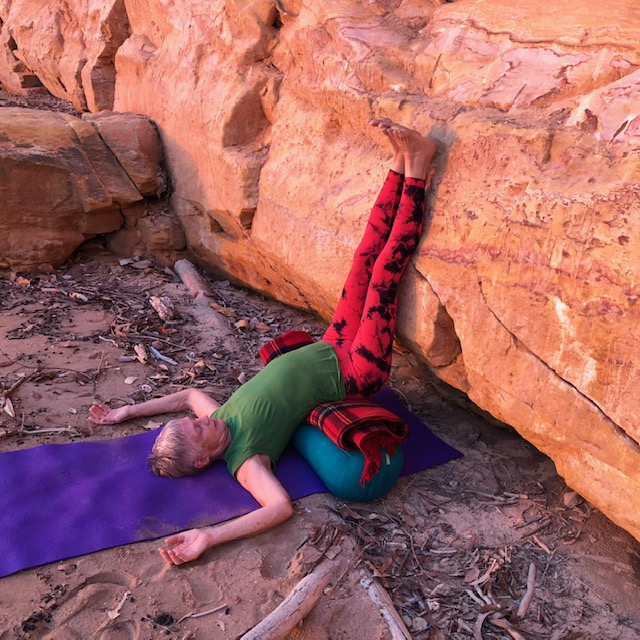
Legs up the wall with a bolster under the hips. Taking the weight off the pelvic floor is a restful way to end a practice.
Read more on the pelvic floor
- Yoga for pelvic floor: what research shows for leaks, prolapse and pelvic pain
- The pelvic floor: what it is, where it is, and why too tight matters as much as too weak
- Pelvic floor exercises: why squeezing alone is not enough
- Stress incontinence: why you leak when you cough, laugh or sneeze and light bladder leakage
- Painful intercourse after menopause
- Yoga for perimenopause
- Yoga for intimacy
- Related guides: haemorrhoids (piles) and hernia
Take it further
This guide gives you the facts on what helps. The ebook, the classes and the masterclass are how you put them into action.
Free ebook: Cool, Calm And Strong. A full chapter on the pelvic floor and bladder, why a pelvic floor can be too tight, the University of California trials, and yoga through the change.
New to Flametree, or away 3 months or more? 2 free classes + 2 ebooks, only available via this offer. Already a student? You can still get this book. Get your free copy of Cool, Calm And Strong
- Classes, in Darwin or LIVE online: new, or away 3 months or more? 2 free classes, then 10 at half price. Already practising yoga? See the non-beginner half price pass. See every class time.
- Masterclass: the pelvic floor is one of our 2027 Sunday Arvo Masterclasses with Chris Lalor. Come for the poses, the sequences and the breath work that put this research into practice. Bookings are open.
- Retreats: a week of daily, adapted yoga in Bali. See the retreats.
Take Yoga For The Pelvic Floor Further
Classes
In Darwin or LIVE online. New, or away 3 months or more? 2 free classes, then 10 at half price.
Masterclass
The pelvic floor is one of our 2027 Sunday Arvo Masterclasses with Chris Lalor. Bookings are open.
Retreats
A week of daily, adapted yoga in Bali.
Yoga for the pelvic floor in Darwin and online.
Related: our guide to PMS symptoms, period cramps and menstrual problems. Other conditions are in our encyclopaedia of yoga for health conditions.
Pelvic floor dysfunction and yoga: questions people ask
What is pelvic floor dysfunction?
Pelvic floor dysfunction means the muscles across the base of the pelvis are not working as they should. It shows up as urinary incontinence (stress leaks with a cough or lift, urge leaks with a sudden need to go), overactive bladder, pelvic organ prolapse, or chronic pelvic pain. The floor can be too weak, too tight, or both. Women and men both have a pelvic floor.
What kind of yoga did the urinary incontinence trials use?
The three main trials, from the University of California, San Francisco, used yoga based on Iyengar yoga: poses chosen by expert yoga consultants, taught with attention to alignment, props and mindful awareness. In the largest, 240 women aged 45 to 90 did 12 weeks of classes, and their leaks fell by about two thirds. General exercise did less well.
What is overactive bladder, and can yoga help it?
Overactive bladder means needing to go urgently and often, with or without leaks. In 140 women with an overactive bladder and leaks, 12 weeks of yoga cut urge leaks by 1.9 a day, and bladder symptom scores fell three times as much as with general exercise. Daytime trips to the toilet also fell more with yoga.
What did Mr BKS Iyengar teach about incontinence and prolapse?
In Yoga: The Path to Holistic Health, Mr Iyengar sets out a yoga approach for urinary incontinence (p. 300) and a prolapsed uterus (pp. 392 to 393). For incontinence he mixes forward bends, supported inversions and seated poses with slow breathing. For prolapse he mixes inversions, standing poses and reclining leg poses. He sees a weaker, slack pelvic floor as a common cause of both.
Which pose needs care if you have a prolapse?
Mr Iyengar writes that Baddhakonasana (Bound Angle Pose, sitting with the soles together and the knees out) is not to be practised with a displaced or prolapsed uterus (Yoga: The Path to Holistic Health, p. 108). If you have a prolapse, be guided by your teacher.
Does mindfulness help chronic pelvic pain?
Yes, in early trials. In 130 women with pain at the entrance to the vagina, pain fell more with mindfulness than with cognitive behavioural therapy, and the gains held at 6 months. In 41 servicewomen, only mindfulness lowered how much pain got in the way of daily life. Iyengar-based yoga also cut chronic pelvic pain by about a third in six weeks.
Are pelvic floor exercises for men different, and where does yoga fit?
Men have a pelvic floor too, and it matters for bladder control, especially after prostate surgery, and for pelvic pain. The same yoga work of lifting and letting go applies. In a 2026 trial of 40 men with chronic pelvic pain, yoga did as well as two prescription medicines on symptoms, with far fewer side effects. Dr Raman, following Mr Iyengar, gives Baddha Konasana for the prostate and urinary tract.
How long did the yoga trials take to show a change?
Six to twelve weeks of classes twice a week. Leaks fell 70% after 6 weeks in the first University of California trial, 76% after 3 months in the second, and by about two thirds after 12 weeks in the largest. Pelvic pain fell by about a third after 6 weeks. Mr Iyengar’s advice is to begin with small expectations, because restructuring muscles and organs takes time.
How Long The Yoga Trials Took
6 to 12 weeks
of classes twice a week in the yoga trials that worked. Leaks fell 70% after 6 weeks, 76% after 3 months, and by about two thirds after 12 weeks. Pelvic pain fell by about a third after 6 weeks.
Mr Iyengar’s advice is to begin with small expectations, because restructuring muscles and organs takes time.
Which yoga poses did Dr J. T. Shah recommend for the pelvic organs?
Dr Shah, a medical doctor who studied with Mr BKS Iyengar, does not write about the pelvic floor by name. He lists poses that relieve pelvic congestion and tone the pelvic organs: Chair Pose, Bound Angle, Hero Pose, Gate Pose, Reclining Bound Angle, Downward-Facing Dog, Bridge, Locust, Upward-Facing Dog and Yoga Mudra. He advises building up from easy poses over weeks or months. Tell your teacher so the poses can be adapted with props.
Where this comes from: BKS Iyengar, Yoga: The Path to Holistic Health (Dorling Kindersley), urinary incontinence (p. 300), prolapsed uterus (pp. 392 to 393) and Baddhakonasana (p. 108); Light on Yoga, Appendix II (pp. 421, 425, 430 and 433). Timothy McCall MD, Yoga as Medicine (Bantam), including his infertility chapter, and his June 2019 list of health conditions helped by yoga. Krishna Raman MD and S. Suresh MD, Yoga and Medical Science: FAQ. Ann Swanson, Science of Yoga. Geeta S Iyengar, Yoga: A Gem for Women (pp. 54, 86 to 92, 188, 196 and 217) and her classes in Sydney. Leslie Howard, Pelvic Liberation (2017). Townsend 2007 and Hjartardottir 1997, as linked above. Studies as linked above. Everything is summarised in our own words.
This page is general information, not medical advice. Flametree Yoga Studio, Darwin and LIVE online.
