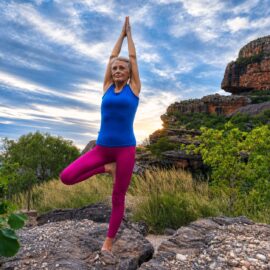
Yoga For Hip Pain: How Iyengar Poses Look After Your Hip Joints
Yoga for hip pain: the short answer
Yoga for hip pain helps by moving the hip joint through all of its natural directions, strengthening the muscles that hold it steady, and teaching you to stay calm and keep moving when it aches. The hip is one of the body’s biggest weight-bearing joints, so when it goes wrong, life gets smaller fast. Iyengar yoga uses props and partial poses so even stiff or sore hips can be worked safely, in Darwin or LIVE online. Hip opening yoga poses are only part of it; standing poses, reclining leg stretches and gentle backbends all count.
Iyengar yoga is the style developed by Mr BKS Iyengar. In the 20th century he did more than anyone to set down traditional Indian yoga, through his books and his teaching, and he pioneered the use of props. It is sometimes called modern classical yoga, and it’s the style we teach at Flametree. This page sits in our back care notes.
Here is the article in short form:
- Why hips matter: the pelvis is the hub almost every movement turns around.
- Why they hurt: sitting, wear, arthritis, bursitis, hormones and more.
- What yoga does: moves the hip six ways and strengthens it.
- Poses taught: reclining big toe poses, Tree, Triangle, forward bends, gentle backbends.
- Pain and the mind: keep moving, little and often, without forcing.
- Stiff hips test: a simple cross-legged check, and why hips and lower back go together.
- Bursitis and falls: what bursitis is, and what a 2013 pilot study found.
- Next step: learn with a teacher who adapts each pose to your hips.

Reclining Big Toe Pose II (Supta Padangusthasana II). The leg goes out to the side with a belt, while the floor supports the back.
Why do so many people get hip pain?
Because the hip carries so much, for so long. When I was doing my home practice one day, I realised there were very few yoga poses that did not involve my hips. Most of them are good for the hips in some way, or in many ways.
When you think about it, the pelvis is the fulcrum around which the whole body moves (or doesn’t!). Each hip joint is a large ball and socket joint where the thigh bone meets the pelvis, and it takes your body weight with every step. So you can quickly imagine the trouble when something goes wrong with it.
Common causes of hip pain include:
- Too much sitting, which stiffens the hips and can leave the pelvic floor too tight;
- Wear and tear with age, and osteoarthritis (worn joint cartilage);
- Bursitis (an inflamed fluid sac on the outer hip);
- Extra body weight, which adds load to the joint;
- For women, hormonal changes, around periods or menopause, and conditions such as endometriosis, which can cause pain felt in the pelvis and hips.
Hip pain can also be felt in the groin, the outer thigh or even the knee.

The hip is a ball and socket joint. Deep muscles hold it steady, and standing poses reach them.
Free ebook: Too Stiff For Yoga? Why stiffness changes in weeks, why chairs steal your hips, and how a stiff body starts.
New to Flametree, or away 3 months or more? 2 free classes + 2 ebooks, only available via this offer. Already a student? You can still get this book. Get your free copy of Too Stiff For Yoga?
How does yoga help hip pain?
By moving the joint, strengthening it, and building the patience to keep going. The hip joint contains a lubricating fluid, and movement helps keep it healthy. Yoga poses also work all the muscles that keep the hip stable, and standing poses put weight through the bones in a way that is very different from the repetition of walking or running.
It helps to know the six ways a hip moves. Yoga uses all of them.
The six hip movements, and the yoga poses that use them
- Adduction (moving the leg inward): Reclining Big Toe Pose with the leg taken across the body, using a belt.
- Abduction (moving the leg out to the side): Reclining Big Toe Pose II, and Tree Pose.
- Flexion (folding forward at the hip): any forward bend.
- Extension (taking the leg back): gentle backbends, which you feel at the front of the hips.
- External rotation (turning the thigh out): Triangle Pose and Bound Angle Pose.
- Internal rotation (turning the thigh in): poses such as Hero Pose, with support.
Put together, these poses stretch the muscles around the hip, improve the range of movement, and build strength to keep the joint stable. Keeping the joints mobile, and creating freedom in both hip joints, is the aim.

A reclining leg stretch with the leg taken across the body. This works the outer hip, a common place for stiffness.
Why are my hips stiff when I sit cross-legged?
Usually because the muscles, tendons and joints around the hips have got used to chairs and long sitting. Try a simple test. Sit cross-legged, even on a bolster or folded blankets. Are your knees higher than you would like? Is it hard to keep your back straight? If so, your hips are the place to start.
Chris sees stiffness in people in their twenties as well as older students. Long hours at a desk or behind the wheel are common causes, and stiffness tends to grow if nothing is done about it. She also notices that when the outer leg muscles are stronger than the inner ones, people tend to squeeze and tighten the lower back.

Fold from the hips and keep the spine long.
Why do hip poses help the lower back too?
Many large muscles join the pelvis to the legs and the spine, so work on the hips reaches the lower back as well. That is why yoga for lower back and hip pain is so often taught together. This page is the hip view. For the back view, see our post on yoga for lower back pain.
Stiff hips can also make it hard to point your feet where you want them, which matters for steadiness. Wide-legged poses, sitting or standing, with a blanket under the hips or a chair for support, are taught to build freedom in the hips and strength in the inner legs.

Bound angle pose with support opens the hips without strain.
What are the best yoga poses for hip pain?
There is no single best pose; a balanced mix works the whole joint. In Iyengar yoga, props make simple poses doable without pain, and poses are broken into stages, so partial poses can still help enormously.
- Reclining Big Toe Poses I, II and III: lying down with a belt, so the back is supported.
- Tree Pose: one-legged standing, with a hand on the wall if needed.
- Triangle Pose: with a block or chair under the hand.
- Bound Angle Pose: seated on a blanket, or reclining over a bolster.
- Gentle backbends: such as bridge pose with support, for the front of the hips.
If you already have a joint or hip condition, do not hold poses too long. Little and often is better. Our yoga for arthritis post covers what research has found for sore joints.
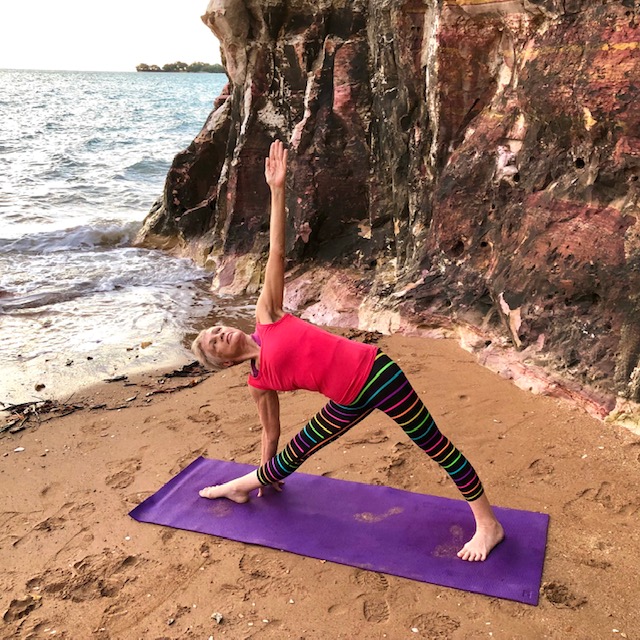
Triangle Pose turns the front thigh outward (external rotation) while the legs bear weight.
How does yoga help you live with hip pain?
By keeping you moving, and changing how you meet the pain. Without some way to manage pain, people can end up in a vicious downward spiral of less and less movement. If you already have painful hips, at least at times, you need to keep up suitable movement, so you are always doing something for yourself.
Mr BKS Iyengar’s approach to pain is worth knowing. His advice was that we must not try to run from the pain, but move through and beyond it. In his book Light on Life he also wrote of learning “to find comfort even in discomfort”, and of the tenacity and perseverance that takes.
In practice that means:
- Mental focus: attention on the breath and the pose, rather than the ache.
- Some detachment: noticing the pain without being swept along by it.
- Patience and discipline: building up slowly, with the poses that help.
- Never forcing: sharp pain means stop and change the pose.
Some yoga traditions also say we store deep emotions in the pelvis, which can show up as tight hips, for example how far the knees fall out when sitting cross-legged.

Trochanteric bursitis, an inflamed fluid sac on the outer hip, is one of many causes of hip pain.
What is hip bursitis, and where does yoga fit?
Hip bursitis is an inflamed bursa, a small fluid-filled cushion between bone and tendon on the outside of the hip. Healthdirect, Australia’s national health information service, says bursitis usually follows overuse or repeated movement of a joint.
What we teach is the careful approach described above: props, short holds, and no forcing. Gentle, well supported poses keep the hip moving. Tell your teacher before class so they can adapt the poses for you.
Is yoga safe if you already have hip pain?
Usually yes, with the right version of each pose. Tell your teacher about your hips before class. Then:
- after a hip replacement, keep to the movement limits you were given;
- use props freely, and skip anything that causes sharp pain;
- practise a little each day rather than a lot once a week.
Looking after the hip joints you have is far better than needing new ones. Regular, well taught practice keeps the joint moving and the muscles around it strong.

Reclining Bound Angle Pose (Supta Baddha Konasana), supported by bolsters and blocks, opens the hips with no effort.
What about hip fractures and falls?
A fall can break a hip, and strong, mobile hips and good balance are what a well taught class builds. In a 2013 pilot study in Sydney (Tiedemann and colleagues, Journals of Gerontology Series A), 54 people with an average age of 68 did 12 weeks of in-person Iyengar-based yoga. Their balance, walking speed, ability to get up from a chair and eyes-closed balance all improved, and these are main risk factors for falls. There were no serious adverse events.
We pull the research on falls together in our balance, bones and strength notes.
Yoga for hip pain in Darwin and live online
Flametree Yoga Studio teaches Iyengar yoga in Darwin and LIVE online, with Christine (Chris) Lalor, Senior Iyengar Yoga Teacher and certified yoga therapist. Classes, including women only classes, use props so stiff or sore hips can be worked safely.
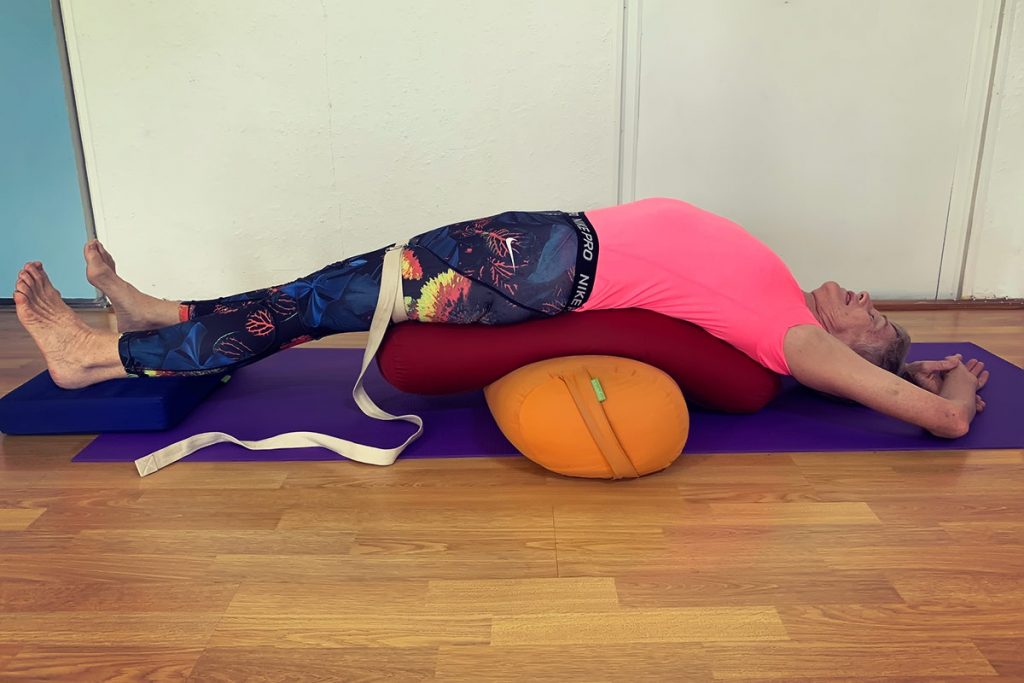
A strap keeps the hips easy while the chest opens.
Practise this at Flametree
Flametree Yoga Studio teaches Iyengar yoga in the studio at Woolner and Coolalinga in Darwin, and LIVE online.
- New to Flametree? Your first class is free. In the studio, just come along. Online, go to our online class list, click the class time you want and we email you the link to join.
- Beginners: new students, and anyone who has been away three months or more, can get a half price 10 class pass with 2 extra classes free, to use online, in the studio, or both. See the beginner half price pass.
- Already practising yoga? The same half price 10 class pass with 2 extra classes free, for new students and for anyone away three months or more, is also available as the non-beginner half price pass.
- See every class time, including online classes, on the timetable.
Can’t make a class? Practise at home with our video courses.
Related reading: tight hips, sacroiliac joint pain, how to get more flexible, yoga for arthritis, yoga for sciatica, yoga for lower back pain, yoga for back pain over 50 and yoga for osteoporosis.
Read more in our free ebook, Too Stiff For Yoga? The science of stiffness, real stiff beginners, and how an Iyengar class loosens a body a little at a time.
2 free classes + 2 ebooks, only available via this offer, for new students or anyone away 3 months or more. Current students can still get the book. See what’s inside and get your copy
Yoga for hip pain: frequently asked questions
Is yoga good for hip pain?
For many people, yes. Yoga moves the hip joint in all six directions, strengthens the muscles that hold it steady, and helps you keep moving when it aches. Learn the poses with a teacher who can adapt them.
What yoga poses are good for hip joint pain?
Commonly taught poses include Reclining Big Toe Poses with a belt, Tree Pose with a hand on the wall, Triangle Pose with a block or chair, Bound Angle Pose on a blanket, and supported gentle backbends. No single pose is best; a balanced mix works the whole joint.
What are hip opening yoga poses?
Hip opening poses move the thigh out to the side or turn it outward, such as Bound Angle Pose, Tree Pose and Reclining Big Toe Pose II. A healthy hip also needs poses that fold forward, extend back, and turn the thigh inward, so Iyengar classes use all six hip movements.
Can yoga make hip pain worse?
It can if poses are forced or held too long on a sore joint. Use props, avoid sharp pain, practise little and often, and tell your teacher about your hips. After a hip replacement, keep to the movement limits you were given.
Is yoga good for hip arthritis?
Gentle, well supported yoga can help keep an arthritic hip moving. Props make poses doable without pain, and short holds suit sore joints. See our yoga for arthritis article for what research has found.
Why do women get hip pain?
Women and men share many causes, such as sitting, wear and arthritis. Women can also feel hip and pelvic pain linked to periods, menopause and conditions such as endometriosis.
How often should I do yoga for hip pain?
A little each day suits sore hips better than one long session a week. Short, regular practice keeps the joint moving without overloading it, and weekly classes help you learn the poses correctly.
Where can I do yoga for hip pain in Darwin?
Flametree Yoga Studio teaches Iyengar yoga in Darwin and LIVE online, with Senior Iyengar Yoga Teacher and yoga therapist Christine (Chris) Lalor. Props are a normal part of Iyengar classes, and your first class is free if you are new to Flametree (in the studio, if you have lived in the NT for three months or more; online, anyone new).
Why are my hips so stiff when I sit cross-legged?
Usually because the muscles, tendons and joints around the hips have got used to chairs and long sitting, and the inner leg muscles are often weaker than the outer ones. Sit on a folded blanket or bolster so the knees can drop, and ask your teacher for hip poses that suit you.
What is hip bursitis, and can yoga help?
Hip bursitis is an inflamed bursa, a small fluid-filled cushion on the outer hip, and Healthdirect says it usually follows overuse or repeated movement. Gentle, well supported poses keep the hip moving. Tell your teacher before class.
This article is general information, not medical advice. Feel free to check with your professional advisers if you wish, but also give yoga a try. Flametree Yoga Studio, Darwin and LIVE online.
Sources: Healthdirect Australia, Hip pain, Bursitis and Osteoarthritis. Tiedemann A et al, Journals of Gerontology Series A, 2013 (Sydney pilot of Iyengar-based yoga and falls risk factors). Mr BKS Iyengar, Light on Life, 2005. Chris Lalor’s own practice and teaching.