Yoga For Sciatica: Gentle Poses That Ease Leg Pain, What To Avoid, And How To Start
Yoga for sciatica: the short answer
Pain that shoots from the buttock down the back of the leg can make sitting, driving and sleeping miserable. Yoga for sciatica helps people stay moving and eases the back that is often behind it. Yoga has good evidence for long-lasting low back pain, and UK health guidelines suggest group exercise, including mind-body exercise such as yoga, for low back pain with or without sciatica. Here is what the research says, the gentle poses an Iyengar class uses, how standing straight fits in, the warning signs to know, and how to start in Darwin or online.
Iyengar yoga is the style developed by Mr BKS Iyengar. In the 20th century he did more than anyone to set down traditional Indian yoga, through his books and his teaching, and he pioneered the use of props. It is sometimes called modern classical yoga, and it’s the style we teach at Flametree. This article sits in our back care notes.
This note in short form
- What it is: pain along the sciatic nerve, usually from the lower back.
- Research: no large yoga trials for sciatica; 2025 reviews found all non-surgical options uncertain.
- Guidelines: UK guidance suggests group exercise, including mind-body, with or without sciatica.
- Back pain evidence: Cochrane 2017 found yoga helped long-lasting low back pain.
- Standing straight: many Iyengar classes begin in Mountain Pose, and posture is part of the picture.
- Next step: a gentle Yoga For Backs class, in Darwin or LIVE online.

Lying with the lower legs resting on a chair seat. A common rest position when the lower back and sciatic nerve are irritated.
What is sciatica?
Sciatica is pain that travels along the sciatic nerve, which runs from the lower back through the buttock and down the back of each leg. It usually affects one side.
The most common cause is a bulging or herniated disc (a spinal disc that has pushed out) pressing on a nerve root in the lower back. Narrowing of the spinal canal and irritation around the buttock muscles can also cause it. Doctors often call it lumbar radiculopathy (irritation of a nerve root in the lower back). The Cleveland Clinic has a plain explanation of sciatica.
Along with the pain there may be pins and needles, numbness or weakness in the leg. Many episodes settle over weeks to a few months.
How common is sciatica?
No one figure is reliable. A 2008 review by Konstantinou and Dunn in the journal Spine looked at 23 studies. The estimates of how many people have sciatica ranged from 1.2 per cent to 43 per cent, depending on how sciatica was defined and how the studies were done. So when you see a single number, treat it with care. What most people can say is that sciatica is common, and for many it is a painful but temporary episode.
Free ebook: Happy Backs. The gentle Iyengar way with a sore back: Raj’s story, and what the trials show.
New to Flametree, or away 3 months or more? 2 free classes + 2 ebooks, only available via this offer. Already a student? You can still get this book. Get your free copy of Happy Backs
Is yoga good for sciatica? What the research says
Yoga helps the back pain behind most sciatica, and UK guidelines back exercise such as yoga. Here is what exists, with the year and what yoga was compared with.
Research on sciatica itself
- 2025 reviews of non-surgical treatments: two network reviews (comparing many treatments at once) covered 50 trials of long-lasting sciatica and 40 trials of recent sciatica. For every non-surgical option, from exercise to injections, the evidence was rated very low confidence. No non-surgical treatment has high-quality proof for sciatica yet.
What guidelines say
- NICE, UK: the National Institute for Health and Care Excellence suggests considering a group exercise programme, including mind-body exercise such as yoga, for people with low back pain with or without sciatica. NICE updated parts of this guidance in 2026, and exercise stayed at the centre of care.

Supporting the back and legs lets the spine rest.
Research on the back pain behind it
- Cochrane review, 2017: 12 trials, 1,080 people with long-lasting low back pain, most using Iyengar, Hatha or Viniyoga. Yoga improved back function more than no exercise, and eased pain. It did about as well as other back exercise. About 5 more people in 100 had a temporary flare of back pain with yoga, with no serious problems.
The full back pain research is on our yoga for back pain page, and there is more in our guides to yoga for lower back pain and yoga for back pain over 50.
Raj, whose story is on the back pain page, had a ruptured disc and sciatica and spent years mostly in bed before starting Iyengar yoga at Flametree. In his own words: “It also led to sciatica, or pain from the sciatic nerve. I was totally incapacitated.” It shows what careful, regular practice can mean.

A gentle twist sitting on a chair. The chair keeps the spine upright, and the twist stays well short of the end of the range.
Watch: yoga for sciatica and other back problems
In this short video, Flametree shows gentle supported yoga for sciatica and other back problems.
What an Iyengar class does for sciatica
For sciatica, an Iyengar class starts gently, supports the back with props, and avoids the movements that pull on an irritated nerve.
Yoga poses for sciatica that are commonly taught
- Lying with the lower legs on a chair: the lower back rests flat and the hips and knees are at right angles.
- Lying leg raise with a belt (Supta Padangusthasana): the leg is lifted only as far as is comfortable, with the belt taking the weight.
- Gentle twists on a chair: sitting tall, turning slowly, well short of the end of the range.
- Standing poses with support: Triangle and Warrior 2 with the hands on a chair or the wall, to build strength around the pelvis and back.
- Half dog at the wall or chair: lengthening the spine with the knees bent if the leg pulls.

A lying leg stretch with a belt (Supta Padangusthasana), the leg taken out to the side and resting on a bolster. Props let the leg go only as far as is comfortable.
What yoga poses to avoid with sciatica
- Deep forward folds with straight legs, which stretch the nerve.
- Strong seated twists and anything taken to the end of the range.
- Deep backbends, which aggravate some people.
- Anything that sends pain further down the leg, or brings on pins and needles. Ease off or come out.
Iyengar teaching holds, from long practice, that sciatica often settles when the pelvis and lower back are brought back into balance with standing work and support. The trials back regular, gentle, supervised practice.
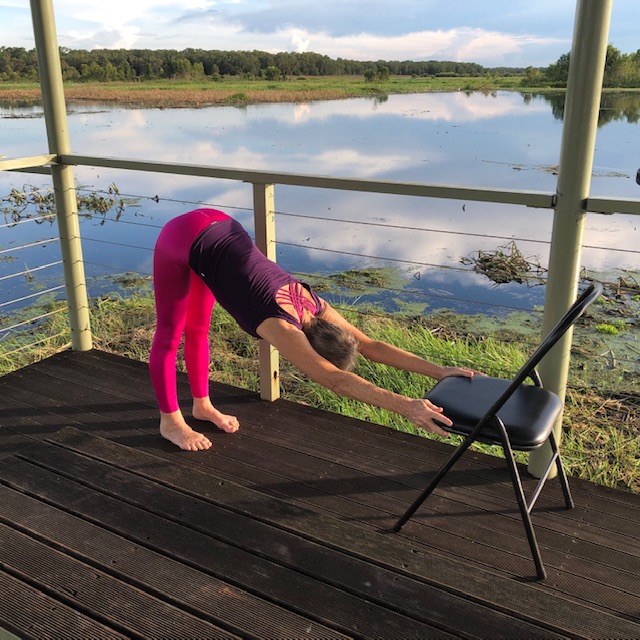
A forward bend with support lengthens the back of the legs.
Does standing straight matter for sciatica?
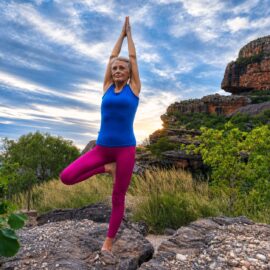
Posture is part of the picture, not the whole of it. “Don’t slouch,” Chris’s mum would say, and she would be happy that so many Iyengar classes begin in Mountain Pose (Tadasana), standing tall and even on both feet. Chris is grateful that her mum kept on her case about standing up straight. Improving posture is one of the strengths of this kind of yoga, and we see how much it matters to how a back feels. Posture does not simply cause sciatica, which most often comes from a disc or a narrowing in the lower back. But many people find that learning to stand and sit more evenly takes some strain off a sore back.
Two common posture patterns are worth knowing. Kyphosis (a hump at the top of the spine) is too much rounding of the upper back, with the head carried forward. Sway back, or lordosis, is too much inward curve in the lower back. The Cleveland Clinic explains both in plain words: kyphosis and lordosis (swayback). If you are unsure whether you have either, ask your teacher.

Bridge lifts the chest and builds strength in the legs.
How does a back class work?
A yoga for backs class in our style aims to work evenly. It looks at posture, it tones and lengthens the inner and outer thighs evenly, it works on the core and the muscles of the lower back, and it works the upper, middle and lower back equally. Poses that spread and lengthen the back may ease the pressure on the sciatic nerve for some people. Our note on yoga for posture goes further.
One student of our back class said: “After starting yoga, I slowly realised I can get better.”

A gentle lying twist with the knees resting on a bolster. Supported this way, the lower back turns without strain.
What should I tell my teacher about sciatica?
Tell your teacher about your leg pain before class so they can adapt the poses for you. Feel free to check with your professional advisers if you wish, but also give yoga a try.

A chair makes many poses safe and easy to reach.
Practise this at Flametree
Flametree Yoga Studio teaches Iyengar yoga, including gentle back care classes, in the studio at Woolner and Coolalinga in Darwin, and LIVE online. Gentle classes can suit people with sciatica too. Tell the teacher about your leg pain before class. More on the Back, Neck and Shoulder Focus class page and the Darwin yoga for back pain page.
- New to Flametree? Your first class is free. In the studio, just come along. Online, go to our online class list, click the class time you want and we email you the link to join.
- Beginners: new students, and anyone who has been away three months or more, can get a half price 10 class pass with 2 extra classes free, to use online, in the studio, or both. See the beginner half price pass.
- Already practising yoga? The same half price 10 class pass with 2 extra classes free, for new students and for anyone away three months or more, is also available as the non-beginner half price pass.
- See every class time, including online classes, on the timetable.
Can’t make a class? Practise at home with our video courses.
Related pages: sacroiliac joint pain, how to reduce lower back pain, yoga for back pain, yoga for lower back pain, yoga for posture and the benefits of yoga page.
Read more in our free ebook, Happy Backs. Stories, the trials and how a gentle Iyengar class works on a sore back.
2 free classes + 2 ebooks, only available via this offer, for new students or anyone away 3 months or more. Current students can still get the book. See what’s inside and get your copy
Yoga for sciatica: frequently asked questions
Is yoga good for sciatica?
Yes, for many people. Yoga has good evidence for long-lasting low back pain, and UK guidelines suggest group exercise, including mind-body exercise, for low back pain with or without sciatica. Gentle, supported poses taught to your level are the sensible way to find out.
Which yoga poses help sciatica?
Gentle, supported poses usually suit best: lying with the lower legs resting on a chair, a lying leg raise with a belt, gentle twists on a chair, and standing poses with the hands on a chair or wall. What suits you depends on what is irritating the nerve, so learn them with a teacher first.
Which yoga poses should I avoid with sciatica?
Deep forward folds with straight legs, strong seated twists, and anything that sharpens the pain down the leg. Some people also find deep backbends aggravate it. If a pose sends pain further down the leg, or brings on pins and needles, come out of it.
Is chair yoga good for sciatica?
Often, yes, especially at first. A chair lets you bend, twist and lengthen the spine without taking the full load, and lying with the lower legs resting on a chair is one of the most common rest positions for an irritated back.
Can yoga make sciatica worse?
It can, if the poses are too strong or pushed through pain. In the 2017 Cochrane review of yoga for low back pain, about 5 more people in 100 had a temporary flare with yoga than without, and none were serious. Choose a gentle, prop-based class and tell the teacher about your leg pain.
Should I tell my teacher about sciatica?
Yes. Tell your teacher about your leg pain before class so they can adapt the poses for you.
How long does sciatica take to settle with yoga?
Many episodes of sciatica settle over weeks to a few months whatever you do, and yoga keeps you moving and comfortable while that happens. For long-lasting sciatica, regular gentle practice over months builds the change.
How common is sciatica?
No one figure is reliable. A 2008 review in Spine of 23 studies found estimates from 1.2 per cent to 43 per cent, depending on how sciatica was defined. It is common, and for many people it is a painful but temporary episode.
Does posture affect sciatica?
Posture does not simply cause sciatica, which most often comes from a disc or a narrowing in the lower back. But many people find that learning to stand and sit more evenly takes some strain off a sore back. Ask your teacher.
Where can I get yoga for sciatica in Darwin or online?
Flametree Yoga Studio teaches gentle back care classes, led by Senior Iyengar Yoga Teacher and certified yoga therapist Christine (Chris) Lalor and the Flametree team, in Darwin, at Woolner and Coolalinga, and LIVE online. Your first class is free if you are new to Flametree (in the studio, if you have lived in the NT for three months or more; online, anyone new): in the studio you just come along, and online you click the class time you want and we email you the link to join. The half price 10 class pass is for newcomers and for students who have been away three months or more.
This article is general information, not medical advice. Feel free to check with your professional advisers if you wish, but also give yoga a try. Flametree Yoga Studio, Darwin and live online.
Sources (studies found through PubMed): Zhu Z and colleagues, Effectiveness of non-surgical interventions for patients with chronic sciatica: a systematic review with network meta-analysis, Journal of Pain, 2025, doi 10.1016/j.jpain.2025.105431. Zhu Z and colleagues, Effectiveness of nonsurgical interventions for patients with acute and subacute sciatica, Journal of Orthopaedic and Sports Physical Therapy, 2025, doi 10.2519/jospt.2025.13068. National Institute for Health and Care Excellence, Low back pain and sciatica in over 16s: assessment and management (NG59), recommendation 1.2.2, nice.org.uk/guidance/ng59. Wieland LS and colleagues, Yoga treatment for chronic non-specific low back pain, Cochrane Database of Systematic Reviews, 2017, doi 10.1002/14651858.CD010671.pub2. Konstantinou K and Dunn KM, Sciatica: review of epidemiological studies and prevalence estimates, Spine, 2008, doi 10.1097/BRS.0b013e318183a4a2.