
Yoga For Arthritis: What The Research Shows, And How To Protect Sore Joints
Yoga for arthritis: the short answer
Stiff hands in the morning, knees that complain on the stairs, a hip that aches after a long day: that is arthritis for millions of Australians. Yoga for arthritis can help you keep moving with less pain, as long as the poses are adapted to your joints. For osteoarthritis (wear-and-tear arthritis), reviews in 2024 and 2026 found yoga reduced knee pain and stiffness and improved function. For rheumatoid arthritis (where the immune system attacks the joints), a 2025 review found yoga added to medical treatment improved disease activity and function. Here is what the research shows, how an Iyengar class adapts poses for sore joints, and how to start in Darwin, where the heat and humidity add their own twist.
Iyengar yoga is the style developed by Mr BKS Iyengar. In the 20th century he did more than anyone to set down traditional Indian yoga, through his books and his teaching, and he pioneered the use of props. It is sometimes called modern classical yoga, and it’s the style we teach at Flametree. This page sits in our Stiffness And Flexibility notes.
Yoga for arthritis in short form
- How common: about 3.7 million Australians had arthritis in 2022.
- Osteoarthritis: 2024 and 2026 reviews found less knee pain and stiffness with yoga.
- Rheumatoid arthritis: a 2025 review found better function and disease activity.
- Limits: trials are small, and yoga works alongside medical care, not instead of it.
- Iyengar method: chairs, blocks and blankets so no joint is forced.
- One woman’s story: slow, gentle classes, and a doctor’s say on any change in medication.
- How joints move: a plain-English panel on the types of joint movement.
- Next step: a free first class for newcomers, in Darwin or LIVE online.

Triangle Pose (Trikonasana) with the lower hand on a chair. Both legs straight, the chair takes weight off the lower arm and back, and the hips and knees still work.

A forward bend with support lengthens the back of the legs.
What is arthritis?
Arthritis is a group of conditions that cause pain and stiffness in the joints. In 2022, just under 3.7 million Australians (14.5%) had arthritis, more women (17%) than men (12%), and almost half of people over 75.
- Osteoarthritis: the most common type, where the cartilage (the smooth cushion at the end of the bones) wears and the joint changes. Knees, hips, hands and the spine are most often affected.
- Rheumatoid arthritis: an autoimmune disease (the immune system attacking the body), where the joint lining becomes inflamed. It often affects the hands and feet on both sides.
- Other types include psoriatic arthritis and gout.
Below is what current reviews say about yoga for each.

A bolster lets the spine rest while the joints are supported.
Free ebook: Too Stiff For Yoga? Why stiff, sore joints change with steady practice, and why many people feel stiffer in Darwin’s build-up.
New to Flametree, or away 3 months or more? 2 free classes + 2 ebooks, only available via this offer. Already a student? You can still get this book. Get your free copy of Too Stiff For Yoga?
Is yoga good for arthritis? What the research says
The evidence is encouraging for osteoarthritis, more tentative for rheumatoid arthritis, and small for both. Here are the studies, with the year and what yoga was compared with.
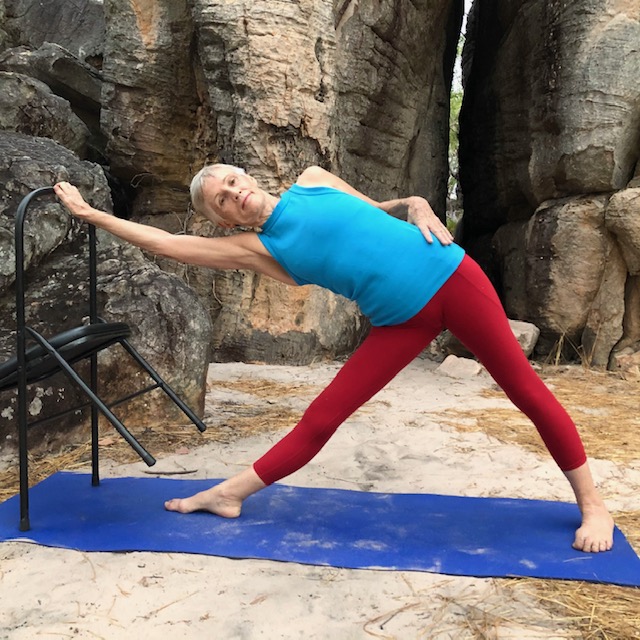
Triangle pose lengthens both sides of the body.
Osteoarthritis
- 2024 review, 8 trials, 756 people with knee osteoarthritis: compared with control groups, yoga reduced pain, stiffness and loss of function. It did not clearly improve daily activities or quality of life.
- 2026 review, 14 studies, 1,183 people: low-certainty evidence that yoga improved knee pain and function. Programmes of 8 weeks or more gave the most consistent results.
- 2024 review of what works, 16 trials: 10 of 14 yoga programmes for osteoarthritis reduced pain or improved function, and most of the effective ones were supervised group classes.
- Hand osteoarthritis, 1994: a small US trial found a supervised weekly yoga programme for 8 weeks eased pain during activity, tenderness and finger stiffness more than no treatment.
- Guideline, 2019: US rheumatologists and the Arthritis Foundation conditionally recommend yoga for knee osteoarthritis.

Lying down lets the body rest while it stretches.
Rheumatoid arthritis
- 2025 review, 5 trials: yoga added to standard medical treatment improved disease activity scores and physical function compared with medical treatment alone. It did not clearly reduce pain. The trials were small and of low quality.
- 2020 review: yoga may improve physical function, disease activity and grip strength, with no clear effect on pain or blood markers of inflammation. The authors asked readers to be very cautious.
Where the evidence is thin: trials are small, styles vary, and few last longer than a few months. Iyengar teaching holds, from long practice, that careful alignment spreads load evenly through a joint. Research has not yet tested that directly.

A lunge with a chair for support. The front knee stays over the ankle, so the thigh works without strain on the joint.
What an Iyengar class does for arthritic joints
An Iyengar class adapts each pose to the joint in front of the teacher. Mr BKS Iyengar developed props so that people who could not do a pose unaided could still get its benefit, and that is exactly what arthritic joints need.
- Chairs: a chair under the hands in standing poses and forward bends, or a seat for twists and breathing.
- Blocks and blankets: to raise the floor, sit higher, or pad a knee.
- Belts: to reach the foot without straining the hip or back.
- The wall: for balance, so standing work can go on safely.
- Precise alignment: the knee in line with the foot, the weight spread through the whole foot, the spine long.
Chris Lalor, Senior Iyengar Yoga Teacher and certified yoga therapist, sees many students with arthritic knees, hips and hands. Her detailed guide to props and alternatives for sore knees is on our Iyengar yoga for knees page. For how a chair helps, see chair yoga.

Bending forward from the hips with the hands on a chair. The chair shortens the reach, so stiff hips and a sore back are not forced.
One woman’s story: slow, gentle yoga with arthritis
A book by Linda Sparrowe with Patricia Walden tells the story of one woman, and it shows how slowly yoga can work. She was diagnosed with a degenerative form of arthritis at 26, and in her forties joined a slow, gentle yoga class. After ten weeks she felt more flexible, although her doctor saw no measurable difference. Three years on, the book reports, she had fewer flare-ups and some pain-free days, and was taking a quarter of the medication she had started on. The book is clear that yoga had not cured her arthritis.
This is one person’s report, not a trial. It shows patience and gentle practice, not a result to expect. Any change in medication is a decision for your doctor.
How do your joints move in yoga poses?
Most of the joints in your body are synovial joints, which allow movement while keeping the bone ends from touching. Yoga poses use many kinds of joint movement, which is why a pose like Triangle Pose (Trikonasana) can feel like a lot is going on. In Triangle Pose, the hinge joints (the knees) mainly bend and straighten, while the ball and socket joints (the hips and shoulders) can move in several directions at once.
Here are the types of joint movement, in plain English, as described in Ann Swanson’s Science of Yoga:
- Flexion: the angle at a joint gets smaller.
- Extension: the angle at a joint gets larger.
- Abduction: a limb moves away from the body.
- Adduction: a limb moves closer to the body.
- External rotation: a limb turns outwards.
- Internal rotation: a limb turns inwards.
- Axial rotation: the spine twists on its own axis.
- Plantar flexion: pointing the feet.
- Dorsiflexion: flexing the feet.
Knowing the names can help when a teacher asks you to move a joint in one direction and not another. It does not tell you how much movement is right for your joint. That is a question for your teacher, and your doctor if you wish.
Yoga for arthritis in Darwin: heat, humidity and the wet season
Many people with arthritis say their joints feel different through the seasons. Research on weather and joint pain is mixed, but the Darwin year does change how people move.
- The build-up and wet season: heat makes muscles feel looser, which can tempt people to push a stiff joint too far. Go by the joint, not by how warm you feel.
- Air-conditioning: long days in cold offices and cars leave many people stiff by evening, which is a good time for a gentle class.
- Drink water: heat and sweating make it easy to get dehydrated in class.
- Choose the time: check the timetable for a time of day your joints like best.

A lying leg stretch to the side (Supta Padangusthasana 2), the leg resting on a bolster. Supported versions like this suit days when the hips are sore.
Safe practice with arthritis
- Tell your teacher which joints are affected, and about any joint replacement.
- Pain rule: a working feeling in the muscles is fine. Sharp or increasing joint pain means stop.
- Flares: during a flare of rheumatoid or other inflammatory arthritis, rest hot, swollen joints and keep to supported poses, or check with your doctor first.
- Hands and wrists: put the hands on a chair or blocks rather than the floor.
- Knees: avoid full kneeling and deep squats until your teacher gives you a padded or supported version.
- Medication: any change in arthritis medication is a decision for you and your doctor.
- Thin bones: many people with arthritis also have osteoporosis. See our yoga for osteoporosis page for the forward-bending caution.
Talk to your yoga teacher, yoga therapist, and your doctor or rheumatologist if you wish.
Yoga for arthritis in Darwin and live online
Flametree Yoga Studio teaches Iyengar yoga at Woolner and Coolalinga in Darwin and LIVE online across Australia, with chairs, blocks, belts and blankets in the classes. Gentle yoga can suit people starting out with arthritis, and restorative yoga suits sore days.
Related research pages: Iyengar yoga for knees, yoga for osteoporosis, yoga for posture, yoga for back pain, yoga for strength, our Triangle Pose note and the benefits of yoga page.
Read more in our free ebook, Too Stiff For Yoga? The science of stiffness, real stiff beginners, and how an Iyengar class loosens a body a little at a time.
2 free classes + 2 ebooks, only available via this offer, for new students or anyone away 3 months or more. Current students can still get the book. See what’s inside and get your copy
Yoga for arthritis: frequently asked questions
Is yoga good for arthritis?
For osteoarthritis (wear-and-tear arthritis) the research is encouraging: reviews in 2024 and 2026 found yoga reduced knee pain and stiffness and improved function. For rheumatoid arthritis, a 2025 review found yoga added to usual medical treatment improved disease activity and function, but not clearly pain. Both evidence bases are small, so yoga works best alongside medical care.
Can yoga help rheumatoid arthritis?
It may help alongside medical treatment. A 2025 review of 5 trials found yoga added to standard treatment improved disease activity scores and physical function compared with standard treatment alone, but did not clearly reduce pain. The trials were small and of low quality. Practise gently and follow your rheumatologist’s advice during flares.
Is yoga good for osteoarthritis?
Mostly yes, with the strongest evidence for the knee. A 2024 review of 16 trials found 10 of 14 yoga programmes for osteoarthritis reduced pain or improved function, and a small 1994 trial found benefit for hand osteoarthritis. Hip and spine osteoarthritis have been studied less. Knee detail is on our Iyengar yoga for knees page.
Should I do yoga when my joints are inflamed?
Go gently. During a flare of rheumatoid or other inflammatory arthritis, rest the hot, swollen joints and choose supported or restorative poses, or skip class and check with your doctor. Tell your teacher which joints are affected so the poses can be changed.
What yoga poses should I avoid with arthritis?
It depends on the joint. Full kneeling and deep squats often trouble arthritic knees, weight on the hands can trouble arthritic wrists, and forcing any joint to the end of its range is best avoided. A chair, a block or a folded blanket usually gives a version that works.
Can I do yoga with arthritis in my hands and wrists?
Yes, with changes. A small 1994 US trial found a yoga programme for hand osteoarthritis eased pain with activity and improved finger movement more than no treatment. In class, the hands can rest on a chair or blocks, or a rolled mat can lift the heel of the hand, to take strain off the wrist.
Is chair yoga good for arthritis?
Often, yes, especially at first or during a flare. A chair lets you do standing and seated poses with less load on painful joints. The aim over time is to use the chair as support in standing poses, so the muscles around the joints still work.
Can yoga replace arthritis medication?
No. Yoga works alongside medical care, not instead of it. One woman in a book by Linda Sparrowe with Patricia Walden reported taking a quarter of her original medication after three years of gentle classes, but that is one person’s report, and any change in medication is a decision for your doctor.
How do joints move in yoga poses?
Joints can bend (flexion), straighten (extension), move away from or towards the body (abduction and adduction), and turn outwards or inwards (external and internal rotation). The spine can also twist on its own axis, and the feet can point or flex.
Where can I do yoga for arthritis in Darwin?
Flametree Yoga Studio teaches Iyengar yoga at Woolner and Coolalinga in Darwin and LIVE online, with chairs, blocks and belts in the classes. Gentle yoga can suit people starting out with arthritis. Your first class is free if you are new to Flametree: in the studio, if you have lived in the NT for three months or more, and online, for anyone new.
Practise this at Flametree
Flametree Yoga Studio teaches Iyengar yoga in the studio at Woolner and Coolalinga in Darwin, and LIVE online.
- New to Flametree? Your first class is free. In the studio, just come along. Online, go to our online class list, click the class time you want and we email you the link to join.
- Beginners: new students, and anyone who has been away three months or more, can get a half price 10 class pass with 2 extra classes free, to use online, in the studio, or both. See the beginner half price pass.
- Already practising yoga? The same half price 10 class pass with 2 extra classes free, for new students and for anyone away three months or more, is also available as the non-beginner half price pass.
- See every class time, including online classes, on the timetable.
Can’t make a class? Practise at home with our video courses.
This article is general information, not medical advice. If you have arthritis, keep following your doctor’s or rheumatologist’s advice, and check with them before starting if your arthritis is inflammatory or you have had a joint replaced. Flametree Yoga Studio, Darwin and live online.
Sources: Australian Bureau of Statistics, Arthritis, National Health Survey 2022, abs.gov.au. Lu J and colleagues, The impact of yoga on patients with knee osteoarthritis, PLoS One, 2024, doi 10.1371/journal.pone.0303641. Zhou J and colleagues, Effects of yoga on pain, physical function, and biomechanical outcomes in knee osteoarthritis, Journal of Back and Musculoskeletal Rehabilitation, 2026, doi 10.1177/10538127261421867. Biswas I and colleagues, Key characteristics of effective yoga interventions for managing osteoarthritis, Rheumatology International, 2024, doi 10.1007/s00296-024-05652-y. Garfinkel MS and colleagues, Evaluation of a yoga based regimen for treatment of osteoarthritis of the hands, Journal of Rheumatology, 1994, PubMed 7699639. Kolasinski SL and colleagues, 2019 American College of Rheumatology/Arthritis Foundation guideline for the management of osteoarthritis of the hand, hip, and knee, Arthritis Care and Research, 2020, doi 10.1002/acr.24131. Biswas I and colleagues, Key features of effective yoga interventions in addition to standard medical treatment for rheumatoid arthritis, ACR Open Rheumatology, 2025, doi 10.1002/acr2.70054. Ye X and colleagues, Yoga for treating rheumatoid arthritis: a systematic review and meta-analysis, Frontiers in Medicine, 2020, doi 10.3389/fmed.2020.586665. Sparrowe L with Walden P, The Woman’s Book of Yoga and Health, for the case story retold above in our own words. Swanson A, Science of Yoga, Dorling Kindersley, for the types of joint movement.



