
Hip Mobility Exercises: A Ten-Minute Chair Sequence That Takes Your Hips In Every Direction
Hip mobility exercises: the short answer
Good hip mobility exercises take the hip joint in every direction it can go: folding forward, taking the leg behind you, out to the side, across the body and turning in and out. A day in chairs uses only the first of those. This ten-minute sequence uses a chair, a belt and the floor to give back the rest, and it is gentle enough to start from stiff. Here is the article in short form:
- Hips move in six directions, and a day in chairs uses one.
- Hip extension (the leg behind you) is the movement we lose most.
- Eight weeks of Iyengar yoga gave older adults more hip extension.
- The sequence has six moves, about a minute or two each.
- A chair, a belt and a wall do the holding.
- Little and often beats long and rare.
- Learn it in Darwin or live online, with a teacher watching your hips.
Last updated: 25 October 2026.
A quick word on Iyengar yoga. Iyengar yoga is the style developed by Mr BKS Iyengar. In the 20th century he did more than anyone to set down traditional Indian yoga, through his books and his teaching, and he pioneered the use of props. It is the style we teach at Flametree, in Darwin and live online.

A day of chairs and cars moves the hip mostly forward. A yoga class takes it in all six directions, including the one we lose most.
What are the six directions a hip can move?
The hip is a ball and socket joint, so it can move more ways than a knee or an elbow. The six movements are: bending forward (flexion), taking the thigh back behind the body (extension), lifting it out to the side (abduction), bringing it across the body (adduction), and turning the thigh out or in (outward and inward rotation).
Sitting, driving and couch time all fold the hip forward. According to Kelly and Juliet Starrett’s book Built to Move, as quoted in our free ebook Too Stiff For Yoga?, a typical day can add up to about 12 hours in a chair. Hardly anything in it takes the thigh back or out to the side.
Which hip movement do we lose most?
Hip extension, the leg going behind you. According to PubMed, a US national health survey measured the hips and knees of 1,683 people. Up to age 74, the oldest group had lost only 3 to 5 degrees in most movements, a small amount. Hip extension was the one exception, where the oldest group had lost more than a fifth of the range (Roach and Miles, Physical Therapy, 1991). So age takes a little, and a lifetime of chairs may take the rest.
Geeta Iyengar, Mr Iyengar’s daughter, noticed the same thing. She wrote that because “everyone sits in chairs these days”, the knees, ankles, hips or spine begin to give trouble.
Can yoga give hip movement back?
In a small exploratory study, yes. According to PubMed, 19 healthy adults aged 62 to 83 finished eight weeks of gentle Iyengar yoga, with two 90-minute classes a week and home practice. Their peak hip extension and stride length rose significantly, and the more they practised at home, the bigger the change (DiBenedetto and colleagues, Archives of Physical Medicine and Rehabilitation, 2005). There was no comparison group, so it is a first step, not a final answer. But it measured the very movement that age and chairs take away.
What is a ten-minute hip mobility sequence?
These six moves take the hip in each direction, standing first and lying down last. Spend a minute or two on each. Move slowly, breathe out as you go a little further, and never bounce. Feel a firm stretch, not a sharp pain. If a move hurts, make it smaller or use a higher prop. If you have had a hip replacement, tell your teacher before you start. These are general steps; in class your teacher shapes each one to your body.

The ten-minute hip mobility sequence on one page: six moves, one for each way the hip can go.
1. Half forward bend with hands on a chair (the hip folds)
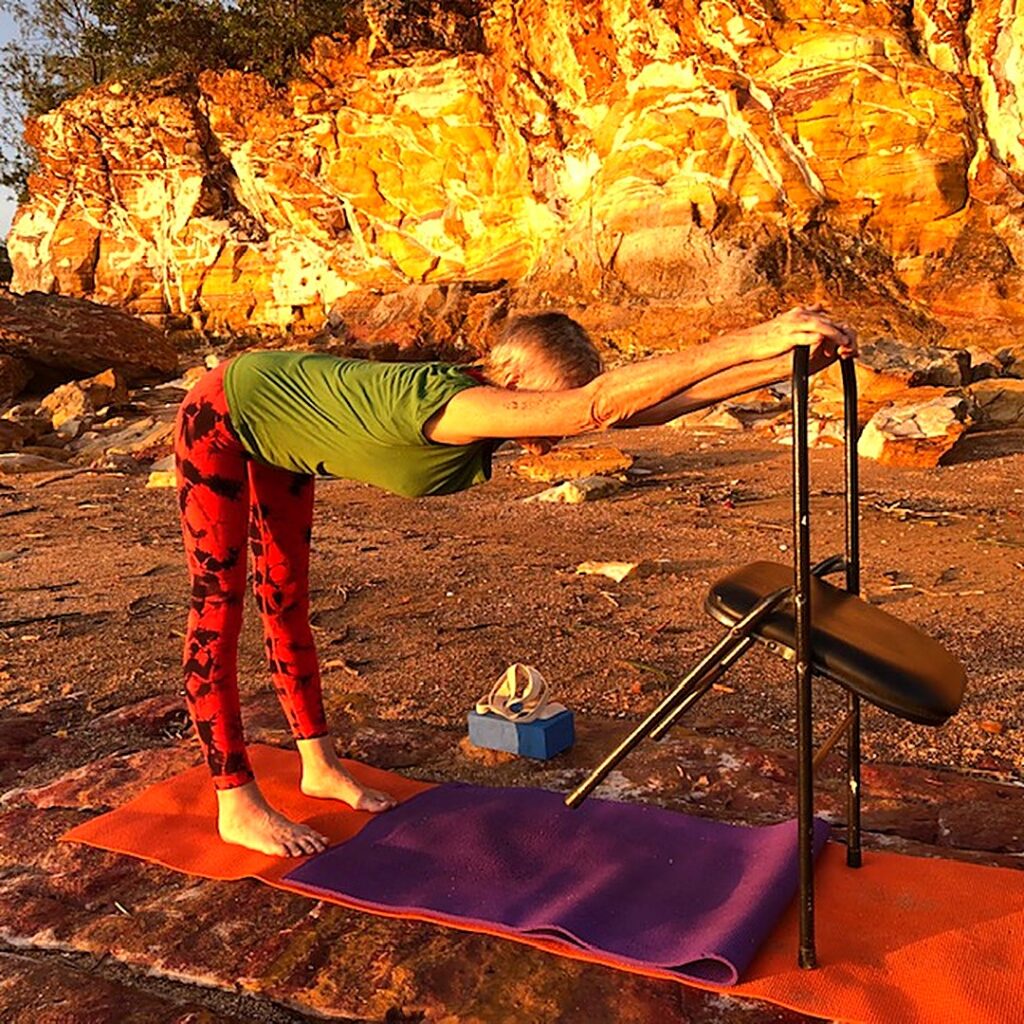
Half forward bend with hands on a chair seat. Fold from the hips, not the back.
Stand an arm’s length from a chair and put your hands on the seat. Fold from the hips until your back is long and flat, and press the thighs back. The chair stops the spine from rounding to make up for stiff hips. Stay for five slow breaths.
2. Wide standing pose with the back leg long (the hip extends)

A wide standing pose beside a chair. The back leg is long and strong, which takes the thigh behind the body.
Stand with a chair beside you for balance, the front knee bent over the ankle and the back leg long and strong. This takes the back thigh behind the body, the movement chairs stop us using. Press the back heel down and stay for four or five breaths, then change sides. For a deeper look at the front of the hip, see Psoas Stretch and Hip Flexor Stretch.
3. Triangle Pose with a hand on a chair (out to the side, turning out)

Triangle Pose (Utthita Trikonasana) with a hand on a chair. Both legs stay straight while the hips open sideways.
Stand with the feet wide, turn the front foot out, and reach sideways over it with your lower hand on a chair seat or a block. Press the outer edge of the back heel down. Triangle takes the front thigh out to the side and turns it outwards, while the legs do real work. Do both sides, with the same number of breaths on each.
4. Lying leg out to the side with a belt (the hip opens sideways)

Reclining Big Toe Pose II (Supta Padangusthasana II). The belt holds the leg and your back rests on the floor.
Lie on your back, loop a belt round one foot, straighten that leg up, then lower it out to the side. Keep the other leg long and the pelvis level, and rest the outer leg on a bolster or cushion if it will not reach the floor. The inner thigh lengthens while the back stays supported. Both sides, a minute each.
5. Chair figure-four (turning out)
Sit tall on the front of a chair. Cross one ankle over the opposite thigh, just above the knee, and let the knee drop away. Keep the back long and fold forward from the hips until you feel the outer hip and buttock stretch. This is the same idea as a lying figure-four, with the chair taking the work out of getting down. For more outer-hip work, see Glute Stretches.
6. Lying with the knees falling in (turning in), then rest
Lie on your back with the knees bent and the feet wider than the hips. Let both knees lean in towards each other, resting against a bolster or a folded blanket if you like. This turns the thighs inward, a movement almost never used in a day. Stay for a minute, then rest with the legs supported. A seated version of the opposite idea is Butterfly Stretch.

Finish with a supported rest, legs on a bolster, so the hips can let go after the work.
How often should you do hip mobility exercises?
A little, often. The older adults in the Virginia study did two classes a week plus 20 minutes of directed home practice on alternate days. Choose three or four of the six moves and do them most days, then add the rest as they get easier. Stiffness does not fade in a day, but a hip that is used in all its directions tends to keep moving.
If your hips are sore as well as stiff, start with Yoga For Hip Pain, and for the tight hamstrings that often go with stiff hips, see Tight Hamstrings. For the wider picture, read Tight Hips.
Is there a class on hips?
Yes. On Sunday 6 December Chris Lalor teaches an online masterclass, Yoga for stronger and more flexible hips. The hip is the largest weight-bearing joint in the body, and the pelvis is the fulcrum everything else moves around. The masterclass is one of the series on the Flametree masterclasses page, where you can read the current details.
Get the free ebook Too Stiff For Yoga? New to Flametree, or away for 3 months or more? You get 2 free classes + 2 ebooks, only available via this offer. Already coming to class? You can still get the book.
Questions people ask
What are the best hip mobility exercises?
Ones that take the hip in every direction: a half forward bend with hands on a chair, a wide standing pose with the back leg long, Triangle Pose with a chair, a lying leg stretch out to the side with a belt, a chair figure-four, and lying with the knees falling in.
Which hip movement do we lose most with age?
Hip extension, the leg going behind the body. In a US survey of 1,683 people, most joints lost only 3 to 5 degrees up to age 74, but hip extension lost more than a fifth of its range.
Can yoga improve hip mobility?
In a small study of 19 healthy adults aged 62 to 83, eight weeks of gentle Iyengar yoga raised peak hip extension and stride length. There was no comparison group, so it is an early finding rather than proof.
How long does it take to improve hip mobility?
No study gives a fixed time. In the Virginia study the change appeared after eight weeks of two classes a week plus home practice, and the more people practised, the bigger it was.
How often should I do hip mobility exercises?
Most days, a little at a time. Pick three or four of the six moves and hold each for a minute or two, then add the rest as they get easier.
Do I need to be flexible to start?
No. A chair, a belt and a bolster hold the position for you, so a stiff hip can work without strain. Props mean nobody is too stiff to start.
Is sitting really bad for my hips?
A long day in a chair keeps the hip folded forward, and hardly anything in a modern day takes the thigh behind the body. The Starretts’ sample day adds up to about 12 hours in a chair. Moving the hip in other directions each day is the answer.
Where can I learn hip mobility exercises in Darwin?
Flametree Yoga Studio teaches Iyengar yoga at Woolner and Coolalinga in Darwin and live online. Beginner and Gentle classes use chairs, belts, blocks and bolsters, and the teacher adjusts each pose to your hips.
Where to next
- New to yoga, or coming back? Start with our half price 10 class pass with 2 classes free, in Darwin or live online.
- For a workplace, team or group: book private yoga classes for groups, online, at a Flametree studio or at your venue.
- Want to see class times first? Look at the beginner timetable.
Flametree Yoga Studio, Darwin and live online. This article is general information, not medical advice.
Sources (via PubMed): Roach KE and Miles TP, Normal hip and knee active range of motion: the relationship to age, Physical Therapy, 1991; DiBenedetto M and colleagues, Effect of a gentle Iyengar yoga program on gait in the elderly: an exploratory study, Archives of Physical Medicine and Rehabilitation, 2005. The Starretts’ sitting figure and the Geeta Iyengar quote are from the Too Stiff For Yoga? ebook; the masterclass description is from the Flametree masterclasses page.



