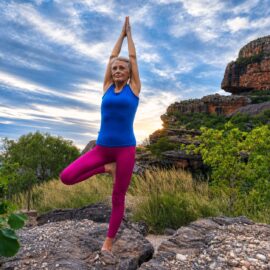
Seated Forward Bend: Why It Feels So Hard, And How To Surrender Into It
Seated forward bend: the short answer
When I first tried a seated forward bend, every muscle around my hips was screaming “let me out of here”! A seated forward bend feels hard for most beginners because short hamstrings, stiff hips and a busy mind all show up at once. In Iyengar yoga, forward bend yoga poses are made doable with props, such as a belt around the feet, a folded blanket to sit on and a chair or bolster to rest the head, so you can stay, breathe and slowly let go. Over time the benefits of forward bends go beyond flexibility: many students find them among the most calming poses in the whole practice. Here is my own story of learning them, and what helped.
Iyengar yoga is the style developed by Mr BKS Iyengar. In the 20th century he did more than anyone to set down traditional Indian yoga, through his books and his teaching, and he pioneered the use of props. It is sometimes called modern classical yoga, and it’s the style we teach at Flametree. This page sits in our flexibility and stiffness notes.
Seated forward bend in short form
- Why it is hard: short hamstrings, tight hips and a restless mind.
- What helps: belts, blankets, bolsters, blocks and a chair.
- Surrender: acceptance and patience, not giving up.
- The legs matter: quiet, active legs let the back relax.
- Sequencing: standing poses first prepare the body to fold.
- The calm: forward bends draw the senses inward, and many students find them settling at bedtime.
- The chin lock: resting the head on support is where the mind often goes quiet.
- Next step: learn them with a teacher, in Darwin or LIVE online.

Seated Forward Bend (Paschimottanasana) after many years of practice. It did not start like this.
Why is a seated forward bend so hard at first?
Because the hamstrings, the hips and the mind all resist at the same time. I still remember looking across the yoga room at other students, wondering how on earth people could bend forward so far. Was it the hamstrings (the muscles at the back of the thighs), or what? How could they sit upright and look so calm?
When I tried, every muscle around my hips was screaming “let me out of here”!
I discovered that to enjoy what sitting poses and forward bends had to offer, I needed to lengthen my hamstrings and become far more flexible around my hips. I also had to find a way to relax into these poses while all of that was happening.
Essentially, I had to learn to accept where I was at.

Seated forward bends lengthen the back of the legs and soothe the mind.
What does surrender mean in a forward bend?
Surrender in yoga means acceptance, not failure. Every time I practised these poses I would go just that little bit further, try to surrender, and stay a little longer.
Surrender is a difficult idea for us Westerners. We often think of it as giving up. I learnt that surrender is more about acceptance, peace, calmness, endurance and stamina.
Contrary to what our culture tells us, surrendering involves a range of noble, dignified and highly useful abilities. It is part of the character and mindset that yoga steadily builds.
Mr BKS Iyengar taught that yoga teaches us “to cure what need not be endured and endure what cannot be cured.” Forward bends test that patience, and then reward it with stillness.
Even when I was so stiff that I could hardly go forward, I sensed that seated forward bends could open a door towards inner peace. They are intense. They stretch all the muscles along the spine and open the hips. But pushing into them only brings pain and distress. So let go of where you would like to be, and use the breath to carry you forward and then inward. With each exhalation you may glimpse a sense of being at one with yourself.
Give yourself time. Try to build up the time you stay in each forward bend each time you practise. Seated Cobbler Pose (Baddha Konasana) is an excellent preparation for Wide Angle Seated Pose (Upavishta Konasana).
Can a forward bend feel peaceful while you are still in it?
Many of us have a love-hate relationship with forward bends. We love how we feel when we come out. In the pose, the hamstrings pull, the back resists and the brain chatters, so we wait for it to be over.
Ropes can change that. In the Iyengar rope sling for Upward Facing Seated Forward Bend (Urdhva Mukha Paschimottanasana), you feel a bit insecure at first. Then you realise the ropes are holding you, and gravity lets you let go. Students describe the spine lengthening, the breath deepening and the mind going quiet, so they feel the calm inside the pose rather than only afterwards. We cover the wall ropes in our post on rope yoga.
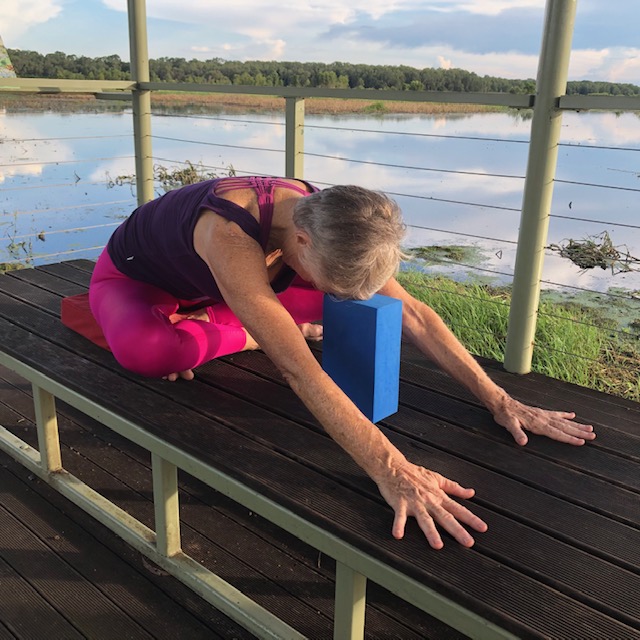
A cross-legged forward bend with the forehead on a block. Supporting the head makes it easier to stay and quieten.
Which props help with forward bend yoga?
Belts, blankets, bolsters, blocks and a chair. Iyengar yoga is known for props, and in forward bends they change everything.
- A belt around the feet: lets you reach without rounding and straining the back.
- A folded blanket or bolster to sit on: tilts the pelvis forward when the hamstrings are short.
- Blankets and bolsters along the legs: soften and spread the back.
- A chair or blocks for the head: so you can rest and hold the pose longer.
- Weights on the thighs: sometimes used to help free the lower spine. See our post on the yoga sandbag.
That is exactly what I did. I used belts to reach my feet, blankets and bolsters to sit on, and I rested my head on chairs or blocks. Slowly the struggle gave way to being able to get quieter. With each exhalation, I learnt to relax my whole back.

Kim in Head to Knee Pose (Janu Sirsasana) with a chair. Holding the chair keeps the length in the spine.
What are the legs doing in a seated forward bend?
At first I used my legs wrongly. I gripped the thigh muscles and the outer thighs. I did not realise the subtle actions needed in the legs to quieten them, so the back of the body could relax.
In class, those actions are taught step by step: the thighs firm without gripping, the backs of the legs lengthen toward the heels, and the legs settle. When the legs go quiet, there is that feeling of being “earthed” and settled that comes from being so close to the ground.
Why do Iyengar classes do standing poses before forward bends?
Because the order of poses prepares the body and the mind. Geeta Iyengar wrote that poses should be arranged so that body, mind and intelligence are “awakened gradually” with “no chaos”. In Iyengar yoga, what is taught, when, and how it is adapted to the person, the weather and even the time of day are all part of the method.
So students commonly learn standing poses first, then forward bends, seated poses, twists, inversions and backbends. Regular standing poses strengthen the legs, open the hips and bring mobility into the upper back. Standing forward bends then prepare the body for a safe, deeper seated forward extension.
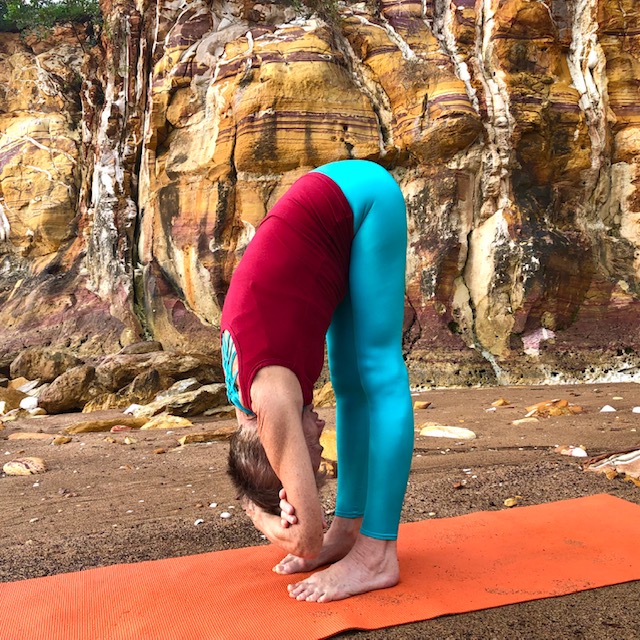
Standing Forward Fold (Uttanasana). Standing forward extensions help free the lower spine before sitting poses.
How can an intense standing pose be calming?
Mr BKS Iyengar wrote in Light on Yoga that Standing Forward Bend (Uttanasana) is a wonderful pose for anyone who is easily excited, and that afterwards one feels calm and cool. At first it can feel like a huge challenge, asking a lot of the legs, spine and mind. But when the actions are clear and the effort steady, many students find the mind quietens. Resting the head on a chair or blocks makes it more settling still.
Uttanasana is intense, so build up to it with poses such as Downward Facing Dog Pose (Adho Mukha Svanasana), and practise it alongside seated forward bends. Twists usually come after forward bends in the sequence: see our note on yoga twists.
What are the benefits of forward bends?
Known from long practice, forward bends release the back, steady the emotions and quieten the mind. Iyengar teaching holds that forward bends:
- release tension in the spine and the back of the body;
- improve flexibility and mobility in the hips and hamstrings;
- reduce fatigue and mental restlessness;
- draw the senses inward, helping reflection, patience and a meditative state.
Over the years I have also read about why forward bends may calm the nervous system: the idea is that they shift the body away from “fight or flight” and toward “rest and digest”. This is long known from practice; research on forward bends in particular is still catching up, so treat the explanation as a working idea rather than settled science. Our post on how to calm your nervous system covers what research has tested so far.
The way I put it: sitting poses and forward bends have a remarkable ability to settle agitation in the mind. What once felt impossible starts to feel like rest, while the extension still continues.
Why does resting the head on support quieten the mind?
I still remember the first time I lowered my head onto support in a forward bend. Almost like magic, my mind stopped churning and a calm wave swept through me. In the Iyengar tradition, this is linked to the chin lock (Jalandhara Bandha). Iyengar teachers pass on Mr Iyengar’s teaching that a bowed head brings humility and a quiet brain, and that forward bends teach quietness. This is known from long practice rather than tested in research.
That is also why supported forward bends, and the Shoulderstand and Plough cycle (Sarvangasana and Halasana), are traditionally placed towards the end of a practice, after the standing poses and standing forward bends have done their work.
Roly Poly, and the stories we tell ourselves
I think many of us are held back in forward bends by the stories we tell. We tell ourselves we are too stiff, or that our hamstrings are not long enough. Roly Poly forward bend sequences, where you rock and roll with some momentum, are a playful way out. Students often finish with a big smile, as if they have washed away their adult worries. You can go further into the folds when there is movement, and you learn to be present right now, where your experience is what it is.
Forward bends and sleep
Stuart tells me he was surprised, when he first knew me, that I would do forward bends when I could not sleep, or when something had upset me. (Including him, he adds!) When I have trouble sleeping I do Downward Facing Hero Pose (Adho Mukha Virasana) with my head supported, and stay about five minutes. My breath gets longer, the neck and shoulders soften and my mind settles. Many students tell us they sleep better after forward bends.
If kneeling bothers your knees, go forward over a chair instead. If your hips are an issue, put support under the buttocks. And on a day when I feel flat, I turn towards livelier poses, such as handstands and backbends, to lift my spirits.
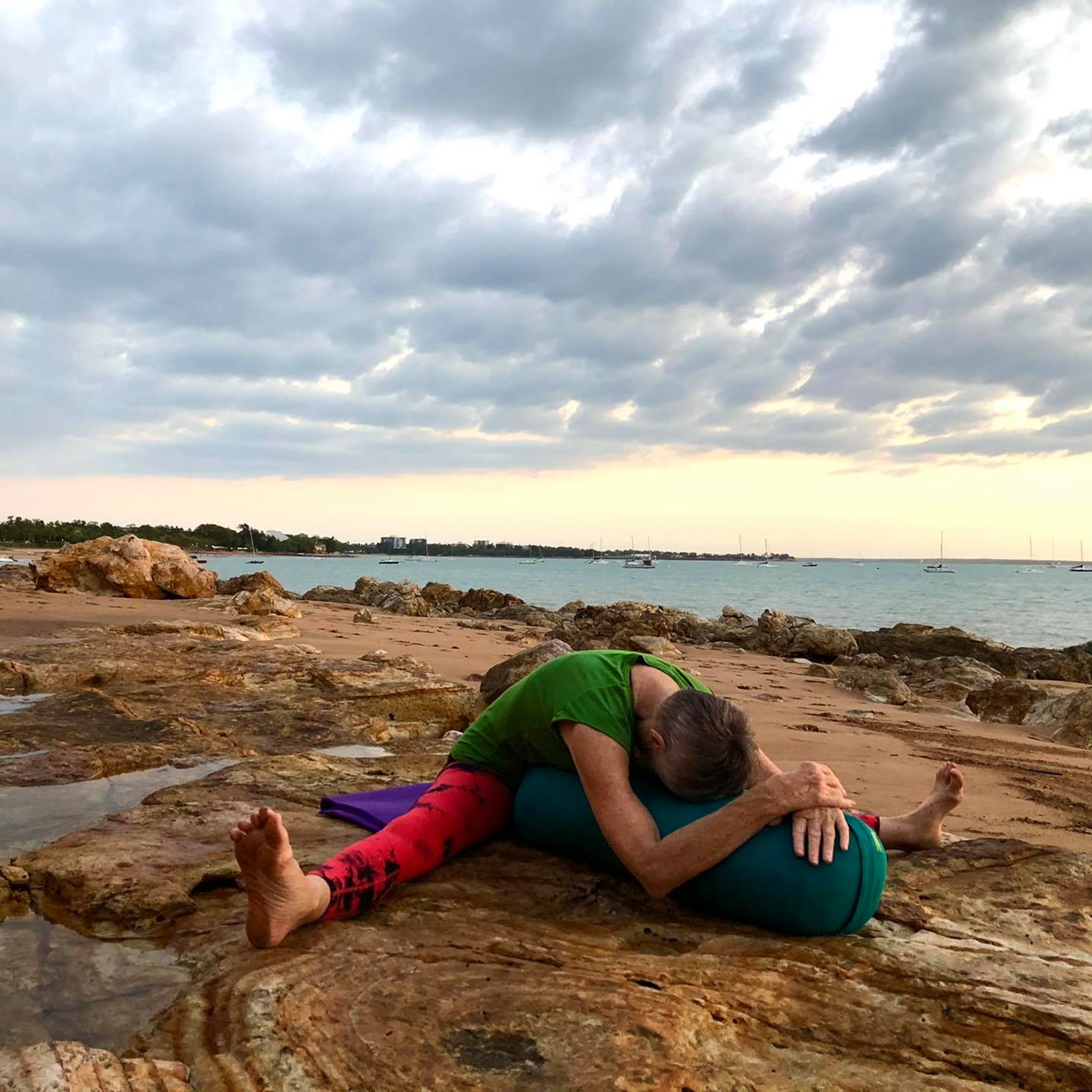
A supported forward bend over a bolster. Resting the trunk lets the back body soften.
Is it normal to feel emotional in a forward bend?
Yes, very. Most of us find these poses super challenging when we start. All sorts of strong sensations arise, and with them a mix of emotions: frustration, irritability, anger, boredom, even envy of the person on the next mat.
I have been to every one of those places, and some that are probably not fit to share! It is normal, it passes, and it is part of the learning. Your teacher can help you adjust the pose so the sensations stay workable.
A word of care: if you have a back, disc or hamstring injury, tell your teacher before forward bends. Rounding hard under strain is not the aim. The props are there so you never have to force.

Downward Facing Hero Pose (Adho Mukha Virasana), a gentle forward bend many beginners can rest in.
Learn the seated forward bend in Darwin and live online
Flametree Yoga Studio teaches Iyengar yoga in Darwin and LIVE online with Christine (Chris) Lalor, Senior Iyengar Yoga Teacher. Forward bends are taught with props from the very first classes, in the studio or online, so you can work at your own level.
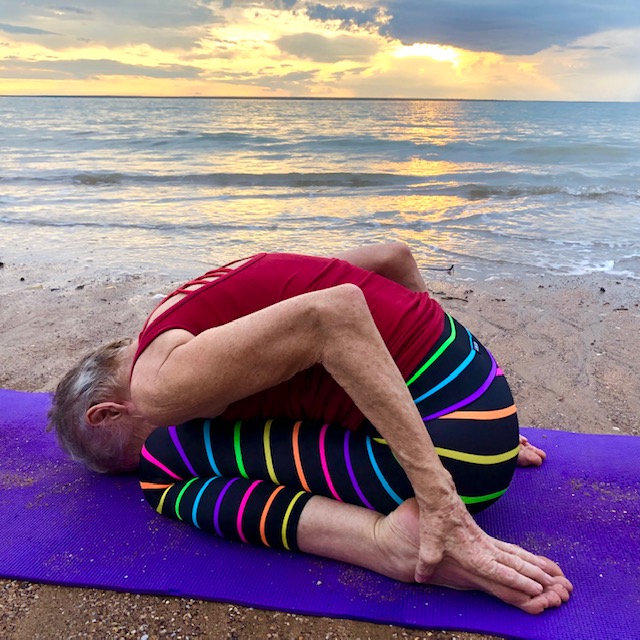
Fold from the hips and keep the spine long.
Practise this at Flametree
Flametree Yoga Studio teaches Iyengar yoga in the studio at Woolner and Coolalinga in Darwin, and LIVE online.
- New to Flametree? Your first class is free. In the studio, just come along. Online, go to our online class list, click the class time you want and we email you the link to join.
- Beginners: new students, and anyone who has been away three months or more, can get a half price 10 class pass with 2 extra classes free, to use online, in the studio, or both. See the beginner half price pass.
- Already practising yoga? The same half price 10 class pass with 2 extra classes free, for new students and for anyone away three months or more, is also available as the non-beginner half price pass.
- See every class time, including online classes, on the timetable.
Related reading: yoga for hip pain, how long to hold yoga poses, what is restorative yoga, yoga for back pain over 50 and yoga for stress relief.
Seated forward bend: frequently asked questions
Why can’t I bend forward in a seated forward bend?
Usually because of short hamstrings (the muscles at the back of the thighs) and stiff hips, plus a habit of gripping the legs. In Iyengar yoga, sitting on a folded blanket, using a belt around the feet and resting the head on a support make the pose doable while flexibility slowly improves.
What props help with a seated forward bend?
A belt around the feet, a folded blanket or bolster to sit on, blankets or a bolster along the legs, and a chair or blocks to rest the head. Props let you stay longer with a long spine instead of straining.
What are the benefits of forward bends?
Iyengar teaching holds that forward bends release tension in the spine and back body, improve hip and hamstring flexibility, reduce fatigue and mental restlessness, and draw the senses inward. These benefits are known from long practice; research on forward bends in particular is still catching up.
Do forward bends calm the nervous system?
Many students find them among the most calming poses in yoga. One explanation is that they shift the body toward the rest and digest side of the nervous system. That is a working idea from practice rather than a settled research finding.
What does surrender mean in yoga?
Surrender means acceptance, not failure. In a forward bend it means accepting where your body is today, staying with steady breath, and letting go of strain a little more with each exhalation, while the pose still extends.
Should I do standing poses before forward bends?
In Iyengar yoga, yes. Standing poses are usually taught first because they strengthen the legs, open the hips and prepare the spine, so the seated forward bend that follows is safer and easier.
Are forward bends safe with back problems?
Forward bends need care with disc problems, some back injuries and hamstring tears. Tell your teacher first. Supported versions, with the spine kept long and the head resting, are often taught instead of deep folds.
Why does resting your head on a support make a forward bend calming?
In the Iyengar tradition, a lowered head and a softly closed throat (the chin lock, Jalandhara Bandha) are said to quieten the brain. Chris Lalor remembers her mind stopping its churning the first time she rested her head on support in a forward bend. This is known from practice rather than tested in research.
Is it normal to feel emotional in a forward bend?
Yes, very. Many students meet frustration, irritability, boredom or even envy when they start, because forward bends bring up strong sensations. It passes, and your teacher can adjust the pose so the sensations stay workable.
Where can I learn forward bends in Darwin or online?
Flametree Yoga Studio teaches Iyengar yoga at Woolner and Coolalinga in Darwin and LIVE online, with Senior Iyengar Yoga Teacher Christine (Chris) Lalor. Your first class is free if you are new to Flametree. See the class times on the timetable.
We share more from our classes and teachers on the Flametree Yoga Facebook page.
This article is general information, not medical advice. If you have a back or hamstring injury, check with your doctor or physiotherapist before starting. Flametree Yoga Studio, Darwin and LIVE online.
Sources: Mr BKS Iyengar’s teaching, including Light on Yoga that yoga teaches us to cure what need not be endured, as quoted by Chris Lalor. Geeta S. Iyengar’s writing on sequencing in Iyengar yoga, as quoted by Chris Lalor. Mr Iyengar’s sayings on the chin lock and forward bends, as quoted by Chris Lalor. Chris Lalor’s own practice and teaching. Iyengar Yoga Australia.