
Shoulder Mobility: Five Supported Moves For Shoulders That Will Not Lift
Shoulder mobility: the short answer
Shoulder mobility is how freely your shoulder joint moves: how high your arms lift, how far they reach behind you, and how easily they turn. When your shoulders will not lift, the fix is rarely a harder stretch. It is a supported one: let a wall, a chair or a bolster hold the weight, so the muscles can let go and you can breathe out. Here is the article in short form:
- Five supported moves: arms up a wall, hands on a chair back, one arm up seated, a belt overhead, and a chest opener over a bolster.
- Hold each for 20 to 30 seconds with a long breath out. Little and often beats one big session.
- Keep the shoulders back and down, never pulled up toward the ears.
- Stress and a desk both tighten shoulders. A slow breath out is part of the fix.
- In a 2025 trial of 444 women, 12 weeks of yoga improved shoulder rotation.
Last updated: 25 October 2026.
Can you reach the top shelf? Can you reach behind you to do up a zip, or put your hand in your back pocket? If your shoulders stop short of where they used to go, you are in good company. Shoulders are the most mobile joint in the body, and they are also the first to stiffen when we sit, stoop and worry.
To see how far stiff shoulders can go, here is an outside story, not a Flametree student. In her book Does Yoga Work? Answers from Science, Mary Flaherty tells of Sarath, who was born in Sri Lanka and now lives in New Zealand. In 2010 he had emergency heart bypass surgery. Three weeks later, both his shoulders froze. Over about two years, physiotherapy and yoga together got him pain free and moving, though with some limits left. His words: “Now I am at peace with myself and enjoying yoga.” It is one man’s account, not proof, and it shows yoga working alongside other care rather than instead of it.
A quick word on Iyengar yoga. Iyengar yoga is the style developed by Mr BKS Iyengar. In the 20th century he did more than anyone to set down traditional Indian yoga, through his books and his teaching, and he pioneered the use of props. It is the style we teach at Flametree, in Darwin and live online.

Arms overhead and chest open. This is the movement stiff shoulders lose first.
Why won’t my shoulders lift?
Three things usually go together.
- The desk. Hours of typing round the upper back. Mr BKS Iyengar once pointed out, in a 1992 class in Australia, that when the upper back rounds, the lower back and the neck end up doing its job. The shoulder blades then cannot slide properly, and the arm cannot lift.
- Stress. Shoulders rise when we are tense. Mr BKS Iyengar named three places where stress is stored: the muscles, the diaphragm and the nervous system. You can only work with the first by moving. The other two answer to the breath.
- Habit. We rarely lift our arms fully overhead any more. Joints that do not use their full range slowly lose it.
On the stress part, in her book Crooked, Cathryn Jakobson Ramin describes a man whose tight shoulder, shown at about 6 out of 10 on a screen, fell to zero within minutes of slowing his breathing. That is one demonstration, not a trial. It does fit what the muscles in your own shoulders may tell you after one long breath out.

The set-up for every move below: shoulders back and down, chin level, jaw soft.
Geeta Iyengar put the set-up in one line: “The shoulders should be extended sideways away from the neck and should not be tensed up nor pulled towards the ears” (Yoga: A Gem for Women). Keep that picture in your mind for each move.
What are five supported moves for shoulder mobility?
Do them in this order, slowly. Stay in each for about 20 to 30 seconds (the shoulders need time to soften), breathing out for longer than you breathe in.

Five supported moves for shoulder mobility, from the gentlest to the most open.
- Arms up the wall. Stand facing a wall, an arm’s length away. Rest your hands on it at shoulder height and walk them up as far as is comfortable. Let your head drop between your arms, and lengthen the sides of your waist.
- Hands on a chair back. Hold the back of a chair and walk your feet back until your arms and spine are long, like a table. Let your chest sink a little toward the floor, and press your hands into the chair.
- One arm up, seated. Sit tall on a chair. Lift one arm up by your ear while the other hand rests on your thigh. Lift the ribs on the arm side. Change sides.
- A belt overhead. Hold a belt in both hands, wider than your shoulders. Lift it up and over, keeping your arms straight. As the shoulders free, bring the hands closer, a finger-width at a time.
- Chest open over a bolster. Lie back with a bolster along your spine, your head resting, and your arms out to the sides, palms up. Let your chest open. Start with one minute.

Move two: hands on a chair back, arms long. The chair holds the weight.
Keep your jaw and neck soft in every one. If you notice your teeth clenching, pause and breathe out. Do not push into pain. Stop at the first sign of sharpness and come back a little.
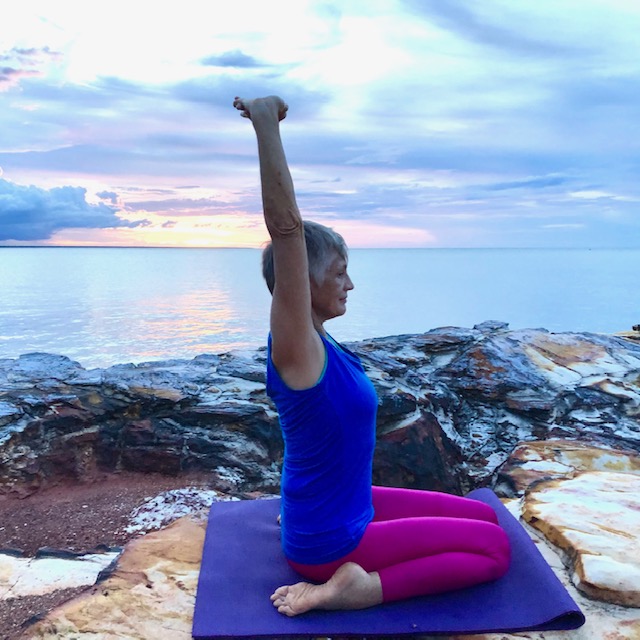
Move three: one arm up, seated. A chair works just as well as the floor.
Does yoga help shoulder mobility?
There is a good trial behind it. In 2025, researchers followed 444 women after breast cancer surgery. Twelve weeks of yoga improved their shoulder rotation flexibility and the right-hand-up back scratch test, compared with a group given a postoperative exercise DVD (Lam and colleagues, Sports Medicine – Open, 2025). The left-hand version and the secondary measures did not differ between groups, so it is a promising result, not a promise.
A second line of evidence concerns office workers. In a 2023 trial of 80 office workers with neck and shoulder pain, four weeks of yoga reduced the pain and improved neck flexibility, as did Ruesi Dadton (a traditional Thai stretching exercise) and plain stretching, with no differences between the three (Thanasilungkoon and colleagues, International Journal of Exercise Science, 2023). Yoga did as well as the alternatives, and it asked for no equipment.
Short, regular effort also counts. In a 10-week trial of 198 adults with neck and shoulder pain, elastic-tube strength work for just 2 or 12 minutes a day, five days a week, raised quick-force strength by about 16 to 18 percent, and the sore muscles became less sensitive to pressure (Jay and colleagues, Clinical Physiology and Functional Imaging, 2013; Andersen and colleagues, Pain Physician, 2012). Two minutes a day did about as well as twelve. It is strength work, not a stretch, but the lesson is the same: a little, often.

Move five: chest open over a bolster. Lie still and let the breath do the work.
Where should I go next?
If your shoulders are very stiff or painful, and not just tight, our guides on yoga for frozen shoulder and yoga for neck pain go further, and tech neck covers the phone and laptop posture. For the rest of the body, see yoga for flexibility.
Get the free ebook Too Stiff For Yoga? New to Flametree, or away for 3 months or more? You get 2 free classes + 2 ebooks, only available via this offer. Already coming to class? You can still get the book.
Where can I learn shoulder mobility in Darwin?
Come to a beginner class at Flametree’s Woolner studio or join live online from anywhere in Australia. Every class has walls, chairs, belts and bolsters, and a teacher who can see how high your arms go. Our Too Stiff For Yoga? pass gives you 10 classes at half price plus 2 free, for new students or those away 3 months or more. Feel free to check with your professional advisers if you wish, but also give yoga a try.
Frequently asked questions
What is shoulder mobility?
Shoulder mobility is how freely the shoulder joint moves: how high the arms lift, how far they reach behind you and how easily they turn. It depends on the joint, the shoulder blades, the upper back and the muscles around them.
How do I improve shoulder mobility?
Use supported moves that let the muscles soften: arms up a wall, hands on a chair back, one arm up seated, a belt overhead and a chest opener over a bolster. Hold each for 20 to 30 seconds and breathe out slowly.
Why are my shoulders so tight?
Common reasons are long hours at a desk, which round the upper back, stress, which raises the shoulders, and not using the full range of the arms. All three can be eased with regular, gentle movement and a slower breath.
How often should I do shoulder mobility exercises?
A little every day works better than one long session. Two to five minutes a day is a good start, and you can lengthen it as the shoulders free up.
Can stress cause tight shoulders?
Yes. Shoulders rise when we are tense. Mr BKS Iyengar named the muscles, the diaphragm and the nervous system as places where stress is stored, so slowing the breath is part of loosening the shoulders.
Does yoga help shoulder stiffness?
In a 2025 trial of 444 women after breast cancer surgery, 12 weeks of yoga improved shoulder rotation flexibility compared with a group given an exercise DVD. In office workers, four weeks of yoga reduced neck and shoulder pain as much as stretching.
What if my shoulders will not lift above my head?
Start with arms up the wall and a belt overhead, and go only as far as the breath stays easy. If the stiffness is severe, our guide to yoga for frozen shoulder goes further.
Where can I learn shoulder mobility in Darwin?
Flametree Yoga Studio teaches Iyengar yoga at Woolner in Darwin and live online. Beginner classes use walls, chairs, belts and bolsters, and the teacher adjusts each pose to your body.
Where to next
- New to yoga, or coming back? Start with our half price 10 class pass with 2 classes free, in Darwin or live online.
- For a workplace, team or group: book private yoga classes for groups, online, at a Flametree studio or at your venue.
- Want to see class times first? Look at the beginner timetable.
Flametree Yoga Studio, Darwin and live online. This article is general information, not medical advice.
Sources: Lam WWT and colleagues, Does Yoga Therapy Improve Range of Motion in Shoulders of Women Recovering from Breast Cancer Surgery? A Randomised Controlled Trial, Sports Medicine – Open, 2025; Jay K and colleagues, Effect of brief daily resistance training on rapid force development in painful neck and shoulder muscles: randomized controlled trial, Clinical Physiology and Functional Imaging, 2013; Andersen LL and colleagues, Central adaptation of pain perception in response to rehabilitation of musculoskeletal pain: randomized controlled trial, Pain Physician, 2012; Thanasilungkoon B and colleagues, The Efficacy of Ruesi Dadton and Yoga on Reducing Neck and Shoulder Pain in Office Workers, International Journal of Exercise Science, 2023; Mary Flaherty, Does Yoga Work? Answers from Science; Cathryn Jakobson Ramin, Crooked; Geeta S Iyengar, Yoga: A Gem for Women; Too Stiff For Yoga? and Happy Backs ebooks.



