
Frozen Shoulder And Menopause: Why It Strikes At Midlife, And The Gentle Yoga That Keeps You Moving
Frozen shoulder and menopause: the short answer
Frozen shoulder (adhesive capsulitis, a thickened, tight shoulder joint lining) most often arrives in women between about 40 and 60, which are the same years as the menopause change. Falling oestrogen (the main female hormone) is one suspect, because oestrogen helps keep joints moist and supple, but research has not yet pinned the link down. What practice does show is that a stiff shoulder in these years does best with regular, gentle, supported movement. Here is the article in short form:
- Frozen shoulder peaks at 40 to 60, in women.
- Oestrogen is a suspect, not a proven cause.
- Aching joints are common through menopause.
- Keep the shoulder moving, in the comfortable range.
- A belt, a chair and a wall do the work of a coach.
- Supported rest eases the painful stage and the night.
- Learn it in Darwin or live online, step by step.
Last updated: 25 October 2026.
A quick word on Iyengar yoga. Iyengar yoga is the style developed by Mr BKS Iyengar. In the 20th century he did more than anyone to set down traditional Indian yoga, through his books and his teaching, and he pioneered the use of props. It is the style we teach at Flametree, in Darwin and live online.
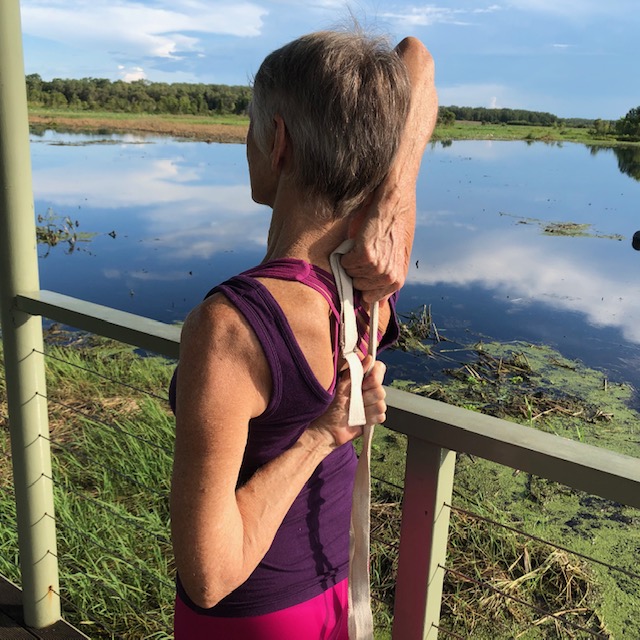
Cow face arms (Gomukhasana) with a belt. The belt lets each arm go only as far as the shoulder allows.
Why does frozen shoulder show up around menopause?
Nobody knows for certain, but the timing is striking. A 2026 paper in Climacteric (the journal of the International Menopause Society) opens by noting that adhesive capsulitis typically affects women aged 40 to 60. Those are the years of perimenopause and menopause.
The same paper tested the oestrogen idea. A team at Duke University looked at the records of 1,952 postmenopausal women aged 40 to 60 (Reinke and colleagues). Frozen shoulder was recorded in 3.95% of the 152 women using hormone therapy and 7.65% of the 1,800 who were not. That is about half as many, but the pilot was small and the difference was not statistically significant, so it does not settle the question. The authors call for larger studies.
The wider picture is clearer. Oestrogen has jobs in almost every part of the body, including the joints. Rajvi Mehta explains the yoga tradition’s view in Yoga Rahasya: oestrogen helps keep the joints moist, so as it falls the knees and shoulders can ache, and moving less stiffens them further. A 2024 review in Climacteric, as reported in our free ebook Cool, Calm And Strong, estimated that more than 70% of women have muscle and joint symptoms through the menopause transition, and 25% are disabled by them.
Geeta Iyengar saw this in her own students. “Stiffness comes everywhere after the menopause,” she said. “So make the muscles juicy a bit.” And she was clear it need not last: “If they do decidedly the stiffness goes. If they don’t do at all then the stiffness becomes a permanent feature.”

Three stages, one change. Frozen shoulder is most common in these same years.
Is it frozen shoulder, or a stiff shoulder from menopause?
The two overlap, and the answer is the same: keep the shoulder moving gently. A true frozen shoulder is stiff and sore in every direction. It usually comes on slowly with no injury and moves through three stages: freezing (painful), frozen (stiff) and thawing (movement returns). The whole process often takes one to three years.
A menopause-stiff shoulder is more often an ache and a loss of ease, usually with a tight neck and upper back. Many women have a bit of both. Our guide to yoga for frozen shoulder covers the stages, the poses taught for each, and the two small yoga studies we found. This page is about the menopause years in particular.
What helps a frozen shoulder in the menopause years?
Regular movement in the comfortable range, never forced, with props to do the holding. Short and often beats long and hard. The goal in the painful stage is comfort and keeping the arm in use. In the stiffer stages the goal is to ease the range a little further each week.
Three props do most of the work. Always stay inside a comfortable stretch, and let your teacher set you up.
1. A belt, for cow face arms
Sit tall. Reach one arm up and bend the elbow so the hand drops behind your head. Reach the other arm behind your back and up. Hold a belt between the hands and let the hands come only as close as the shoulders allow. The belt bridges the gap, so you do not strain to touch your fingers. Breathe out slowly and stay a few breaths, then swap sides.
2. A chair, for arms up and the chest opener
Stand facing the back of a chair. Lift the arms only as high as is comfortable, with a belt between the hands if it helps them stay level. Then rest your hands on the chair back or seat and let the chest lift and open. The chair takes the weight, so the shoulders open without strain.

Arms up (Urdhva Hastasana) beside a chair. With a stiff shoulder, the arms rise only as far as is comfortable.
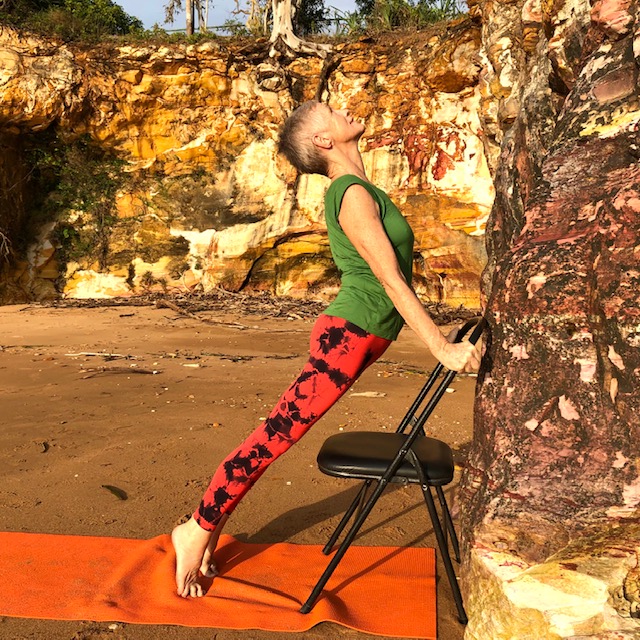
Hands on a chair to lift and open the chest. The chair takes the weight.
3. A wall, for walking the hands up
Stand side-on to a wall, with the hand of the stiff arm on it at hip height. Walk the fingers up the wall a little at a time, as far as is comfortable, breathing out as you go. Mark your high point with a piece of tape and watch it creep up over the weeks. Little and often is the rule.

Arms raised in a wide stance. Lifting the arms from the sides of the chest is a daily part of Iyengar practice.
What eases the painful stage and the night?
Supported rest. Lie back over a bolster, or on blankets, with the arms resting on cushions so the shoulders hang open and heavy, and breathe out slowly. In the Iyengar tradition the long out-breath turns the body from rev up to rest, and a quieter nervous system tends to loosen a guarded shoulder. Many women find this the most useful part of class in the years of hot nights and broken sleep. See our guides to waking up at 3am and hot flushes for the night-time side.

Supported poses and a slow out-breath switch the body from rev up to rest.
What should you leave out while the shoulder is sore?
Poses that put weight through the arms, such as Downward Facing Dog, plank and arm balances, wait until your teacher says they are comfortable. Skip anything that makes the shoulder grip or hurt more. Mild stretch is fine; sharp or lasting discomfort means ease off. Strong effort also feeds hot flushes, so the shoulders do not push hard in the supported poses.
Get the free ebook Cool, Calm And Strong. New to Flametree, or away for 3 months or more? You get 2 free classes + 2 ebooks, only available via this offer. Already coming to class? You can still get the book.
Where can I do yoga for frozen shoulder and menopause in Darwin?
For a stiff shoulder in the menopause years in Darwin, come to a beginner or Gentle class at Flametree’s Woolner or Coolalinga studios, or join live online from anywhere in Australia. Every class uses chairs, walls, belts, blocks and bolsters, and the teacher adjusts each pose to your shoulder. Tell your teacher about your shoulder before class. The wider picture for these years is in our guide to yoga for perimenopause.
Frequently asked questions
Why does frozen shoulder happen at menopause?
The cause is not proven. Frozen shoulder most often affects women aged 40 to 60, the menopause years, and falling oestrogen is a suspect because it helps keep joints moist. A 2026 pilot of 1,952 women found a lower rate with hormone therapy (3.95% against 7.65%) but the difference was not statistically significant.
Does menopause cause shoulder stiffness?
Often, yes. A 2024 review in Climacteric, as reported in our ebook, estimated more than 70% of women have muscle and joint symptoms through the menopause transition. Shoulders and knees are common places for aching and stiffness.
How long does a menopause frozen shoulder last?
A frozen shoulder often runs one to three years through the freezing, frozen and thawing stages. Gentle, regular movement in the comfortable range, with props, helps many students stay comfortable while it thaws.
What exercises help a frozen shoulder?
Gentle, supported ones: cow face arms with a belt, arms up beside a chair, hands on a chair to open the chest, and walking the fingers up a wall. Stay in the comfortable range and never force.
Can yoga help frozen shoulder in menopause?
Yes, it can help you keep moving and stay comfortable. We found only two small yoga studies for frozen shoulder itself, so our view comes from long practice with belts, chairs and walls. See our yoga for frozen shoulder guide for them.
Which yoga poses should I avoid with a frozen shoulder?
Leave out weight-bearing arm poses such as Downward Facing Dog, plank and arm balances until your teacher says they are comfortable, and anything that makes the shoulder grip or hurt more.
Does hormone therapy prevent frozen shoulder?
That is not yet known. A 2026 pilot study of 1,952 postmenopausal women found a lower rate of frozen shoulder with hormone therapy, but the difference was not statistically significant, and the authors call for larger studies.
Where can I do yoga for a menopause frozen shoulder in Darwin?
Flametree Yoga Studio teaches Iyengar yoga at Woolner and Coolalinga in Darwin and live online. Beginner and Gentle classes use belts, chairs and walls, and the teacher adjusts the poses to your shoulder.
Where to next
- New to yoga, or coming back? Start with our half price 10 class pass with 2 classes free, in Darwin or live online.
- For a workplace, team or group: book private yoga classes for groups, online, at a Flametree studio or at your venue.
- Want to see class times first? Look at the beginner timetable.
Flametree Yoga Studio, Darwin and live online. This article is general information, not medical advice.
Sources (via PubMed): Reinke EK and colleagues, A preliminary pilot study to address design issues related to research on potential association of hormone therapy and adhesive capsulitis, Climacteric, 2026; Climacteric 2024 review of musculoskeletal symptoms in the menopause transition, as reported in the Cool, Calm And Strong ebook; Rajvi Mehta, Yoga Rahasya; Geeta Iyengar quotes, as in the ebook. Full references are in the Cool, Calm And Strong ebook.



