
Chaturanga Dandasana: How To Do It With A Belt And Without Strain
Chaturanga dandasana: the short version
Many students try Chaturanga Dandasana (Four-Limbed Staff Pose, the low plank), decide it is an arm pose, and decide they cannot do it. In the Iyengar way it is a whole-body pose. The legs and the core hold the line, and a belt can help you learn it without strain. The full pose is demanding and is not a first-class pose. Chris Lalor says it took her a long time to learn, so start with the supported versions below.
This note in short form
- What it is: a low plank, one straight line just above the floor, elbows bent beside the ribs.
- How hard it is: demanding. Start with a plank with your hands on a wall or a chair.
- The big idea: the arms are only part of it. The legs and core do much of the holding.
- The belt: lowering onto a belt, or looping one around the outer arms, helps you learn the action.
- Take care: sore wrists, shoulders or lower back mean back off and ask your teacher.
- Next step: learn the belt set-up in class, in the studio or LIVE online. Your first class is free if you’re new.
Back to our Poses And Practice notes, and our Bones And Balance notes.
What is chaturanga dandasana?
Chaturanga Dandasana means Four-Limbed Staff Pose. You hold the whole body in one straight line, a few centimetres above the floor, from the head to the heels. The elbows are bent and hugged in beside the ribs, the hands sit under the lower ribs, and the toes are tucked under. Many people call it plank pose. In our classes the arms-straight version is a plank, and the low version with bent elbows is Chaturanga Dandasana.
Iyengar yoga is the style developed by Mr BKS Iyengar. In the 20th century he did more than anyone to set down traditional Indian yoga, through his books and his teaching, and he pioneered the use of props. It is sometimes called modern classical yoga, and it’s the style we teach at Flametree.
Mr Iyengar’s method builds a pose like this in steps, with props. That is why a belt and a wall come before the full pose.

Kim in Chaturanga Dandasana: one straight line, elbows in. This is the full pose, which takes time.
How do you start if you cannot hold it yet?
Start with a plank at a wall or on a chair. Both take weight off the arms, so you can learn the straight line first. Your teacher will show you the exact set-up, because the height matters.
- Stand an arm’s length from a wall and put your hands flat on it at shoulder height.
- Step your feet back until your body makes one straight, slanting line.
- Press your heels back and lift your belly in. Do not let the middle of your body sag.
- Stay for a few breaths, then walk your feet in and rest.
A chair seat can be used in the same way, with your hands on the seat and a lower slope. If this feels easy, your teacher can lower the height step by step. Our note on Downward Facing Dog covers the next pose that shares the same hand and arm work.
How does a belt help in chaturanga dandasana?
A belt shows you that the arms are only one part of the pose. Chris uses a belt in her own practice. In a short video taken at Fogg Dam near Darwin she shows how she lowers onto a belt.
A belt looped around the outer arms is another way to use one. It contains and organises the muscles, so you can build strength with better form. The body learns a safe action first, before you struggle to get into the pose. That builds the courage to go further. The details of belt length and placement are taught in class, so ask your teacher to set it up for you. Our note on how to use a yoga strap has more.
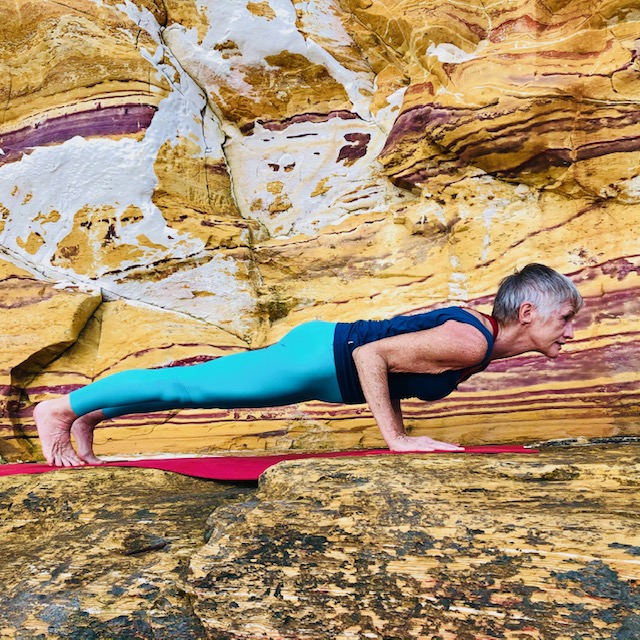
Chris Lalor in the low plank (Chaturanga Dandasana). The legs reach back as the chest reaches forward.
Why is chaturanga dandasana a core and leg pose?
Because many people rely too much on the arms, try it, and decide they cannot do it. Chris teaches that the core muscles (the front, back and lower end of the torso) and the legs are a key part of the pose too. Gravity tries to bend you through the middle, and the belly and legs stop it.
That core work is useful in other poses. In an inversion, for example, a weak middle shows up as a sag in the body. Chaturanga Dandasana is one way to build the strength to stay long and firm. We looked at this in can yoga build muscle, and you will find a longer explanation there. This note is based on Iyengar teaching and our experience. It does not rest on a trial of this pose.
What did Chris learn about plank pose?
Chris used to think men found this pose easy because of their upper-body strength, and that she was always going to struggle. She was resigned to it, at least in her mind. She read every book about the pose and asked leading teachers, and she made very little progress.
Then, one day in Pune, India, she was in a class with Geeta Iyengar when Warrior I (Virabhadrasana I) was demonstrated. As she watched, she realised that Chaturanga Dandasana was about using the base of the spine, with much less work from the shoulders. It was a lesson in how a teacher can give you something you never knew you were missing. It was also a lesson in how a mindset can limit you or open you up.
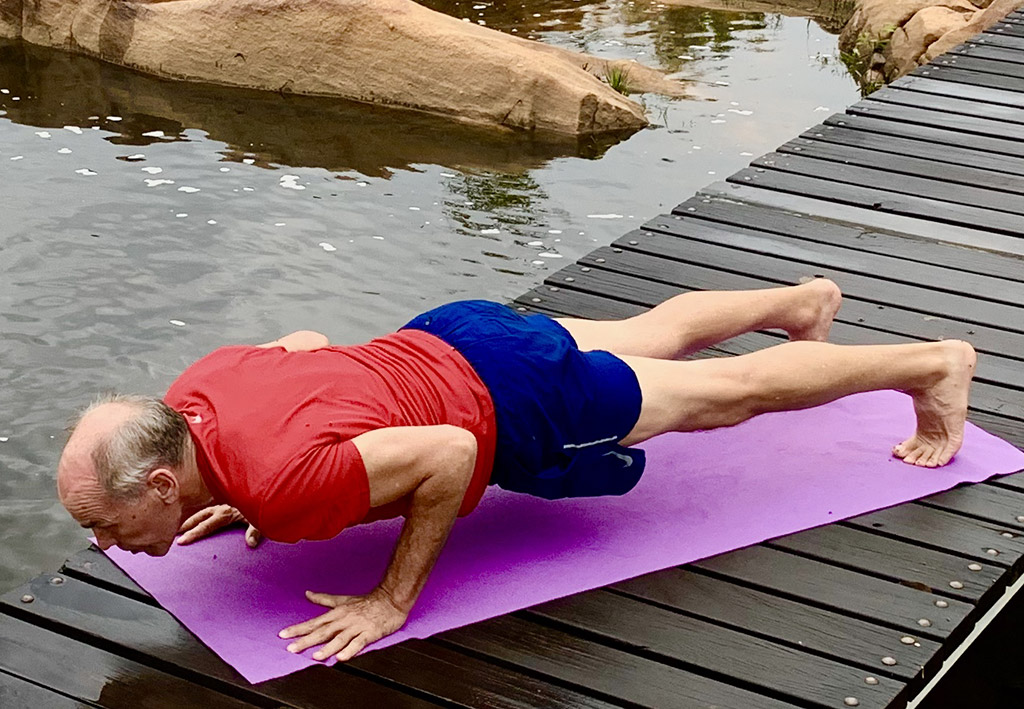
Stuart in the low plank. A straight line from head to heels, with the elbows close to the ribs.
What about patience?
Chris has shared a passage from Mr Iyengar’s book Light on Life alongside this pose. In it, a gardener plants an apple seed and does not expect apples at once. The gardener waters it, watches it each day and is happy to see it grow. Mr Iyengar says to treat practice the same way, with love and joy, and to enjoy the small progress. That suits a pose where gains come slowly.

Chris Lalor in plank pose with straight arms. This is the stage before the low plank.
When should you take extra care?
Take extra care if you have sore wrists, shoulders or a painful lower back. If any of these flare up, come out, rest, and talk to your yoga teacher, your yoga therapist, and your doctor if you wish. Our note on yoga for wrists has props for sore wrists.
Some signs need a doctor straight away: numbness around the saddle area, a change in bladder or bowel control, leg weakness that is getting worse, pain after a fall, fever, or night pain that does not ease.
When you are ready to try handstand or other arm balances, read our note on how to learn handstand and forearm balance, which builds on the same arm work.
Practise this at Flametree
Your first class is free if you’re new to Flametree. New students, and anyone who has been away three months or more, can also get a half price 10 class pass with 2 extra classes free, to use online, in the studio, or both. We teach in the studio at Woolner and Coolalinga in Darwin and LIVE online. For the studio, just come along. For an online class, click the class time you want and we email you the link to join.
- Beginners: see the half price 10 class pass for new and lapsed students
- Not a beginner: see the half price 10 class pass for new and lapsed students
- The timetable, including online classes
Can’t make a class? Practise at home with our video courses.
Questions people ask about chaturanga dandasana
What is chaturanga dandasana?
Chaturanga Dandasana (Four-Limbed Staff Pose) is a low plank. The body is held in one straight line a few centimetres above the floor, with the elbows bent beside the ribs, the hands under the lower ribs and the toes tucked under.
Is chaturanga dandasana hard for beginners?
Yes, it is demanding, and it is not a first-class pose. Chris Lalor says it took her a long time to learn. Beginners usually start with a plank at a wall or on a chair, and with a belt, and build up with a teacher watching.
How do you do chaturanga dandasana with a belt?
A belt can be used by lowering onto it, or by looping it around the outer arms. It shows you that the arms are only part of the pose, and lets you learn a safe action before you struggle to get into the shape. The exact set-up is taught in class.
Which muscles does chaturanga dandasana use?
The arms, the legs and the core all work. Chris teaches that many people rely too much on the arms. The core (the front, back and lower end of the torso) and the legs hold the body in one straight line so the middle does not sag.
Is plank pose the same as chaturanga dandasana?
Not quite. In our classes plank is the arms-straight version and Chaturanga Dandasana is the low version with the elbows bent beside the ribs. Plank is the stage before it, and many people use the word plank for both.
Why do my wrists or shoulders hurt in chaturanga dandasana?
Pain is a sign to come out of the pose, not to push on. Relying too much on the arms can be part of it, so ask your teacher to check your set-up and to give you a wall, chair or belt version. Our yoga for wrists note has props for sore wrists.
Can I learn chaturanga dandasana without a teacher?
You can read about it, but the pose is best learned with a teacher watching. Chris read every book about it and still made little progress, until one class in Pune with Geeta Iyengar showed her the work was in the base of the spine. You can join in the studio or LIVE online.
Where can I learn chaturanga dandasana in Darwin?
Flametree Yoga Studio teaches Iyengar yoga in the studio at Woolner and Coolalinga in Darwin and LIVE online, using belts, chairs and the wall. Your first class is free if you’re new to Flametree.
Flametree Yoga Studio, Darwin NT, teaching Iyengar yoga in the studio and LIVE online. This note is general information, not medical advice.
Sources
- Britannica: B.K.S. Iyengar, Indian yoga teacher (1918 to 2014).
- Flametree teaching notes by Chris Lalor, Senior Iyengar Yoga Teacher, on Chaturanga Dandasana, the belt and her learning in Pune (shared on Flametree’s Facebook page, 2018 to 2025).
- BKS Iyengar, Light on Life (Rodale, 2005), the apple seed passage, as shared by Chris Lalor (paraphrased, not quoted).
- Pose shape reference: the Level One practice chart used in Flametree teacher training. See also Can yoga build muscle?



