
Rounded Upper Back And Posture: Kyphosis, A Hunched Back, And What Yoga Does
Is your upper back starting to round, so your head and shoulders drift forward? A rounded upper back, called kyphosis when the curve is marked, creeps up on desk workers, gardeners, parents and almost everyone over 60. People call it a hunched back, rounded shoulders, slumping or a dowager’s hump. The good news: the curve is not set in stone, and yoga is one of the few things trialled for it. This guide brings together what Mr BKS Iyengar, Geeta S Iyengar and the medical doctors who worked with Mr Iyengar say about a rounded upper back, and what the research has found. Last updated: 1 November 2026.
Get 2 Free Yoga Classes And 2 Free Ebooks
Can yoga help kyphosis? The short answer
Yes. Yoga can lessen a rounded upper back, at any age. In a trial of 118 people aged 60 and over, all with a marked kyphosis, six months of yoga three times a week made the curve smaller on two of the trial’s three measures. A follow-up found their shoulder blades sat further back and they lifted books onto a shelf 26% better. People who practise yoga have less thoracic kyphosis than people who do not, and reviews of more than 20 exercise trials find that the right movement shrinks the curve. Mr Iyengar and Geeta Iyengar built a whole teaching around lifting the chest and lengthening the spine, and the yoga doctors explain why it works: a rounded back is mostly habit, weak back muscles and a closed chest, and all three respond to practice.
One thing to keep in mind as you read: the trials tested “yoga” designed for each study, taught by teachers with different training. None tested Iyengar yoga by name. In our view as certified Iyengar teachers, well-taught Iyengar yoga, with its focus on alignment, props and lifting the chest, is likely to go further. Why the kind of yoga matters.
The bottom line: five key moves for a rounded upper back
- Go to a yoga class at your level, two or three times a week. The trials that changed the curve ran for 3 to 6 months. Give it time.
- Lengthen first, then open. Lift the spine up out of the hips before you arch or turn. That is the Iyengar rule for backbends, and it is the safe way to open a rounded back.
- Strengthen the back of the body. Standing poses and gentle, supported back arching build the muscles that hold you upright. Weak back muscles let the curve deepen.
- Add breath work (pranayama). A caved-in chest cannot breathe well. Slow, full breathing lifts the ribs from inside and calms the mind, and posture and mood go together.
- Start now. New to Flametree, or away 3 months or more? 2 free classes, then 10 at half price, in Darwin or LIVE online.
Iyengar yoga is the style we teach at Flametree. During the 20th century, Mr BKS Iyengar was the major person who codified traditional Indian yoga, through his seminal books and widespread teaching. He also pioneered the use of props, so poses can be adapted to almost any body. His style is sometimes called modern classical yoga. This guide is part of our encyclopaedia of yoga for health conditions.
This guide in short
- Mr BKS Iyengar: slouching dulls body and mind. Work the whole trunk, standing up through the feet, and be patient.
- Geeta S Iyengar: we bend forward all day and rarely the other way. In her view backbends help drooping shoulders and a hunched back, always with the spine lengthened first.
- Dr Timothy McCall: thoracic hyperkyphosis is no. 111 on his list of conditions helped by yoga. Good yoga therapy fits the person.
- Dr Loren Fishman: daily habits such as slumping drive much back trouble, and yoga changes habits.
- Dr Krishna Raman: a rounded upper back is no bar to yoga, and poor posture undoes yoga’s good work.
- The research: 19 studies listed below, from the UCLA yoga trial to reviews of 28 trials.
- Bone safety: with thin bones, strong rounding forward is the move to leave out. Back-arching work came out far better.
- For men: older men are twice as likely as older women to have a hunched posture, and do far less yoga.
- Take it further: a free ebook, Happy Backs, the 2027 backs masterclass, and classes in Darwin and online.
A Rounded Upper Back And Yoga On One Page
Five sources, one direction: lengthen, lift the chest, strengthen the back.
Slouching dulls the body. Stand from the feet, lift the chest, work the whole trunk.
We bend forward all day. Backbends, with the spine lengthened first, open a stooping back.
Thoracic hyperkyphosis is no. 111 on his list. Yoga works best fitted to the person.
Slumping is a habit yoga can change. A rounded back is no reason to stay away.
Yoga made the curve smaller in a trial of 118 people over 60. Exercise reviews of 13 to 28 trials agree.
Each source is set out in full below. Research: Greendale 2009; Bansal 2014; Khorramroo 2026.

Chris Lalor in Triangle Pose at the wall. The wall lets the spine lengthen and the chest turn open.
“Slouching acts like a narcotic to the body.”
What is kyphosis, and why does the upper back round?
Everyone has some forward curve in the upper back. That curve is the thoracic kyphosis. When it grows past the normal range, usually counted as 40 degrees or more, doctors call it hyperkyphosis. Most people simply say a rounded upper back or a hunched back. Its cousins are rounded shoulders and a forward head, a pattern sometimes called upper crossed syndrome. A dowager’s hump is the everyday name for a marked rounding at the base of the neck in older people.
Four things build a rounded back, and they feed each other:
- Habits. Desks, phones, driving, cooking, gardening and caring for children all bend us forward. As Geeta Iyengar put it, we rarely bend the other way.
- Weak back muscles. The muscles along the spine hold us upright. When they weaken, the curve deepens.
- Thin bones. In older people a rounded back is linked with low bone mass and with spine bones that have wedged or compressed, and with wear in the discs.
- Mood and breath. A slumped chest goes with a low mood and shallow breathing, and each makes the other worse.
Why it matters. A review of the research on age-related hyperkyphosis links it with more trouble doing everyday tasks and with slower, weaker movement. In a study of 1,353 older people in California, those with a hunched posture had a higher death rate over about four years than those without. That is a link, not proof, and it is one more reason to keep the chest lifted.
How A Rounded Upper Back Builds
Four causes that feed each other. Yoga works on all four.
Hours bent forward at desks, phones and chores. The body takes the shape it holds most.
The muscles behind the spine tire and weaken, and the curve deepens.
In older people, wedged spine bones and worn discs can add to the curve.
A caved-in chest breathes poorly and goes with a low mood.
Yoga answers each one: new habits of standing and sitting, standing poses and supported back arching for the back muscles, weight-bearing poses for the bones, and pranayama for the breath and the mind.
After Katzman 2010 and Koelé 2020 (reviews of age-related hyperkyphosis), Geeta S Iyengar and Mr BKS Iyengar. A simplified picture.
“It is the spine’s job to keep the mind alert.”
What Mr BKS Iyengar taught about a rounded upper back
In short: slouching dulls body and mind. Work the whole trunk, build from the feet up, and be patient.
In Yoga: The Path to Holistic Health, Mr Iyengar sets out a yoga approach for 72 health conditions. He has no entry called kyphosis. The nearest is “Upper backache” (p. 322), which he links to a sitting life, excess weight, weak muscle tone, and stiff or inflamed muscles and tendons. He names poor posture as a cause of middle and lower backache too (pp. 319 to 320). His ideas, in our words:
- Move the whole upper trunk. His course for the upper back moves the shoulders and spine in every direction: standing, twisting, backbending and reclining poses, with inversions near the end (p. 322).
- Match the poses to the person. Wrongly chosen poses can do harm (p. 260), so a teacher adapts each pose.
- Work from the edges in. Build strength around a stiff or sore area first, then work towards it (p. 263).
- Be patient. In his words, “Do not get discouraged if the healing of your ailment takes time” (p. 263).
- Stand from the feet. In Light on Life he links firm standing with confidence: dejected people cannot stand firmly, and standing firmly rebuilds them (Rodale edition, p. 43). Posture and slouching are tied to mood (p. 40).
- Say it the positive way. He suggests “Let me find out the right way to lift my chest” rather than “don’t slouch” (p. 131). In our view that is the best posture advice there is.
His first book, Light on Yoga (1966), does name the problem. Its appendix of poses grouped under ailments (Appendix II) has an entry for a hunched back (p. 425), as well as for arthritis of the upper (dorsal) spine (p. 414) and for the chest (p. 418). For a hunched back he draws on standing poses, backbends, forward bends, twists and arm-support poses: the same whole-trunk idea as his later course.
We do not publish his sequences. A sequence needs a teacher who can see your back and adapt each pose, which is what a class is for.
“If the chest gets collapsed, then the mind sinks and the emotional weather becomes heavy.”
What Geeta S Iyengar said about a hunched back
In short: we spend the day bending forward. Teach the spine to bend back, with the trunk lengthened first.
Geeta S Iyengar, Mr Iyengar’s daughter, taught alongside him in Pune for decades and wrote Yoga: A Gem for Women. A rounded upper back is common in women after midlife, so her view matters here. Her points, in our words:
- We rarely bend the other way. Daily tasks bend the spine forward, she wrote, and women in particular spend much of the day bent over household work.
- Backbends for a stooping back. In her view, backbends help drooping shoulders, a hunched back and stooping (pp. 242, 245). She lists Intense Side Stretch (Parsvottanasana) for stiff shoulders “and hunchback” (p. 135). These are her claims, from a lifetime of teaching.
- Standing poses for poise. Standing poses improve balance and poise (pp. 122, 129).
- Lengthen before you arch. In a 1996 teachers’ course in Sydney she said that in a backbend we never touch the spine straightaway: the lengthening of the trunk has to come first.
- The chest and the mood. She wrote that opening the chest brings a feeling of happiness and joy.
How we read her advice for thin bones. Geeta Iyengar also wrote that backbends suit older people (p. 246). Her book does not discuss osteoporosis. So at Flametree we keep her direction, opening the chest and bending back, and make it gentle and safe: backbends for a rounded upper back start supported, over a chair or on blankets, with the spine lengthened first, and are built up slowly. Deep backbends are not where an older back starts. The research on thin bones, below, points the same way: back-arching work came out far better than rounding forward.
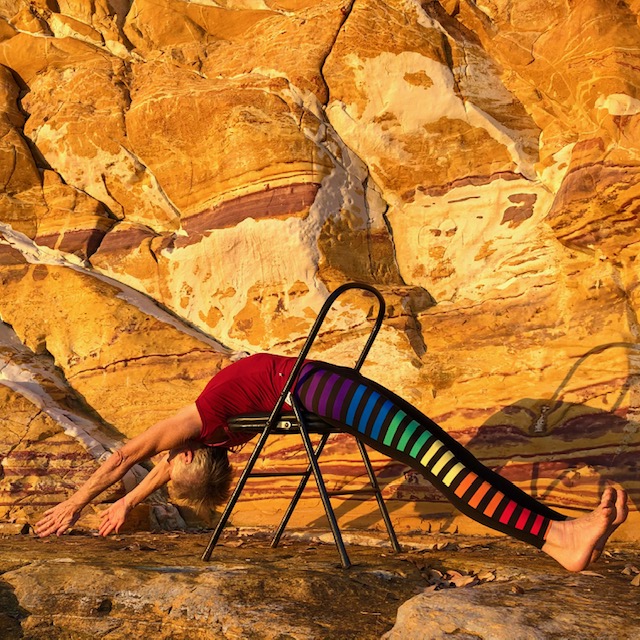
Chris Lalor in a supported backbend over a chair. The chair holds the back, so the chest can open without strain.
“You should know that in backbend we never touch the spine straightaway. The lengthening of the trunk has to come.”
What Dr Timothy McCall says
In short: a rounded upper back is on his list of conditions helped by yoga, and the best yoga is fitted to the person.
Dr McCall is a US medical doctor and yoga therapist, author of Yoga as Medicine and former medical editor of Yoga Journal. His June 2019 list of conditions studied in yoga research places thoracic hyperkyphosis at no. 111. His book has no chapter on a rounded upper back, so we draw on his wider views, in our words:
- Posture comes first. In his back pain chapter he sees posture as the foundation: the sloping shoulders and slumped C-shape of desk life, and long hours of sitting, which he names as a main driver of back trouble. Judith Lasater, the physical therapist and yoga teacher in that chapter, looks first at how a student stands, sits and drives before choosing any poses.
- Fit the yoga to the person. He argues that the best yoga therapy is tailored to each student, so a trial that gives everyone the same set routine often tests a plainer version of yoga than a good teacher would give. We think that helps explain why some measures in the yoga trials below moved and others did not.
- Bones and backbends. In his menopause chapter, Elise Browning Miller, a senior Iyengar teacher who first came to Iyengar yoga with back spasms from a curved spine, moves students on to standing poses and weight-bearing backbends to keep the bones and spirit strong. The same chapter is careful with forward bends where bones are thin.
- Yoga is cheap and safe to try. He sets out yoga as a low-cost tool that people can keep using for life.
“The chest expansion gives a feeling of happiness and joy.”
What Dr Loren Fishman and Dr Krishna Raman say
In short: slumping is a habit yoga can change, and a rounded upper back is no reason to stay away from yoga.
Dr Loren Fishman is a New York rehabilitation physician on the Columbia University medical faculty, who spent time in Pune with Mr Iyengar. Speaking of back pain in general, he puts much muscle and joint pain down to unconscious daily habits such as slumping and awkward lifting. In his view, yoga changes those habits and the posture they build, as well as loosening tight tissue. His book Healing Yoga runs from backache to bone loss.
Dr Krishna Raman is a Chennai physician who trained in yoga under Mr Iyengar. In his question-and-answer book on yoga and medical science, his views, in our words:
- No bar to yoga. A rounded upper back gives no reason to avoid yoga (Q298).
- Posture carries the benefit. Poor posture cancels much of yoga’s good work, so how you stand and sit through the day matters as much as the class.
- The lower back is different. Where the lower back is over-arched, back bends are left until later (Q294 to Q299).
“Begin with small expectations. Restructuring muscles, bones, tissues, posture, and internal organs takes time.”
Other yoga voices on posture
- The “short arms” that grew. Chris Lalor, Certified Senior Iyengar Yoga Teacher and certified Yoga Therapist, believed for years that she had short arms. Her teacher did not believe it. Tension in her chest and shoulders had pulled her shoulder joints forward, and as her chest opened her reach grew. She calls herself “the yoga T. rex”. Read the story in our yoga for posture article.
- “Don’t slouch,” Mum said. She was right. At a health festival in Darwin, Chris noticed how many people had rounded shoulders, a sunken chest and short hamstrings, all of which pull the upper back forward.
- Floor first, then chair. In Yoga for Healthy Bones, Linda Sparrowe and Patricia Walden, a senior Iyengar teacher, give one sequence for a rounded back on the floor and a chair version for those already at ease with it. Their aim, in our words: release tension, deepen the breath, open the chest and strengthen the upper back. Their tip: put folded blankets under the head when lying on the back, so the chin does not tip to the ceiling.
What does the research say about yoga for kyphosis?
In short: yoga made a rounded upper back smaller in older people, people who do yoga have less thoracic kyphosis, and reviews of exercise trials find the right movement shrinks the curve. These are the best kyphosis exercises the research knows of: classes of steady, targeted work, kept up for months. The yoga trials tested yoga designed for each study, not Iyengar yoga. Why the difference matters.
The Research At A Glance
Four studies that sum up the evidence. All of them, with links, are listed below.
Yoga made a marked kyphosis smaller in people over 60. Greendale 2009: 118 people, three classes a week for 24 weeks. Two of three curve measures improved.
Shoulder blades sat further back and arm function improved 26%. Wang 2012: 21 people from the same trial, after 24 weeks of yoga.
People who practise yoga have less thoracic kyphosis. Grabara 2021: 667 yoga practitioners compared with 578 non-practising students, who were younger.
Targeted exercise shrinks the curve. Khorramroo 2026: 28 trials, 901 people. Large gains in forward head, rounded shoulders and kyphosis angles.
Every study is listed in full in this section, with a link to read it.
Yoga for a rounded upper back
- Yoga made the curve smaller: the flexicurve kyphosis angle improved 4.4% and the kyphosis index 5% against the comparison group. The third curve measure (a kyphometer), physical performance tests and quality of life did not change significantly. Greendale 2009, a randomised trial of 118 women and men aged 60 and over with a kyphosis of 40 degrees or more; hour-long yoga classes three times a week for 24 weeks, against a monthly lunch and talk. The authors called it a critical first step and suggested people with less rigid spines may respond more. Read the study. Note: this yoga was designed for the trial and was not described as Iyengar yoga, which has not yet been tested for kyphosis on its own. Why it matters.
- After 24 weeks of yoga, people with hyperkyphosis did 26.4% better on a timed task of lifting books onto a shelf, and their shoulder blades sat further back when sitting and walking. Reach overhead did not change. Wang 2012, a before-and-after study of 21 people averaging 75 from the UCLA trial. Read the study.
- People who practise yoga had less pronounced thoracic kyphosis and were more often in the normal range than non-practising students. Grabara 2021, a study of 667 yoga practitioners aged 18 to 68 and 578 students aged 18 to 30. Read the study.
- The pilot that started it: yoga for women with hyperkyphosis. Greendale 2002, a small pilot study in older women by the UCLA team, which led to the 2009 trial. No abstract is published, so we give no figures. Read the study.
What Changed In The UCLA Yoga Trial
118 people over 60, three classes a week for six months. Exactly what moved.
4.4% better
Kyphosis angle measured with a flexicurve, a bendable ruler laid along the spine
5% better
Kyphosis index, a second way of reading the curve
No clear change
Kyphosis angle measured with a kyphometer, a third tool
No clear change
Physical performance tests and quality of life
Greendale 2009, J Am Geriatr Soc. The sub-study (Wang 2012) found the shoulder blades sat further back and book lifting improved 26.4%.
Exercise for thoracic kyphosis
These trials tested exercise programmes rather than yoga. Many of the moves are close to what a yoga class does: strengthening the back, opening the chest and training posture.
- Targeted exercise made a large improvement in forward head, rounded shoulder and thoracic kyphosis angles. Khorramroo 2026, a review of 28 randomised trials and 901 people with upper crossed syndrome. Read the study.
- Exercise improved forward head, rounded shoulders and thoracic kyphosis. Sepehri 2024, a review of 22 studies in people with upper crossed syndrome. Strength, stretching and whole-body programmes all helped. Read the study.
- Spine strengthening and posture training made the curve 3 degrees smaller on X-ray than in the comparison group, and people felt better about how they looked. Katzman 2017 (the SHEAF trial), 99 people aged 60 to 88 with a kyphosis of 40 degrees or more, three one-hour group classes a week for 6 months. Read the study.
- Three months of the same programme made the curve smaller on a kyphometer, by 4.8 degrees against a waiting list, and men and women did equally well. Katzman 2017, a trial of 101 people aged 60 and over, twice a week. Read the study.
- Structured exercise reduced thoracic hyperkyphosis, strongly in younger people and less so in older people. Jenkins 2021, a review of 28 randomised trials. Read the study.
- Eight of 13 exercise studies improved at least one measure of posture in people with an age-related rounded back, and people stuck with the exercise. Bansal 2014, a review of studies in adults aged 45 and over. Read the study.
Iyengar yoga studies
These trials tested Iyengar yoga specifically, taught by trained Iyengar teachers, with props and adapted poses. No Iyengar trial of a rounded upper back has yet been listed on PubMed. Not yet studied is not the same as not working. The nearest Iyengar trial is for the older bodies that most often have a rounded back:
- Iyengar yoga improved standing balance, the time to rise from a chair and walking speed, with no serious adverse events. Twelve weeks, twice a week. Tiedemann 2013, a trial of 54 people averaging 68, in Sydney. Read the study.
Thin bones and which way the spine moves
- Women with spinal osteoporosis who did back-arching (extension) exercises had far fewer new spine fractures (16%) than those who did forward-rounding (flexion) exercises (89%). Sinaki 1984, Mayo Clinic, 59 women aged 49 to 60 followed for one to six years. Read the study.
- A rounded upper back in older age is linked with low bone mass, compressed spine bones and worn discs, and with more trouble in daily life. Katzman 2010, a review of age-related hyperkyphosis. Read the study.
- A rounded upper back may be a risk factor for falls and fractures that can be changed. Koelé 2020, a review of the clinical meaning of hyperkyphosis. Read the study.
Which Way The Spine Moves Matters
With thin bones, rounding forward under load is the move to leave out.
16%
New spine fractures with back-arching (extension) exercises
89%
New spine fractures with forward-rounding (flexion) exercises
So in class: lengthen the spine first, open the chest gently with support, and fold forward from the hips with a long back, never by curling the spine down.
Sinaki and Mikkelsen 1984, 59 women with spinal osteoporosis (the forward-rounding group was small, 9 women). A simplified picture.
Posture, mood and breathing
- Sitting upright under stress kept self-esteem higher, mood better and fear lower than sitting slumped. Nair 2015, a randomised trial of 74 adults in New Zealand. Read the study.
- In people with mild to moderate depression, an upright posture raised positive mood and lowered tiredness, and a more upright shoulder angle went with less anxiety. Wilkes 2017, a randomised trial of 61 people. Read the study.
- Adding breathing techniques to posture exercise made the kyphosis angle smaller than exercise alone, clearly so in teenagers. In older adults the gain was not clear, so more trials are needed there. Kirkbir 2026, a review of 5 studies and 247 people. Read the study.
Pranayama, meditation and mindfulness. No trial has yet tested pranayama, meditation or mindfulness on their own for a rounded upper back. Not yet studied is not the same as not working. The breathing in the review above was taught as part of exercise, and “breathing techniques” can mean many things. The pranayama we teach (staircase, ocean, alternate nostril, humming and a gentle shining skull breath) is slow, nasal and taught step by step, and it starts with lifting and spreading the chest. Why the kind of breathing matters.
A hunched back: for men
In short: older men are more likely than women to have a hunched posture, they respond to training just as well, and they do far less yoga.
- More common in men. In the California study of 1,353 older people, a hunched posture was twice as common in men as in women: 44% against 22%.
- Men respond as well as women. In a trial of 101 older people, men started with stronger spines, denser bones and more spine fractures, yet the curve shrank just as much in men as in women.
- Men do far less yoga. In a national survey of 2,567 Australian yoga practitioners, 85% were women.
- Work and sport bend men forward. Desks, driving, tools and gym work on the chest and front of the shoulders all pull the upper back round.
What men can do: come to a beginner class and use the chairs and blankets without embarrassment. Bring a mate or come alone, but give it 12 weeks. Our yoga for men page covers sport and life after 40.
Why Men Should Lift The Chest
Three numbers from the research.
44% of men
Older men with a hunched posture, against 22% of women (Kado 2004)
Same gain
Men and women improved equally in a kyphosis trial (Katzman 2017)
85% women
Of Australian yoga practitioners in a national survey (Penman 2012)
Studies linked in this section and the research section above.
- A hunched posture was twice as common in older men as in older women, and was linked with a higher death rate. Kado 2004, a study of 1,353 older people in Rancho Bernardo, California, followed for about four years. Read the study.
- 85% of Australian yoga practitioners surveyed were women. Penman 2012, a national survey of 2,567 practitioners. Read the survey.

Stuart, yoga teacher, Flametree Yoga Darwin, in Warrior 2. Standing poses build the back and lift the chest.
“Let me find out the right way to lift my chest”
Where can I do yoga for a hunched back in Darwin?
At Flametree, in Darwin and LIVE online. Everything above points the same way, and it is how we teach a rounded upper back.
- From the feet up. Mountain Pose and the standing poses build the base, so the spine can rise from it.
- Length first. Every backbend and twist starts by lifting the spine, as Geeta Iyengar taught.
- Supported back arching. Backbends over a chair, on blankets or at the wall open the chest without strain. Held steadily, they also strengthen the back.
- Shoulders back, chest broad. Arm work such as Cow Face Pose arms with a belt moves the shoulder blades in and opens the front of the shoulders, the plain way to work on rounded shoulders.
- Forward bends with a long back. We fold from the hips, hands on a chair or blocks if needed, not by curling the spine.
- Classes adapted to the people in them. No one-size-fits-all. Tell your teacher about your back and your bones, and the poses are changed for you.
- Breath and calm: every class ends in rest, and our pranayama classes go further. On tired days, try gentle yoga or restorative yoga.
Classes run at Woolner and Coolalinga in Darwin, and LIVE online across Australia.
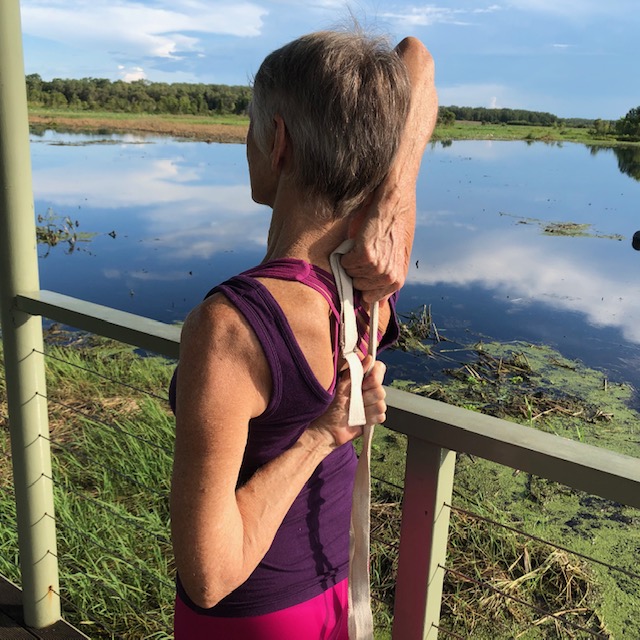
Cow Face Pose arms with a belt. The shoulder blades move in and the chest broadens.
Read more on posture and a rounded upper back
- Yoga for posture: what the research shows, and how to stand taller
- Dowager’s hump: why the upper back rounds with age
- Upper back pain and a rounded upper back
- Back stretches for the upper and mid back
- Forward head posture
- Tech neck
- Uneven shoulders
- Shoulder mobility: five supported moves
- Backbend yoga: the uplift of opening the chest
- Cow Face Pose: are your arms too short, or is your chest closed?
- Yoga for osteoporosis
- Back pain and yoga: the full guide
- Scoliosis and yoga: the full guide
- Bone health, balance and falls: the full guide
- Stiff joints and flexibility: the full guide
Take it further
Free ebook: Happy Backs. Iyengar yoga for the upper back, neck and lower back: the trials, and real stories of backs that came good. By Chris Lalor, Certified Senior Iyengar Yoga Teacher and certified Yoga Therapist.
New to Flametree, or away 3 months or more? 2 free classes + 2 ebooks, only available via this offer. Already a student? You can still get this book. Get your free copy of Happy Backs
Here are the facts on what helps. The ebook has even more, including stories of how it has helped people. Then do the free classes, see what you think, and buy a pass that puts all of this into action for you. Worried about thin bones as well? Our free ebook Strong Bones, Steady Feet covers them.
- Classes, in Darwin or LIVE online: new, or away 3 months or more? 2 free classes, then 10 at half price. Already practising yoga? See the non-beginner half price pass. See every class time.
- Masterclass: backs are one of our 2027 Sunday Arvo Masterclasses with Chris Lalor, in Darwin and online, where you get the poses, sequences and breathing that put this guide into action.
- Retreats: a week of daily, adapted yoga in Bali. See the retreats.
Other conditions are in our encyclopaedia of yoga for health conditions.
Kyphosis and a rounded upper back: questions people ask
What is kyphosis?
Kyphosis is the forward curve of the upper back. Everyone has some. When the curve grows past the normal range, usually 40 degrees or more, it is called hyperkyphosis, and people describe it as a rounded upper back, a hunched back or, in older people, a dowager’s hump. It often comes with rounded shoulders and a forward head. Habits, weak back muscles, thin bones and a slumped mood all add to it.
What are the best kyphosis exercises?
The research points to steady work that strengthens the back, opens the chest and trains posture, kept up for months. In a trial of 118 people over 60, yoga three times a week for six months made the curve smaller. Reviews of 13 to 28 exercise trials found targeted programmes shrank thoracic kyphosis, rounded shoulders and a forward head. Iyengar yoga adds props and close attention to alignment, so each pose can be fitted to your back.
Is a rounded upper back the same as osteoporosis?
No, though they can overlap. Many rounded backs come from habits, weak back muscles and a closed chest. In older people, thin bones and wedged spine bones can add to the curve. Where bones are thin, strong forward rounding is the move to leave out: in a Mayo Clinic study, women with spinal osteoporosis doing back-arching exercises had 16% new spine fractures, against 89% for forward-rounding exercises.
Why did the yoga trial for kyphosis improve one measure but not another?
The 2009 UCLA trial measured the curve three ways. After six months of yoga, two improved: the flexicurve angle by 4.4% and the kyphosis index by 5%. The third, a kyphometer reading, did not change clearly, and nor did physical performance tests or quality of life. The authors called it a critical first step and suggested people with less rigid spines may respond more. The yoga was designed for the trial and was not Iyengar yoga.
Do breathing exercises help a hunched back?
They seem to help most when added to posture work. A 2026 review of 5 studies found breathing techniques plus exercise shrank the kyphosis angle more than exercise alone, clearly so in teenagers; in older adults more trials are needed. Mr Iyengar wrote that a caved-in chest cannot breathe correctly. The pranayama we teach starts by lifting and spreading the chest.
Is a hunched back linked to mood?
Yes. Mr BKS Iyengar wrote that slouching acts like a narcotic and that a collapsed chest makes the mind sink. Trials back him: sitting upright under stress kept mood and self-esteem higher than slumping, and in people with mild to moderate depression an upright posture raised positive mood and lowered tiredness.
Should I do backbends if my upper back is rounded?
Gentle, supported ones, yes. Geeta S Iyengar wrote that backbends help drooping shoulders and a hunched back, and that in a backbend the trunk is always lengthened first. At Flametree we start with backbends over a chair or on blankets and build up slowly, and we leave out deep backbends for older or thin-boned backs until a teacher has seen them. Tell your teacher about your back and your bones.
Are men more likely to have a hunched back?
Among older people, yes. In a California study of 1,353 older people, 44% of men had a hunched posture against 22% of women. Men respond to training just as well: in a kyphosis exercise trial, the curve shrank as much in men as in women. Yet 85% of Australian yoga practitioners are women. Classes in Darwin and online welcome men starting from scratch.
Where this comes from: BKS Iyengar, Yoga: The Path to Holistic Health (Dorling Kindersley), the general chapters and the courses for upper, middle and lower backache; Light on Life (Rodale edition, printed page numbers); Yoga Wisdom and Practice; Light on Yoga, Appendix II (pp. 414, 418 and 425). Geeta S Iyengar, Yoga: A Gem for Women, and her Sydney teachers’ course of 1996. Timothy McCall MD, Yoga as Medicine (Bantam), including his back pain chapter, and his June 2019 list of health conditions helped by yoga. Loren Fishman MD, from his published interviews and Healing Yoga (W. W. Norton, 2014). Krishna Raman MD and S. Suresh MD, Yoga and Medical Science: FAQ. Linda Sparrowe with Patricia Walden, Yoga for Healthy Bones. Flametree’s ebook Happy Backs and our posture articles. Studies as linked above. Everything is summarised in our own words.
This page is general information, not medical advice. Flametree Yoga Studio, Darwin and LIVE online.
