
Strong Bones, Steady Feet: Free Ebook On Yoga For Bones And Balance
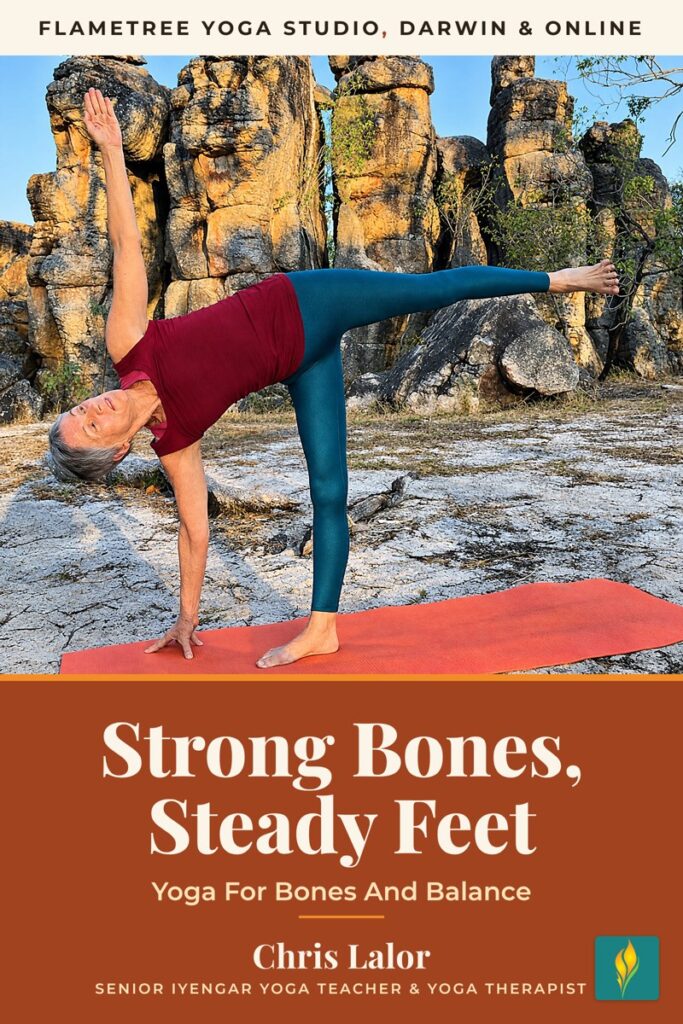
“Have you got any metal in you, love?” The airport security guard was surprised. She does not often feel shoulders that firm on someone of Chris Lalor’s vintage. This free ebook on yoga for bones and balance explains how ordinary yoga poses build that kind of strength, and what the research shows.
New to Flametree, or away for 3 months or more? You get 2 free classes + 2 ebooks, only available via this offer. Choose this book and one more. Already a student? You can still get this book free. Jump to the form.
Iyengar yoga is the style developed by Mr BKS Iyengar. In the 20th century he did more than anyone to set down traditional Indian yoga, through his books and his teaching, and he pioneered the use of props. It’s the style we teach at Flametree, in Darwin and live online, and it is the style tested in a Sydney trial of balance in older people.

Strong Bones, Steady Feet: Yoga For Bones And Balance. By Chris Lalor, Senior Iyengar Yoga Teacher.
What’s inside Strong Bones, Steady Feet?
About 60 pages, with photos and simple diagrams. Some of what you will find:
- Chris’s first Downward Facing Dog. “My wrists certainly let me know it!” How weight through the hands went from almost unbearable to strong.
- A skier with thin bones. What limited her poses was not her bones at all.
- Mr Iyengar’s backbend in his seventies, held still for minutes, that moved a senior London teacher to tears.
- Falls kill five times more Australians than the roads. 6,698 Australians died from falls in 2022-23.
- Weak legs, more falls. Older people with weak legs have nearly twice the odds of a fall, and three times the odds of falling again and again.
- The Sydney pilot. Twelve weeks of Iyengar-based yoga, and the four falls risk factors that all improved.
- Bone only answers a load it is not used to. Why yoga’s sideways, turning and upside-down shapes give bones something new.
- The one known risk, and how easy it is to avoid: rounding forward under load with thin bones.
- How we do it at Flametree: standing poses first, weight on the hands, short holds repeated, a wall or chair close by, and length before depth.
- Use it or lose it. Two people of the same age: one gave up her bike, one still paddles and rides.
Key findings on yoga for bones and balance
- Iyengar yoga, tested here in Australia. In a 2013 Sydney trial (Tiedemann and colleagues, Journals of Gerontology), 54 people with an average age of 68 did twelve weeks of Iyengar-based yoga, two classes a week. Standing balance, balance with eyes closed, standing up from a chair and walking speed all improved. These are the main risk factors for falls. There were no serious problems in class.
- Balance work cuts falls. The 2019 Cochrane review of 108 trials, with more than 23,000 older people, found exercise cut the rate of falls by about a quarter. Programmes built around balance work did best.
- Stronger legs, faster walking. A 2023 review of 33 studies, with 2,384 older people, found faster walking and stronger, longer-lasting legs with yoga. Iyengar and chair-based yoga were the styles used most often.
- Bone density: promising, and growing. A 2024 review of 11 trials, with 1,005 women around and after menopause, found mind-body exercise, including yoga, raised bone density.
The executive summary, in full
This is the opening of the book, the whole thing on two pages. The rest is in the free download.
If you are over 50 and want strong bones and steady feet, yoga is one of the best things you can do, and it is well worth starting now.
The major benefits of yoga that people seek most are more strength, flexibility, calmness and wellness. In the process, by quietening the chatter of the mind, people often find it brings useful transformations, as well as greater contentment and happiness.
What the research says
- Falls are Australia’s biggest injury killer. 6,698 Australians died from falls in 2022-23, roughly five times the road toll. After a broken hip, about 1 in 4 people die within a year.
- Weak legs, more falls. Older people with weak legs have nearly twice the odds of a fall, and three times the odds of falling again and again.
- Balance work cuts falls. The biggest review of its kind, 108 trials with more than 23,000 older people, found that exercise cut the rate of falls by about a quarter.
- More hours, fewer falls. A 2020 update for the World Health Organization, 116 trials with 25,160 people, found balance and functional exercise cut falls by 24%. At three or more hours a week, falls dropped by 42%.
- Iyengar yoga has been tested for balance, here in Australia. In a 2013 Sydney trial, 12 weeks of Iyengar-based yoga gave people aged around 68 better balance, faster walking and quicker standing up from a chair.
- Yoga clearly improves balance. A 2025 review of 18 trials found almost all of them showed better balance with yoga.
- Bone density: promising, and still growing. A 2026 review of 74 trials found mind-body exercise combined with strength work did best of all for the spine and hip. Reviews of yoga alone found smaller effects so far, mostly from short, gentle programmes.
- Bone is alive, and it answers load. Yoga loads your legs, hips, spine, wrists and shoulders, from many directions. Few other kinds of exercise do all of that.
- Not yet tested does not mean wrong. Yoga’s knowledge of what keeps the body strong in old age has been built and tested in classes for thousands of years. Research is still catching up.
How yoga does it
- Load the bones. Standing poses carry your weight through the legs and hips. Poses on the hands carry it through the wrists and shoulders, the places that often break first.
- Muscles pull on bone. A well-made pose has muscles working hard on both sides of a limb.
- Something new for the bones. Bone only answers a load it is not used to.
- Hold, then repeat. Short holds, done often, suit bone best.
- Often beats long. Several classes a week do more than one long session.
- Balance is a skill. Your brain, eyes, inner ear and feet learn it, and they keep learning at any age.
- Long spine, never loaded rounding. If your bones are thin, bend forward from the hips with a long back. That is the one known risk, and it is easy to avoid.
- Props bring the pose to you. A chair, a wall or a block lets you hold a pose long enough for it to work.
- Confidence comes back. Fear of falling makes people move less, and moving less makes falls more likely. Steady standing poses, near a wall, break that circle.
- Come regularly. The Sydney trial used two classes a week for 12 weeks. More often is better.
- Length before depth. Stand and sit tall first. How far you bend or turn comes second.

Get your free copy
2 free classes + 2 ebooks only available via this offer.
What happens next: we email you a link straight away. Click it, choose your two books, and download them on the spot. No payment, no card.
Want to see the other seven books first? See all eight free yoga ebooks.
Questions about yoga for bones and balance
Is yoga good for balance?
Yes. A 2025 review of 18 trials found almost all of them showed better balance with yoga. In the 2013 Sydney trial, twelve weeks of Iyengar-based yoga improved standing balance and balance with the eyes closed in people with an average age of 68.
Can yoga lower the risk of falls?
The evidence is encouraging. The 2013 Sydney pilot of Iyengar-based yoga improved balance, walking speed and getting up from a chair, the main risk factors for falls. More broadly, the 2019 Cochrane review of 108 trials found exercise built around balance cut the rate of falls by about a quarter.
Why does leg strength matter so much for falls?
Because strong legs catch you. Older people with weak legs have nearly twice the odds of a fall, and three times the odds of falling again and again. Standing poses build leg strength and balance at the same time, which is why every Iyengar class starts with them.
I have osteopenia. Should I stop exercising?
No. Osteopenia means bones thinner than normal, the stage before osteoporosis, and bone answers load. The one known risk is rounding the spine forward under load, so forward bends are done from the hips with a long back. A Canadian physiotherapist’s model for her bone book was a downhill skier with osteopenia, and what limited her poses was flexibility, not bone.
Why are standing poses so important after 50?
They load the hips and spine from many directions, build the legs, and train balance, all at once. Bone only answers a load it is not used to, and yoga’s sideways and turning shapes give it loads that daily life never does.
How often should I do yoga for balance?
Two classes a week is a good start, and more is better. The Sydney trial used two classes a week for 12 weeks. A 2020 review for the World Health Organization, 116 trials with 25,160 people, found falls dropped by 42% at three or more hours of balance work a week.
Do men need to think about bones and falls too?
Yes. Men lose bone too, and men fall too. The book is written for both, and Stuart, who teaches many of our beginner classes, is in some of the pictures.
Which Flametree classes in Darwin build balance and bone?
Any of our beginner classes, at Woolner and Coolalinga or live online, does this work, with a wall or chair close by when you need it. Some classes are gentler, such as Friday 10.15am Gentle Yoga at Woolner. See the beginner timetable. New students get 2 free classes with this offer.
