
Happy Backs: Free Ebook On Iyengar Yoga For Back Pain
Raj thought yoga was a myth. He was mostly in bed, and he had tried everything. Then one day, in a beginner class, he realised: “I can get better.” This free ebook on Iyengar yoga for back pain tells his story, and what the trials show.
New to Flametree, or away for 3 months or more? You get 2 free classes + 2 ebooks, only available via this offer. Choose this book and one more. Already a student? You can still get this book free. Jump to the form.
Iyengar yoga is the style developed by Mr BKS Iyengar. In the 20th century he did more than anyone to set down traditional Indian yoga, through his books and his teaching, and he pioneered the use of props. It’s the style we teach at Flametree, in Darwin and live online, and it is one of the most tested styles for sore backs.

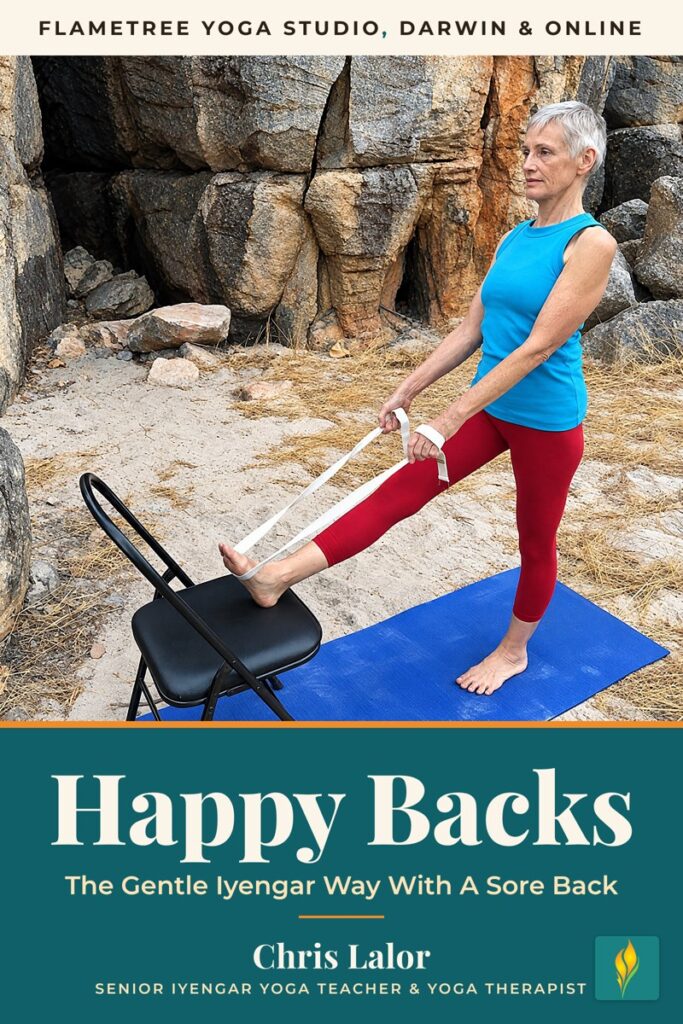
Happy Backs: The Gentle Iyengar Way With A Sore Back. By Chris Lalor, Senior Iyengar Yoga Teacher.
What’s inside Happy Backs?
About 55 pages, with photos and simple diagrams. Here is some of what you will find.
- Raj’s story. A trucking boss crippled by a slipped disc, offered surgery with “likely paralysis!”, who now runs two businesses and comes to our experienced classes.
- Gone in a month. Two Coolalinga students, Sharon and Rachel, who found their back pain had gone by the end of their first month of two classes a week.
- A carpenter told he needed surgery, and a Queensland firefighter who, at 50, ended up doing headstands.
- Mr Iyengar’s scooter accidents. At 60 he had to start again “as a raw beginner”, and rebuilt his practice from the soles of his feet.
- Scans and grey hair. Why disc “wear and tear” shows up in most people with no back pain at all.
- 2 days off against 43. What happened to hospital staff who did yoga.
- Why fear keeps backs sore, and how a gentle, safe-feeling class breaks the circle.
- Golfers, take note. More than a third of 1,170 male golfers had low back pain in the past week.
- How we do it at Flametree: rest, then space, then strength. Chairs, walls, belts and bolsters. Short holds, repeated. Backbends wait.
- What to tell your teacher, and why most sore backs are fine to bring to class.
Key findings on Iyengar yoga for back pain
- The biggest summary. The 2017 Cochrane review (the most trusted kind of research summary) pooled 12 trials with 1,080 people with long-lasting low back pain. Yoga improved how well backs worked in daily life, and eased pain.
- Iyengar yoga, tested directly. In a 2005 American trial of 60 people, 16 weeks of Iyengar yoga gave less pain, less disability and less pain medicine than an education programme. In a 2009 trial of 90 people, 24 weeks of Iyengar yoga gave less pain, disability and low mood than usual care, and the gains lasted for months.
- Better backs for a whole year. In a 2011 English trial of 313 people, 12 yoga classes gave better back function at 3, 6 and 12 months.
- Fewer days off work. In a 2017 trial of 151 hospital staff in Wales, the yoga group missed 2 working days for aches and pains over six months, against 43 days in the comparison group.
The executive summary, in full
This is the opening of the book, the whole thing on two pages. The rest is in the free download.
If you have a sore back, yoga is very likely to help, and it is certainly worth trying, based on our experience. The gentle Iyengar way is one of the best ways to do it.
A happy back is not the whole point. The major benefits of yoga that people seek most are more strength, flexibility, calmness and wellness. In the process, by quietening the chatter of the mind, people often find it brings useful transformations, as well as more contentment and happiness.
What the research says
- Yoga is one of the best studied ways to help a long-lasting sore back. The 2017 Cochrane review of 12 trials found yoga improved how well backs worked in daily life, and eased pain.
- Iyengar yoga is one of the most tested styles. In two American trials, Iyengar yoga gave less pain, less disability and less low mood than education or usual medical care. In a 2015 review, all six Iyengar trials favoured yoga.
- Yoga often beats ordinary exercise. A 2026 review of 70 trials found yoga cut back disability more than other kinds of exercise.
- A back that works better, even before the pain fades. In an English trial of 313 people, yoga gave better back function for a whole year, although pain scores were much the same.
- Sore necks too. A review of 10 trials found yoga eased neck pain and freed up neck movement.
- A scan rarely tells the whole story. In people with no back pain at all, disc “wear and tear” shows up on scans in more than a third of 20-year-olds and almost everyone over 80. It is as normal as grey hair.
- Fear keeps backs sore. Australian research shows fear and worry predict lasting back pain more than scans do. Gentle movement that feels safe helps break that.
- Mindfulness helps backs, and Iyengar yoga is a mindfulness practice. A 2026 trial of 451 people found mindfulness eased back pain for a year, partly by easing fear and worry.
- Not yet tested does not mean wrong. Yoga’s knowledge of what helps backs has been built and tested in classes for thousands of years. Research is still catching up.
How yoga does it
- Gentle first, always. Nothing in a back class should hurt or leave you worse off. If a pose hurts, the teacher changes it.
- Show the back it is safe to move. Slow, supported poses calm the guarding that keeps a back tight.
- Rest, then space, then strength. Rest the sore part and move around it. Make space in the spine. Then build strength.
- Every class starts standing. Mountain Pose (Tadasana) and standing poses build the legs and hips, so the back no longer carries the body alone.
- Chairs, walls, belts and bolsters. Props bring each pose to you, so you get its benefit without strain.
- Broaden and lengthen the back. Poses such as Half Angle Pose with a chair spread the back and make room between the bones.
- Short holds, repeated. Short holds are kinder to a sore back than one long struggle.
- Soften the breath. Slow, quiet breathing in the rests at the start and end of class teaches a clenched back to let go.
- Backbends wait. Strong, fast yoga is not for sore backs. We have not seen it help one.
- Keep coming. The trials used one or two classes a week for four to six months. Many of our students tell us their back pain went within the first month.

Get your free copy
2 free classes + 2 ebooks only available via this offer.
What happens next: we email you a link straight away. Click it, choose your two books, and download them on the spot. No payment, no card.
Want to see the other seven books first? See all eight free yoga ebooks.
Questions about Iyengar yoga for back pain
Does yoga help with back pain?
Yes, and often a lot. The 2017 Cochrane review of 12 trials, with 1,080 people, found yoga improved how well backs worked in daily life and eased pain. Based on our experience, yoga is very likely to help a sore back and certainly worth trying.
What type of yoga is best for back pain?
Gentle, prop-based yoga taught by a well-trained teacher. Iyengar yoga is one of the most tested styles: in a 2015 review, all six Iyengar trials for back and neck pain favoured yoga. Chairs, belts and bolsters let a sore back do each pose without strain.
Is yoga good for sciatica?
Many of our students with a little sciatica find a gentle class helps, because the work is done where the nerve is irritated: the back and the pelvis. When it is bad, the poses are supported and lying down. When it settles, standing poses come in at the wall. Tell your teacher about numbness between the legs, bladder or bowel changes, or a leg getting weaker, so they can adapt the class.
My scan shows disc wear and tear. Can I still do yoga?
Usually, yes. A 2015 Mayo Clinic review of 33 studies, with 3,110 people who had no back pain at all, found disc changes in 37% of 20-year-olds and 96% of 80-year-olds. Like grey hair, they are a normal part of ageing, so a scan on its own rarely explains a sore back. Tell your teacher if you wish, so they can choose the right version of each pose.
Can yoga make back pain worse?
Rarely, and not seriously. In the Cochrane review, about 5 more people in every 100 had a short flare of back pain with yoga, and none was serious. That is why how yoga is taught matters: a gentle class with props, where a pose that hurts is changed, is built to keep you out of that 5 in 100.
How soon will yoga help my back?
The trials used one or two classes a week for four to six months, and the gains lasted. Many of our students tell us their back pain went within the first month. Coming regularly matters more than any single class.
Should I push through pain in a yoga class?
No. Nothing in a back class should hurt or leave you worse off. A sore back does not respond to force, it responds to patience. Mr Iyengar put it simply: “It is not yoga that injures, but it is the way one does yoga that leads to injury.”
Which Darwin classes suit a sore back?
Flametree’s Yoga For Backs class runs on Wednesdays at 7.15pm at Woolner, in the studio only. Most of our beginner classes suit sore backs too, at Woolner and Coolalinga or live online. See the beginner timetable. New students get 2 free classes with this offer.
More on backs from Flametree
- Yoga for back pain over 50: gentle, safe, and what the research shows
- Yoga for neck pain: what the Iyengar trials found
- Are twists bad for your back?
- Yoga for posture
- Yoga for a sore back: the man told surgery might paralyse him and yoga for back pain: Raj’s story
- All eight free yoga ebooks and the beginner timetable
